

Notarisation in the UK is the process of having a document authenticated, certified, or witnessed by a Notary Public a specially qualified legal professional whose role is specifically focused on authenticating documents for use abroad and in other formal contexts.
UK Notaries Public are different from ordinary solicitors, although they are often legally qualified. The notarial profession in England and Wales dates back centuries and is regulated by the Faculty Office of the Archbishop of Canterbury making it one of the oldest regulated legal professions in the country. In Scotland and Northern Ireland, slightly different notarial systems operate, but the function is similar.
A UK notary's signature and seal are recognised internationally, and crucially, notaries' signatures should be registered with the FCDO so that the FCDO can apostille notarised documents.
Notarisation is NOT required for documents that already bear the official signature and seal of a UK public authority. Birth certificates from the GRO, degree certificates bearing the university's seal, and ACRO police certificates can all be apostilled directly without notarisation.
Notarisation IS required in the following situations:
The Society of Notaries maintains a directory of notaries in England and Wales. The Royal Faculty of Procurators in Glasgow covers notaries in Scotland. For Northern Ireland, the Law Society of Northern Ireland can assist.
When looking for a notary for Spain-related documents, it is advisable to find one who has experience with international documents, particularly for Spain. They will be familiar with the requirements and will know to produce the notarial act in a form that the FCDO can apostille and that Spanish authorities will accept.
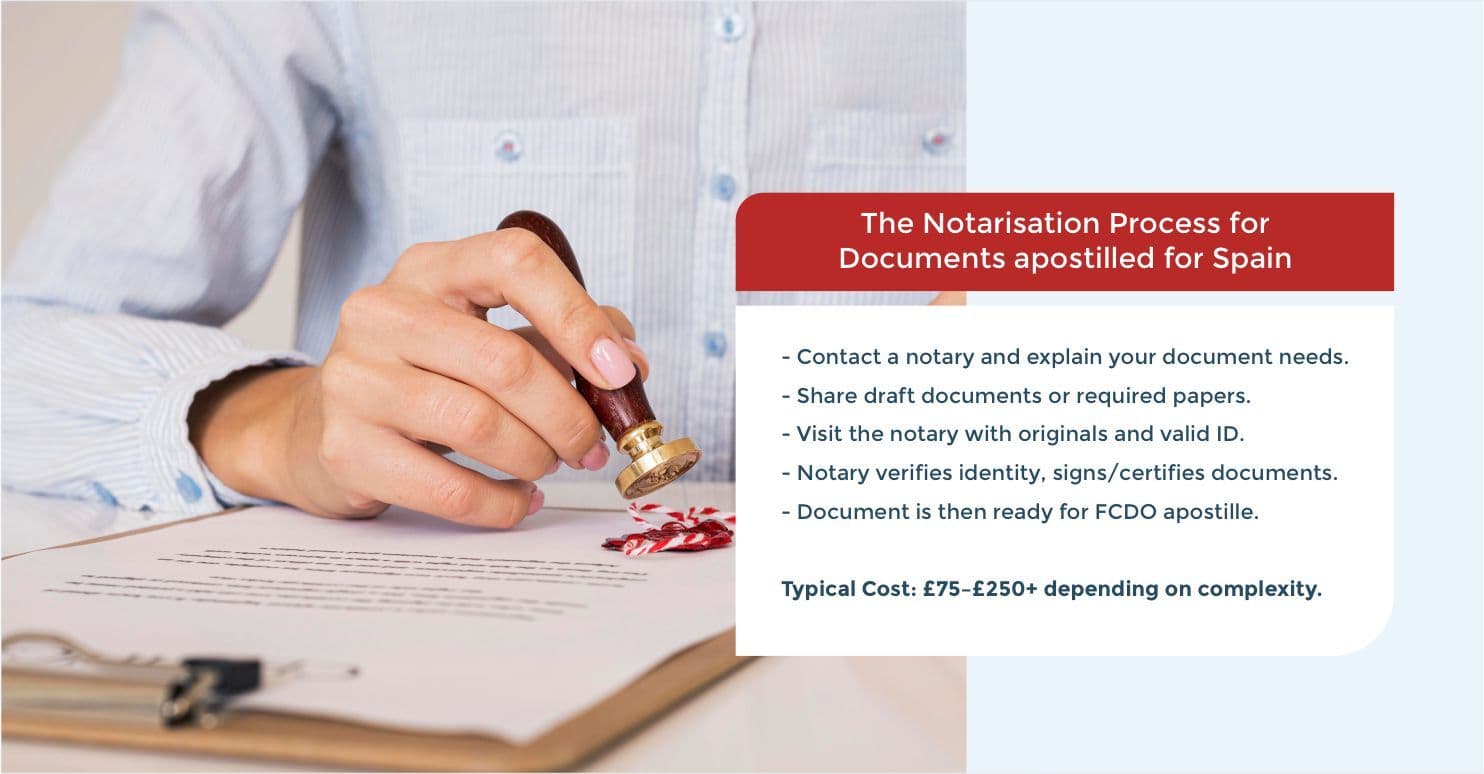
The typical process for notarising a document that will be apostilled for Spain is:
1. You contact the notary in advance and explain what you need (e.g., a Power of Attorney for property purchase in Spain, or a certified copy of your degree certificate)
2. The notary may ask you to provide a draft of the document or to bring specific materials3. You attend the notary's office (or in some cases, the notary can attend you) with your original documents and valid ID4. The notary reviews the document, checks your identity, witnesses your signature (or certifies the document), and prepares the notarial act5. The notarised document is then ready to be submitted to the FCDO for apostillingFees vary by notary but between £75 and £250 for a standard notarisation, more for complex documents.
There are some differences in how notarisation works in Scotland compared to England and Wales. Scottish notaries (who are solicitors who have been admitted as notaries public) work within a slightly different legal system. However, for the purposes of apostilling documents for Spain, documents notarised by a properly qualified Scottish notary are just as valid as those notarised in England and Wales.
Need help with your application or background check?
Contact us now and speak with a dedicated Globeia expert today.

