
The process of obtaining a UK apostille for use in Spain involves a specific sequence of steps, and understanding the sequence upfront will save you time, money, and frustration. The most common mistake people make is to start the process in the wrong order, or to submit documents that are not in the right condition to be apostilled.
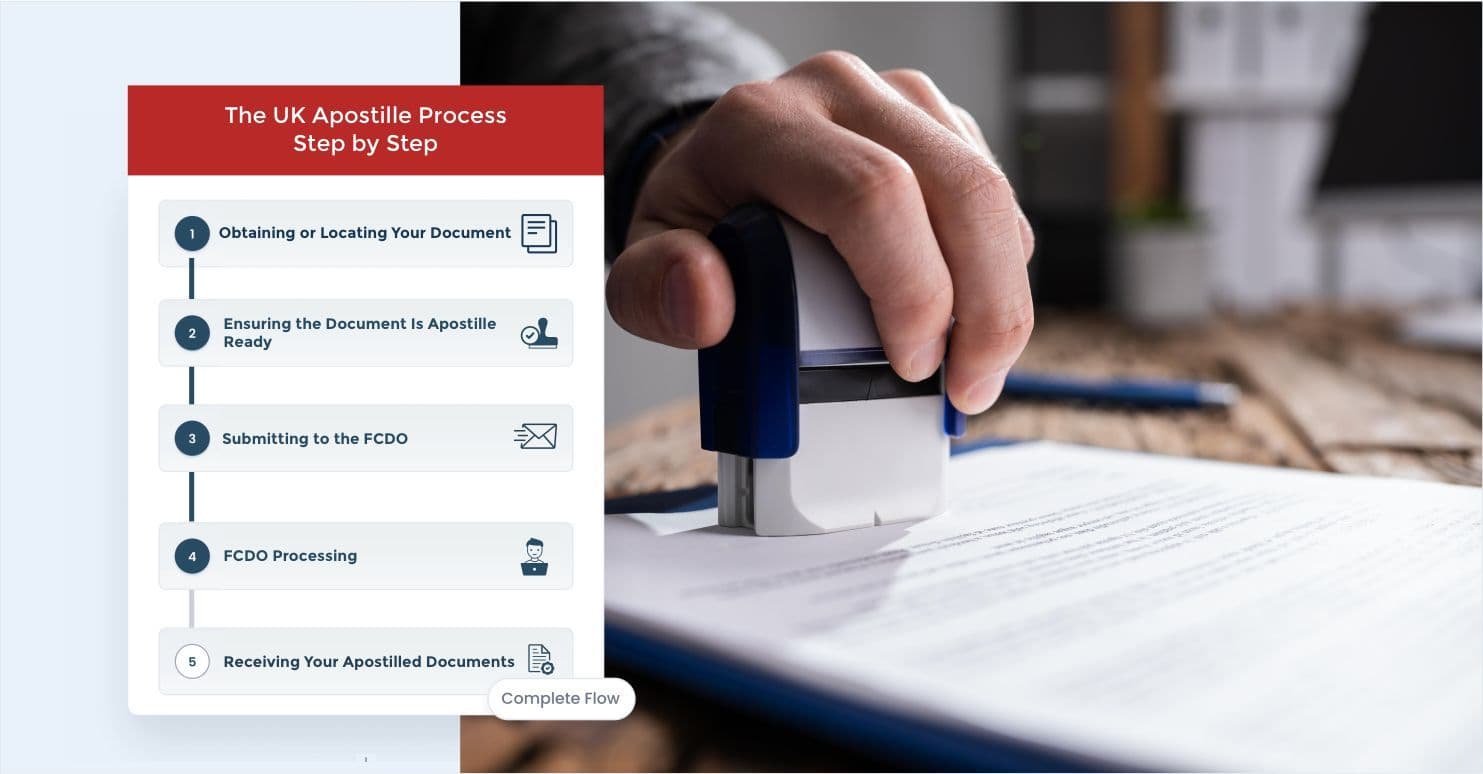
The basic sequence is: Obtain the document → Ensure it is in apostille-ready condition → Submit to the FCDO → Receive apostilled document → Arrange translation if needed → Submit to the Spanish authority.
Before you can get anything apostilled, you need the actual document. This sounds obvious, but it is worth spending a moment on because the condition of your document matters enormously.
If you already have the original document (for example, your marriage certificate is in a file at home), check its condition carefully. It needs to be an official original or a certified copy not a photocopy, not a scan, not a photographed version. It must have the original signature and/or seal of the issuing authority.
If you do not have the original, you will need to obtain a new copy from the issuing authority. For birth, marriage, and death certificates, this means ordering from the General Register Office (GRO) for England and Wales, the National Records of Scotland, or the General Register Office for Northern Ireland. For degree certificates, contact your university's registry. For criminal record certificates, apply to ACRO.
Allow time for this step ordering replacement documents can take days or weeks depending on the issuing authority.
The FCDO has specific requirements about which documents it can apostille. The key requirement is that the document must bear the authentic signature and/or seal of a UK public official. The FCDO verifies apostilles against its register of known signatures and seals from UK authorities.
Documents that are apostille-ready from the outset (no additional steps needed):
• Official civil registration certificates (birth, marriage, death, civil partnership) obtained directly from registry offices• Certificates from government departments bearing official stamps and signatures• ACRO police certificates• Companies House documents with official sealsDocuments that need to be notarised before they can be apostilled:
• Private documents you want to use abroad (contracts, declarations, etc.)• Some educational certificates that lack an identifiable official signature• Medical reports from private practitioners• Certified copies made by a solicitorNotarisation means having the document signed or authenticated by a UK Notary Public. Notaries Public are different from ordinary solicitors they are specifically trained in international document law. A notary can certify a copy of a document, authenticate a signature, or provide other attestations that make a document suitable for apostilling.The Foreign, Commonwealth & Development Office is the UK's sole competent authority for issuing apostilles on UK documents. There are several ways to submit documents to the FCDO.
Current FCDO postal address for apostilles: FCDO Legalisation Office, PO Box 6255, Milton Keynes, MK10 1XX.
Note: Address details occasionally change, and it is always advisable to check the current official FCDO website for the most up-to-date submission address and requirements before applying.
Once the FCDO receives your documents, they verify the signature and/or seal on the document against their register. The UK government maintains a comprehensive register of the signatures and seals of UK public officials whose documents are eligible for apostilling.
If the FCDO can verify the document, they issue the apostille a certificate that is either stamped directly onto the document, attached to it, or provided as a separate sheet. The apostille bears the FCDO's seal and signature of an authorised official.
If the FCDO cannot verify the document (usually because the signature or seal is not on their register, or the document is in poor condition), they will return it to you with an explanation.
When your apostilled documents are returned to you, check them carefully. Verify that the apostille has been correctly applied to each document, that the information on the apostille is accurate, and that the document itself is in good condition.
Store your apostilled documents carefully. While there is no expiry date on apostilles under the Hague Convention itself, receiving authorities may have their own validity requirements. Some Spanish authorities require apostilled documents to be no more than 3 or 6 months old at the time of submission so timing your apostille application correctly relative to your Spanish deadline is important.
Apostilled UK documents in English will need to be translated into Spanish for use with Spanish authorities.
Need help with your application or background check?
Contact us now and speak with a dedicated Globeia expert today.

