

Australia has over 120 visa types, but only a small number actually matter if you are planning moving to Australia from USA.
Electronic Travel Authority (ETA) - Subclass 601
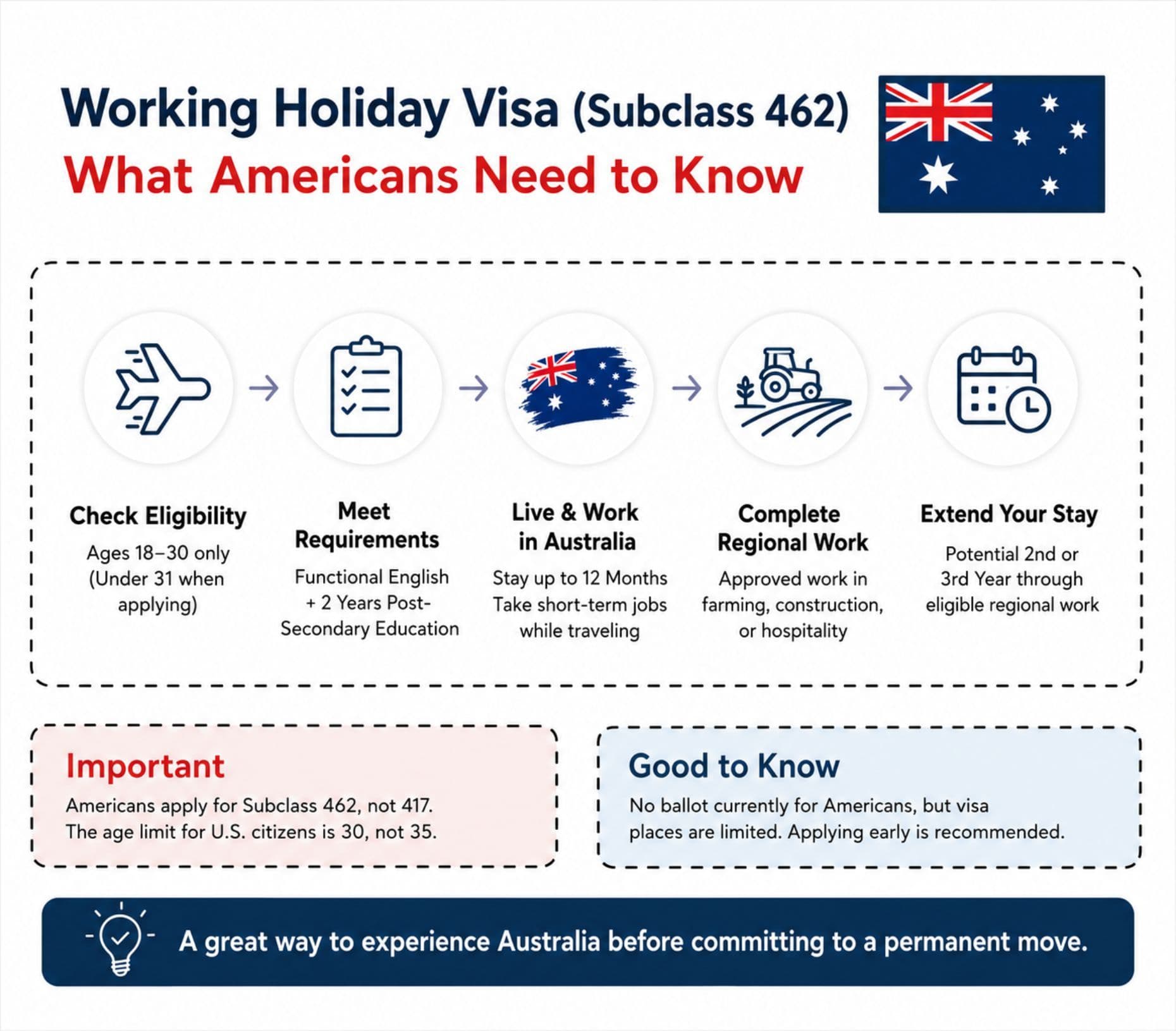
The ETA is the simplest entry visa for Americans visiting Australia. It is mainly used for tourism, short visits, or seeing family and friends. It allows stays of up to three months per visit and is usually approved quickly online or through an app. The cost is low, and the process is simple.Just keep in mind you can't work on this visa, and it won't lead to permanent residency. It's a tourist visa, nothing more. Using repeated back-to-back stays is not a long-term solution and can raise immigration concerns.Working Holiday Visa - Subclass 462The Working Holiday visa is one of the most popular options for young Americans who want to experience life in Australia. It is available to people aged 18 to 30 (who are under 31 years of age at the time of application) and requires basic financial proof to support your arrival. This visa allows you to live in Australia for 12 months and take short-term jobs to fund your stay. Many people extend it for a second or third year by completing approved regional work in industries like farming, construction, or hospitality.
Americans use the 462 (Work and Holiday), not the 417 (Working Holiday). The distinction matters because the 35-year age limit that applies to applicants from Canada, Denmark, France, Ireland, Italy, and the UK does not extend to Americans. US citizens cap at 30 with no exception. If you have read about the 35-year limit elsewhere and assumed it applies to you, it does not. The 462 also has additional requirements compared to the 417: you must demonstrate functional English (IELTS 4.5 or equivalent) and show evidence of at least two years of post-secondary education. Some nationalities on the 462 face annual caps or ballot systems - Americans are not currently subject to a ballot, but the cap exists, so applying early in the program year is sensible.This visa won't put you on the path to PR by itself, but lots of people use it to test Australia before committing to a full move.Student Visa - Subclass 500The Student visa is for Americans who want to study in Australia at an approved institution. You must first receive a Confirmation of Enrolment from a registered school or university before applying.Applicants must show proof of financial support and meet English language requirements in most cases. The visa allows part-time work during study periods and more flexible work during breaks.After completing studies, many students move on to a Temporary Graduate visa, which can open the door to skilled migration pathways. Common documents required include academic records, financial statements, and proof of genuine study intent.Skills in Demand Visa - Subclass 482The Skills in Demand (SID) visa is the main route into Australia if you already have a job offer. It replaced the old Temporary Skill Shortage visa on 7 December 2024, keeping the 482 subclass number but restructuring it into three streams.Core Skills covers around 456 occupations on the Core Skills Occupation List - healthcare, IT, engineering, trades, education, and more. The minimum salary is AUD $76,515, rising to $79,499 on 1 July 2026. A skills assessment is required for most roles in this stream.Specialist Skills is for high earners in senior roles. No occupation list applies - the salary floor does the filtering. The minimum is AUD $141,210 until 30 June 2026, then $146,717. Processing can be as fast as seven days.Labour Agreement covers industries with specific government-negotiated arrangements, aged care, agriculture, and regional sectors where standard streams don't apply.All streams are employer-sponsored, meaning your visa is tied to your job. If that changes, you have 180 days to find a new approved sponsor. After two years with an eligible employer, most holders can transition to permanent residency through the Employer Nomination Scheme (subclass 186).Temporary Visa Options for Americans (Quick View)
| Visa | Subclass | Who It’s For | Duration | Work Rights | Path to PR |
| Electronic Travel Authority | 601 | Tourists and short visits | Up to 3 months per visit | Not allowed | No |
| Working Holiday | 462 | Young Americans (18–30) | 12 months (up to 3 years with regional work) | Yes, short-term jobs allowed | No direct path |
| Student Visa | 500 | International students | Length of study + short extension | 48 hrs per fortnight | Possible via graduate visa |
| Temporary Graduate | 485 | Recent graduates in Australia | 2–6 years | Full work rights | Yes, skilled pathway |
| Skills in Demand | 482 | Skilled workers with job offer | Up to 4 year(varies by stream) | Sponsored role only | Yes → 186 visa |
Skilled Independent Visa - Subclass 189
The 189 gives you permanent residency the moment it's approved. No job offer needed, no state sponsor. Just your points score.Instead, you apply through a points-based system that considers age, work experience, education, and English ability. Although the minimum requirement is 65 points, actual invitation scores are often higher due to competition.This visa allows you to live and work anywhere in Australia without restrictions. Required documents include skills assessments, English test results, employment records, and identity verification documents.Skilled Nominated Visa - Subclass 190The 190 visa is similar to the 189 but requires nomination from an Australian state or territory. In exchange, you receive additional points toward your application.Each state has its own occupation list and selection criteria, meaning eligibility depends on where your skills are needed most. Applicants are usually expected to live and work in the nominating state for a minimum period after approval.Documents include a state nomination approval, skills assessment, employment history, and proof of qualifications.Skilled Regional Visa - Subclass 491The 491 visa is designed for people willing to live and work in regional Australia. It is a temporary visa that can lead to permanent residency after meeting specific requirements.You receive extra points for choosing regional areas, which increases your chances of approval. After three years of living and working in a regional area, you may become eligible for permanent residency.This visa requires state or family sponsorship, proof of skills, and a commitment to regional residence.Partner and Spouse Visas - Subclass 820/801 and 309/100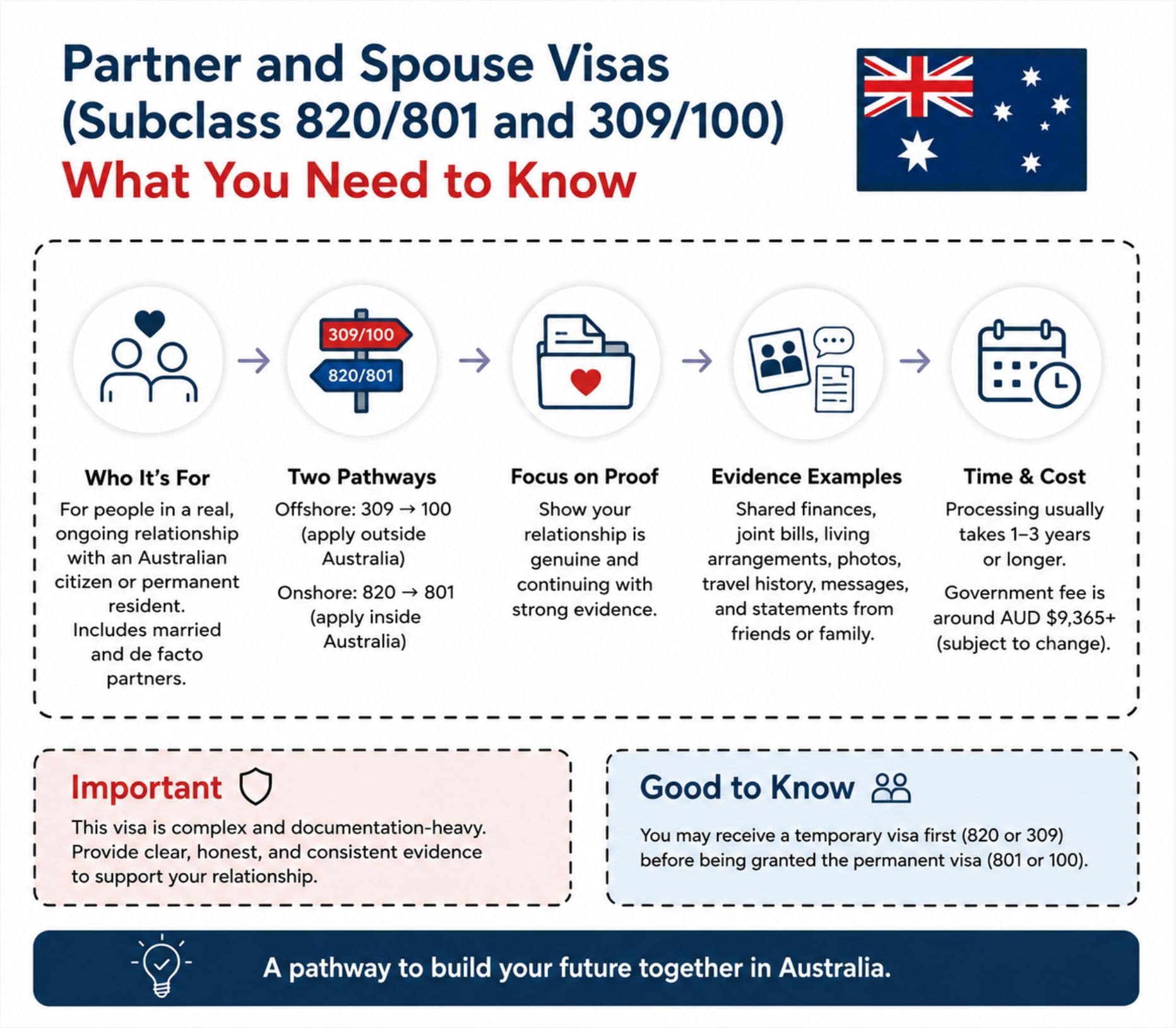
The Partner visa is for people who are in a real, ongoing relationship with an Australian citizen or permanent resident. This includes both married couples and de facto partners. There are two main pathways. The offshore visa (subclass 309 leading to 100) is for people applying from outside Australia. The onshore visa (subclass 820 leading to 801) is for people already living in Australia.
This visa is heavily focused on proof. You must clearly show that your relationship is genuine and continuing. This usually includes shared bank accounts, joint bills, living arrangements, photos over time, travel history together, messages, and written statements from friends or family who know your relationship.The process is detailed and takes time. Most applications take around 1 to 3 years or longer to fully process. The government fee is also high, usually around AUD $9,365 or more depending on updates.Parent VisasParent visas are for people whose children are Australian citizens or permanent residents. These visas allow parents to move to Australia, but they are extremely slow and highly regulated. The standard parent visa has very long waiting times, often 20 to 30 years due to limited places and high demand. This makes it unrealistic for most people.There is a faster option called the contributory parent visa. This version moves through the system more quickly, usually in several years, but the cost is very high and can exceed AUD $48,000 for one applicant. To qualify, you must show a genuine parent-child relationship and meet financial and eligibility requirements. For most families, the contributory visa is the only practical option if they want to move within a reasonable timeframe.Global Talent Visa - Subclass 858The Global Talent visa is designed for highly skilled individuals who are recognised internationally in their field. It is aimed at people working in industries like technology, science, engineering, finance, advanced manufacturing, health, and creative sectors.To apply, you must first secure an endorsement from an eligible Australian organisation or a prominent Australian citizen in your field. This endorsement step is what stops most GTI applications before they start. Reaching out directly to Australian research institutions, professional peak bodies, or industry organisations in your field is the typical route to securing an endorsement. Unlike other visas, there is no points test. Instead, you must show strong evidence of your achievements, such as awards, leadership roles, major projects, publications, or global recognition in your industry. This visa is fast-tracked compared to most other pathways and can lead directly to permanent residency. It is highly competitive and is intended for people at the top level of their profession.Retirement Visas - Subclass 405 and 410Australia does not offer a simple or open retirement visa like some other countries. The existing retirement visa options are very limited. They are generally only available to people who are older (usually 55 and above) and who can show strong financial resources to support themselves without working.These visas are temporary and do not allow employment. They are also being reduced or phased out over time, making them less accessible for new applicants. Because of these limits, most people who want to retire in Australia instead use family-based visas, such as partner or parent visas, if they qualify.Permanent Residency Visa Options for Americans (Overview)
| Visa | Subclass | Sponsor Needed | Points Test | Cost (AUD) | Timeframe |
| Skilled Independent | 189 | No | Yes | ~$4,770+ | 3–18 months |
| Skilled Nominated | 190 | State govt | Yes | ~$4,770+ | 4–18 months |
| Employer Nomination | 186 | Employer | No | ~$4,770+ | 6–18 months |
| Skilled Regional | 491/191 | State/relative | Yes | ~$4,045+ | 3–5 years total |
| Partner Visa | 820/801 | Partner | No | ~$9,365+ | 2–4 years |
| Parent Visa | 143 | Child sponsor | No | $48,000+ | 4–10+ years |
| Global Talent | 858 | No | No | Varies | Weeks to months |
Need help with your application or background check?
Contact us now and speak with a dedicated Globeia expert today.

