

When preparing U.S. documents for Spain, it’s important to understand that not all documents are treated the same. A birth certificate doesn’t follow the same path as a university diploma or an FBI background check. Each document has its own quirks, requirements, and common mistakes.
Below is a document-by-document guide, written in a slightly different style for each section, so you can clearly understand what makes each process unique.
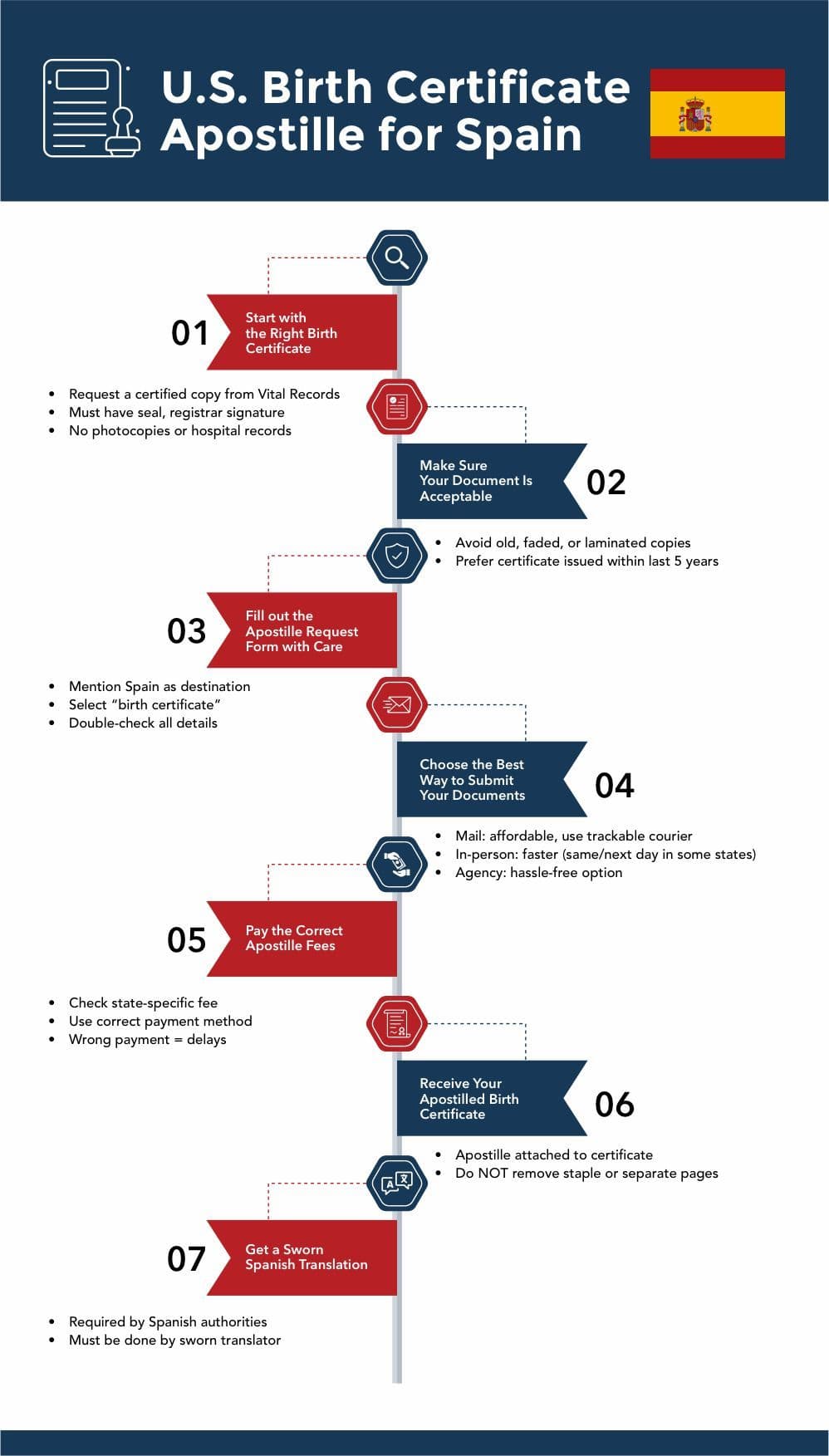
Getting a U.S. birth certificate apostille for Spain isn’t complicated, but it does require attention to detail. Here are a few steps that need to be followed:
Step 1: Start with the Right Birth Certificate
Before thinking about apostilles, you need to make sure you have the correct type of birth certificate.
You'll need to request a certified copy from the state where you were born through the Vital Records Office. This isn't the same as a photocopy or a hospital-issued record; those won't work for a Spain visa document apostille from the USA. A valid certificate should:
If you're ordering online, stick to trusted platforms or official state websites. Many people order unusable copies from third-party sites, which can slow down the entire U.S. apostille for Spain process.
Step 2: Make Sure Your Document Is Acceptable
Even if you already have a birth certificate, it's worth taking a closer look. If your certificate is old, faded, or laminated, and was issued more than 5 years ago, request a new one. Many state offices have updated their seal or registrar signature since then, and an old format can trigger extra verification steps.
Step 3: Fill Out the Apostille Request Form with Care
Once your document is ready, the next step is paperwork, but this is where small mistakes can cause big delays. Each state has its own apostille request form available on the Secretary of State's website. When filling it out:
It may seem like a simple step, but missing or incorrect information is one of the most common reasons documents are returned during the apostille process for Spain visa from the USA.
Step 4: Choose the Best Way to Submit Your Documents
Now comes the actual submission. You have a few options, and the right one depends on your timeline and comfort level.
Step 5: Pay the Correct Apostille Fees
This step is straightforward, but it's easy to get wrong. Each state has its own fee and preferred payment method: a check or money order. Some states allow online payments, but many still rely on traditional methods.
Before you send anything, double-check the exact fee. Incorrect payments are a very common reason for delays in the U.S. apostille process for Spain.
Step 6: Receive Your Apostilled Birth Certificate
Once your application is processed, your birth certificate will come back with an apostille attached. This apostille is what makes your document valid to use in Spain. It confirms that the signature and seal on your certificate are authentic.
One important thing to keep in mind: Don't remove the staple or separate the apostille from the document. Even if everything else is perfect, separating the pages can invalidate your apostille documents for Spain from the USA.
Step 7: Get a Sworn Spanish Translation
Most people get their apostille back and assume they're done. They're not. Spanish authorities won't read an English document regardless of how many official seals it carries; you need a sworn translation by a traductor jurado every time. Without this, your Spain application from the USA may be incomplete even if your apostille is correct.
State-Specific Rules for US Birth Certificates Apostille
Some states have different steps to follow, and some have extra requirements that you might not expect.
The marriage certificate is the document Spanish registries scrutinise most carefully for family reunification and spouse visa applications; name mismatches, even minor ones, are the single most common cause of rejection.
Step 1: Get a Certified Marriage Certificate
First, get a certified copy from the County Clerk or State Vital Records Office where your marriage was recorded. Make sure you have an official certified version and not just an informational one.
Step 2: Verify the Format Is Correct
States use different formats for their documents, so the certified copy can be accepted as valid when you need a marriage certificate apostille USA to apply for a visa or other applications.
Step 3: Fill Out the Apostille Request Form
Complete your state’s apostille form. Make sure to include:
Step 4: Submit Document to Apostille
Send the marriage certificate to the Secretary of State. You can either mail it, deliver it in person, or use a professional apostille service to handle Spain visa documents.
Step 5: Make the Payment
Double-check the amount and payment options to make sure the process goes without delays.
Step 6: Get the Apostille & Arrange Translation
After getting it apostilled, obtain a sworn Spanish translation to use it in Spain.
This step is crucial to apply for a Spanish visa in the USA for married individuals.
State-Specific Points to Think About for US Marriage Certificates Apostilles
Handling inheritance or property matters in Spain often requires a U.S. death certificate apostille. This process proves the document is authentic and recognized under the Hague Apostille Convention.
Who Can Request
Eligibility rules differ by state: in California, only the registrant's spouse, parent, child, or legal representative can request a certified copy. In New York, the estate executor or an immediate family member qualifies. Check your state's vital records office before ordering.
Getting a Certified Copy
You must request a certified death certificate from the issuing authority. Make sure it includes the official seal and signature. Small mistakes like a misspelled name or incorrect date can cause major delays.
Tip: Compare the certificate to other legal documents before you submit it for apostille. Even minor inconsistencies can hold up processing.Apostille Submission
Unlike some other documents, a death certificate does not need notarization. Complete the apostille form and specify Spain as the destination country. Then submit it to the Secretary of State via mail, in-person, or through a specialized apostille service.
Processing times differ by state, so plan ahead. Once approved, your document becomes valid for Spain.Translation Requirement
Once apostilled, the death certificate must be translated by a sworn Spanish translator before Spanish courts, notaries, or inheritance registries will process it. No exceptions!
Special Considerations by State
One family in California waited four weeks before realizing they needed a direct request from the county office rather than submitting through a third-party service. Planning ahead avoids this common delay.
If you want to get married again or change your marital status in Spain, you need divorce records. Apostilles prove that something is real, although the steps are different in each state. You need to do three simple things to get an apostille on a US divorce certificate.
First, request a certified copy of the court record from the court where your divorce was concluded. Make sure that all of the pages are there and that they can be read. Missing pages are a common mistake.
Second, send the paper to the Secretary of State for apostille processing, making sure to say that it is going to Spain. Follow any rules that are specific to your state.
Finally, get a sworn Spanish translation ready before you send it to the Spanish government. Your document won't be accepted for legal or visa purposes without it.
State-Specific Rules for Divorce Decrees
Studying or working in Spain requires your U.S. academic documents to be apostilled and translated.
Step-by-Step Approach for Education Documents
State Rules for Educational Documents
Some states needs Notarization while some accepts originals. Check with SOS for these documents first
If you’re expanding or operating a business in Spain, you’ll need an apostille for U.S. business documents for Spain.
3-Step Summary for Private Business Documents
Specific Rules for Business Documents
In some cases, civil records and business documents issued within the last 6 months will be eligible for use in Spain; that’s why it is better to check with the authority before sending them for a US apostille.
Need help with your application or background check?
Contact us now and speak with a dedicated Globeia expert today.

