
By Sejal Jain · Updated September 11, 2026
Reviewed by Vasu Singla
Every year, many Americans decide to move to Spain. They do it to study, work, start a business, retire, or just experience a change in lifestyle. Most people spend a minimum of six months getting paperwork ready before they leave. One such preparation is Apostille US documents.
Apostille helps US documents to be recognized overseas. Without it, important paperwork like diplomas, birth certificates, background checks, or other legal documents won’t work for official use in Spain. This can create problems in areas like applying for visas in Spain, getting into universities, or handling jobs and legal matters.
The problem with the US apostille process is that it can confuse first-time applicants. Each type of document goes through its own steps, and without proper direction, figuring out how to apostille US documents for Spain can be confusing. This guide covers every document type, the correct authority to send it to, and the exact steps, so you're not guessing and know how the apostille process for Spain works, which documents need to be verified, and what common errors you should avoid.
A US apostille is a certified document that proves a public record is legitimate when used abroad. It does not serve as a translation, a visa, or evidence that the details in the document are accurate. Instead, it shows that the person who signed or issued it is an authorized official.
The Hague-Convention of 1961 established the apostille system through an international treaty. This treaty has been signed by 129 participating countries, including the United States, which joined in 1981, and Spain, which became a member in 1978. Since both countries are part of this treaty, Spain accepts apostilles as valid authentication for documents from the United States. If Spain is your destination, the apostille is the only internationally recognised form of document authentication the country accepts.
An apostille from the US is crucial when you need to use American documents in Spain. Authorities in Spain cannot confirm if US documents are authentic, so they depend on the apostille system set up by the Hague Apostille Convention. This system provides a certificate that shows the document is legitimate and issued by an official authority. Without it, your documents have no legal validity in Spain, and government offices, courts, universities, or notaries there will reject them.
Anyone using documents from the United States for official purposes in Spain needs a US apostille. This applies not just to visa applicants but to anyone dealing with legal, educational, business, or personal matters.
Key situations where a US apostille is necessary:
People applying for Spanish visas, residency, or citizenship often need apostilled documents such as birth certificates, FBI background checks, and marriage records. Without an apostille, applications may be delayed or rejected.
Americans planning to marry in Spain or handle family-related processes may need apostilled birth certificates, divorce papers, or marriage certificates for legal recognition.
Buying property or managing inheritance in Spain may require apostilled documents like power of attorney, wills, or death certificates. Spanish notaries usually require these before proceeding.
Companies expanding into Spain and professionals seeking to work there may need apostilled business documents, degrees, and certifications for registration and recognition.
Students enrolling in Spanish institutions and individuals involved in legal cases may also need apostilled academic or legal documents for official acceptance.
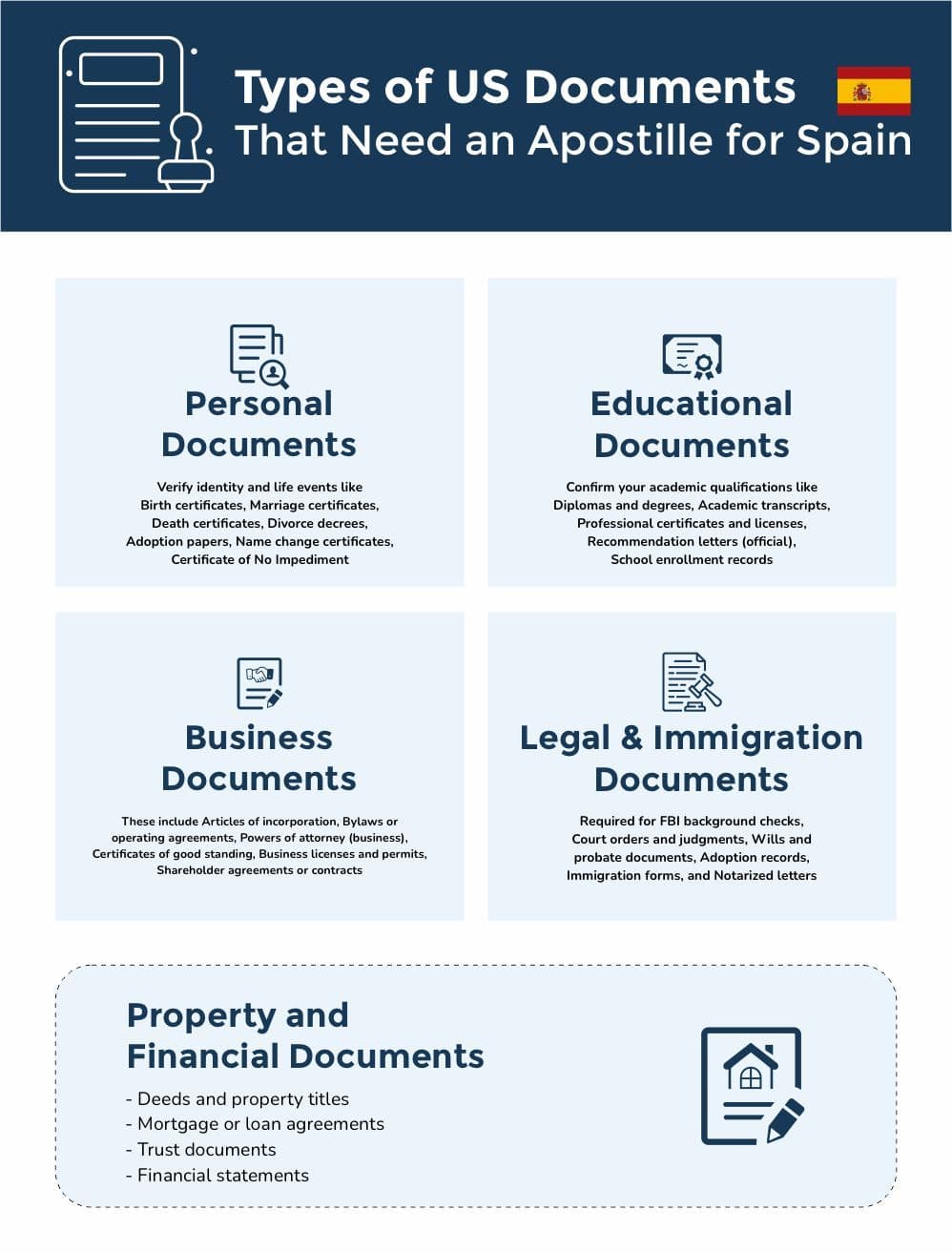
The documents you need to apostille depend entirely on what you're doing in Spain. Below is a full breakdown by category.
Personal documents are where most people start, and where the most mistakes happen. Spain doesn't just want to see a birth certificate; it wants one verified by an authority it's treaty-bound to trust.
For anyone studying, working, or practicing a regulated profession in Spain, academic credentials must be apostilled before they carry any official weight.
Spanish business registration requires proof that your company is legitimate and that any representative acting on its behalf has legal authority to do so.
These are the documents most commonly required by Spanish courts, immigration offices, and government agencies.
If you're buying property, managing assets, or handling financial obligations in Spain, these documents need to be apostilled before Spanish notaries, and banks will act on them.
When you need an apostille for a U.S. document, the first thing you should know is that there's no single office that handles all apostilles. Depending on the type of document and where it was issued, you may need to contact different authorities.
In the U.S., there are two main apostille authorities:
Six states require an extra step before the Secretary of State will touch a notarised document. Three others route apostilles through a different office entirely. Getting this wrong costs 4–6 weeks, not days.
Most documents, such as birth certificates, marriage certificates, divorce decrees, notarized affidavits, educational records, and business filings, are issued at the state level. For most state-issued documents, go directly to the Secretary of State in the state that issued the document not where you currently live, not where you're applying
Below is the state, its designated apostille authority, and the relevant department or office responsible to process apostille:
| State | Apostille Officer | Apostille Authority / Department |
| Alabama | Alabama Secretary of State | Office of the Secretary of State, Montgomery |
| Arizona | Arizona Secretary of State | Office of the Secretary of State, Phoenix |
| California | California Secretary of State | Office of the Secretary of State, Sacramento |
| Colorado | Colorado Secretary of State | Office of the Secretary of State, Denver |
| Illinois | Illinois Secretary of State | Office of the Secretary of State, Springfield |
| Indiana | Indiana Secretary of State | Office of the Secretary of State, Indianapolis |
| Kentucky | Kentucky Secretary of State | Office of the Secretary of State, Frankfort |
| Maryland | Maryland Secretary of State | Office of the Secretary of State, Annapolis |
| Nevada | Nevada Secretary of State | Office of the Secretary of State, Carson City & Las Vegas |
| New Hampshire | New Hampshire Secretary of State | Office of the Secretary of State, Concord |
| New Mexico | New Mexico Secretary of State | Office of the Secretary of State, Santa Fe |
| North Carolina | North Carolina Secretary of State | Office of the Secretary of State, Raleigh |
| Ohio | Ohio Secretary of State | Office of the Secretary of State, Columbus |
| South Carolina | South Carolina Secretary of State | Office of the Secretary of State, Columbia |
| Texas | Texas Secretary of State | Office of the Secretary of State, Austin |
| Washington | Washington Secretary of State | Office of the Secretary of State, Olympia |
| West Virginia | West Virginia Secretary of State | Office of the Secretary of State, Charleston |
| Wyoming | Wyoming Secretary of State | Office of the Secretary of State, Cheyenne |
| State | Apostille Officer | Apostille Authority / Department / Office |
| Alaska | Lieutenant Governor | Office of the Lieutenant Governor, Anchorage; Attorney General & Clerk of Appellate Courts, also authorized |
| Connecticut | Secretary of State | Office of the Secretary of State, Hartford; Deputy Secretary & Director, Commercial Recording Division |
| Delaware | Delaware Secretary of State | Department of State, Division of Corporations, Dover |
| Florida | Florida Secretary of State | Department of State, Division of Corporations, Tallahassee |
| Georgia | Georgia Superior Courts Clerks' Cooperative Authority | Atlanta office; county clerk certification required |
| Hawaii | Lieutenant Governor | Office of the Lieutenant Governor, Honolulu |
| Massachusetts | Secretary of the Commonwealth | Office of the Secretary of the Commonwealth, Boston; Deputy Secretary of Commonwealth |
| New Jersey | Secretary of State | Division of Revenue; county clerk certification required |
| New York | Secretary of State | Department of State, New York City, Albany, Binghamton, Buffalo, and Utica only |
| Pennsylvania | Secretary of the Commonwealth | Office of the Secretary of the Commonwealth, Harrisburg; Prothonotary certification required |
| Utah | Lieutenant Governor | Office of the Lieutenant Governor, Salt Lake City; Deputy & Administrative Assistant |
| Virginia | Secretary of the Commonwealth | Office of the Secretary of the Commonwealth, Richmond; Chief Clerk |
| Wisconsin | Secretary of State / Department of Financial Institutions | Madison, Secretary & Administrator of Government Records / DFI handles corporate, notary, school & vital records |
If a federal agency issued your document or a federal official signed it, it must go to the U.S. Department of State Office of Authentications in Washington D.C.
Common federal documents include:
Contact info for federal apostilles:
Mail:
U.S. Department of State
Office of Authentications 44132 Mercure Circle,PO Box 1206, Sterling, VA 20166-1206Walk-in service:
Office of Authentications
600 19th Street NWWashington, DC 20006Required form: DS-4194 (select "Apostille" for Spain, not "Authentication Certificate")
Always Remember: State offices cannot apostille federal documents. If you send them to a Secretary of State office, you will receive a returned document and lose 3–6 weeks.
State offices only certify signatures they have on file, registrars, notaries, and officials who filed credentials with that state. An FBI agent's signature is filed with the federal government, not any state, so only Washington can verify it. The federal government, the Department of State, has the authority to certify federal signatures and seals.
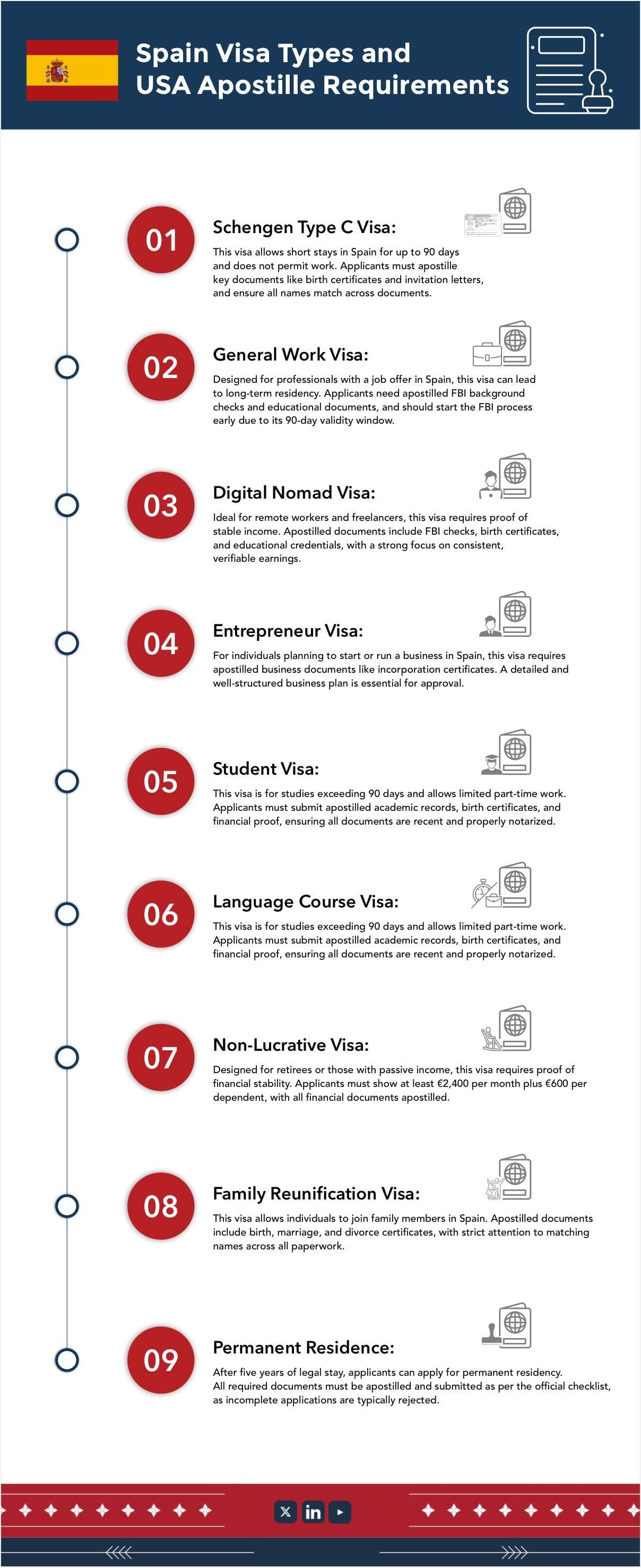
Applying for a Spanish visa from the USA can seem complicated, but understanding which US documents require an apostille makes the process smoother and reduces the risk of rejection. Each visa type has unique requirements, and skipping the apostille step is one of the most common reasons the Spanish consulate denies applications.
Below are the main Spanish visa types, their purposes, eligibility, and the US documents that need an apostille.
U.S. citizens can visit Spain for up to 90 days within 180 days with the Schengen Type C visa. This visa is perfect for tourists who want to learn about Spain's rich culture, go to short business meetings, or see family. It lets you travel within the Schengen Area, but it doesn't let you work. Many applicants fail because they overlook the need for proper apostille verification on key documents.
Documents that need apostille:
Your passport spelling is the master reference. If your birth certificate shows 'María José' and your passport shows 'Maria Jose,' that mismatch will pause processing at the consulate, fix the source document, or carry a sworn explanation letter.
The General Work Visa allows professionals from the U.S. to work legally in Spain through a local employer. It works for people who have a job offer and may lead to long-term residency with renewals. Applicants must show proof of their identity, qualifications, and criminal history by giving apostilled documents.
Documents that need an apostille:
Start the FBI background check process first; it takes the longest. Once you receive it, you have a 90-day window to get the apostille and submit. Missing that window means restarting from fingerprints
The Digital Nomad Visa Spain is designed for U.S. remote workers or freelancers who want to live in Spain while working for foreign clients or employers. To qualify, applicants must demonstrate stable remote income and submit apostilled documents.
Documents needing apostille:
Make sure income is consistent and verifiable; authorities check financial stability for this visa.
If you are a U.S. citizen and want to start or run a business in Spain, you can get an Entrepreneur Visa. Applicants must send in a detailed, approved business plan that shows how the business will be good for the economy and last. To check the information, you need apostilled business documents.
Documents needing apostille:
Generic or vague business plans often result in denial. Make sure all documents are notarized and apostilled.
The Student Visa lets U.S. students study in Spain for more than 90 days. This includes university, graduate, and language courses. It lets you work part-time on a limited basis, but its main purpose is to help you learn.
Documents that need apostille:
Student visa applications are rejected most often for one of three reasons: academic transcripts not notarised before apostille, financial support documents older than 6 months, or enrollment confirmation that isn't on official letterhead.
Non-EU students attending long-term Spanish language programs exceeding 90 days will require Language Course Visa. It provides an immersive cultural and educational experience, but does not grant work rights.
Documents needing apostille:
Language course visas have a lower income threshold than student or work visas, but the documentation still needs to be apostilled and sworn-translated. A bank statement older than 3 months at the time of submission will be rejected.
U.S. citizens can visit family members who live in Spain using the Family Reunification Visa. Eligible relatives include spouses, dependent children, and sometimes dependent parents. Proper apostille verification of family documentation is required.
Documents needing apostille:
Make sure all family names are consistent across apostilled documents to avoid processing delays.
For U.S. retirees or individuals with a sufficient passive income who desire to reside in Spain without working, the Non-Lucrative Visa is intended. Applicants must demonstrate financial independence and provide apostilled documentation.
Documents needing apostille:
NLV applicants need to show passive income of at least €2,400/month (2026 rate) per applicant, plus €600/month per dependent. Bank statements, pension letters, and investment income documents all need apostilles and sworn translations, and the right number matters more than having many documents.
Permanent Residence allows long-term legal residency for U.S. nationals who have lived in Spain for five or more years. It grants full rights to work, access to services, and can serve as a pathway to Spanish citizenship.
Documents that need apostille:
After 5 years of legal residence, your application is reviewed against a specific document list from the immigration authority. Submit everything on their checklist, apostilled and sworn-translated, they do not chase missing items, they simply deny.
Preparing for a USA apostille is important because even small mistakes can cause frustrating delays or rejections. Here are some of the documents and guidelines you need to follow :
Check the issue date of your documents. In most cases, US state documents should be issued within the last 3–5 years, or FBI background checks must be issued within 90 days. Check your consulate's specific list. There is no single rule.
Apostille authorities require original documents or certified copies. Regular photocopies or unofficial duplicates are not accepted and will be rejected.
All documents must include a valid signature and official seal from the issuing authority. Faint, incomplete, or unclear signatures and seals are common reasons for rejection.
If a document requires notarization, it must comply with all notary requirements. This includes the notary's full name, date, location, and complete certification wording. Even minor errors can delay processing.
RON documents may be notarized, but not all states accept them for apostille purposes. Verify acceptance with the issuing Secretary of State before you submit.
Documents issued by local authorities may need county clerk certification before they can be apostilled. Missing this step is a common source of delays.
Birth, marriage, and death certificates must come from authorized state or county offices and include the signatures of the appropriate officials.
Use the current apostille request form from the issuing office. Complete all required fields with accuracy: applicant info, document type, number of copies, and country of use. Include a return envelope with correct postage if submitting by mail.
Ensure the exact fee is included via check or money order. Incorrect or missing payment is one of the most common reasons for delays.
Always indicate the intended country (e.g., Spain). Missing or incorrect country info may lead to the wrong certificate being issued.
If you submit by mail, include a self-addressed return envelope with accurate details. This ensures your documents are returned without delay.
Before sending anything, check the correct authority (state vs federal), matching names across all documents, complete notarization where required, and the right payment amount. One wrong detail sends everything back.
Sending the wrong type of original, notarized copy, or certified copy is one of the most common reasons applications get delayed or rejected. Understanding the differences and knowing how to obtain the correct documents can save you time, money, and stress.
Original documents are the primary records issued at the time of creation. They contain the original signatures, seals, and legal markings of the issuing authority. Examples include:
While originals are the most authoritative, sending your only original overseas is risky. Originals cannot be replaced if lost, damaged, or mishandled in transit, and getting a replacement can take weeks to months, depending on the issuing office.
All original documents must be issued by an authorised government office, county, state, or federal, and carry an original seal and signature from that office.
A certified copy is a duplicate of the original authority issued by a county, state office, court, or university. These copies have their own signature and seal confirming they are an exact and official representation of the original record. They are equivalent to the original. Used for Spain:
Why certified copies are ideal:
Certified copies are the smarter choice as they carry the same legal weight as originals, can be replaced if lost in transit, and are accepted by Spanish authorities once apostilled
How to get a certified copy:
1.Essential Records (Birth, Marriage, Death Certificates):
2.Court Records (Divorce Decrees, Court Orders):
3.Educational Documents (Degrees Transcripts):
Note: Always order two certified copies, one to submit and one backup. Apostilled certified copies are preferred by Spanish authorities and reduce risk.
Notarization is the official act of a licensed notary public who verifies a document. The notary confirms that the signatures on the document are genuine, that the person signing understood the document, and that the person signed it. Without a notary's signature and seal, a privately signed document carries no more legal weight in Spain than a handwritten note. The notary is the link that makes it official.
Documents that are signed or created require notarization. These documents must be notarized before they can receive an apostille. Below are the common types:
Legal Documents
Real Estate Documents
Financial Documents
Business Documents
Personal and Identity Documents
Educational & Supporting Documents
Key Point
Government-issued documents (like birth or marriage certificates) do not need notarization and should be submitted as certified copies. Also, the federal documents signed by the US Officials also do not need notarization.
Key Points About Notarization
1. Who Can Notarize2. What the Notary Does
Confirms the identity of the signer (via ID).
3. Key Details to Remember
4. After Notarization
Once notarised, private documents, powers of attorney, affidavits, and financial declarations need an apostille before Spanish authorities will accept them.
A notarized copy is a photocopy of a document certified by a licensed notary public to confirm it matches the original. The notary adds their signature, seal, and certification wording to verify authenticity.
Used for Spain:
Notarized copies are not the same as certified copies issued by a government office. Vital records such as birth or marriage certificates cannot be notarized; instead, of being certified by the issuing authority.
When to use notarized copies:
If you're submitting a notarized document for an apostille in the US, most states allow you to send it to the Secretary of State. Six states, though, require an additional local certification first. This extra step ensures the Secretary of State can verify that the notary who signed your document is legitimate.
This applies to notarized documents like powers of attorney, affidavits, and personal declarations. Government-issued records such as birth, marriage, and death certificates do not need this extra step; they go straight to the Secretary of State.
| State | Local Certification Required |
| New York | County clerk of the notary’s county |
| New Jersey | County clerk before the Division of Revenue |
| Pennsylvania | Prothonotary of the Court of Common Pleas in the notary’s county |
| Connecticut | The town clerk certifies the notary |
| Georgia | County clerk certification required |
| Louisiana | Parish clerk certifies the notary’s credentials |
If you skip this step, the Secretary of State will return your document unprocessed, which can add 1–3 extra weeks to your timeline. Always check local rules and get the notary certified at the county, parish, or town level before submission to avoid delays.
Remember: Keep a copy of all notarized documents and certification receipts. This ensures you have backups if anything is delayed or rejected.
If you need a US state apostille for Spain, there are three main ways to get it: mail submission, in-person submission, and professional apostille services. Each method has its pros and cons depending on your timeline, location, and comfort with handling official documents.
This is the most common and least expensive choice. You collect your original documents (or certified copies), fill out the apostille request form that your state gives you, include the required fee (usually a check or money order), and mail everything to the Secretary of State's office.
If you don't have to do this urgently, this is a good choice. A lot of people use this method when they live far away from the state office or are submitting just one or two documents.
Mail submissions take 1–3 weeks for most states, though California SOS and New York DOS can run 3–6 weeks during peak periods. Texas SOS is usually faster, often under 10 business days. There is also a small but real chance that documents will be delayed or lost in the mail. So, it's a good idea to use a mailing service that can be tracked and keep copies of everything you send.
If you can go to the Secretary of State's office, this is usually the quickest and easiest way to complete apostilled US documents. Some US states let people walk in, while other states want to book an appointment.
The best thing about this is how quickly you can get your apostille. You can usually get it the same day or within 24 hours, but the actual time depends on SOS. In-person submission is also good if something is wrong (like missing notarization or the wrong type of document), as you can fix that right away.
The only drawback is that it's not convenient. You might have to wait in line and plan around limited business hours to get to the office. This option also might not work for people who don't live in the state or the office that issues it.
A professional service makes sense when you're handling more than two documents, working to a visa deadline, or submitting across multiple states at once. Apostille service providers are mediators. They check your U.S. documents for Spain and make sure everything is in order, and send them to the right state office for you.
A lot of agencies offer tracking updates and can help with things like notarization or certified translations. This ease of use does, of course, come at a cost. The service fees depend on how urgent the request is and how many documents there are. However, many people find the reduced stress and quicker processing time valuable when errors could result in setbacks with visa applications, school enrollment, or legal procedures in a foreign country.
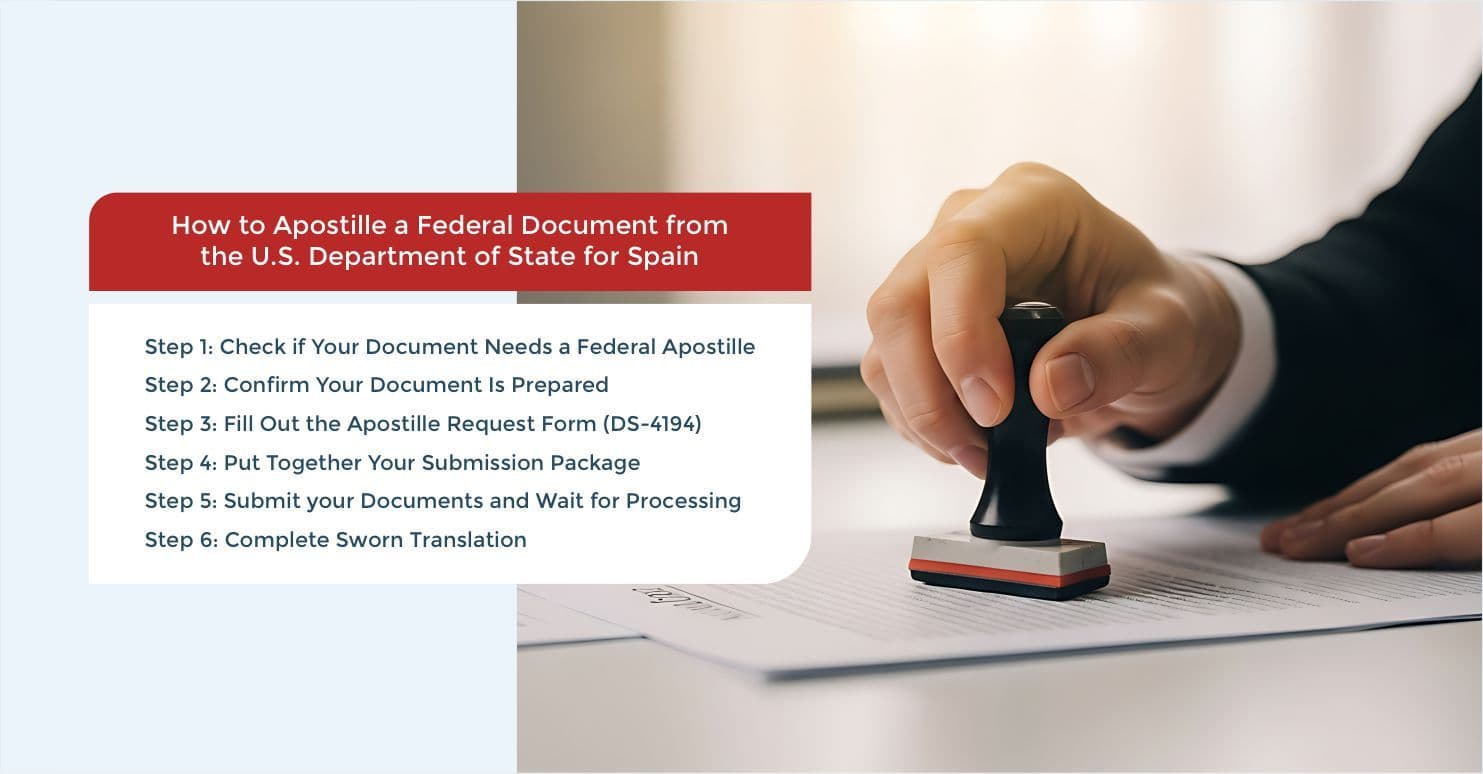
If the U.S. federal government issues your document and you need to use it in Spain, the U.S. Department of State must apostille it. The process isn't complicated, but each step matters.
Before you do anything, make sure you send your document to the right place. Documents that U.S. federal authorities issue need a federal apostille, like an FBI background check or a federal court document. State offices cannot apostille these.
If your document comes from a state (like a birth or marriage certificate), then this process does not apply to you. Getting this step right saves you time and avoids rejection.
This step ensures your document meets the requirements before you send it. The U.S. Department of State accepts official, original, or certified documents. As an example, if you submit federal court documents, the federal courts must issue them. If you send a copy, printout, or document with incorrect certification, you will receive it back without an apostille.
This form DS-4194 tells the Department of State what you're requesting and where the document will be used. You'll need to provide basic details like your name, contact information, and the country where the document will be used (Spain). You'll also list the type of document you're submitting. It's a simple form,m but accuracy is crucial; any mismatch between the form and your document can slow things down.
Now you combine everything into one complete package. This includes your document, the filled form, payment, and a return envelope. Included in one envelope: your original FBI report or federal document, completed DS-4194 form, correct payment (check or money order), and a prepaid return envelope with your address. Do not staple
Once your package is ready, you send it to the U.S. Department of State in Washington, D.C. There are four ways to submit your application:
Once you get your apostilled document, get it translated into Spanish by a certified (sworn) translator. This makes sure it has legal validity and acceptance by Spanish authorities for visa legal processes or consulate submissions.
When preparing U.S. documents for Spain, it’s important to understand that not all documents are treated the same. A birth certificate doesn’t follow the same path as a university diploma or an FBI background check. Each document has its own quirks, requirements, and common mistakes.
Below is a document-by-document guide, written in a slightly different style for each section, so you can clearly understand what makes each process unique.
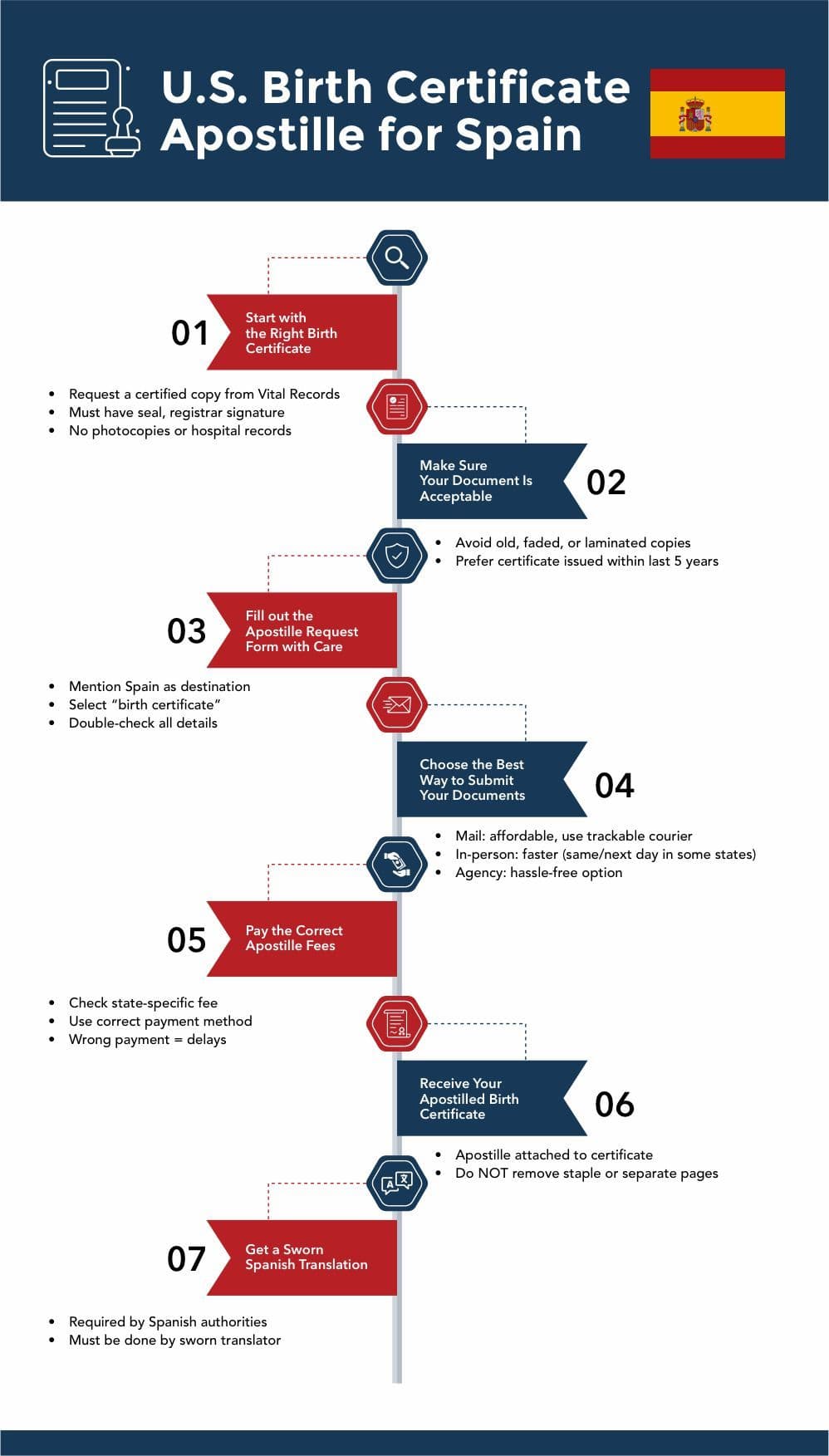
Getting a U.S. birth certificate apostille for Spain isn’t complicated, but it does require attention to detail. Here are a few steps that need to be followed:
Step 1: Start with the Right Birth Certificate
Before thinking about apostilles, you need to make sure you have the correct type of birth certificate.
You'll need to request a certified copy from the state where you were born through the Vital Records Office. This isn't the same as a photocopy or a hospital-issued record; those won't work for a Spain visa document apostille from the USA. A valid certificate should:
If you're ordering online, stick to trusted platforms or official state websites. Many people order unusable copies from third-party sites, which can slow down the entire U.S. apostille for Spain process.
Step 2: Make Sure Your Document Is Acceptable
Even if you already have a birth certificate, it's worth taking a closer look. If your certificate is old, faded, or laminated, and was issued more than 5 years ago, request a new one. Many state offices have updated their seal or registrar signature since then, and an old format can trigger extra verification steps.
Step 3: Fill Out the Apostille Request Form with Care
Once your document is ready, the next step is paperwork, but this is where small mistakes can cause big delays. Each state has its own apostille request form available on the Secretary of State's website. When filling it out:
It may seem like a simple step, but missing or incorrect information is one of the most common reasons documents are returned during the apostille process for Spain visa from the USA.
Step 4: Choose the Best Way to Submit Your Documents
Now comes the actual submission. You have a few options, and the right one depends on your timeline and comfort level.
Step 5: Pay the Correct Apostille Fees
This step is straightforward, but it's easy to get wrong. Each state has its own fee and preferred payment method: a check or money order. Some states allow online payments, but many still rely on traditional methods.
Before you send anything, double-check the exact fee. Incorrect payments are a very common reason for delays in the U.S. apostille process for Spain.
Step 6: Receive Your Apostilled Birth Certificate
Once your application is processed, your birth certificate will come back with an apostille attached. This apostille is what makes your document valid to use in Spain. It confirms that the signature and seal on your certificate are authentic.
One important thing to keep in mind: Don't remove the staple or separate the apostille from the document. Even if everything else is perfect, separating the pages can invalidate your apostille documents for Spain from the USA.
Step 7: Get a Sworn Spanish Translation
Most people get their apostille back and assume they're done. They're not. Spanish authorities won't read an English document regardless of how many official seals it carries; you need a sworn translation by a traductor jurado every time. Without this, your Spain application from the USA may be incomplete even if your apostille is correct.
State-Specific Rules for US Birth Certificates Apostille
Some states have different steps to follow, and some have extra requirements that you might not expect.
The marriage certificate is the document Spanish registries scrutinise most carefully for family reunification and spouse visa applications; name mismatches, even minor ones, are the single most common cause of rejection.
Step 1: Get a Certified Marriage Certificate
First, get a certified copy from the County Clerk or State Vital Records Office where your marriage was recorded. Make sure you have an official certified version and not just an informational one.
Step 2: Verify the Format Is Correct
States use different formats for their documents, so the certified copy can be accepted as valid when you need a marriage certificate apostille USA to apply for a visa or other applications.
Step 3: Fill Out the Apostille Request Form
Complete your state’s apostille form. Make sure to include:
Step 4: Submit Document to Apostille
Send the marriage certificate to the Secretary of State. You can either mail it, deliver it in person, or use a professional apostille service to handle Spain visa documents.
Step 5: Make the Payment
Double-check the amount and payment options to make sure the process goes without delays.
Step 6: Get the Apostille & Arrange Translation
After getting it apostilled, obtain a sworn Spanish translation to use it in Spain.
This step is crucial to apply for a Spanish visa in the USA for married individuals.
State-Specific Points to Think About for US Marriage Certificates Apostilles
Handling inheritance or property matters in Spain often requires a U.S. death certificate apostille. This process proves the document is authentic and recognized under the Hague Apostille Convention.
Who Can Request
Eligibility rules differ by state: in California, only the registrant's spouse, parent, child, or legal representative can request a certified copy. In New York, the estate executor or an immediate family member qualifies. Check your state's vital records office before ordering.
Getting a Certified Copy
You must request a certified death certificate from the issuing authority. Make sure it includes the official seal and signature. Small mistakes like a misspelled name or incorrect date can cause major delays.
Tip: Compare the certificate to other legal documents before you submit it for apostille. Even minor inconsistencies can hold up processing.Apostille Submission
Unlike some other documents, a death certificate does not need notarization. Complete the apostille form and specify Spain as the destination country. Then submit it to the Secretary of State via mail, in-person, or through a specialized apostille service.
Processing times differ by state, so plan ahead. Once approved, your document becomes valid for Spain.Translation Requirement
Once apostilled, the death certificate must be translated by a sworn Spanish translator before Spanish courts, notaries, or inheritance registries will process it. No exceptions!
Special Considerations by State
One family in California waited four weeks before realizing they needed a direct request from the county office rather than submitting through a third-party service. Planning ahead avoids this common delay.
If you want to get married again or change your marital status in Spain, you need divorce records. Apostilles prove that something is real, although the steps are different in each state. You need to do three simple things to get an apostille on a US divorce certificate.
First, request a certified copy of the court record from the court where your divorce was concluded. Make sure that all of the pages are there and that they can be read. Missing pages are a common mistake.
Second, send the paper to the Secretary of State for apostille processing, making sure to say that it is going to Spain. Follow any rules that are specific to your state.
Finally, get a sworn Spanish translation ready before you send it to the Spanish government. Your document won't be accepted for legal or visa purposes without it.
State-Specific Rules for Divorce Decrees
Studying or working in Spain requires your U.S. academic documents to be apostilled and translated.
Step-by-Step Approach for Education Documents
State Rules for Educational Documents
Some states needs Notarization while some accepts originals. Check with SOS for these documents first
If you’re expanding or operating a business in Spain, you’ll need an apostille for U.S. business documents for Spain.
3-Step Summary for Private Business Documents
Specific Rules for Business Documents
In some cases, civil records and business documents issued within the last 6 months will be eligible for use in Spain; that’s why it is better to check with the authority before sending them for a US apostille.
The FBI background check apostille for Spain is a mandatory requirement for U.S. applicants applying for a Spain work visa, digital nomad visa, or residency permit. This document confirms your criminal record status and must be officially legalized before it can be accepted by authorities in Spain.
If you are applying from the United States, this process involves federal-level authentication, making it one of the most important and often the slowest steps in the Spain visa application process from the USA.
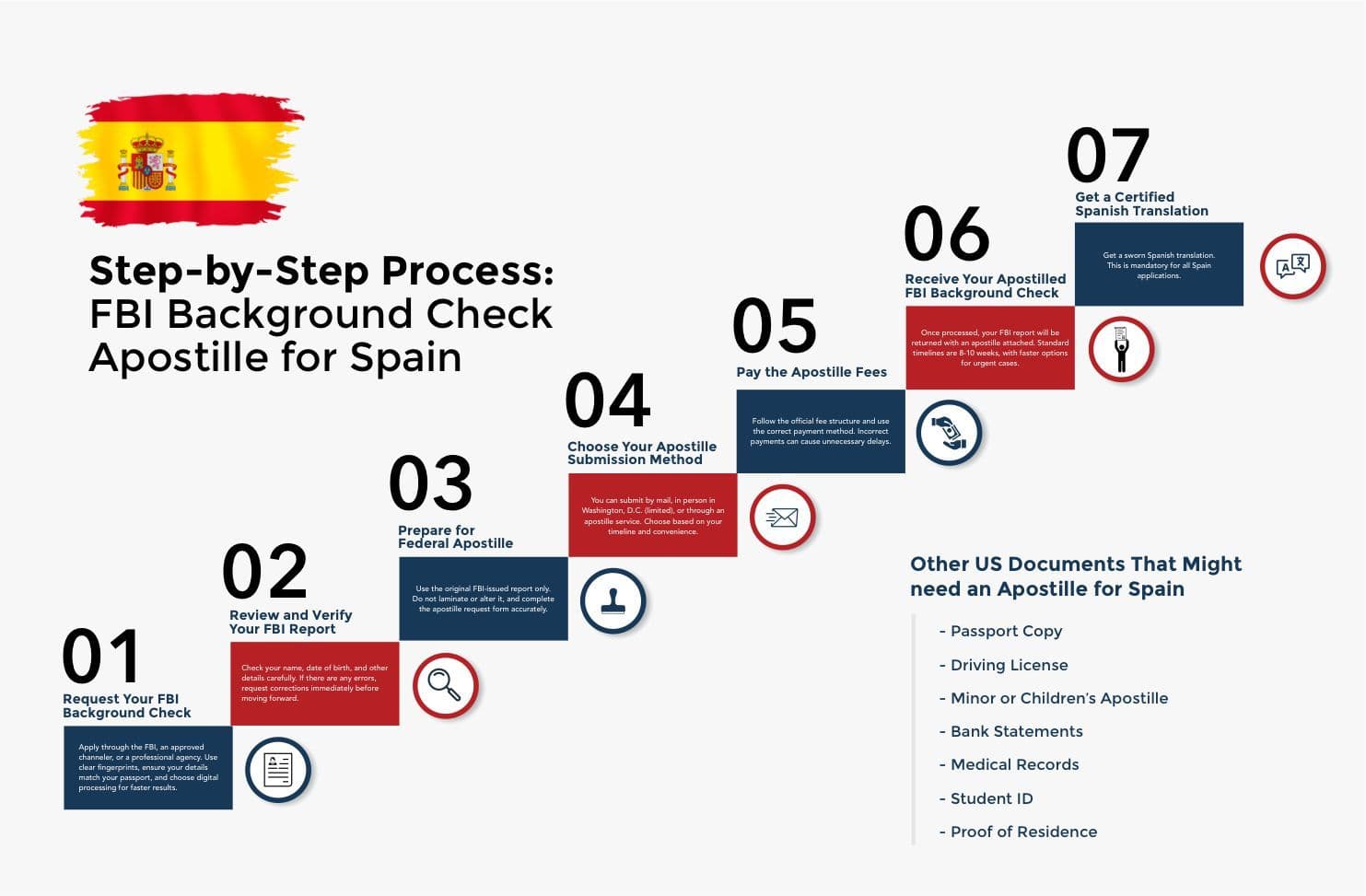
Step 1: Request Your FBI Background Check
Begin by applying for your FBI Identity History Summary through the Federal Bureau of Investigation. You have two options:
Tips:
To know more about obtaining FBI background checks for Spain, read our blog “Easy Guide to Get an FBI Background Check for Spain”.
Step 2: Review and Verify Your FBI Report
Once you receive your FBI background check:
Accuracy at this stage is essential before proceeding to apostille.
Step 3: Prepare for Federal Apostille
Unlike state-issued documents, the FBI report requires a federal apostille. Your document must be submitted to the U.S. Department of State in Washington, D.C. Before submitting:
Step 4: Choose Your Apostille Submission Method
You can submit your FBI background check for apostille using one of the following methods:
Mail Submission (Standard Option)
In-Person Submission (Limited Availability)
Apostille Services (Expedited Option)
Step 5: Pay the Apostille Fees
Include the correct payment with your application:
Step 6: Receive Your Apostilled FBI Background Check
After processing, your document will be returned with an official apostille attached.
Step 7: Get a Certified Spanish Translation
To use your document in Spain, you must obtain a sworn Spanish translation. Requirements:
The FBI background check apostille for a Spanish visa is often the longest step, as the Spanish authorities only accept FBI checks issued within the last 90 days. Delays can occur at multiple stages, including fingerprinting, apostille processing, and translation. Start at least 6–10 weeks in advance to ensure your documents are ready on time. Also, for the emergency appointment, it will take 5 to 6 days, but it is best to check with the U.S. Department of State for accurate timing.
Most people get their birth certificates or FBI background checks ready, but there are other US documents that might also need to be apostilled for Spain. These requirements usually come up during visa applications, residency processes, school admissions, or legal matters. Many applicants only discover this later, which can lead to unexpected delays
Passport Copy
Sometimes, Spanish officials may ask for an apostilled copy of your US passport to prove your identity, residency, or legal status. You need to make a notarized true copy of the original passport because it can't be apostilled. After being notarized, the copy can be sent to the Secretary of State for an apostille.
Driving License
A US driving license may also be requested for identification or residency-related processes in Spain. Similar to the passport, a copy of the driving license is first notarized and then submitted for apostille if required.
Minor or Children’s Apostille
If you are moving to Spain with kids, their papers may also need to be apostilled. This is often the case for applications for school, family visas, or residency. Usually, parents or legal guardians can do the apostille process for minors.
Bank Statements
Some applications for long-term visas and residency need proof that you are financially stable. Depending on what the Spanish authority needs, official bank statements may need to be notarized before they can be sent in for apostille.
Medical Records
For long-term visas or residency applications, you might need to get a medical certificate. You need to get these papers from a licensed doctor or hospital, then have them notarized before you can send them in for apostille.
Student ID
Students applying to Spanish schools or universities may be asked to provide apostilled student ID other academic verification, student letters, or identification documents. These are usually requested during admissions or residency-related processes.
Proof of Residence
In some legal or administrative situations, you may need to show proof of residence, like a utility bill or a lease agreement. Most of the time, these papers are notarized before they are sent for apostille.
Most of the time, the documents will also need to be translated into Spanish before they can be used in Spain after the apostille is done. Getting these papers ready ahead of time can help things go more smoothly later on.When you're preparing documents to use in Spain, it's easy to think that once you've gotten an apostille, everything is ready. But there's one more crucial step that many people overlook.
An apostille confirms that your document is real and valid, but it doesn't help Spanish authorities understand what's written in it. If your document is in English, it still needs translation into Spanish in a way that is accepted. That's where sworn translation becomes crucial.
What Makes a Translation "Sworn"?
A sworn translation does more than convert English to Spanish. The translator attaches a signed, stamped certification, their personal legal declaration confirming that the translation is complete and accurate. That certification is what makes it binding.
These translations are done by translators who are approved by the Spanish Ministry of Foreign Affairs. Each sworn translation comes with an official stamp and signature. Because of this, the translation is treated as a legal document, not just a simple translation.
Why This Step Matters for Spain
This is where a lot of applications go wrong. Even if you use a professional translator or a well-known translation service, the document can still be rejected if it's not a sworn translation. There are strict rules in Spain, and only authorized translators can follow them. It may not be possible for your papers to be accepted for visas, residency, or legal processes without it.
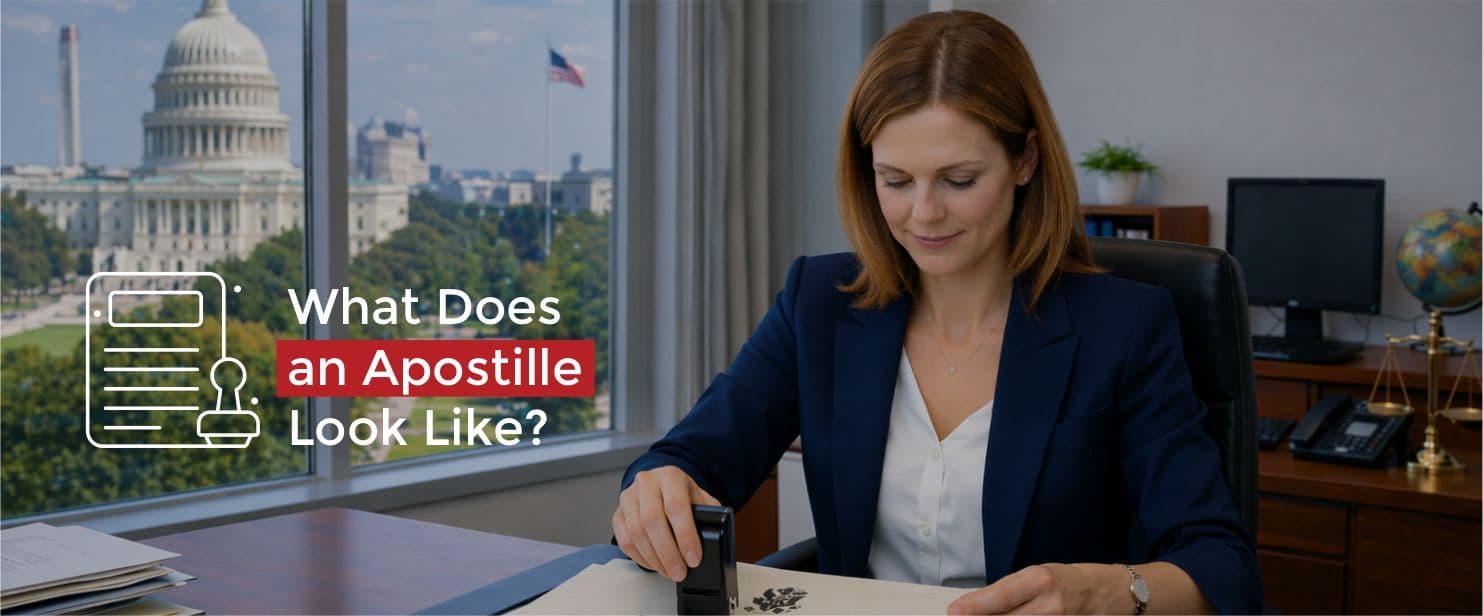
Many first-time applicants are surprised by what an apostille looks like in practice. A clear understanding of the physical format helps you verify that what you received is correct before you submit it to Spain.
The physical format
In the United States, an apostille is a separate white or colored certificate, A4 or letter size, that is attached to the back of your original document with a rivet, staple through a seal, or adhesive. Some states use a stamp-style apostille on the document. The apostille certificate contains the 10 standard Hague Convention fields, including a unique apostille number that can be verified online through many states' Secretary of State websites.
One apostille per document
Each document in your package needs its own separate apostille. If you submit a birth certificate, a marriage certificate, and an FBI background check, that's three separate apostilles, one on each document. There is no single apostille that covers a bundle of documents.
Multi-page documents
If your document is multiple pages, the apostille covers the entire document as a unit and attaches to the final page. All pages of a multi-page document must be connected (stapled or bound through the apostille rivet) before submission. Loose pages are not accepted.
Preparing your documents to use in Spain might seem simple at first, but many applicants run into unexpected issues that can delay their Spain visa, a digital nomad visa, or residency application. These problems come up constantly, and almost always in the same predictable places. Here is exactly where applicants lose weeks.
1. Incorrect or Incomplete Documents
One of the biggest reasons for rejection in the U.S. apostille process for Spain is submitting documents that miss key details. This could be a missing signature, an outdated certificate, or incorrect notarization.
Even a small mistake can mean starting the process all over again.
2. Confusion Between State and Federal Apostille
Many applicants are unsure where they should send their documents. Vital records like birth or marriage certificates require a state apostille, while federal documents like FBI background checks must go through the U.S. Department of State.
Sending your documents to the wrong office is a very common mistake, and it can cost you weeks.
3. Using the Wrong Document Type
Not all documents are accepted to get an apostille. Short-form birth certificates that many states issue are rejected by Spanish consulates. You need the full long-form certificate with both parents listed, the registrar's signature, and the raised or stamped state seal.
4. Document Recency Requirements
Many Spanish authorities require documents to have a recent issue date, often within 3–6 months. This holds particular importance for FBI background checks and civil documents.
The submission of older documents, even if they carry an apostille, can lead to delays or rejection.
5. Name Mismatch Across Documents
If your name appears with different spellings across documents (for example, a missing middle name or the use of different formats), it can create problems during your Spain visa or residency process.
All documents need consistency.
6. Sworn Translation Errors
Spain only recognises translations produced by a traductor-intérprete jurado, a sworn translator listed on the Spanish Ministry of Foreign Affairs register. A certified translation from a US agency, even a well-known one, will be rejected at the consulate.
7. Multiple Steps Across Different Offices
The apostille process often involves several steps: notarization, authentication, apostille, translation, and submission. Managing all of these across different states or offices can become difficult.
8. Shipping and Handling Risks
Since original documents are required, mailing them can be stressful. Send apostilled documents via FedEx or DHL with signature confirmation and declared value. USPS Priority Mail International does not offer the same recovery options if a document is lost, and original apostilled documents can take 4–8 weeks to replace.
9. Tight Deadlines for Spain Visa Applications
Apostille processing times can take longer than expected at the federal level. If you're working toward a visa appointment, delays can create serious problems.
For Spain visa appointments: add 4 weeks for apostille, 2 weeks for sworn translation, and 1 week buffer for returns. If you're using the FBI check, add another 8–10 weeks at the front
10. Hidden Costs and Budget Surprises
The total cost of getting an apostille for Spain from the United States can add up. Fees may include notarization, apostille processing, sworn translation, shipping, and expedited services.
Many applicants underestimate the full cost at the start.
11. Missing or Incorrect Apostille Request Details
Simple mistakes, like not listing Spain as the destination country on your request, can delay processing or lead to rejection.
12. Differences Between Spanish Consulates
Requirements can vary a bit depending on which Spanish consulate handles your application. What works for one location may not always apply to another.
Always double-check the requirements specific to your consulate.
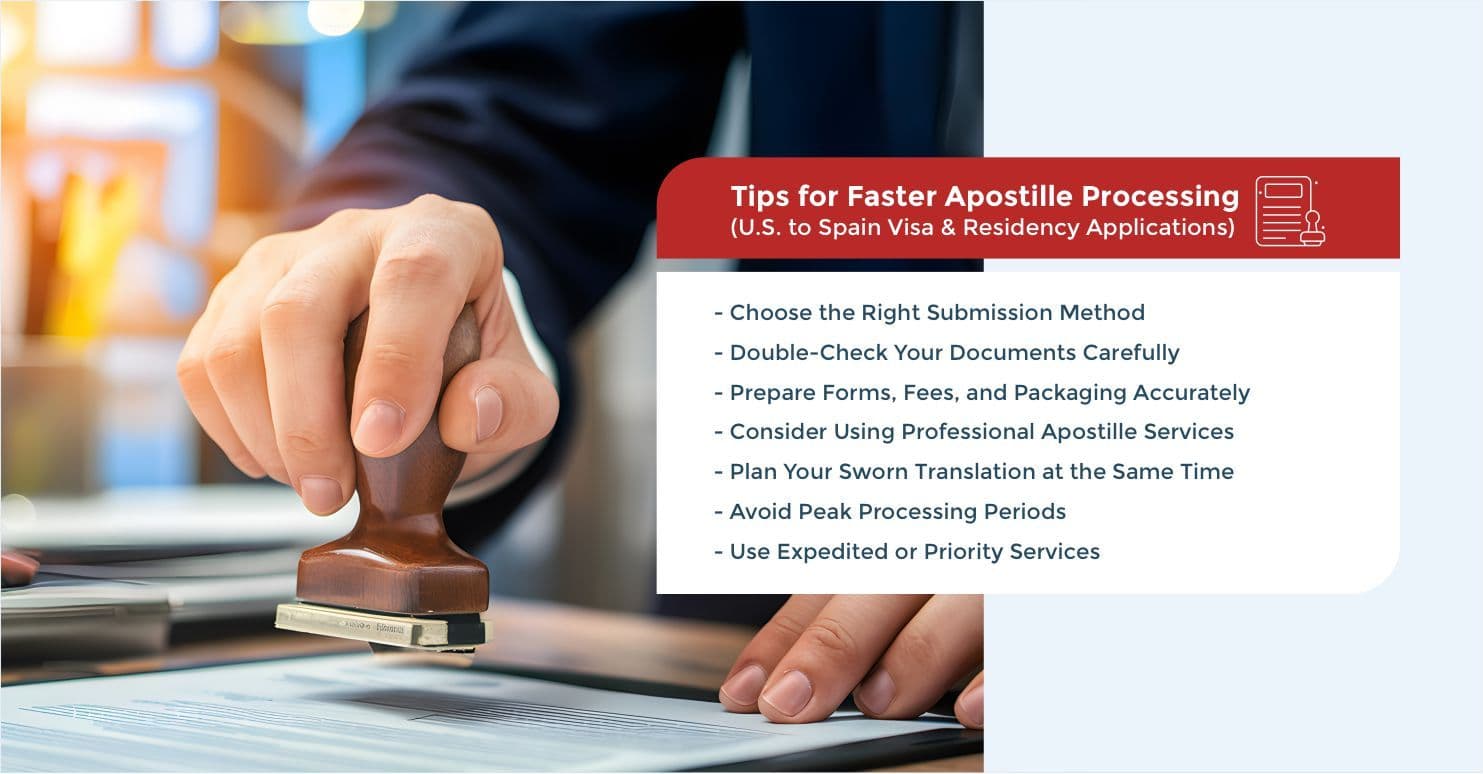
When you're preparing documents to use in Spain, speed matters if you're working toward a Spain visa, digital nomad visa, or residency deadline. The apostille process can take time, but with the right approach, you can avoid delays and move things forward much faster.
Choose the Right Submission Method
One of the easiest ways to speed up the U.S. apostille process for Spain is by choosing how you submit your documents. In many states, in-person submissions are much faster than mailing your documents, with some offices offering same-day or next-day processing.
If your timeline is tight, check whether emergency or priority appointments are available. These options are not always advertised, but they can make a big difference when you're on a deadline.
Double-Check Your Documents Carefully
The most common reasons for rejection are: wrong document type (informational copy instead of certified), mismatched names across documents, and missing county clerk certification in New York, New Jersey, Pennsylvania, Connecticut, Georgia, or Louisiana. Check these specifically
Many delays in apostille processing for Spain visa documents happen due to simple issues like missing signatures, incorrect seals, or outdated certificates. Fix these small mistakes to save yourself weeks of back-and-forth later.
Prepare Forms, Fees, and Packaging Accurately
Submitting your documents for the first time is essential to avoid delays. Complete all required forms with care, federal forms like DS-4194 if you're handling documents such as FBI background checks. Also, confirm that you:
Using dependable trackable shipping reduces the risk of lost documents and helps you stay updated throughout the process.
Consider Using Professional Apostille Services
If you're short on time or handling multiple documents, working with a professional apostille service can make things much simpler. These experts understand the apostille requirements for Spain and can help you avoid common mistakes. They often:
While there is an extra cost, it can be worth it for peace of mind and faster results.
Plan Your Sworn Translation at the Same Time
For use in Spain, many documents also require a sworn translation (traducción jurada). Instead of waiting until you send your documents to the apostille office, contact a sworn translator on the same day. Most translators can begin from a scanned copy and finalize once the original arrives. This alone cuts 1–2 weeks off the total process.
Avoid Peak Processing Periods
Processing times can vary depending on the time of year. During busy seasons such as summer or major holidays, apostille offices often experience higher demand, which can slow things down.
If you submit your documents during quieter periods, you can avoid long wait times and get faster results.
Use Expedited or Priority Services
Many state offices, as well as the U.S. Department of State, offer expedited apostille services for an additional fee.
If you're on a strict timeline for your Spain visa or residency application, paying for faster processing can be a practical and worthwhile option.
Preparing a U.S. document for use in Spain involves a variety of costs that go beyond the basic apostille. You'll need to account for the official state or federal apostille fees and notary charges for any required signatures. Many documents also require sworn, certified translations into Spanish. These translations ensure legal validity and acceptance by Spanish authorities.
Other expenses include shipping and return delivery, and, if you choose professional services that handle document review, submission, and tracking for a smoother process. Miscellaneous costs, such as travel to in-person drop-off locations, rush or expedited processing, and extra copies or document preparation, can add up as well.
Underestimating total cost is one of the most common reasons people use slow mail processing when expedited is the safer option. Budget for apostille fees, notarisation, sworn translation ($80–150 per doc), and FedEx return shipping as one combined line item.
The time it takes to apostille a U.S. document for use in Spain depends on the type of document, the submission method, and whether you use standard or expedited service:
It's always best to plan several weeks to account for processing the apostille, mailing, translations, and Spanish consulate requirements if you have a fixed travel or visa deadline.
• Every document has its own individual apostille certificate
• All apostilles are from the correct authority that issues them (state vs federal)• Every document that requires translation has been sworn-translated by a Spanish Ministry of Foreign Affairs certified translator• All documents are within Spain's accepted age/recency window• Your name stays the same across all documents• You have made full copies of the entire package• Your submission is being sent through a tracked insured courier• You have your consulate appointment confirmedGetting Apostille US documents for Spain is intense at first, but once you grasp the process, it is easier to handle. The key is knowing which authority to approach, preparing your documents, and following each step with care and precision. Order certified copies, do the apostille, and set up translations to make sure your documents are accepted in Spain without any issues.

Applying for a Schengen visa from India in 2026? Get the full process, document checklist, fees, processing times, and rejection-proof tips in one guide.

Planning a move to Portugal from the USA? Learn about visas, documents, housing, banking, taxes, healthcare, and settling in with a step-by-step guide.

Everything you need for a UK apostille in 2026 - FCDO process, fees, timelines, document types, non-Hague countries, and common rejection fixes.
Need help with your application or background check?
Contact us now and speak with a dedicated Globeia expert today.


