
By Muskan Aggarwal · Updated September 11, 2026
Reviewed by Vasu Singla
The hardest part of moving to Portugal isn't getting there. It's figuring out which advice actually applies to you.
When you start searching online, you might find one article explaining visas. Another covering taxes. A third discussing healthcare, housing, or banking. Somewhere in between, you're expected to connect the dots yourself. By the time you've finished researching, you probably have dozens of browser tabs open but no clear plan.
This guide changes that.
Instead of treating your move as a collection of separate tasks, it walks you through the entire relocation journey as one connected process. From choosing the right visa and preparing your documents to opening a bank account, finding a home, understanding taxes, and settling into everyday life, each step builds on the one before it.
| Note: While this guide is designed to be read from start to finish, you can also use it as a reference. Each chapter covers a different stage of the relocation process, allowing you to jump directly to the information that's most relevant to where you are today. |
A visa gives you permission to move to Portugal. A flight gets you there physically. But neither one actually prepares you for the way daily life unfolds on the ground. The language you hear, the rhythm of the workday, how you see a doctor, open a bank account, or deal with bureaucracy, all of it works differently. The differences aren't huge, but they touch almost every part of your day, and knowing what to expect can make the transition immeasurably smoother.
As an American preparing to build a life in Portugal, here are the essentials you should know.
| Topic | Quick Fact |
| Official Name | Portuguese Republic (República Portuguesa) |
| Capital | Lisbon |
| Population | Approximately 10.4 million (currently)Portuguese |
| Official Language | Euro (€); both cash and card payments are widely accepted. |
| Currency | Western European Time (UTC+0) and Western European Summer Time (UTC+1) |
| Time Zone | Parliamentary democracy with a semi-presidential system |
| Government | Member since 1 January 1986 |
| European Union | Yes |
| Schengen Area | 112 (covers police, ambulance, and fire) |
| Emergency Number | Drive on the right-hand side of the road and overtake on the left |
| Driving Convention | 230V, 50Hz (Type C and F plugs) |
| Electricity | Mixed public-private system - Publicly Funded National Health Service |
| Healthcare | (Serviço Nacional de Saúde or SNS) and private healthcare system |

Portugal has long been a favorite vacation spot, but today, many Americans are choosing to stay for much longer. Over the past decade, it has become one of Europe's most sought-after relocation destinations for retirees, remote workers, entrepreneurs, and those seeking a slower pace of life.
No single factor explains Portugal's appeal. Instead, it's the combination of safety, lifestyle, healthcare, climate, and accessibility that continues to attract Americans.
A High Standard of Living Without the Pace of Major US Cities
Portugal consistently ranks well for quality of life, combining modern infrastructure with a slower, more relaxed lifestyle. Outside the busiest urban centres, many newcomers appreciate shorter commutes, walkable neighbourhoods, and greater emphasis on work-life balance.
One of the Safest Countries in the World
Safety is one of Portugal's strongest points. The country ranked 7th globally in the 2024 Global Peace Index, making it one of the world's safest places to live. For many Americans, particularly families and retirees, this provides a strong sense of everyday security.
A Gateway to Europe
Living in Portugal also means living within the Schengen Area. Once you obtain the appropriate residence status, travelling across much of Europe becomes considerably easier.
Portugal's location also places major European destinations just a short flight away, making weekend travel far more practical than it is from the United States.
Healthcare That Combines Public and Private Options
Portugal operates a universal public healthcare system (SNS) alongside a well-developed private sector. Many residents use a combination of both, and private healthcare is often more affordable than many Americans expect, especially when compared with healthcare costs in the United States.
A Climate That Encourages Outdoor Living
Much of Portugal enjoys a Mediterranean climate, with mild winters and warm, sunny summers. Coastal cities, hiking trails, beaches, and year-round outdoor cafés become part of everyday life rather than occasional weekend activities.
Immigration Pathways for Different Goals
Unlike countries with only a few immigration options, Portugal offers several residency pathways, including visas for remote workers, retirees with passive income, entrepreneurs, students, skilled professionals, and families. This flexibility allows applicants to choose a route that aligns with their circumstances.
A Balanced Perspective
Portugal offers many advantages, but it isn't the perfect fit for everyone. Salaries are lower than in the United States, bureaucracy can move slowly, and learning Portuguese becomes increasingly important the longer you stay, particularly outside major cities. Housing costs have also risen significantly in cities such as Lisbon and Porto, making careful budgeting an essential part of any relocation plan.
| Note: While Portugal remains attractive, rising housing costs and recent immigration policy changes mean that relocating today requires more planning than it did just a few years ago. |
| Topic | United States | Portugal |
| Banking | Cards dominate; checks still exist | IBAN bank transfers are widely used; checks are uncommon |
| Healthcare | Employer-based private insurance is common | Public healthcare (SNS) alongside private care |
| Government Services | Many services available online | Some processes still require in-person appointments |
| Housing | Central air and dryers are common | Older homes may lack central heating, air conditioning, or dryers |
| Bureaucracy | Slightly faster | Often slower but highly process-driven |
| Administrative Culture | Digital-first | Paperwork still matters. Appointments, original documents, and official certificates remain common. |
Now that you have a clearer picture of what everyday life in Portugal looks like, it's time to focus on the question that shapes your experience in Portugal: where you actually want to live. The next chapter walks through the regions and cities Americans choose most often, and how to think about the tradeoffs.
Your visa choice is the one decision that shapes almost every other phase of your move to Portugal. It decides how you enter the country, which documents you'll need to gather, how long you're allowed to stay, whether you can work, and what your path toward long-term residency or citizenship will look like.
Portugal offers different immigration routes for Americans, each built around unique life circumstances. The common mistake most applicants make is they start comparing every requirement side by side. A better approach is to start by identifying the option that genuinely lines up with your goals. That small shift can make the whole process feel far less overwhelming.
For decades, the Serviço de Estrangeiros e Fronteiras (SEF) handled everything related to immigration and border control in Portugal. If you applied for a residence permit, renewed your card, or dealt with an entry issue at the airport, you were dealing with SEF. Over time, SEF became synonymous with long waits, overwhelmed offices, and a reputation that frustrated both immigrants and the government.
In October 2023, the Portuguese government dismantled SEF and redistributed its responsibilities. Border control moved to the Polícia de Segurança Pública (PSP) and Guarda Nacional Republicana (GNR). The administrative side of immigration, including residence permits, renewals, and family reunification, was transferred to the newly created Agência para a Integração, Migrações e Asilo (AIMA).
This restructuring isn't just a name change. AIMA inherited a massive backlog of pending cases and a mandate to digitize and streamline processes. For Americans applying today, that means the system is in a period of adjustment.
Wait times can vary significantly. Some consulates and AIMA offices are operating faster than others. The transition is still ongoing in 2026, and while improvements are visible, it's wise to approach any fixed timeline you read online with a degree of skepticism.
For official, up-to-date information, your primary source should always be AIMA's website (aima.gov.pt) and the Portuguese government's immigration portal (gov.pt). Consular websites are useful but occasionally lag behind. When in doubt, working with a registered Portuguese immigration lawyer who has direct AIMA experience can prevent months of confusion.
It depends on how long you’ll stay and what you plan to do.
Visiting Portugal
If you’re coming for tourism or business and your stay won’t exceed 90 days, you don’t need a visa in advance. What you do need is:
As per the US embassy, if you show up without one, you won’t be allowed to enter Portugal and will be returned to your point of origin.
Moving to Portugal
Visa-free travel is designed for short visits only. If your plan is to live, work, study, retire, start a business, or stay longer than 90 days, you’ll almost certainly need the appropriate Portuguese residence visa before you travel.
The visa you’ll need depends on your specific reason for relocating. Portugal offers distinct pathways for retirees, remote workers, employees, entrepreneurs, students, and family members of legal residents. The sections that follow explain each of these options in detail.
Traveling With Children
Portuguese immigration law requires minors under 18 who are entering or leaving the country without a parent or legal guardian to carry written authorization (parental consent).
If you’re moving with children who may at any point travel separately from you or their other parent, make sure you understand these requirements well before your trip.
Talking about immigration in Portugal can feel like a bunch of similar-sounding terms. Clarifying them early will save you a lot of confusion.
| Residence Visa (Visto de Residência) | This is the sticker placed in your passport by a Portuguese consulate. It allows you to enter Portugal for the purpose of obtaining a residence permit. |
| Residence Permit (Autorização de Residência) | This is the physical card issued by AIMA after you arrive in Portugal and complete the required steps. |
| Temporary Residence | Initial residence permits are usually granted for two years. Validity depends on the legal basis under which the permit is issued. |
| Permanent Residence | After five years of legal, continuous temporary residence, you may apply for permanent residence. This status offers long-term security, broader rights, and no recurring renewal cycles (mostly). |
| Long-Stay Visa | Sometimes used interchangeably with residence visas, though technically a long-stay visa can also refer to temporary stay visas that do not necessarily lead to residence. |
| Note: Although permanent residence is indefinite, the residence card itself must still be renewed periodically. |
Each visa is designed for a different life situation. Here are the options most relevant to Americans, including who each works for, what it requires at a high level, and the nuances that often get lost in summaries.
| If you want to... | Start here |
| Retire in Portugal or live on passive income | D7 Visa |
| Work remotely for a U.S. or foreign employer | D9 Digital Nomad Visa |
| Accept a job with a Portuguese employer | D1 Work Visa |
| Start or expand a business in Portugal | D2 Entrepreneur Visa |
| Work in a highly qualified or specialist role | D3 Highly Qualified Activity Visa |
| Study, conduct research, complete an internship, or volunteer | D4 Student & Research Visa |
| Join an eligible family member already living in Portugal | D6 Family Reunification Visa |
| Move to Portugal at the same time as the main visa applicant | D8 Accompanying Family Member Visa |
| Obtain residency through a qualifying investment | Golden Visa (ARI - Residence Permit for Investment) |
| Note: This table is intended as a starting point. Each visa has its own eligibility criteria, documentation requirements, and application process. The following sections examine every pathway in detail to help you determine which option best matches your circumstances |
D7 Visa - For Retirees, Living on Income, or Religious Purposes
Who it's for: Americans who can support themselves through stable passive income, such as pensions, rental income, dividends, royalties, or investment returns. Despite its reputation as Portugal's retirement visa, the D7 isn't limited to retirees.
What you'll need:
Depending on your circumstances, you'll also need documents specific to your income source. For example, pensioners are expected to provide proof of their pension, while applicants relying on investments or rental income must document both the existence and availability of those funds.
What to know: The D7 is intended for applicants who can demonstrate stable and regular income independent of employment in Portugal. While holding a D7 residence permit doesn't automatically prevent you from working in Portugal, your eligibility is based on demonstrating sufficient passive income at the time of application.
Download the D7 Visa Checklist
D9 Visa - For Digital Nomads
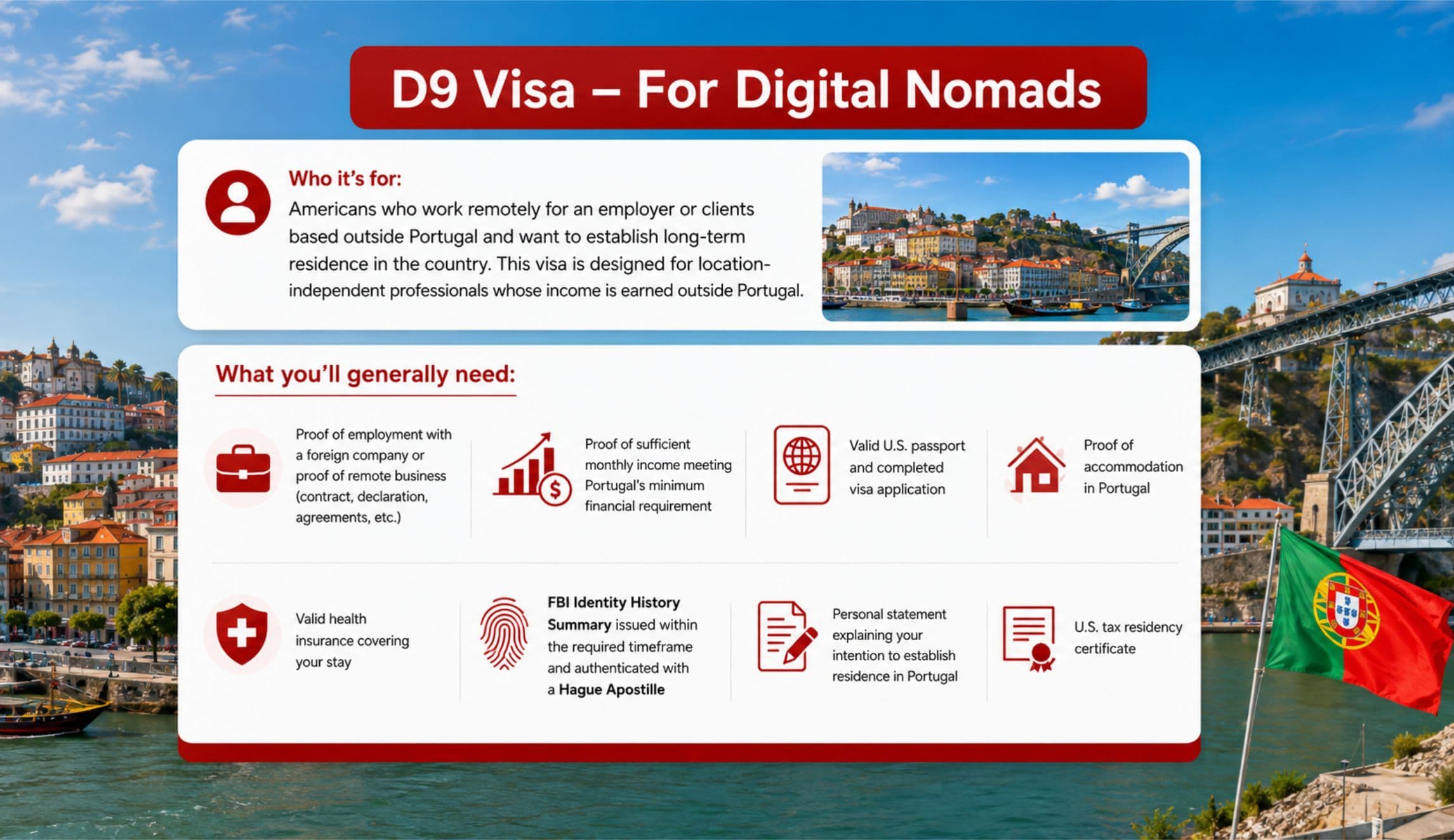
Who it's for: Americans who work remotely for an employer or clients based outside Portugal and want to establish long-term residence in the country. This visa is designed for location-independent professionals whose income is earned outside Portugal.
What you'll need:
What to know: The D9 Visa is specifically designed for people earning active income through remote employment or self-employment outside Portugal. Portugal also offers a Temporary Stay Visa for Remote Work, but that option is intended for shorter stays.
The D9 Resident Visa is the appropriate route for Americans planning a long-term move, as it allows you to apply for a residence permit after arriving in Portugal.
Download the Digital Nomad Visa Checklist
D2 Visa - For Entrepreneur and Self-Employment
Who it's for: Americans who plan to establish or expand a business in Portugal, work as self-employed professionals, or launch an innovative startup. The D2 Visa is suitable for entrepreneurs with a viable business proposal as well as freelancers intending to provide services independently.
What you'll need:
What to know: The D2 Visa is designed for applicants who intend to create economic activity within Portugal. Approval depends not only on your financial resources but also on whether your proposed business or professional activity appears genuine, viable, and capable of supporting your residence in the country.
Download the D2 Visa Checklist
D1 Visa - For Employment
Who it's for: Americans who have secured a job with a Portuguese employer before relocating. The D1 Visa is Portugal's standard employment-based residence visa and is intended for applicants entering into an employer-employee relationship with a company established in Portugal.
What you'll need:
What to know: The D1 Visa is specifically tied to employment with a Portuguese company. In most cases, you'll need to secure a qualifying job offer before submitting your visa application.
Download the D1 Visa Checklist
D3 Visa - For Highly Qualified Activity
Who it's for: Americans who have secured a highly skilled position in Portugal or have been invited to carry out teaching, research, cultural, or other highly qualified professional activities. The D3 Visa is commonly used by professionals in fields such as technology, engineering, healthcare, academia, scientific research, and other specialized occupations.
What you'll need:
What to know: The D3 Visa is intended for applicants whose qualifications and employment meet Portugal's definition of a highly qualified activity. In addition to holding an appropriate job offer or invitation, applicants are expected to satisfy minimum remuneration thresholds established by Portuguese law.
If your profession is regulated in Portugal, you'll also need to demonstrate that you meet the licensing or qualification requirements necessary to practice.
Compared with the standard D1 Employment Visa, the D3 is specifically designed for highly skilled professionals and researchers whose expertise is considered valuable to the Portuguese economy or academic sector.
Download the D3 Visa Checklist
D4 Visa - For Student, Research, Internship, and Exchange
Who it's for: Americans who plan to move to Portugal for higher education, academic research, student exchange programs, internships, vocational training, or approved voluntary work. The D4 Visa covers several educational and research-related pathways under a single residence visa category.
What you'll need:
What to know: The D4 Visa isn't limited to university students. It also covers researchers, vocational students, exchange participants, interns, and certain volunteer programs. Many applicants who receive scholarships or are hosted by recognized Portuguese universities or research institutions may qualify for exemptions from some documentary requirements, such as proof of financial means or health insurance.
If you're moving with children under 18, additional documentation, including proof of legal guardianship or parental travel authorization, may also be required.
Download the D4 Visa Checklist
D6 Visa - For Family Reunification
Who it's for: Americans who wish to join a close family member who is already legally residing in Portugal. The D6 Visa allows eligible family members to reunite with spouses, partners, dependent children, dependent parents, and other qualifying relatives, subject to Portugal's family reunification rules.
What you'll need:
What to know: Unlike most other Portuguese residence visas, the D6 Visa requires prior approval from AIMA before the visa application can be submitted. Once AIMA grants family reunification, the residence visa application needs to be lodged within 90 days, or the approval may lapse.
Because family reunification applications involve both the sponsor in Portugal and the family member abroad, coordinating documents and timelines carefully is essential to avoid unnecessary delays.
Download the D6 Visa Checklist
D8 Visa - For Accompanying Family Member Holding a Residence Visa
Who it's for: Americans who plan to move to Portugal at the same time as a close family member who is applying for a Portuguese residence visa. Unlike the D6 Family Reunification Visa, the D8 Visa is intended for accompanying relatives rather than those joining a family member who is already living in Portugal.
What you'll need:
What to know: The D8 Visa allows eligible family members to accompany the primary residence visa applicant from the outset rather than relocating later through family reunification. Eligible accompanying relatives include spouses or legally recognized partners, dependent children, certain dependent parents, and other qualifying family members recognized under Portuguese immigration law.
Because eligibility depends on the relationship to the principal applicant and the family's financial resources, both applications are assessed together as part of the same relocation process.
Download the D8 Visa Checklist
Portugal Golden Visa - Residence Permit for Investment (ARI)
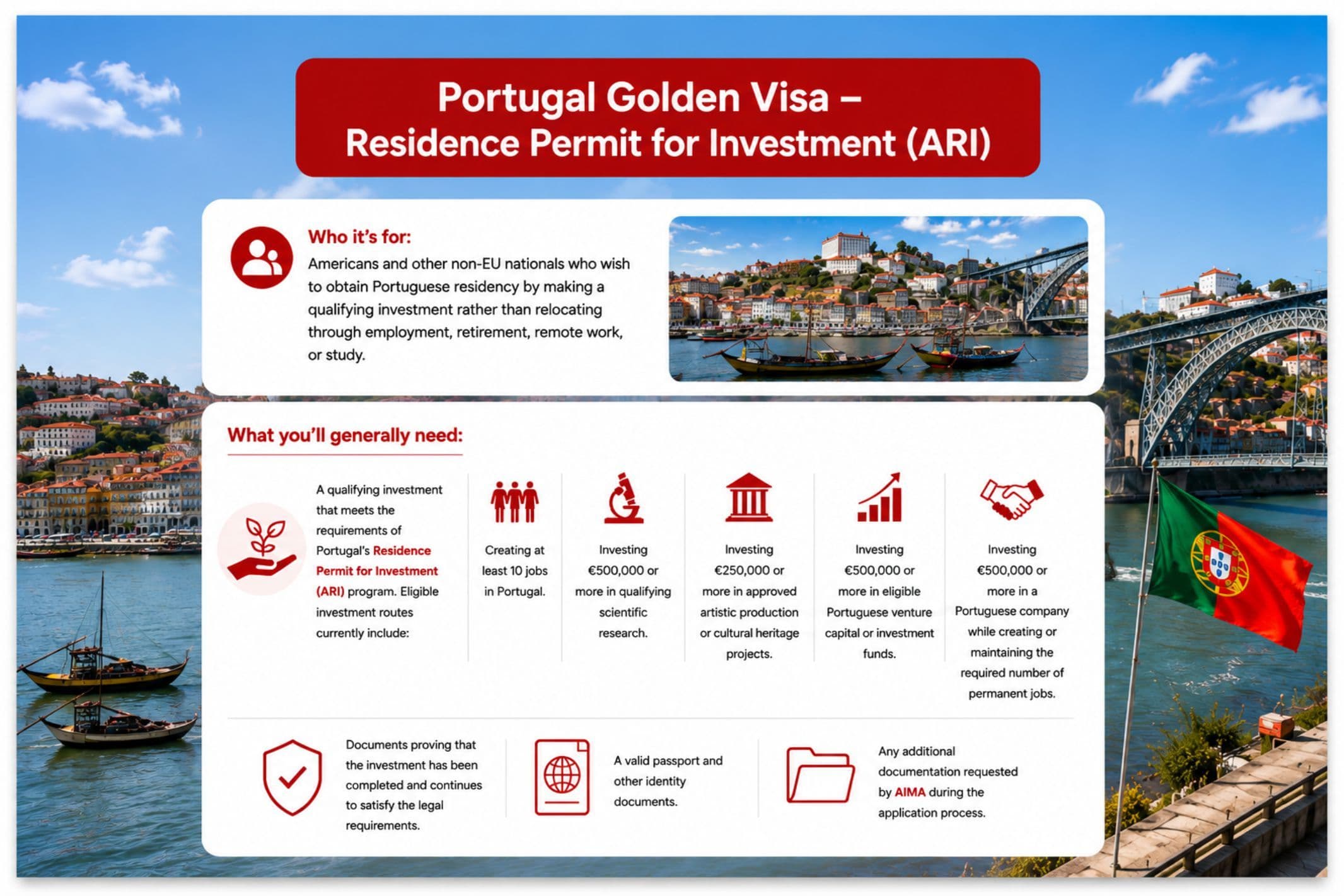
Who it's for: Americans and other non-EU nationals who wish to obtain Portuguese residency by making a qualifying investment rather than relocating through employment, retirement, remote work, or study.
What you'll need:
A qualifying investment that meets the requirements of Portugal's Residence Permit for Investment (ARI) program. Eligible investment routes currently include:
What to know: Despite its popular name, the Portugal Golden Visa is officially known as the Residence Permit for Investment (ARI) and operates differently from Portugal's D-series residence visas. One of its biggest advantages is that it does not require applicants to obtain a residence visa before entering Portugal. Instead, eligible investors can apply directly for the residence permit under the ARI framework.
The program also has relatively light physical presence requirements, requiring holders to spend at least seven days in Portugal during the first year and at least 14 days during each subsequent two-year permit period.
ARI holders may live and work in Portugal, travel freely throughout the Schengen Area, apply for family reunification, and, provided they continue to meet the legal requirements, eventually become eligible to apply for permanent residence or Portuguese citizenship.
Important: Many older guides describe buying residential property as the primary route to obtaining a Portuguese Golden Visa. That is no longer the case. After legislative changes, simply buying a property in Portugal does not make you eligible for a visa. The new ARI program focuses on qualifying investments such as research, investment funds, cultural projects, business investment, and job creation rather than property purchases. |
The latest information on this visa type can be found on the official AIMA website.
Not everyone moving to Portugal intends to settle permanently. Portugal also offers several Temporary Stay Visas for short-term purposes. In most cases, these visas allow stays of up to one year (with possible extensions in some cases) but do not follow the standard residence permit pathway.
| Temporary Stay Visa | Purpose | Best For |
| Schengen Visa | Short stays (up to 90 days in any 180-day period) | Tourism, business visits, visiting family or friends |
| Medical Assistance (E1)Service Providing / Professional Training (E2) | Receiving medical treatment | Patients undergoing treatment in Portugal |
| Self-Employment (E3) | Providing services or attending professional training | Employees on temporary assignments or training |
| Scientific Research / Academic Teaching / Highly Qualified Activity (E4) | Temporary self-employed activity | Independent professionals undertaking temporary work |
| Amateur Sports (E5) | Research, teaching, or highly qualified professional activity | Researchers, academics, and specialists |
| Exchange Programmes, Internships & Volunteering (E6) | Sporting activities | Amateur athletes participating in competitions or training |
| Medical Accompanying Family Member (E7) | Educational, cultural, internship, or volunteer programmes | Students, interns, volunteers, exchange participants |
| Seasonal Work (E8) | Accompanying someone receiving medical treatment | Eligible family members |
| Study (E9) | Study or educational programmes | Students attending eligible courses |
| Accompanying Family Member (E10) | Accompanying a Temporary Stay Visa holder | Eligible family members |
| Remote Work (E11) | Working remotely from Portugal for an employer or clients abroad | Remote employees and self-employed remote workers |
| Note: Temporary Stay Visas are different from residence visas. If your goal is to relocate permanently, work long-term, retire, or eventually qualify for permanent residence or Portuguese citizenship, you'll usually need a residence visa rather than a Temporary Stay Visa. |
At this point, you've probably identified the residence visa that matches your situation. It's tempting to just ask Google for a "D7 checklist" and start printing whatever you find. But most checklists you come across might be incomplete, outdated, or generic. A better approach is to understand the underlying categories of documents all residence visas share. When you see the structure, gathering everything becomes less overwhelming.
| Document | Required for Most Residence Visas? | Notes |
| Visa application form | ✓ | Official form |
| Passport | ✓ | Valid passport |
| Passport photos | ✓ | Two photos |
| FBI background check | ✓ | Apostilled |
| Health insurance | ✓ | Schengen-compliant |
| Financial evidence | ✓ | Amount depends on visa |
| Accommodation | Usually | Depends on pathway |
| Visa-specific documents | ✓ | Employment contract, pension proof, university acceptance, etc. |
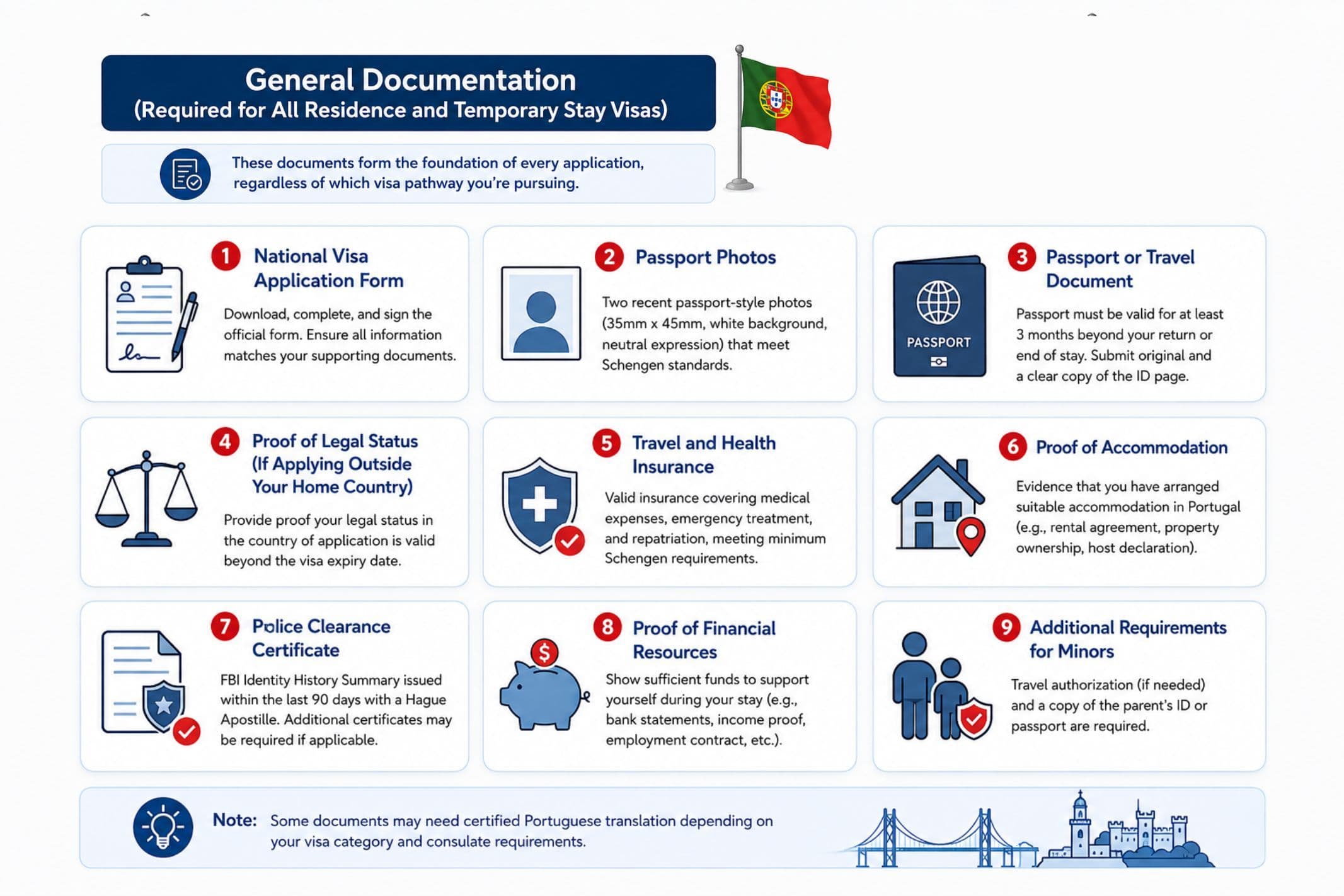
These documents form the foundation of every application, regardless of which visa pathway you're pursuing.
1. National Visa Application Form
The official form must be downloaded, filled out completely, and signed by the applicant. If the applicant is a minor or legally incapacitated, the legal guardian must sign. Double-check that every field matches your supporting documents.
2. Passport Photos
Two recent, passport-style photographs that meet Schengen standards (35mm x 45mm, white background, neutral expression). One photo is attached to the application form; the second is kept on file. Photos should be in good condition and clearly identify you.
3. Passport or Travel Document
Your passport must be valid for at least three months beyond the estimated date of your return or, for a residence visa, the end of your intended initial stay. You'll need to submit both the original passport and a clear photocopy of the biographical data page.
4. Proof of Legal Status (If Applying from Outside Your Home Country)
If you hold U.S. citizenship but are applying for a visa from a country where you are not a citizen, you must provide proof that your status there is valid for longer than the expiry date of the visa you're requesting. For most American applicants applying from the U.S., this does not apply.
5. Travel and Health Insurance
A valid insurance policy covering necessary medical expenses, including emergency medical treatment and repatriation, is required for nearly all Portuguese residence visa applications. Your policy must meet the minimum Schengen requirements and remain valid throughout your initial period of stay in Portugal.
Many applicants also discover that some supporting documents may need to be translated. Depending on your visa category and the requirements of the Portuguese authorities or the consulate processing your application, documents issued in English may need to be accompanied by a certified Portuguese translation. We'll discuss translation requirements in more detail later in this chapter.
6. Proof of Accommodation
Most Portuguese residence visa applications require evidence that you have arranged suitable accommodation before you arrive. This helps demonstrate that you have a realistic plan for settling in Portugal and a place to live during the initial stage of your residence.
Depending on your visa category, acceptable evidence may include:
Some residence visa categories, such as the D7 Visa, specifically require applicants to demonstrate that accommodation has been secured for a minimum period. Always refer to the official checklist for your visa type to confirm the exact requirements.
7. Police Clearance Certificate
You must provide a criminal background check from your country of nationality or from any country where you have lived for more than one year. For Americans who have resided in the U.S. for over a year, this means:
8. Proof of Financial Resources
Portugal requires applicants to demonstrate that they have sufficient financial resources to support themselves during their stay without becoming dependent on public assistance. The exact evidence you'll need depends on the residence visa you're applying for.
Common forms of financial evidence include:
The type of financial documentation varies considerably between visa pathways. For example:
| Visa | Financial Evidence |
| D7 Visa | Pension income, rental income, investment income, dividends, or other passive income, together with proof of sufficient savings. |
| D9 Digital Nomad Visa | Employment contract or service agreement with a foreign employer or clients, together with evidence of recent qualifying income. |
| D1 Work Visa | Employment contract or promise of employment from a Portuguese employer. |
| D2 Entrepreneur Visa | Business proposal or service contracts, together with evidence that sufficient funds are available to establish or operate the business. |
| D4 Student Visa | Scholarship award, sponsorship letter, or other evidence demonstrating that tuition and living expenses can be covered during the period of study. |
The important point is that Portuguese authorities are looking for evidence that matches the purpose of your visa. A retiree, a remote worker, and a university student will naturally provide very different financial documents. Avoid comparing your application to someone else's unless they're applying under the same visa category.
9. Additional Requirements for Minors
If a minor (under 18) is applying, the following additional documents are required:
This applies both at the visa stage and at the Portuguese border. Don't overlook it, as unaccompanied minors without proper documentation may be denied entry.
Most Americans applying for a Portuguese residence visa must submit an FBI Identity History Summary (commonly called an FBI background check) as proof of their criminal record history. Here are the steps in the correct sequence:
Step 1: Have Your Fingerprints Taken
The FBI issues an Identity History Summary based on your fingerprints, so the first step is to have them captured correctly.
If you're applying through a submission coordinator or FBI-approved Channeler, you'll have your fingerprints taken electronically or on an FD-258/FD-1164 fingerprint card at a participating fingerprinting provider, police department, or private fingerprinting service.
If you're applying directly to the FBI by mail, you'll need to submit a completed FD-258 Fingerprint Card with your application.
Whichever method you choose, fingerprint quality is something you should pay attention to.
Step 2: Request Your FBI Identity History Summary
Once your fingerprints are ready, submit your request to the FBI. Applicants have two options:
The best option depends on your timeline, whether you require an apostille, and the application method accepted by the Portuguese authorities handling your case.
Step 3: Receive Your Report
After processing, you'll receive your FBI Identity History Summary. This phase is entirely controlled by the FBI.
Depending on the application method, the report may be delivered electronically as a digitally signed PDF or mailed as a paper document by first class US mail.
If your Portuguese visa application requires the document to be apostilled, make sure you obtain a version that can be submitted to the U.S. Department of State for authentication before proceeding to the next step.
Step 4: Obtain a Hague Apostille
This is one of the most important steps in the process.
Because an FBI Identity History Summary is a federal document, it must receive a Hague Apostille from the U.S. Department of State's Office of Authentications in Washington DC. A state-level apostille cannot be used for an FBI-issued background check.
You may submit the document directly to the Office of Authentications or use a professional apostille service to manage the process on your behalf. Processing times vary depending on application volumes, so it's wise to begin this step well before your visa appointment.
Step 5: Arrange a Certified Translation (If Required)
Depending on the requirements of your Portuguese visa application, you may also need to provide a Portuguese translation of your supporting documents.
If a translation is required, both the FBI Identity History Summary and the attached apostille may need to be translated by a certified or sworn translator recognized for use in Portugal.
We'll discuss translation requirements in more detail later in this chapter.
| Tip: Start your FBI background check early. Between fingerprinting, processing, obtaining a Hague Apostille, and any required translations, this document often takes longer to prepare than applicants expect and is a frequent source of visa application delays. |
Beyond the general documents, each visa type requires its own set of evidence tailored to the purpose of your stay. Portugal groups these into two broad categories: temporary stay visas and residence visas.
The official checklists for each visa are available through the consulate or VFS portal, and you should always download the most current version before preparing your application.
When you click through to the checklist for your specific visa, you'll see exactly which documents from the general list remain necessary and which additional items are required.
Consular officers appreciate order. Arrange your packet as logically as possible:
A messy or incomplete submission is among the most common, and most avoidable, reasons for delays. Take the time to build your packet carefully, and you'll dramatically increase the odds of a smooth, swift approval.
| National Visa Application | Download Here |
| Official Checklists for Each Portuguese Visa | Find Here |
| Photo Specifications | Read Here |
| Portugal – Residency - Checklist for Long Stay (type D) | Check Here |
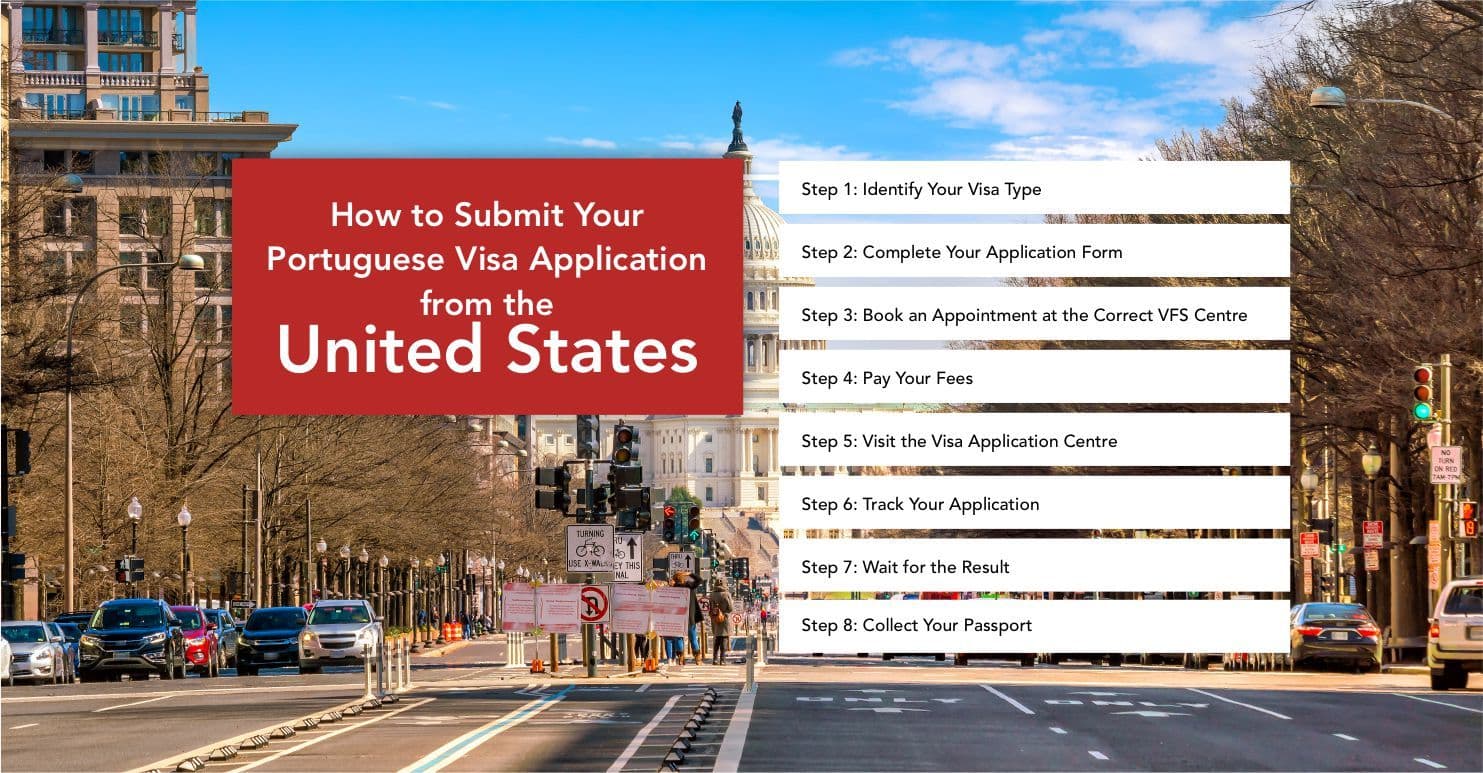
As soon as your documents are ready, the next step is physically submitting your application. Only in-person applications are accepted at VFS visa application centers in the US. Portugal has contracted VFS Global as its official partner for collecting visa applications across the United States. VFS doesn't decide who gets a visa; that decision still rests entirely with the Portuguese consular authorities.
What VFS does is run the physical application centers, collect your paperwork, take your payment, and courier everything to the relevant Portuguese consulate. Understanding this division of labor will save you a lot of confusion later, especially when you're tracking your application or wondering who to call with a question.
The process is simple once you know the sequence. Here's the step-by-step walkthrough.
Before you do anything else, confirm exactly which visa you need. Your visa category determines the application form, the documents you must submit, the fees you'll pay, and the consulate's criteria for approval. You should already have a clear answer from earlier chapters.
Want to go through the visa options again? Check our guide chapter covering all visa options here.
You can also find all major categories listed under visa types on the VFS portal, including both temporary stay and residence visas.
Fill the official Portuguese national visa application form completely, print it, and sign it. Do this before your appointment. You cannot submit an incomplete form at the centre.
Make sure every detail on the form matches your passport and supporting documents. Even a minor discrepancy can cause delays. If you have dependents or family members applying, each person requires their own form.
Bring the signed printed form with you to your appointment, along with all required supporting documents for your visa category.
Portugal divides the United States into consular jurisdictions. You cannot simply choose the most convenient VFS location; you must apply at the centre that serves the Portuguese consulate responsible for your state of legal residence.
For example:
| If you live in... | You apply through... |
| California, Washington, Oregon, Nevada, Arizona, Colorado, Utah, etc. | San Francisco VFS |
| New York, Connecticut, Michigan, Puerto Rico, U.S. Virgin Islands | New York VFS |
| Texas, Florida and several southeastern states | Washington, DC consular jurisdiction (applications may also be submitted at the Houston or Miami VACs, where applicable) |
The VFS jurisdiction page provides a full breakdown by state. Before booking, check that page carefully. Applying at the wrong centre will result in your application being turned away.
Once you know your correct centre, book an appointment through the VFS online booking system. You’ll need to:
After booking, you will receive a confirmation email with your appointment letter attached. Print this letter and bring it to the centre.
If you’re applying as part of a family, each member (including children) needs a separate appointment. Book them back‑to‑back if you want to attend together, but each person is an individual applicant.
When you attend your appointment, you'll pay two types of fees:
At U.S. Visa Application Centres, payment can usually be made by cash or credit/debit card, but accepted methods can vary by location. Check the specific centre's payment information before your visit to avoid surprises.
Note: Fees are non-refundable even if your application is refused.
On the day of your appointment, arrive at the VFS centre a little early. Bring:
What Happens Inside the Centre
After a brief security check, you’ll receive a token number. When called to the counter, a VFS agent will review your documents for completeness. They will not assess the merit of your application, but they will check that the required items are present, photos meet the standard, and the form is signed.
If required, you'll have your biometric data (such as fingerprints and a photograph) collected as part of the application process.
Once everything is in order, the agent will accept your application package and you’ll pay the fees. Your passport will be kept by VFS so the consulate can affix the visa sticker if approved. At this point, you’ll also choose the courier return service for when your passport is ready. This is how you’ll get your passport back.
The whole visit, assuming you arrive with a well‑organized packet, usually takes 30 to 60 minutes.
You can follow the progress of your application online using the reference number from your receipt and your last name on the VFS Global tracking portal. If you'd like more detailed or proactive updates, you may be able to sign up for SMS alerts (availability varies by centre).
You'll also receive an email notification when your passport has been returned from the consulate to the Visa Application Centre and is ready for collection or dispatch.
Processing times depend on the type of Portuguese visa you've applied for. While the Portuguese authorities set statutory decision deadlines for national visas, actual processing may vary depending on your circumstances, the completeness of your application, and whether the consulate requests additional information.
| Visa Type | Common Processing Time |
| Schengen (Short-Stay) Visa | Minimum of 3 weeks* |
| EU/EEA Family Member Visa | Minimum of 3 weeks* |
| Temporary Stay Visa | Up to 30 days |
| Residence Visa (D1, D2, D3, D4, D6, D7, D8, D9, etc.) | Up to 60 days |
| Work Search Visa | Up to 60 days |
*Schengen and EU/EEA family member visa processing times may be longer for certain nationalities or if additional security checks are required.
The timelines above assume you've submitted a complete application. Processing may take longer if:
If the consulate contacts you for additional information, respond as quickly as possible. The sooner you provide the requested documents, the sooner processing can continue.
It's fairly common for the Portuguese consulate to request additional documentation before making a decision. This doesn't necessarily mean that there’s a problem with your application.
You may be asked to provide:
Respond as quickly as possible, as processing won't continue until the requested documents have been received.
Tip:
|
When the Portuguese consulate finishes reviewing your application, they will return your passport to the VFS centre. VFS will then send it to you using the courier service you selected at the time of submission. The courier is next‑day air for most U.S. destinations, so once your passport leaves the centre, it usually arrives quickly.
Open the envelope carefully. If approved, your passport will contain the residence visa sticker (for a residence visa) or a temporary stay visa sticker. Check immediately that:
If the consulate needs additional information, they will contact you directly. So keep an eye on your phone and email throughout the processing period.
Lost Your Receipt?
If you lose your receipt, you'll need to visit the Visa Application Centre in person with a government ID and a signed declaration, and possibly a police report depending on the centre's requirements. This will delay the release of your passport, so store your receipt securely.
Once you have your passport back with the visa sticker inside, you're officially ready for the next chapter: traveling to Portugal and completing the residence permit process.
In addition to collecting your visa application, VFS Global offers several optional services for an additional fee. These are entirely optional and do not influence the outcome or processing speed of your visa application.
Some of the most commonly used services include:
| Service | What it does |
| Courier Return | Have your passport and documents delivered directly to your home or office instead of collecting them from the Visa Application Centre. |
| Photograph Service | Have passport photos taken at the centre if you don't already have compliant visa photos. |
| SMS Updates | Receive text message notifications as your application progresses through the processing stages. |
| Photocopy & Printing | Make photocopies or print documents at the centre if you discover something is missing during your appointment. |
| Note: Optional service fees are set by VFS Global and may change over time. Check the VFS website for the latest pricing before your appointment. |
| Reschedule Visa Appointment at VFS | Click Here |
| Official Consular Jurisdiction Map | Check Here |
| Current Visa Application Fee | See Here |
| Track Your Visa Application Status Online | Track Here |
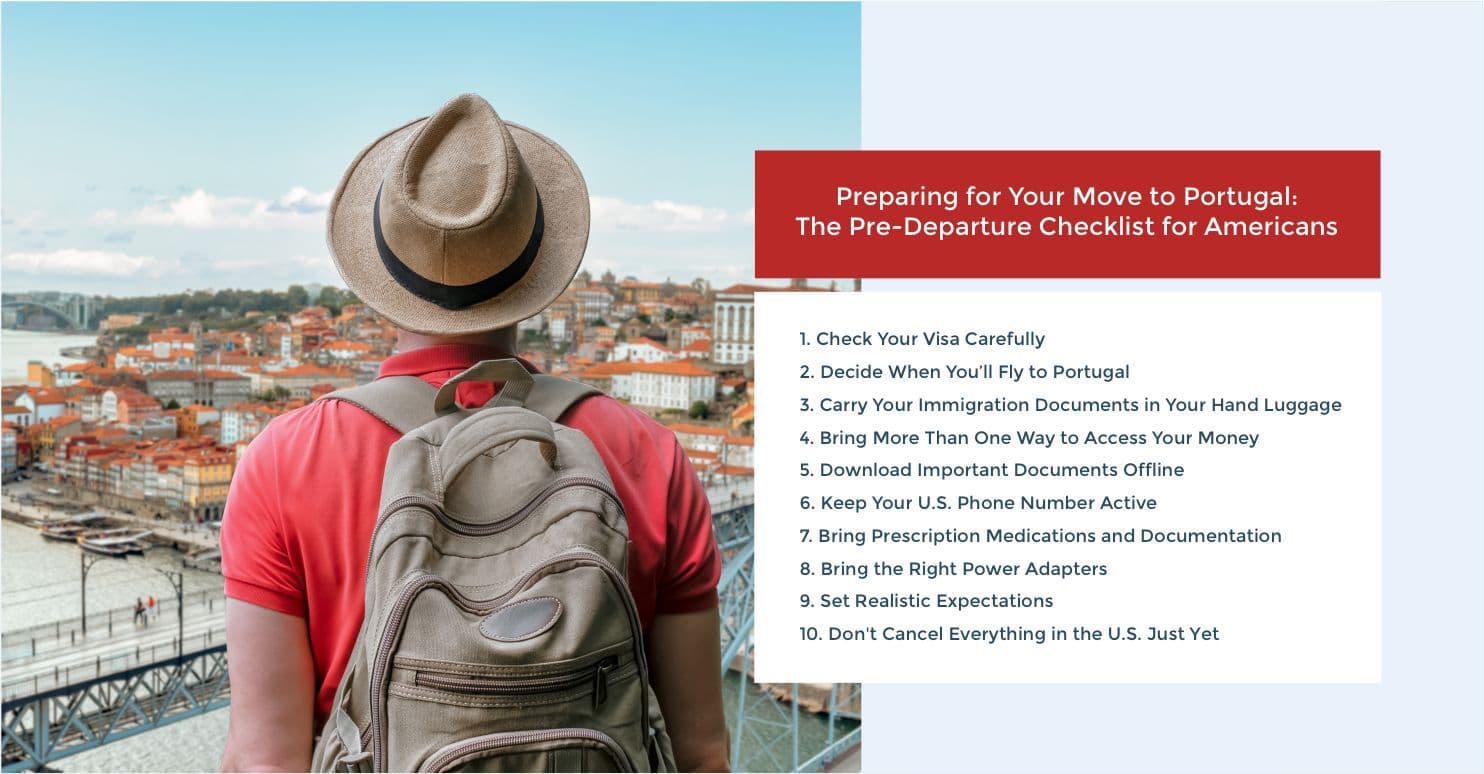
Congratulations! You've received your Portuguese residence visa. This is where many applicants think the hard part is over. In reality, the weeks between receiving your passport and boarding your flight are where many avoidable mistakes happen. Important documents get left behind. Bank cards expire. Medication runs out. Accommodation arrangements change at the last minute.
The weeks before departure aren't just about packing. They're about taking care of the details that will make your arrival in Portugal far smoother. The following checklist focuses on the practical tasks that are easy to overlook but much harder to fix once you've landed.
When the passport arrives with a fresh visa sticker, the natural reaction is relief and celebration. But before you tell anyone, before you book anything, open it and check every detail because your ability to enter Portugal depends on it.
Look for:
If anything is incorrect, even a single letter, contact the issuing consulate immediately. You'll need the consulate to correct or reissue the sticker, which takes time. Don't put this off until the week you're supposed to fly.
Remember this would mark the moment your in-country timeline begins. A few practical considerations make a big difference.
Also Check How to Find Last-Minute Accommodation in Portugal
Never pack your essential immigration documents in checked baggage. If your suitcase is lost or delayed, you still need to enter the country, prove your status, and attend appointments.
Use the table below as a packing guide:
| Carry With You (Hand Luggage) | Pack in Checked Luggage |
|
|
Everything on the left must be physically with you when you land in Portugal. Even if your checked bag goes on an unplanned European tour without you, you'll be able to handle every official interaction with confidence.
Relying on a single debit or credit card while moving overseas is surprisingly common for Americans moving to Portugal. But what if your card gets frozen, lost, or eaten by ATMs? You'll need alternatives while you sort out a Portuguese bank account on the ground.
Before you leave, at least have:
Separate your cards physically as well. Keep one debit and one credit card in your wallet, and the others in a secure, different place, like a money belt or the inside pocket of your carry-on.
You'll be in a new country. Your U.S. phone data might not work immediately, and Wi-Fi isn't guaranteed in every taxi, train station, or government waiting room. Having your critical documents available offline can save a lot of stress in many situations.
Create a folder on your phone called something like "Portugal Move" and store PDF copies of:
Then back that folder up to a secure cloud service, and also keep a copy on a small USB drive in your carry-on. Airport Wi-Fi and mobile service may not be available when you need them.
This advice might come across as minor or redundant. But many Americans discover only after moving that their U.S. phone number is the key to a dozen critical services:
If you cancel your U.S. number before you've migrated all these accounts to alternative verification methods, like app-based authenticators or a Portuguese number, you can lock yourself out of your own financial life.
| Tip: Port your number to a low-cost VoIP service or keep a minimal U.S. mobile plan active for several months after your move. |
Portuguese pharmacies are excellent, but that doesn't mean you can walk in on day one and fill a U.S. prescription without a local doctor's involvement. While you're setting up, bring:
Check Portugal's rules on medication importation (controlled substances are handled more strictly). Most common medications are fine for personal use in reasonable quantities, but verifying this ahead of time is always wise. You can consult the Portuguese medicines authority (Infarmed) or your local consulate if you're uncertain.
Portugal uses Type C and Type F electrical outlets with a 230V / 50Hz power supply, which differs from the U.S. standard.
Before you travel, pack:
Most modern laptops, smartphones, tablets, and camera chargers are designed to work on both 120V and 230V, but check the label on each charger before plugging it in.
If you regularly use high-wattage appliances such as hair dryers, curling irons, or electric shavers designed only for 120V, leave them at home or purchase European versions after you arrive. Using the wrong voltage can permanently damage them.
It's easy to imagine that your arrival in Portugal will instantly give you access to new statuses and services. The ground reality is that almost everything happens in the days and weeks that follow, not the moment you step off the plane. Being mentally prepared for this prevents unnecessary panic.
On day one, do not expect to have:
None of this is a sign that something's wrong. It's just the normal administrative workflow. Allow yourself the time to settle in.
The urge to make a clean break is understandable, but closing every account and severing every tie before you leave the US can create a different set of problems.
For at least the first few months, and possibly longer, keep:
You'll need these while you set up your Portuguese equivalents, while you handle any U.S. tax filings, and while you ensure that automatic payments and transfers aren't interrupted. You can always close these accounts later, once your new financial life is fully established. You can't easily reopen them from abroad.
Notify Important Organizations Before Departure
Before boarding your flight, update your contact information with organizations that may need to reach you after you've moved.
This commonly includes:
This prevents security holds, missed correspondence, and unnecessary complications after you've relocated.
Think of this less as a list to skim and more as a packing strategy. Everything you need is already gathered. The question now is where to put it so that nothing critical ends up in a lost suitcase or buried at the bottom of a bag.
| On You (Literally) |
Keep these on your body, in a secure pocket, money belt, or cross-body bag that never leaves your side. □ Passport with valid residence visa □ Boarding pass and flight itinerary □ Small amount of euros (enough for your first day) □ Emergency U.S. dollars (tucked separately) □ Phone (charged, documents downloaded offline) |
| In Your Personal Item (Under the Seat) |
This is the bag that stays at your feet during the flight - your purse, laptop bag, or small backpack. □ Printed copy of your visa and passport biographical page □ Printed accommodation proof (lease, deed, or invitation letter) □ Health insurance policy document and emergency contact numbers □ Prescription medications (original packaging) and copy of prescription □ One debit card and one credit card (different from the ones in your carry-on) □ Phone charger and power bank □ USB drive with backup of all essential documents □ A change of clothes (in case checked luggage is delayed) |
| In Your Carry-On (Overhead Bin) |
This is the bag you’ll stow above you. It holds your original documents and financial backup. □ All original immigration documents:
□ Second set of debit and credit cards (different banks, physically separate from those in your personal item) □ Additional printed copies of everything in your personal item □ Any valuable or hard-to-replace personal items |
Many Americans might not be familiar with this, but a Portuguese residence visa only allows you to enter the country. It doesn’t give you the permission to live there. After arriving in Portugal, you'll need to complete the residence permit process with AIMA (Agency for Integration, Migration and Asylum). After AIMA grants your residence permit, you become a legal resident of Portugal under the conditions of your approved immigration pathway.
The exact procedure can vary depending on your visa category, and AIMA continues to expand its online services for residence visa holders. The overall process remains broadly the same.
AIMA (Agência para a Integração, Migrações e Asilo) is Portugal's immigration authority. It is responsible for issuing residence permits, processing renewals, handling family reunification applications, and administering many immigration-related services after you arrive in Portugal. While the Portuguese consulate decides whether to issue your residence visa, AIMA manages your immigration status once you're in the country.
Once you're in Portugal, your application for a residence permit must be submitted to AIMA. Depending on your visa category and the current procedures in place, this may happen:
Applications are submitted using AIMA's official residence permit form and must normally be made in person by the applicant or their legal representative.
Many of these documents will already be familiar because you prepared them for your visa application. But AIMA may ask to see updated originals or additional evidence confirming your circumstances after arrival.
| Document | Purpose |
| Passport or other valid travel document | Confirms your identity |
| Valid Portuguese residence visa | Confirms your lawful entry |
| Proof of financial means | Shows you continue to meet your visa conditions |
| Proof of accommodation | Confirms your current address in Portugal |
| Proof of family relationship (if applicable) | Required for family-based applications |
| Portuguese Tax Number (NIF), where applicable | Administrative registration |
| Portuguese Social Security registration (NISS), where applicable | Mainly for workers and certain employees |
| Health insurance or proof of National Health Service coverage | Shows healthcare coverage |
AIMA may also request additional documents depending on your residence category.
You can check the current table of fees and other charges here.
AIMA will review your application to confirm that you continue to meet the legal requirements for residence.
Among other things, the authorities verify that:
If everything is in order, AIMA will issue your Portuguese residence permit in card form. This card serves as your primary proof of legal residence in Portugal and may be required when opening bank accounts, accessing public services, registering with government agencies, or demonstrating your immigration status.
Under the current general rules, an initial temporary residence permit is valid for two years from the date it is issued.
It can usually be renewed for successive three-year periods, provided you continue to meet the legal requirements for your residence category.
Some visa categories operate under special legislation and may follow different validity or renewal rules, so always check the conditions that apply to your specific permit.
| Helpful Tip: Don't assume your visa documents are finished once you land in Portugal. Bring your original supporting documents with you, including your passport, accommodation evidence, financial documents, and any family or employment records. AIMA may ask to review updated versions during the residence permit process. |
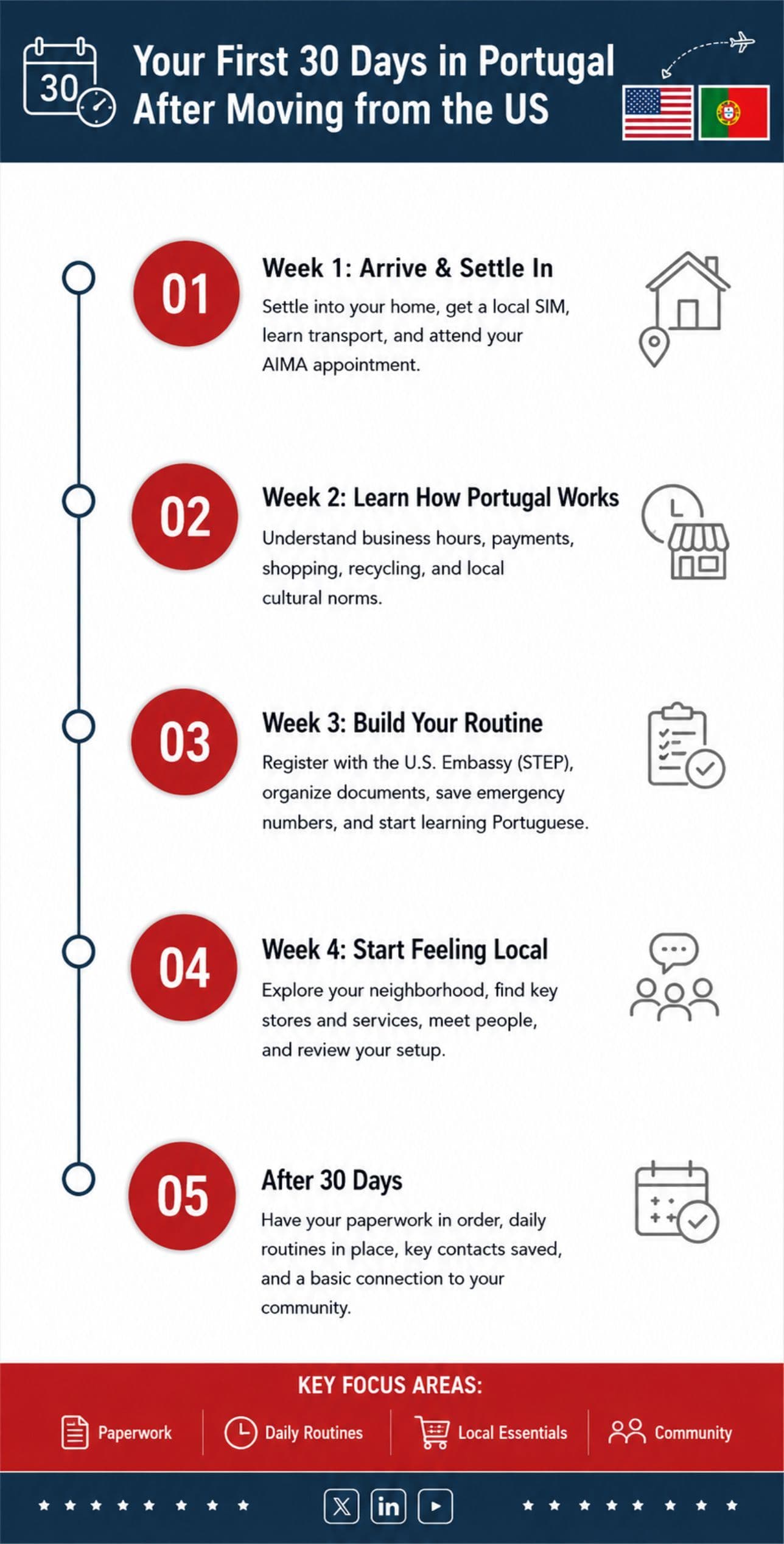
Your arrival in Portugal is the beginning of your new life, and the first 30 days set the pace for everything that follows. Get these weeks right, and you'll feel grounded, capable, and ahead of the administrative curve. Skip or delay certain steps, and you'll spend the next few months catching up on paperwork instead of settling into your new life.
Here we’ll break your first month into a realistic, week-by-week plan. Not every task will apply to everyone in exactly this order, but treat it as a framework.
The first week is about landing physically and administratively. It's not the week to figure out your whole life. It's the week to secure the essentials and catch your breath.
Move Into Your Accommodation
You've already arranged this, the lease, the deed, the invitation letter, and now you need to inhabit it.
You don't need to unpack every box. You do need to know that your base is functional, safe, and yours.
Attend Your AIMA Appointment (If Scheduled)
If your residence permit appointment wasn't completed before arrival or you need to attend a scheduled appointment, make it a priority. Bring your original documents and any updated evidence requested by AIMA. Your residence permit card is essential for many administrative tasks in Portugal.
Remember, your residence visa has a limited validity period, and AIMA appointments can be difficult to secure, especially in high-demand regions.
Buy a Portuguese SIM Card
Your U.S. number is still active (as we discussed). But you now need a Portuguese number for local calls, data, and the two-factor authentication that Portuguese services will require.
Providers like MEO, Vodafone, and NOS have stores throughout Portugal, making it easy to purchase a prepaid or postpaid SIM shortly after you arrive. Bring your passport; you'll need it to register a prepaid or postpaid plan. A prepaid SIM with a generous data package will serve you well in the first weeks while you settle in.
Learn the Basics of Local Transport
You may not have a car yet. Even if you do, understanding the local buses, metro, trams, and trains will free you from dependence on taxis and rideshare apps.
This kind of grounding turns a new place into your place faster than almost anything else.
Register with Your Municipality (If Required)
Some municipalities (Town Halls) expect new foreign residents to register their presence at the local Junta de Freguesia (parish council) within a few days of arrival. This isn't universal, but it's common enough to check.
Ask your landlord, your real estate agent, or a local contact whether your area requires it. The process is usually quick. An Atestado de Residência can be issued on the spot and may be useful later for other bureaucratic steps.
| By the end of Week 1, you should feel physically settled, have a working phone, know where the grocery store is, and either have attended your AIMA appointment or have it booked. |
Now that you're settled, Week 2 is about understanding the rhythm and rules that make life run smoothly in Portugal. These might not sound like dramatic transitions, but together they'll save you from confusion and small frustrations that can pile up fast.
Understand Portuguese Business Hours
Many shops and services still close for lunch around 1:00 p.m. and 3:00 p.m. This will affect your errands.Government offices usually operate only during business hours and many require appointments, so avoid leaving important errands until late in the day. Sundays are genuinely quiet. Most supermarkets close early, if they open at all, and smaller shops will be shuttered.
Public holidays matter here, which means a holiday on a Thursday isn't moved to a Monday, and you should expect closures on the actual day. Check the Portuguese holiday calendar and plan around it.
Portuguese Holiday List
| Approximate Time | Public Holiday | Portuguese Name |
| Early January | New Year's Day | Ano Novo |
| March or April | Good Friday | Sexta-feira Santa |
| March or April | Easter Sunday | Domingo de Páscoa |
| Late April | Freedom Day | Dia da Liberdade |
| Early May | Labour Day | Dia do Trabalhador |
| May or June | Corpus Christi | Corpo de Deus |
| Mid-June | Portugal Day | Dia de Portugal |
| Mid-August | Assumption of Mary | Assunção de Nossa Senhora |
| Early October | Republic Day | Implantação da República |
| Early November | All Saints' Day | Todos os Santos |
| Early December | Restoration of Independence | Restauração da Independência |
| Early December | Immaculate Conception | Imaculada Conceição |
| Late December | Christmas Day | Natal |
Be a Thoughtful Neighbor
Living in Portugal often means living closer to your neighbors than many Americans are used to. Apartment buildings tend to be quieter, and being considerate goes a long way toward building good relationships.
A few simple habits will help you settle in:
These small courtesies are part of everyday life in Portugal and often make a better first impression than perfect Portuguese.
Understand Portuguese Payment Culture
Debit cards are widely accepted, even for small purchases, and contactless payments are standard. But some tiny cafés and very traditional shops still prefer cash, so always carry €20 to €40 in your wallet.
What you'll really need to start using is MB Way, a mobile payment system built into most Portuguese banking apps. It's used everywhere: to send money to a friend, pay at a café, or split a bill. Once you set up MB Way through your bank's app, you'll wonder how you lived without it.
Grocery Shopping Works Differently
Supermarkets are smaller than many Americans expect, and they often close earlier, like by 9:00 p.m. or 10:00 p.m., with shorter hours on Sundays. You'll quickly learn the major chains: Continente, Pingo Doce, Lidl, and Mercadona.
Two differences will be apparent immediately.
Learn the Recycling System
Portugal takes recycling seriously, and you'll notice colored bins on nearly every street corner.
Some town halls also have small organic waste containers. You don't need to memorize every rule at once, but start separating your waste now, and it will quickly become a habit.
For many Americans, the basics of Portuguese daily life begin to feel familiar at this point. Week 3 is about creating personal infrastructure - the systems that keep you safe, organized, and connected.
Register With Your Embassy (Optional but Smart)
U.S. citizens can enroll in the Smart Traveler Enrollment Program (STEP) through the U.S. Embassy in Lisbon. It's a free service, takes a few minutes, and ensures you'll receive safety alerts and that the embassy can reach you in an emergency.
It won't change your daily life, but in a crisis, like a natural disaster, civil unrest, or a serious medical event, it can make a meaningful difference.
Keep Important Documents Together
You've been carrying a lot of paperwork across an ocean. Now is the time to give it a permanent space. Get a single folder, physical or digital, that holds: passport, residence permit (or application proof), visa copies, lease agreement, health insurance policy, NIF document, and emergency contacts.
This is because during a move, documents can disappear in strange ways - into boxes, under furniture, into the wrong bag. One dedicated folder eliminates that risk.
Memorize Important Numbers
You have these in your phone, yes. But the phone's battery may die, you may lose it, or it may freeze in moments of stress. Memorize these by heart, or keep a written card in your wallet:
| National Emergency (Police, Fire, Medical) | 112 |
| Health Line 24 (SNS 24) | 808 24 24 24 |
| Missing Children Helpline | 116 000 |
| Child Support Line | 116 111 |
Also remember:
It takes ten minutes to memorize or note these down, and perhaps sometime you’ll be very glad you did.
Start Using Portuguese Every Day
You don't need to become fluent this month. You do need to become comfortable using a few words every day. Even a basic A1 course transforms everyday interactions from transactional to human. Apps like Memrise or Practice Portuguese are good starters, but also look for in-person or Zoom-based group classes through local language schools or municipal programs. Many are surprisingly affordable and double as social spaces.
You've built the practical foundation. Now it's time to turn your neighborhood into a place you belong.
Explore Beyond Tourist Areas
Find the places that will form the backdrop of your daily life, not just your weekend highlights. Walk your streets with intention and locate your closest:
The hardware store (drogaria) is especially useful. It's where you'll buy light bulbs, cleaning supplies, and the tiny household items that big supermarkets don't carry well. Knowing these spots by name and face changes how a neighborhood feels.
Get to Know Portugal's Everyday Stores
During your first month, you'll quickly recognize a handful of names that locals rely on every day. Knowing where to go saves time and helps you settle in faster.
| If you need... | You'll probably visit... |
| Groceries | Continente, Pingo Doce, Lidl, Mercadona |
| Pharmacy | Farmácia |
| Electronics | Worten, FNAC |
| Home improvement | Leroy Merlin |
| Furniture & household items | IKEA |
| Everyday bargains | Chinese bazaars (often called Lojas Chinesas) |
You'll soon develop your own favorites, but recognizing these names makes everyday errands much easier during your first few weeks.
Meet People
You don't need a hundred friends. You need a few familiar faces. Attend one in-person gathering this week. It could be an expat meetup, a language exchange, or a community event at the Junta de Freguesia.
Portuguese culture is warm but often opens through repeated contact and introductions. Show up somewhere consistently, and connections will follow. This isn't just about feeling good; it's about having a network when you need practical help, advice, or simply someone to ask a dumb question without embarrassment.
Review Your First Month
Before the month closes, do a quick honest inventory. Ask yourself:
If the answer to each is yes, you've done far more than just survive your first 30 days. You've built a platform. The next months will grow from here.
After Week 4: Congratulations! You’ve reached the 30-day mark. It is not an easy milestone. You might not be feeling completely confident or familiar in Portugal, but that’s normal. You've definitely given yourself what most people forget to build: a stable foundation and the confidence that comes from knowing how the small things work in a new country. The big things, like permanent residence, citizenship, a career, a community, take time. You've already laid the groundwork beautifully. Keep that folder handy, keep your Portuguese going, and keep walking out your front door curious. The rest will come. |
A Portuguese bank account is a crucial aspect of your financial life in Portugal. Without one, you may not be able to pay rent by direct debit, set up utilities, receive a local salary, or use MB Way. Even if you plan to keep your U.S. accounts active, a local account can make your daily life easier.
The NIF, or Número de Identificação Fiscal, is your Portuguese tax identification number. It's a nine-digit number you'll need for almost everything: opening a bank account, signing a lease, setting up utilities, getting a phone contract, and filing taxes. If you plan to live, work, or own property in Portugal, you need one.
The process is simple and free, but there are a few rules that might be confusing for Americans moving to Portugal.
Who Needs a NIF
So, eventually, you and every member of your household will need one.
What Documents You'll Need
If you're already a Portuguese resident (you hold a residence permit or visa that establishes residency):
If you're not yet a resident (you're applying from abroad or before your permit is issued):
The fiscal representative requirement disappears once you become a resident. You simply update your address with the tax authority (Finanças) and represent yourself from that point forward.
How to Apply
There are two routes:
| Method 1 - In person at a Finanças office (Tax Office) | Method 2 - Through a representative (for non-residents outside the EU/EEA) |
You'll need an appointment. Schedule one by calling the Portuguese Tax Authority's Call Centre (CAT) at +351 217 206 707, available on working days from 9:00 a.m. to 7:00 p.m. Appointments can be hard to get in busy areas, so call as early as possible. | The representative can apply on your behalf through the e-balcão (online portal) on the Portuguese Tax Authority's website. This is the standard route when you're still in the U.S. and need a NIF before moving. Your fiscal representative will handle the submission. |
Cost: Applying for a NIF is free. The Portuguese government does not charge for the number itself. If you hire someone to act as your fiscal representative or assist with the application, that's a separate service fee you negotiate with them.
For children without a passport: A document proving birth is sufficient.
Practical Tips for Americans Moving to Portugal
With a NIF in hand, you're ready to open a bank account, sign a lease, and begin building your financial life in Portugal. It's a small number that unlocks a long list of doors.
Banks in Portugal categorize you as either a resident or non-resident for account purposes. This label affects the type of account you can open and the documentation you’ll need.
| Non-resident bank account | Resident bank account |
|
|
If you’re newly arrived and still waiting for your residence card, you’ll likely start with a non-resident account. That’s fine. Just remember to convert it when your status changes. Not doing so can cause problems later.
You have two options for Portuguese banks:
| Traditional Portuguese Banks - Solid, well-regulated, and widely accepted for everything from direct debits to mortgages. | Digital-First Portuguese Banks - Real Portuguese banks, not fintechs sitting on top of another bank. They offer Portuguese IBANs (starting with PT50) and full functionality, often with no monthly fees. |
|
Note: Both issue Portuguese debit cards and work flawlessly with MB Way and direct debits. |
International Neobanks: Wise, Revolut, and Others
These can be useful as secondary tools, but they’re not yet a full replacement for a local Portuguese bank account in most situations. Here’s why:
Neither Revolut nor Wise is a member of the Multibanco network in the same way local banks are, so certain local transactions (like some government payments or older terminal systems) may not accept them.
Use Revolut or Wise for low-cost currency exchange and international transfers, but open a local Portuguese account, especially one with a Portuguese IBAN, as your primary financial hub.
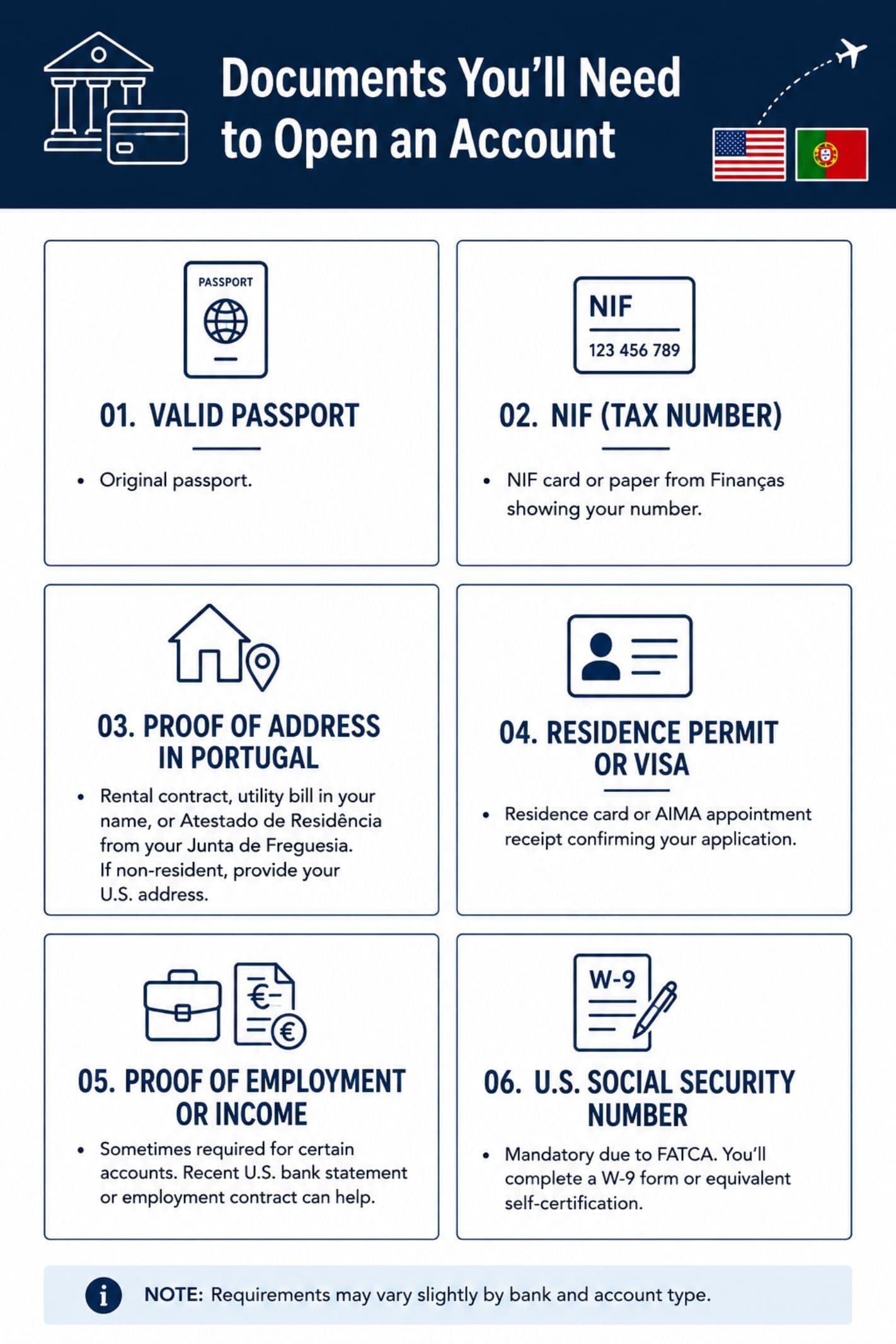
Bank requirements vary slightly, but you should expect to show:
If you open from abroad before moving, some banks may accept notarized copies and conduct a video verification call. Some banks, including Millennium BCP and certain digital banks, may allow remote account opening or video identification depending on your residency status and documentation.
If you've built an excellent credit history in the United States, it's important to know that it doesn't automatically transfer to Portugal. Portuguese banks assess creditworthiness using local records, income, residency status, and their own lending criteria rather than your U.S. credit score.
As a new resident, you may initially have access only to a basic current account and debit card. If you later apply for a Portuguese credit card, personal loan, or mortgage, the bank will evaluate your application based on your financial situation in Portugal.
MB Way is a mobile payment service connected to your Portuguese bank account. It allows you to:
You activate MB Way through your bank’s mobile app by linking your phone number. Once set up, it becomes your wallet, your transfer tool, and your cash-replacement. Every local you meet will suggest splitting a bill “por MB Way.” You'll probably use it almost every day. Set it up the day your account goes live.
Your Portuguese account will come with a Multibanco debit card. It is usually a dual-network card that also supports Mastercard or Visa for international use. Key things to know:
Portuguese banking fees are lower than U.S. ones.
Fee structures vary significantly between banks, so always review the current tariff before opening an account. Ask for an English-language version if available.
Portugal’s banks participate in FATCA (Foreign Account Tax Compliance Act), which means they’ll identify you as a U.S. person, ask for your Social Security number, and report your account information to the IRS through Portuguese authorities. This is automatic. It’s legally required and built into every account opening process.
On your side, you must report foreign bank accounts if the aggregate balance across all accounts exceeds $10,000 at any point during the year. You do this by filing:
Penalties for not filing FBAR can be severe, even if no tax is owed. The reporting is simple; the cost of ignoring it is not. If you’re unsure, hire a U.S. tax professional experienced with expat filings.
Quick Summary: What to Do, in Order
|
With a Portuguese bank account in place, everything else, like utilities, rent, phone bills, daily spending, finally clicks into a routine. It’s one of the most consequential steps you’ll take in your first month, and done right, it takes far less time than most people fear.
While Portugal has one of Europe's well-regarded healthcare systems, it doesn't work the same way as it does in the United States. Concepts like family doctors, health centres, and modest co-payments may be unfamiliar at first.
But once you understand how the system is structured, accessing healthcare becomes far less intimidating. Here we'll discuss how the Portuguese healthcare system works and what you should do before you ever need medical treatment.
| Public SNS | Private Healthcare |
| Tax-funded | Insurance or self-pay |
| Low or no consultation fees | Higher consultation fees |
| Family doctor system | Direct access to specialists |
| Longer waiting times for some specialties | Much shorter waiting times |
| Large public hospitals | Private hospital groups (CUF, Hospital da Luz, Lusíadas) |
| Excellent for emergencies and major care | Popular for routine consultations |
Legal residents with a valid residence permit (or proof of application from AIMA) can register with the SNS. Registration happens at your local Centro de Saúde (health centre). You'll need:
Once registered, you receive a Número de Utente (health user number). This opens the door to public care. Even if you plan to use private insurance, register with the SNS. It's free and it's required for certain things like referrals to public hospitals and some vaccinations.
If you're still in the visa process and haven't yet obtained your residence permit, you won't be able to register. You'll rely entirely on private insurance during that window.
| Helpful Tip: After registering with the SNS and receiving your Número de Utente, you can also create an account on the SNS Portal or install the SNS 24 mobile app. These let you access prescriptions, appointments, vaccination records, and other healthcare services online. |
Do You Still Need Private Health Insurance?
Usually, yes, at least initially. But the reason changes once you become a Portuguese resident.
Before your residence permit is granted, private health insurance is often required as part of your visa application because you aren't yet eligible to register with Portugal's public healthcare system (SNS).
Once you've obtained your residence permit and successfully registered with the SNS, you're entitled to access Portugal's public healthcare on the same terms as other legal residents. At that point, private health insurance becomes optional rather than mandatory.
Once registered at your local health centre (Centro de Saúde), you'll be assigned a médico de família. This is a general practitioner who becomes your first point of contact for non-emergency care. They manage:
In high-demand areas, there's a shortage of family doctors. It's not unusual to be placed on a waiting list initially. While waiting, you can access the health centre's "open consultations" (consulta aberta) for acute needs. These consultations are available without an assigned family doctor, although they often involve arriving early and waiting in line.
If you have private insurance, you can simply book a GP appointment at a private clinic, which is often same-day.
For emergencies, dial 112. This is the single European emergency number, available free and in English. Ambulance, fire, and police are all dispatched through this number.
Public hospital emergency departments (Serviço de Urgência) are open 24/7. Your case will be prioritized by severity, not arrival time, and fees are low. For urgent but non-life-threatening situations, consider a private urgent care clinic (available in most cities) if you have insurance. It's often faster.
For medical advice without an emergency, call Saúde 24 at 808 24 24 24. English-speaking nurses provide guidance and can direct you to the right service.
Pharmacies (farmácias) are everywhere, recognizable by the illuminated green cross. They offer:
Many pharmacies can also measure your blood pressure, provide basic health advice, and administer certain vaccinations and health services.
| Note: U.S. prescriptions cannot be filled directly in Portuguese pharmacies. If you take regular medication, bring an adequate supply for your move and arrange to obtain a Portuguese prescription after registering with a local doctor. |
Many Americans continue using private health insurance even after registering with the SNS. While the public system provides comprehensive healthcare, private insurance offers greater flexibility, particularly for specialist appointments and elective care.
A standard private policy may provide:
Premiums vary according to your age, medical history, level of coverage, and whether you purchase an individual or family policy.
Before choosing a plan, compare:
If you're moving on a work visa, check whether your employer already provides private health insurance as part of your employment package.
One concern many Americans have is whether they'll be able to communicate comfortably with healthcare professionals.
To their relief, English is commonly spoken by many doctors, particularly:
Outside major cities, English proficiency can be less common, particularly at smaller public health centres.
If speaking English is important to you, you can:
Learning basic Portuguese medical vocabulary is still worthwhile, especially when visiting pharmacies or smaller clinics.
Telemedicine has become a routine part of healthcare in Portugal and is available through many private insurers and healthcare providers. Virtual consultations can be useful for:
Many private insurance plans include unlimited or low-cost video consultations through their mobile apps.
While telemedicine is convenient, emergencies, diagnostic imaging, and physical examinations still require an in-person visit.
You may see mentions of the European Health Insurance Card (EHIC) or the UK's GHIC in healthcare guides. These allow citizens of EU/EEA countries, Switzerland, and the UK to access state healthcare in Portugal on similar terms as locals.
Americans do not qualify for EHIC or GHIC. These cards are not a pathway for U.S. citizens. Your healthcare access depends entirely on your residence permit, SNS registration, and private insurance. Don't be misled by advice written for EU nationals.
| Note: Healthcare is one of those things you hope you'll rarely need, but you'll be glad you've taken the time to understand it. Once you're registered with the SNS, know where your nearest health centre and pharmacy are, and understand when to use public or private care, you'll be prepared for almost any health-related situation. |
Taxation is the area where Portugal and the United States collide most directly in your financial life. Portugal taxes residents on worldwide income, while the U.S. taxes citizens on worldwide income regardless of where they live. So, the first question that comes to mind is: Do I need to pay double taxes? Perhaps not if you plan proactively for tax implications.
Here our goal is to give you a clear mental map of what you owe, to whom, and what filing obligations you carry as an American living in Portugal.
Once you become a tax resident of Portugal, your worldwide income, like salary, pensions, rental income, dividends, and capital gains, is subject to Portuguese taxation. You're considered a tax resident:
Tax residency is separate from immigration residency. You can hold a Portuguese residence permit and not yet be a Portuguese tax resident if you haven't met the tax residency tests. Conversely, in some circumstances, a person may become a Portuguese tax resident even before holding a residence permit. The distinction is important because your tax obligations are determined by tax residency, not immigration status.
| Note: Most Americans who move permanently become Portuguese tax residents in their first full year. |
Your First Tax Task: Register with Finanças
One of the first administrative steps after becoming established in Portugal is making sure your information is correctly registered with Autoridade Tributária e Aduaneira (AT), commonly known as Finanças.
If you've already obtained your Portuguese Tax Identification Number (NIF), update your tax address with Finanças once you've moved into your permanent accommodation. This ensures that official correspondence reaches you and that your taxpayer records reflect your current residence.
Much of your future interaction with the Portuguese tax system happens online through the Portal das Finanças, including updating personal information, accessing tax documents, and submitting annual tax returns.
Portugal uses a progressive income tax system. This means your income is divided into tax bands, with higher portions of income taxed at higher rates.
For most tax residents, personal income tax rates range from approximately 13% to 48%, depending on taxable income. Additional surcharges may apply to very high earners under certain circumstances.
In general, non-residents are taxed only on qualifying Portuguese-source income, although the applicable rules and rates depend on the type of income and current Portuguese tax legislation.
The exact amount of tax you'll pay depends on factors such as:
Rather than focusing on the highest marginal rate, it's more useful to estimate your likely tax position before moving, particularly if you have multiple income sources.
The United States is one of the few countries that taxes based on citizenship, not residence. As a U.S. citizen, or green card holder, you must file a U.S. federal tax return every year, reporting your worldwide income, no matter where you live. This obligation doesn't stop when you move to Portugal.
However, filing is not the same as paying. Several mechanisms exist to offset or eliminate U.S. tax on income already taxed by Portugal.
Filing a Portuguese Tax Return
Becoming a Portuguese tax resident means you'll also need to file an annual Portuguese income tax return (IRS – Imposto sobre o Rendimento das Pessoas Singulares).
The return is normally submitted online through the Portal das Finanças during Portugal's annual income tax filing season. It takes place between April and June. The filing window is announced each year by the Portuguese tax authorities, so check the current deadlines before submitting your return.
Even if your employer withholds taxes throughout the year, you may still have a filing obligation. The exact requirements depend on your income sources, residency status, and personal circumstances, so always confirm the current rules before the filing deadline.
The two countries have a double taxation treaty designed to prevent the same income from being taxed twice. The treaty assigns taxing rights - specifying, for example, that certain types of income (like social security payments or pension income) are taxed exclusively in one country or the other. It also provides mechanisms for claiming relief when both countries have a claim.
In general, the treaty gives Portugal the right to tax most income earned within Portugal or connected to your life there, and the U.S. provides credits or exclusions to avoid double taxation. The treaty's provisions are detailed and income-specific, so for anything beyond employment or retirement income, you'll want professional guidance.
| Importantly, the treaty helps prevent double taxation, but it does not eliminate your obligation to file tax returns or required information reports in either country when applicable. |
For many working Americans abroad, the Foreign Earned Income Exclusion (FEIE) is one of the primary tools used to reduce U.S. tax on foreign-earned income. It allows you to exclude a significant portion of foreign-earned income from U.S. taxation. For example, the exclusion was $126,500 for tax year 2024, but it is adjusted annually for inflation. In 2026, it rose to $132,900 per person.
You qualify if your tax home is in a foreign country and you meet either the Physical Presence Test (330 full days outside the U.S. in a 12-month period) or the Bona Fide Residence Test (you're a genuine resident of Portugal for an entire tax year).
Key points:
Many Americans in Portugal use the FEIE to shield employment or freelance income, and the Foreign Tax Credit (next) for any investment or passive income.
The Foreign Tax Credit lets you offset U.S. tax liability dollar-for-dollar with income taxes you've paid (or accrued) to Portugal. If Portugal taxes your income at a rate equal to or higher than the U.S. rate on that same income, the credit may fully eliminate your U.S. bill.
FTC is claimed on IRS Form 1116. It's more flexible than FEIE because it covers all types of income - earned, passive, capital gains, pensions - provided the foreign tax is a compulsory income tax. Unused credits can sometimes be carried back one year and forward ten years.
A common strategy is to use the FEIE on earned income up to the limit and the FTC on income that doesn't qualify for the exclusion. Deciding which to use, and on which income, is exactly where a cross-border tax professional earns their fee.
Taxes and social security are separate obligations. If you're employed by a Portuguese company, social security contributions are deducted automatically from your salary.
If you're self-employed or running a business in Portugal, you'll normally have separate Portuguese social security obligations. Depending on your circumstances, the U.S.–Portugal Social Security Totalization Agreement may determine which country's social security system applies and help prevent double contributions.
Because these rules vary considerably depending on your employment situation, it's worth seeking professional advice if you're relocating as a freelancer, contractor, or business owner.
FBAR is a reporting requirement, not a tax. If the total balance of all your foreign financial accounts, including:
exceeds $10,000 at any point during the calendar year, you must file FinCEN Form 114 electronically. This is separate from your tax return.
FBAR filing is simple for most people: list the accounts, maximum balances, and institution details. The penalties for not filing can be severe, even if no tax is owed. There's no tax liability attached to FBAR; it's purely an information report. The filing deadline is April 15, with an automatic extension to October.
FATCA is the other reporting pillar. If the total value of your specified foreign financial assets exceeds certain thresholds, you must file IRS Form 8938 with your U.S. tax return. For a single filer living abroad, the threshold is $200,000 on the last day of the tax year, or $300,000 at any point during the year, though lower thresholds apply to those married filing separately or residing in the U.S.
The bank you opened in Portugal asked for your Social Security number for a reason: FATCA requires foreign financial institutions to report accounts held by U.S. persons directly to the IRS. On your side, Form 8938 duplicates some of the FBAR information but has its own thresholds and filing requirements. You must file both if you meet the respective thresholds. They're separate, and both matter.
If you're self-employed, earning freelance income, or receiving income that isn't subject to withholding, you may need to make advance or estimated tax payments in Portugal.
Whether this applies depends on your income sources and tax situation, so don't assume that filing an annual return is your only obligation. If you're unsure, speak with a Portuguese tax adviser early rather than waiting until filing season.
The line between "I can handle this myself" and "I need professional help" varies by person, but certain triggers make professional advice a wise investment:
A qualified cross-border CPA or enrolled agent who handles U.S.-Portugal filings specifically will understand the treaty, the interaction between the two tax systems, and the foreign reporting requirements. Expect to pay a few hundred to a few thousand dollars annually, depending on complexity. For anyone with more than a simple salary and a bank account, this is usually money well spent
Portugal's Non-Habitual Resident (NHR) tax regime closed to most new applicants on 1 January 2024. Individuals who met specific transitional requirements were able to apply until 31 March 2025.
The regime has largely been replaced by the Tax Incentive for Scientific Research and Innovation (IFICI), sometimes referred to as "NHR 2.0." Unlike NHR, IFICI is available only to eligible researchers, certain highly qualified professionals, startup-related roles, and other qualifying innovation activities. It is not a general tax incentive for retirees, passive investors, or most digital nomads.
If you are planning your move based on tax incentives, verify your eligibility before assuming you can access the benefits that were available under the former NHR regime.
| Note: You don't have to become a tax expert to manage your obligations in Portugal. But you do need to understand which country expects a return, which reporting requirements apply to you, and when it's worth asking for professional advice. A little planning in your first year can prevent expensive mistakes later and make living in Portugal far less stressful. |
| Resource | Purpose |
| Portal das Finanças | File Portuguese tax returns, manage your taxpayer account, and update your tax information. |
| Autoridade Tributária e Aduaneira (AT) | Portugal's official tax authority. |
| Portugal-U.S. Tax Treaty | Official text of the tax treaty that helps prevent double taxation. |
| IRS - Americans Abroad Tax Information | IRS guidance for U.S. citizens and green card holders living overseas |
| IRS Form 2555 (Foreign Earned Income Exclusion) | Claim the Foreign Earned Income Exclusion (FEIE). |
| IRS Form 1116 | Claim the Foreign Tax Credit (FTC). |
| FinCEN FBAR (Form 114) | Report qualifying foreign financial accounts. |
| IRS Form 8938 | Report specified foreign financial assets under FATCA. |
| U.S.-Portugal Social Security Totalization Agreement | Learn how the agreement helps prevent double Social Security contributions for qualifying workers. |
Before you start comparing mortgage rates or browsing apartment listings, there's one question worth answering: Should I rent first or buy immediately?
For most Americans relocating to Portugal, the answer isn't simply about money. It's about giving yourself time to understand neighbourhoods, daily life, and whether the place you imagined is the place you actually want to call home. Here we’ll walk you through both options, explain what landlords and banks require, and highlight the practical considerations.
Buying a home can be an exciting milestone, but it doesn't have to be your first one. Many Americans arrive in Portugal convinced they've already found the perfect neighbourhood, only to discover a few months later that daily life looks very different from a short scouting trip or holiday.
Some things only become clear after you've lived somewhere for a while:
Renting first gives you the opportunity to answer these questions before making one of the largest financial commitments of your move. If, after living in an area for a while, it still feels like home, you'll be in a much stronger position to buy with confidence.
The majority of Americans living in Portugal rent for the first year. It's low-risk, fast, and gives you time to understand the local market.
Documents landlords may request:
Upfront costs:
Where Can Americans Find Rentals in Portugal?
| Idealista, Imovirtual, Casa Sapo | Major aggregators. Wide selection, English interface. Some listings are stale, so move fast on fresh ones. |
| Facebook groups | Useful for direct-from-owner rentals, but scams are real. Never wire money without viewing. |
| Local estate agencies | They have off-market listings and can handle paperwork. Commission is often paid by the landlord, but always confirmed. |
Renting Red Flags
Buying a property in Portugal does not grant you immigration rights. The Golden Visa real estate route ended in 2023. So, only consider buying after you've lived here for a while.
Hidden Costs Americans May Forget
| Renting: Agents represent the landlord. Commission is often one month's rent, sometimes paid by the landlord, sometimes split. Clarify before signing. | Buying: A buyer's agent can negotiate for you and provide local market insight. The seller usually pays commission, but having your own lawyer is essential regardless. |
| Check | Why It Matters |
| Mobile signal | Some buildings block reception |
| Internet type & speed | Fibre isn't available everywhere |
| Water pressure | Test shower and taps |
| Heating/cooling | Many homes lack central heating |
| Dampness or mould | Look and smell for problems |
| Window insulation | Drafts = high winter energy bills |
| Parking | Check availability at 8 p.m. |
| Noise | Visit by day and at night |
| Distance to supermarket & pharmacy | Daily convenience matters |
| Public transport | Walk to the stop and check evening/weekend schedules |
| Idealista Portugal | One of Portugal's largest property portals for rentals and homes for sale. |
| Imovirtual | Search rental properties and homes for sale across Portugal. |
| Casa Sapo | Portuguese property portal with residential and commercial listings. |
| APEMIP (Portuguese Association of Real Estate Professionals) | Find licensed real estate professionals and learn about the Portuguese property market. |
| Banco de Portugal Mortgage Simulator | Official mortgage calculator to estimate monthly repayments and total borrowing costs. |
| Bankinter Portugal Mortgage Simulator | Estimate mortgage repayments and compare financing scenarios. |
| Millennium BCP Mortgage Simulator | Estimate mortgage repayments and compare financing scenarios. |
| Santander Portugal Mortgage Calculator | Estimate mortgage affordability and repayment amounts. |
| Predial Online | Official land registry service used to obtain property registration information and ownership records (accessed by your lawyer or solicitor during due diligence). |
You probably already know that Portugal is often described as more affordable than the United States. Maybe that’s one of the reasons for your move to Portugal. What you may not know is what "affordable" actually looks like once you're living there.
Here we’ll give you a realistic picture of what living in Portugal actually costs, so you can plan your finances with confidence..
These are real-world ranges for a comfortable but not extravagant lifestyle. Costs assume renting in a mid-range neighborhood of a city like Lisbon, Porto, or a well-connected suburb. Smaller inland towns will cost less; premium areas and large cities will push the upper end.
| Monthly Expense | Single Professional | Couple | Family of Four |
| Housing | 1-bedroom apartment: €800-€1,300 | 2-bedroom apartment: €1,000-€1,700 | 3-bedroom apartment or house: €1,300-€2,500 |
| Utilities, internet & mobile | €120-€180 | €150-€220 | €180-€280 |
| Groceries | €250-€350 | €400-€550 | €600-€850 |
| Transport | €40-€100 | €80-€180 | €120-€250 (including school runs) |
| Private health insurance | €40-€120 | €80-€240 | €120-€350 |
| Education | - | - | €400-€1,200 per child (international school, if applicable) |
| Entertainment & dining | €150-€250 | €250-€400 | €350-€600 |
| Estimated Total per Month | €1,400-€2,200 | €2,200-€3,400 | €3,200-€5,000 |
These ranges account for normal variation in lifestyle.
Some costs aren't obvious until you're living with them.
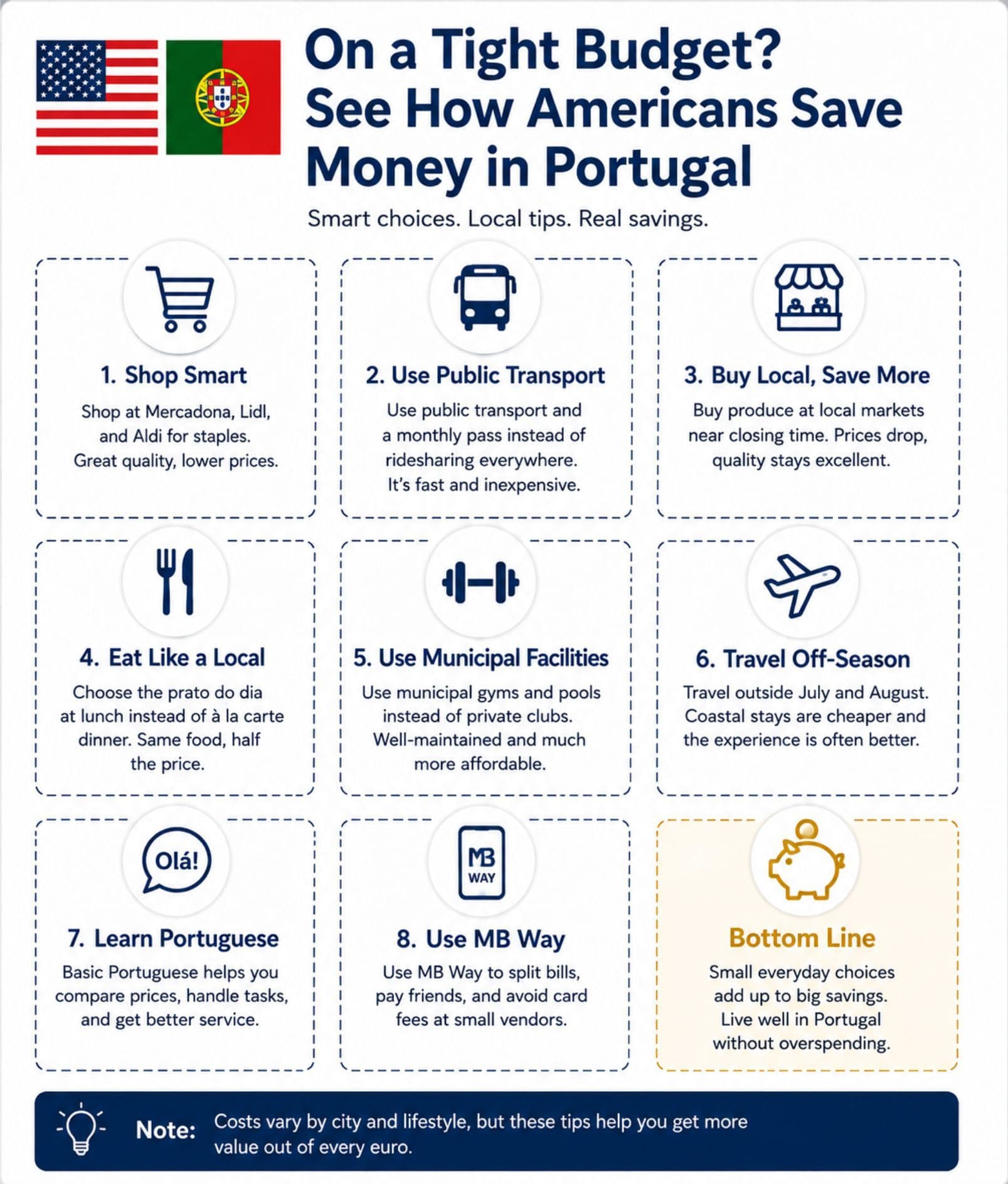
Many new residents in Portugal end up paying more than they need to during their first few months because they're still learning how things work locally.
| Resource | Purpose |
| Statistics Portugal (INE) | Official statistics on inflation, housing, and household spending. |
| Banco de Portugal Financial Education Portal (Todos Contam) | Practical information on budgeting, banking, and personal finance in Portugal. |
| Numbeo Cost of Living | Community-reported cost estimates for comparing cities. Use as a planning tool rather than an official source. |
Quick Fact: Housing costs vary far more by city than groceries or utilities. Choosing a smaller inland city can reduce your monthly housing costs dramatically. For a full region-by-region breakdown, see the guide chapter “Best Cities to Live in Portugal for Americans in 2026” |
Having the right to live in Portugal and the right to work are two separate things. Many Portuguese residence permits allow the holder to work, but the exact rights depend on the type of permit you hold. Here we’ll cover how working in Portugal actually functions once your visa is sorted, whether you're taking a local job, freelancing, or working remotely for a U.S. employer.
Your ability to work depends entirely on the type of residence permit you hold.
If you're entering through a local employment contract, your employer initiates part of the work permit process with Portuguese labor authorities. For self-employed or remote workers, you register your activity with the tax authority and Social Security independently.
| Bottom line: Never assume work authorization. Check your specific residence permit conditions before accepting any paid engagement. |
Portuguese labor law is protective of employees. Most formal jobs come with a written contract, and you should never accept a verbal agreement.
Common contract types:
Contracts must specify salary, working hours, job description, and place of work. If your employer fails to provide a written contract within 60 days, the law may treat the relationship as permanent.
Portuguese workplace culture values structure, and the benefits package reflects this:
Working Hours
The standard workweek is 40 hours, 9:00 a.m. to 6:00 p.m. with a one-hour lunch break. Some offices close entirely for lunch; others operate a shorter break.
Flexible hours and remote work have grown more common but aren't universal. Overtime is compensated at a higher rate or exchanged for time off.
Paid Vacation
Minimum paid annual leave for employees in Portugal amounts to 22 working days per year, apart from public holidays (around 13 per year depending on the region).
13th And 14th Month Salaries
One feature that often surprises Americans is Portugal's holiday and Christmas allowances. Employees receive a Christmas allowance (subsídio de Natal) equivalent to one month's salary. This is usually paid in November or December.
A holiday allowance (subsídio de férias), another month's salary, is paid before the summer break. Effectively, your annual compensation is 14 months of salary, not 12.
Meal Allowance (subsídio de alimentação)
Many employees receive a daily tax-free meal stipend, either as a preloaded card or cash. It is approximately €6.15/day in cash or €10.46/day via meal card currently.
Sick Leave and Parental Leave
Sick leave is covered by Social Security after an initial period paid by the employer. Parental leave is generous by U.S. standards: 120 to 150 days for the birthing parent, with options to share leave between parents, paid at 80–100% of reference earnings through Social Security.
| Statutory Employee Benefits | Common Employer-Provided Benefits |
|
|
Speaking Portuguese can definitely improve your opportunities. But it doesn’t mean you can’t find a good job without knowing the language as many international companies hire English-speaking professionals. This is common in technology, tourism, finance, customer support, and shared service centres.
Here are some job search resources you may want to explore:
A concise European-style CV is preferred, and some employers may request a cover letter.
Portuguese salaries are lower than U.S. equivalents. For example, a gross monthly salary of €2,000-€3,500 may be considered sufficient in many sectors outside senior management or highly specialized tech roles. The national minimum wage is currently €920 per month, but 14 payments in a year raises the annual package. The key is to evaluate purchasing power, not just absolute numbers.
A lower salary in Portugal often goes further than a higher U.S. salary once you account for healthcare costs, housing, food quality, and overall lifestyle. Combined with the 13th and 14th month bonuses, meal allowances, and lower out-of-pocket health expenses, the effective standard of living provides a comparable or even higher quality of life.
Many Americans move to Portugal while continuing to work for an employer or clients based outside the country. Others arrive for retirement or family reasons and later begin working remotely.
From an employment perspective, you might be:
Each arrangement has different employment, tax, and social security implications.
Portugal operates on Western European Time (WET) and Western European Summer Time (WEST), which means you'll often be working several hours ahead of North American colleagues.
For example:
| U.S. Location | Approximate Time Difference from Portugal |
| New York (Eastern Time) | 4-5 hours behind |
| Chicago (Central Time) | 5-6 hours behind |
| Denver (Mountain Time) | 6-7 hours behind |
| Los Angeles (Pacific Time) | 8 hours behind |
For many remote workers, this creates an unexpected advantage. Mornings can be used for errands, language classes, or appointments before the North American workday begins. Others may find themselves working later into the evening to overlap with colleagues in the United States.
If you're planning to work remotely for the long term, invest in a workspace that supports your productivity.
Consider:
A stable work routine will make the transition to life in Portugal much easier, especially during your first few months.
| Remember: Immigration, employment, taxation, and social security are related but separate topics. If you plan to continue working remotely after moving to Portugal, it's worth confirming that your employment arrangement aligns with Portuguese legal and tax requirements. |
Are you moving with children? If yes, you must be preoccupied by the thoughts of the education system.
Portugal offers several education pathways. Some American families choose free public schools to help children integrate into Portuguese life. Others prefer international schools that follow British, American, or International Baccalaureate (IB) curricula. Your choice will depend on your child's age, language ability, long-term plans, and budget.
As one more point of relief, education standards are high in Portugal and multiple options are available for expat families.
Compulsory education in Portugal runs from ages 6 to 18. The system is broadly divided into:
| Level | Age Group |
| Pre-school (optional) | 3-5 |
| Primary education | 6-10 |
| Lower secondary | 10-15 |
| Upper secondary | 15-18 |
| Higher education | 18+ |
Public education is managed by the Portuguese government and is free for legal residents. Families may still pay for some books, meals, activities, and supplies.
Portuguese public schools maintain a high standard and offer many benefits, including:
The only thing to consider here is that the instructions are almost entirely in Portuguese.
For younger children, this might not be a major issue as many adapt surprisingly quickly after several months.
Older students may require additional language support before feeling comfortable academically.
Many expat families choose private or international schools, particularly during their first years in Portugal.
These schools usually teach in English and often follow internationally recognized curricula such as:
The main consideration in this setup is cost.
Annual tuition commonly ranges from €6,000 to more than €20,000 per child, depending on the school, grade level, and location.
Popular international schools are concentrated around:
Many have waiting lists, so applications should begin several months before relocation.
Requirements vary by school, but you'll need:
International schools may also request interviews or placement assessments. Public schools assign students based largely on residential catchment areas.
Portugal has several internationally respected universities. Well-known institutions include:
Many master's and doctoral programs are taught entirely in English. Compared with U.S. universities, tuition is much lower.
Homeschooling is legal in Portugal but is regulated. Families choosing home education must:
Americans considering homeschooling should review the latest Ministry of Education requirements before relocating, as regulations can change.
Students who completed previous education in the United States may need academic recognition depending on the level of study and institution. Recognition requirements vary between:
Portuguese universities evaluate foreign diplomas individually, and some programs may request certified translations or additional documentation.
| Note: If you're applying for higher education, contact the university directly before preparing your documents. |
For those planning to drive, it's worth understanding Portugal's licensing rules, insurance requirements, and road system before getting behind the wheel. Americans also need to prepare for an electronic toll network and fuel prices that are higher than in the United States.
Yes, for a limited time after arriving, Americans can drive in Portugal using a valid U.S. driver's licence. This is subject to Portuguese road traffic regulations.
If you become a Portuguese resident, different rules apply. Depending on the agreements in force between Portugal and the issuing U.S. state, you may be able to exchange your licence or you may need to obtain a Portuguese driver's licence.
An International Driving Permit (IDP) can also be useful when renting vehicles or if requested by local authorities, although it does not replace your U.S. licence.
Exchanging Your U.S. Driver's Licence
When you become a Portuguese resident and plan to drive long term, you may eventually need to exchange your U.S. driver's licence for a Portuguese licence. The first question on your mind might be “Will I have to take a Portuguese driving test?” The answer depends on the reciprocity arrangements between Portugal and the U.S. state that issued your licence.
Some licences can be exchanged without taking driving tests, while others require you to complete the Portuguese licensing process, which may include both theory and practical examinations.
| Note: Because these rules occasionally change, always verify the current requirements with the Portuguese Institute for Mobility and Transport (IMT). |
Foreign residents are free to purchase vehicles in Portugal. Whether buying from a dealership or a private seller, you'll normally need:
Ownership must be formally transferred and the vehicle registered in your name before you become the legal owner.
| Strongly Recommended: Have a trusted mechanic inspect a used vehicle before completing the car purchase. |
Motor insurance is mandatory for every vehicle driven on Portuguese roads. At a minimum, you'll need third-party liability insurance. Many residents also choose comprehensive insurance, particularly for newer or financed vehicles.
Premiums vary depending on factors such as:
Portugal has an extensive motorway network, much of which operates on tolls.
Some roads use traditional toll booths, while others rely entirely on electronic toll collection. Many regular drivers use a Via Verde electronic transponder, although rental companies also provide toll payment options.
In larger cities, parking is often regulated through paid parking zones with time limits.
Fuel prices are higher than those in the United States and fluctuate throughout the year.
Your location will usually determine whether owning a vehicle makes sense.
| Where you live | Is a car necessary? |
| Lisbon | Usually no |
| Porto | Usually no |
| Braga | Helpful but optional |
| Algarve | Often yes |
| Rural Portugal | Usually yes |
Many Americans rent a car occasionally rather than purchasing one immediately. This can be a wise decision during the first year while deciding where you’ll settle permanently.
Good to Know: Driving Facts about Portugal for People Moving from US
|
We’re almost at the end of the journey, and if you've made it this far, you've already tackled the biggest parts of relocating to Portugal. The final step is understanding your long-term options. Many Americans start thinking beyond residency after living for a long period in Portugal. Whether you plan to stay indefinitely or eventually become a Portuguese citizen, this chapter explains what comes next.
Renewals are handled through the Portuguese immigration authorities and require that you continue meeting the conditions of your residence permit.
Keep your passport, address, tax records, and supporting documents up to date, and begin the renewal process well before your permit expires.
Portugal's nationality law changed significantly in 2026. If you're planning your timeline around citizenship rather than just residence, you need to understand these changes.
What Changed
Given AIMA's backlogs, this can add a meaningful delay before your residency-for-citizenship clock even begins. This is especially relevant for Golden Visa applicants, where the gap between application and permit issuance has often been long.
Transitional Protection for Pending Applications
If you had already filed a nationality application with the Institute of Registries and Notaries (IRN) before May 19, 2026, your application will still be assessed under the previous five-year rule. The Constitutional Court had struck down an earlier version of this law in December 2025 specifically because applying longer timelines retroactively to pending cases would have been unconstitutional, so the government built the transitional carve-out into this version.
| Permanent ResidencePortuguese | Citizenship/Nationality | |
| Availability | May be eligible after 5 years of legal residence | 7 years (EU/CPLP nationals) or 10 years (all other nationals, including Americans), counted from your first AIMA-issued residence permit |
| Nationality | You remain a U.S. citizen; no change to your existing nationality | Dual citizenship is permitted. Most Americans keep U.S. citizenship |
| Rights | Live and work in Portugal indefinitely; cannot vote in national elections or hold a Portuguese passport | Full EU citizenship rights: Portuguese passport, voting rights, freedom of movement |
| Requirements | Continued compliance with immigration rules | A2 Portuguese, civic knowledge assessment, declaration of adherence to democratic principles, sufficient means of subsistence, clean criminal record |
| Applies to pending applications? | N/A | Applications filed with IRN before May 19, 2026 are assessed under the old 5-year rule |
Note: Check IRN (Institute of Registries and Notaries) and AIMA directly for the latest procedural details.
For some people, permanent residence provides everything they need. Others choose citizenship for the additional security, voting rights, and freedom of movement within the European Union.
What Is Dual Citizenship? Dual citizenship means you're legally recognised as a citizen of two countries at the same time. Portugal permits dual citizenship, which means many Americans can become Portuguese citizens without giving up their U.S. citizenship. Before applying, it's still wise to understand the legal rights and obligations that come with citizenship in both countries. |
| Category | Resource | Purpose |
| Immigration | AIMA (Agência para a Integração, Migrações e Asilo) | Residence permits, renewals, appointments, immigration guidance. |
| ePortugal | Official government portal for public services and step-by-step guides. | |
| Tax & Finance | Portal das Finanças | NIF management, tax returns, taxpayer account, invoices, and tax services. |
| Bookmark this page before you move. Most government procedures in Portugal are completed online, and the websites above are the official sources you'll return to throughout your relocation journey. Laws, forms, fees, and appointment systems change over time, so always rely on the latest information published by the relevant authority. |
This guide ends here. But your journey to Portugal has just started.
Everything you've read, from visas and banking to healthcare, housing, taxes, employment, and everyday life, has been preparation for a decision that reaches far beyond paperwork.
You're preparing for a different routine. A different pace. A different future.
Some days after you arrive will feel effortless. Others will test your patience. You'll celebrate small victories that seem ordinary to everyone else: opening your first Portuguese bank account, ordering confidently in Portuguese, finding your favourite café, or finally feeling like the city around you makes sense.
We hope this guide has given you the confidence to replace uncertainty with action, and questions with a clear plan. Portugal is no longer just somewhere you're thinking about. It's somewhere you're ready to begin.
Boa viagem e boa sorte!

Applying for a Schengen visa from India in 2026? Get the full process, document checklist, fees, processing times, and rejection-proof tips in one guide.

Everything you need for a UK apostille in 2026 - FCDO process, fees, timelines, document types, non-Hague countries, and common rejection fixes.

Complete 2026 guide to US apostilles: state vs. federal authorities, fees by state, processing times, document requirements, and step-by-step instructions.
Need help with your application or background check?
Contact us now and speak with a dedicated Globeia expert today.


