
By Sejal Jain · Updated September 11, 2026
Reviewed by Vasu Singla
If you've ever tried to use an American document in another country, you've probably run into one confusing word: apostille. Maybe a foreign university asked for one. Maybe an embassy, an employer, or a marriage registrar did. And maybe you spent an hour googling it and still weren't sure where to even start.
That's what this guide is for. We're going to walk through the whole US apostille process in plain language: what an apostille actually is, who issues one for your specific document, what it costs, how long it takes, and what to do if your destination country doesn't even use apostilles. We'll also go state by state, document by document, so you can find your exact situation instead of reading through stuff that doesn't apply to you.
One thing worth knowing before we start: the United States doesn't have one single office that handles every apostille. It depends on what kind of document you have. A document from the federal government goes to one office. A document from your state goes to a different office, and it has to be the state that issued the document, not the state you happen to live in now. That one rule explains almost every mix-up people run into, so keep it in mind as we go.
It helps to understand why this extra step even exists. The United States has thousands of different offices that can sign or seal a document: fifty separate state governments, thousands of counties, cities, courts, schools, and hundreds of thousands of individual notaries. A foreign clerk in another country has no realistic way to verify that any particular signature, from any particular one of those offices, is genuine. They've never seen it before and have no database to check it against.
An apostille solves that by routing the verification through one trusted office per jurisdiction, your state's apostille authority, or the federal Department of State. That office already has the original signature on file (because it commissioned the notary, or it's the registrar's own office), so it can confirm authenticity in a way no foreign clerk ever could on their own. Once that one office vouches for the document with a standardized certificate, every other Hague Convention country agrees to trust it without needing to verify anything themselves.
An apostille is a certificate, usually a single page, that attaches to your document and confirms three things: the signature on it is genuine, the person who signed it actually held the position they claimed, and any official seal or stamp is real. That's it. It doesn't say anything about whether the information inside your document is accurate. It's strictly about whether the document itself is authentic.
Think of it like this: if you apostille a diploma, you're not getting someone to confirm you actually graduated. You're getting confirmation that the registrar who signed off on your diploma copy is a real registrar, and their signature is genuine. The content of the document is your business. The apostille's only job is authenticity.
Once attached, the apostille travels with your document. Any country that's part of the Hague Apostille Convention has to accept it without asking for any further proof, stamps, or embassy visits. That's the entire point of the system: one certificate, recognized everywhere that matters, no extra steps.
The Hague Apostille Convention is an international agreement signed in 1961 by a group of countries that were tired of the old system. Before this treaty, getting a document recognized abroad meant collecting a chain of stamps, one office authenticating the last office, all the way up to a visit to the destination country's embassy. It could take months for a single document.
The treaty's full name is (the Convention Abolishing the Requirement of Legalisation for Foreign Public Documents), but the idea behind it is simple. Member countries agreed to trust one standardized certificate, the apostille, from each other. No more embassy visits between member countries. Just one stamp from your own government, and you're done.
The US became part of the Hague Apostille Convention on October 15, 1981. Since then, American documents have been able to travel to any other member country with a single apostille, instead of going through full legalization. As of recent counts, well over 125 countries are part of the Convention, and new countries keep joining. China joined in late 2023. Canada joined in early 2024. Bangladesh joined in early 2025. Each new member shrinks the list of countries that still require the older, slower process.
Before 1961, authenticating a document for international use often meant visiting multiple government offices in sequence, then finally the destination country's embassy or consulate. Each stop added time, fees, and the chance of something going wrong. The apostille system collapsed all of that into a single step for documents moving between member countries. You apostille it once, in the country where it was issued, and that's the whole process.
The apostille itself is the same everywhere, but what happens after it, especially around translation, tends to follow regional patterns worth knowing as you plan. Continental European countries like Germany, France, Italy, and Spain almost always want a sworn translation by a translator on an official roster, and several of them want the apostille itself translated, not just the underlying document.
Latin American countries, including Mexico, Colombia, and Argentina, follow a similar pattern with Spanish or Portuguese translations, often with strict rules about who's allowed to translate.
English-speaking Hague countries, like the United Kingdom, Ireland, and Australia, rarely require any translation at all if your original document is already in English. And the Gulf region includes some of the last remaining non-Hague countries, like the United Arab Emirates, Qatar, and Kuwait, which means documents headed there need the full legalization chain covered later in this guide rather than a simple apostille.
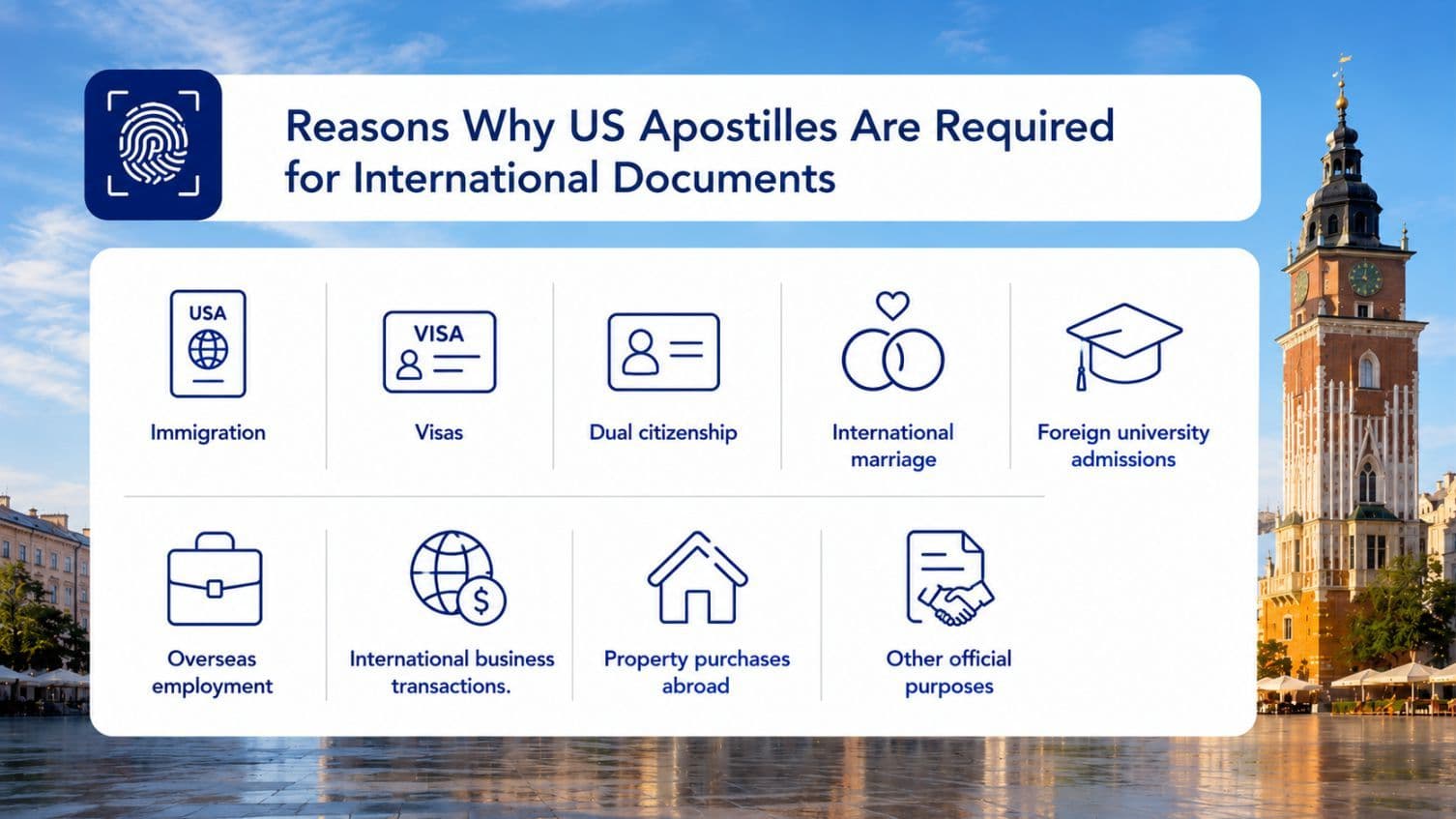
If you're not sure whether you actually need one, here are the situations that come up most often, explained a little further.
Foreign immigration authorities frequently want apostilled birth certificates, marriage certificates, and background checks before they'll process residency or visa applications. This is usually the broadest document list of any apostille situation, since immigration offices want proof of who you are, your family status, and your background, all at once.
Some visa categories, especially work and long-term residency visas, require apostilled documents proving your identity, education, or criminal history. Short-term tourist visas almost never require this; it's mostly work, study, and residency categories that ask for it.
Claiming citizenship through a parent or grandparent usually means proving a family chain with apostilled birth, marriage, and sometimes death certificates. The further back the family connection goes, the more documents are usually involved.
Many countries won't register a marriage involving a US citizen without an apostilled birth certificate and a notarized single status affidavit confirming you're legally free to marry.
Universities and credential evaluators abroad often want your diploma and transcript apostilled to confirm they're genuine before they'll evaluate your academic credentials or admit you into a program.
Foreign employers, especially government and regulated industries like healthcare, education, and finance, frequently require an apostilled background check and sometimes a diploma or professional license before extending a job offer.
Opening a company branch abroad, signing certain contracts, or registering a trademark overseas usually calls for apostilled business formation documents, since foreign business registries need proof your company legitimately exists.
Buying property in another country, especially when you can't be there in person for closing, usually means apostilling a power of attorney so a local representative can legally act on your behalf.
This table is your fast reference. Find your state, see who handles it, roughly what it costs, and how it's usually submitted. Fees shift from year to year and sometimes differ by document type within the same state, so treat these as a solid starting point and confirm the exact number on your state's website before you pay anything.
Almost every state uses the Secretary of State's office, but a few don't. Hawaii, Alaska, and Utah use the Lieutenant Governor's Office instead. Massachusetts and Virginia call it the Secretary of the Commonwealth. New Jersey runs it through its Department of the Treasury. Georgia is the most unusual case: apostilles for Hague Convention countries go through the GSCCCA, a court clerks' authority, while documents headed to non-member countries go through the Georgia Secretary of State instead.
The table above gives you the basics. Here's a closer look at each state, grouped by region, with the details that actually matter when you're getting ready to submit.
New York's apostilles come from the Department of State, and it's one of the faster states, often returning mail requests in three to five business days. There are walk-in counters in both Albany and New York City. One local quirk: if your document was issued in New York City specifically, it may need a County Clerk certification and letter of Exemplification before the state will apostille it, so check that first if your birth or marriage record came from the five boroughs.
New Jersey is unusual in that its apostilles come through the Department of the Treasury's Division of Revenue, not the Secretary of State. The fee runs around $25, on the higher end nationally, and mail processing usually takes ten to fifteen business days. Plan a little extra time here compared to neighboring states.
Pennsylvania's apostilles are issued through its Department of State, with a fee around $15 and a mail turnaround of ten to fifteen business days. There's no walk-in counter, so mail-in is your only real option unless you're using a courier or in-person filing service.
Massachusetts calls its apostille office the Secretary of the Commonwealth rather than Secretary of State, but it does the same job. The fee is one of the lowest in the Northeast at around $6, and there's a walk-in counter in Boston if you want faster service than the standard week-and-a-half mail turnaround.
Connecticut has the highest apostille fee in the entire country, around $40 per document. Mail processing usually takes five to ten business days. If you're apostilling multiple Connecticut documents, that fee adds up fast, so it's worth confirming exactly which documents you need before submitting.
Rhode Island's Secretary of State handles apostilles for a flat $10 fee, with a standard mail turnaround of about seven to ten business days. There's no walk-in service, so build mailing time into your plan.
Vermont apostilles also run through the Secretary of State, at $10 per document, with typical processing in seven to ten business days by mail. It's a straightforward, no-surprises state to work with.
New Hampshire's fee sits at $5, among the more affordable options, with the usual seven-to-ten-day mail processing window through the Secretary of State's office.
Maine charges $10 through its Secretary of State, with processing in the standard seven-to-ten-day range. Nothing unusual here, just a routine mail-in process.
Delaware's fee is notably high at $30, second only to Connecticut nationally. The Secretary of State processes requests in about seven to ten business days, with no walk-in option available.
Maryland keeps things simple with a $5 fee through the Secretary of State and a standard seven-to-ten-day mail turnaround. No walk-in counter, so plan for mail time.
The District of Columbia has its own apostille authority, the Office of the Secretary of the District of Columbia, separate from the federal Department of State office also located in D.C. (don't confuse the two). One important local rule: D.C. marriage certificates and divorce decrees must be original documents from the Superior Court of the District of Columbia, carrying a triple seal, or they'll be rejected.
Texas is one of the most apostille-friendly states for speed, with a walk-in counter in Austin that can turn around same-day service. Mail-in requests take longer, usually ten to fifteen business days. The fee is $15. One rule that catches people off guard: Texas only accepts recordable documents that are less than five years old, so an older birth or marriage certificate needs to be reordered fresh before it can be apostilled.
Florida's apostilles come through the Department of State, with fees ranging from $10 to $20 depending on whether the document is notarized or a certified court record. Processing usually takes seven to ten business days by mail, and there's no walk-in counter.
Georgia splits its apostille process based on destination. If your document is headed to a Hague Convention country, it goes to the GSCCCA, a court clerks' authority that offers same-day walk-in service. If it's headed to a non-member country, it instead goes to the Georgia Secretary of State. Sending it to the wrong one of these two means starting over.
North Carolina charges $10 through its Secretary of State, with the typical seven-to-ten-day mail processing window and no walk-in service.
South Carolina's process mirrors most of its neighbors: $10 fee, Secretary of State, seven to ten business days by mail.
Virginia's office goes by the Secretary of the Commonwealth, the same naming convention as Massachusetts. The fee is $10, and processing runs about seven to ten business days. One rule worth knowing: Virginia only authenticates documents issued within the last twelve months, so older records need to be reissued before they're eligible.
Tennessee charges $10 through the Secretary of State, with standard seven-to-ten-day mail processing and no walk-in option.
Kentucky's fee is $5, on the lower end, and there's a walk-in counter in Frankfort if you'd rather skip the mail wait entirely.
Alabama keeps it simple: $5 fee, Secretary of State, seven to ten business days by mail, no walk-in service.
Mississippi's apostille fee is $10, processed through the Secretary of State in the standard seven-to-ten-day window.
Louisiana charges $5 through the Secretary of State, with typical seven-to-ten-day mail processing.
Arkansas's fee is $5, and like most states in this region, expect seven to ten business days for mail-in requests through the Secretary of State.
Oklahoma's fee is notably higher than its neighbors at $25, with mail processing in the standard seven-to-ten-day range through the Secretary of State.
West Virginia charges $10 through the Secretary of State. One rule to know: West Virginia only accepts documents attested by a notary public, a county clerk, or the State Registrar of Vital Statistics, so check that your document was certified by one of those officials before submitting.
Illinois charges $5 through the Secretary of State's Index Department, and offers walk-in service in Springfield if you want to avoid the mail wait. Standard mail processing runs seven to ten business days.
Ohio's fee is one of the lowest in the country at $3, and there's a walk-in counter in Columbus offering faster turnaround than the standard five-to-ten-day mail window.
Michigan has the lowest apostille fee in the nation, just $1, processed through the Office of the Great Seal within the Secretary of State's office. Standard mail processing takes seven to ten business days.
Indiana charges $5 for most documents, though eligible vital records are sometimes apostilled free of charge. Processing through the Secretary of State runs the standard seven to ten business days.
Wisconsin's fee is $10 through the Secretary of State. One local detail: Wisconsin vital records are often issued through county Registers of Deeds or Clerks of Court rather than a single state office, so your starting point may be at the county level before the state apostille step.
Minnesota charges $5 through the Secretary of State, with the standard seven-to-ten-day mail turnaround.
Iowa's fee is $5, processed through the Secretary of State in the usual seven-to-ten-day window.
Missouri charges $10 through the Secretary of State, with standard seven-to-ten-day mail processing.
Kansas's fee is $7.50, a slightly unusual number, processed through the Secretary of State in the typical seven-to-ten-day range.
Nebraska charges $15, on the higher side for the Midwest, through the Secretary of State, with standard processing times.
North Dakota's fee is $10 through the Secretary of State, with the usual seven-to-ten-day mail window.
South Dakota has one of the lowest fees in the country at $2, processed through the Secretary of State in the standard timeframe.
California's fee is $20, and the state offers appointment-based walk-in service in Sacramento and Los Angeles, with mail processing usually running five to seven business days, faster than many other states.
Washington charges $20 through the Secretary of State, with standard seven-to-ten-day mail processing and no walk-in counter.
Oregon's fee is $25, on the higher end, processed through the Secretary of State in the usual seven-to-ten-day window.
Nevada charges $20 and offers walk-in service in Carson City, a useful option if you're nearby and want to skip the mail wait.
Arizona has one of the lowest fees nationally at $3, through the Secretary of State, though mail processing can run longer than average during busy periods.
Utah routes its apostilles through the Lieutenant Governor's Office rather than a Secretary of State, with a fee of $20 and standard seven-to-ten-day processing.
Colorado charges $10 through the Secretary of State, with the typical seven-to-ten-day mail turnaround.
New Mexico's fee is $3, among the lowest in the country, processed through the Secretary of State in the standard window.
Idaho charges $10 through the Secretary of State, with standard seven-to-ten-day processing.
Montana's fee is $10, processed through the Secretary of State in the usual timeframe.
Wyoming charges $10 through the Secretary of State. One local rule: Wyoming wants your document certified by a Wyoming official first, such as a county clerk, the state registrar, or a notary, before it will issue the apostille.
Alaska routes its apostilles through the Lieutenant Governor's Office, with a fee of $15 and a slightly longer processing window of ten to fifteen business days.
Hawaii has the lowest apostille fee in the country at just $1, processed through the Lieutenant Governor's Office (which also functions as Hawaii's Secretary of State equivalent). Standard processing takes seven to ten business days.
The document mix tends to shift a little by region, based on what each area's economy and population look like, which is worth knowing as you plan ahead.
In the Northeast, with its concentration of universities and international business hubs like New York and Boston, diplomas, transcripts, and corporate documents make up a larger share of requests than in most other regions. New York in particular processes a high volume of business and immigration-related paperwork given its size and international population.In the South, especially Texas and Florida, immigration-related documents dominate: birth certificates, marriage certificates, and FBI background checks tied to visa and residency applications. Both states have large immigrant communities and serve as common entry and exit points for international travel, which drives this pattern.
In the Midwest, vital records and education documents are the most common requests, often tied to international adoption finalizations and citizenship-by-descent applications, since many Midwestern states have strong historical immigration ties to Europe that families are now tracing in reverse.
In the West, California's large international business and tech presence means business documents and corporate filings make up a significant share of requests, alongside the usual mix of vital records and background checks tied to immigration and overseas employment.None of this changes the actual process for your specific document, but it's a useful reality check: if your state's apostille office seems slow during a particular season, you're probably not alone, and a stack of similar requests from people in situations just like yours is likely sitting in the same queue.
Before we move into the federal process and document specifics, here are short, direct answers to the questions that bring most people to this guide in the first place.
| Question | Short answer |
| Where do I get a US apostille? | From your state's apostille authority for state documents, or the US Department of State for federal documents |
| Does a US apostille expire? | No, but the document underneath it might need to be recently issued, depending on the destination |
| Who apostilles an FBI background check? | Only the US Department of State, never a state office |
| Which state apostilles my birth certificate? | The state that issued it, not the state you live in now |
| Do I need to notarize a birth certificate first? | No, a certified vital record is submitted as-is |
| What if my destination isn't a Hague country? | You'll need an authentication certificate plus embassy legalization instead |
| How long does a state apostille take? | Usually seven to ten business days by mail |
| Can a US embassy abroad apostille my document? | No, only a US-based state or federal authority can |
A federal apostille is the same kind of certificate as a state apostille, just issued by a different office. Instead of going to a state authority, federal documents go to the Office of Authentications at the US Department of State in Washington, D.C. This office handles nothing but federal documents, so a state-issued birth certificate sent here will simply be returned.
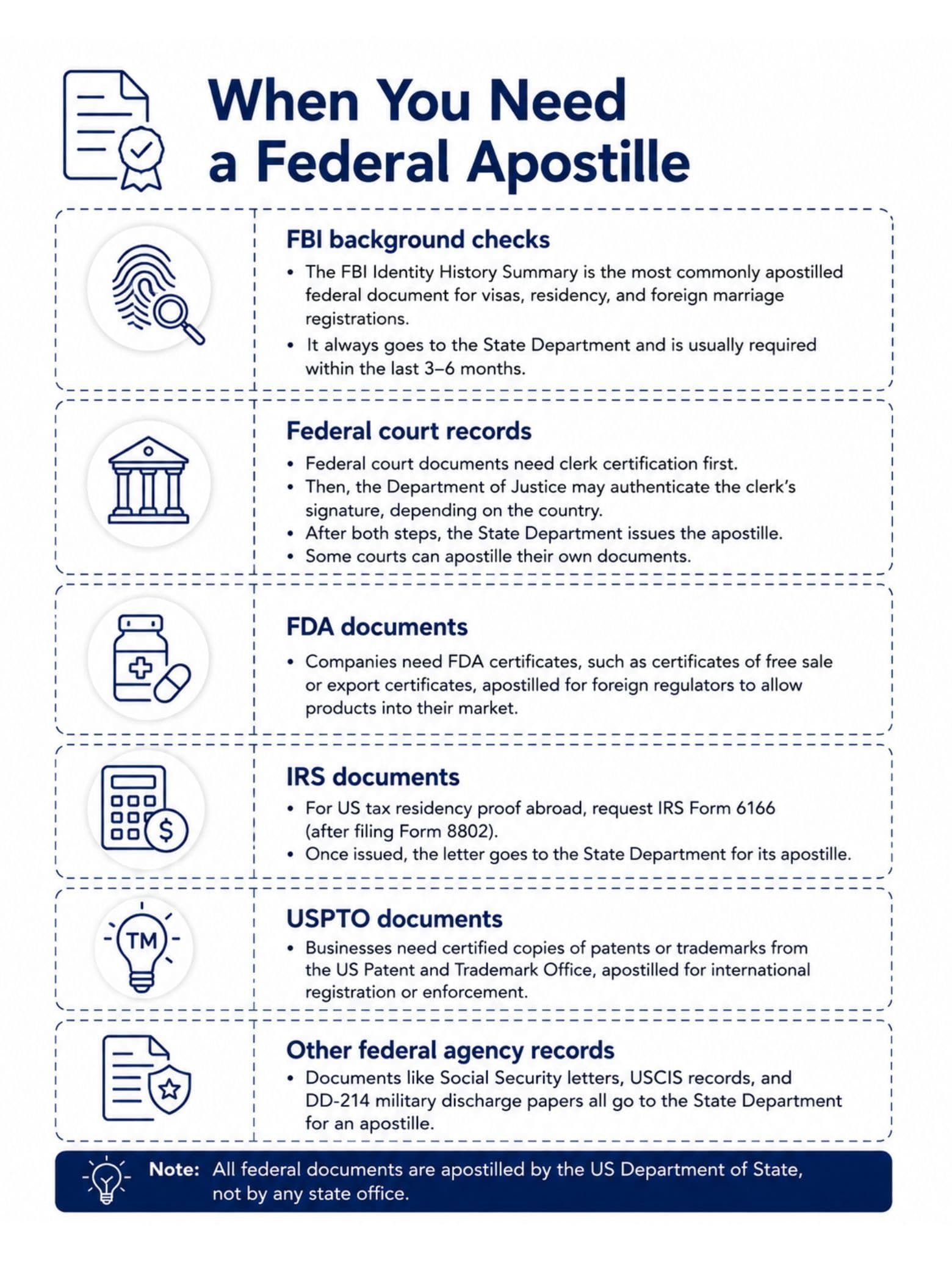
FBI background checks
The FBI Identity History Summary is the single most commonly apostilled federal document, mostly because so many work visas, residency applications, and foreign marriage registrations require one. It always goes to the State Department, never to a state office, no matter where you live. Most countries want this report to be fairly recent, often within three to six months of when you actually use it abroad, so timing matters here more than with most documents.
Federal court records
Documents from US federal courts, like judgments or certified case records, need an extra step before they reach the State Department. The court clerk certifies the document first, and then, depending on the destination, the Department of Justice authenticates the clerk's signature. Only after both of those steps does the State Department add the apostille. Some federal court clerks can actually issue apostilles directly on their own court's documents, which skips a step, so it's worth asking your specific court.
FDA documents
Companies exporting food, drugs, cosmetics, or medical devices often need an FDA certificate of free sale or export certificate apostilled before a foreign regulator will allow the product into their market.
IRS documents
If you need to prove US tax residency abroad for treaty benefit purposes, you'll request IRS Form 6166 (after first filing Form 8802), and once you receive it, that letter goes to the State Department for its apostille.
USPTO documents
Businesses registering or enforcing a patent or trademark internationally usually need a certified copy from the US Patent and Trademark Office, apostilled the same way as any other federal record.
Other federal agency records
A handful of other federal documents come up occasionally: Social Security benefit verification letters, USCIS immigration and naturalization records, and DD-214 military discharge papers. All of these route to the State Department rather than any state office, since the issuing agency is federal in every case.
Required documents
You'll need the original document or, in some cases like the FBI report, the official electronic version. Photocopies and scans of originals aren't normally accepted, because there's no real signature for the office to verify.
Submission process
You can mail your document with the request form DS-4194 and fee, or drop it off in person at the Washington, D.C. office during their morning intake window, usually 8 to 9 AM on business days.
Fees
The federal apostille fee is a flat rate, usually around $20 per document, regardless of which agency issued it or where it's headed.
Processing times
In-person drop-offs are reviewed and returned within 10-12 business days. Mail-in requests are much slower, sometimes taking up to five weeks to seven weeks, especially during busy periods. If you're working against a deadline, in-person submission or a courier service is worth the extra effort.
If you have more than one federal document to apostille, like an FBI report and a USPTO certificate, you can usually submit them together in a single mailing or drop-off, as long as each one includes its own fee and meets its own preparation requirements. Include one cover letter listing every document in the package, your contact information, and the destination country for each item, since this helps the office process a multi-document request without separating or losing track of any single piece. Keep your own copy of that cover letter and a list of what you sent, so you have a reference if anything comes back incomplete.
Different documents need different preparation before they're ready for an apostille. For each one below, we'll cover who's eligible to request it, what certification it needs, where you actually get it, why it tends to get rejected, and any state-specific quirks worth knowing.
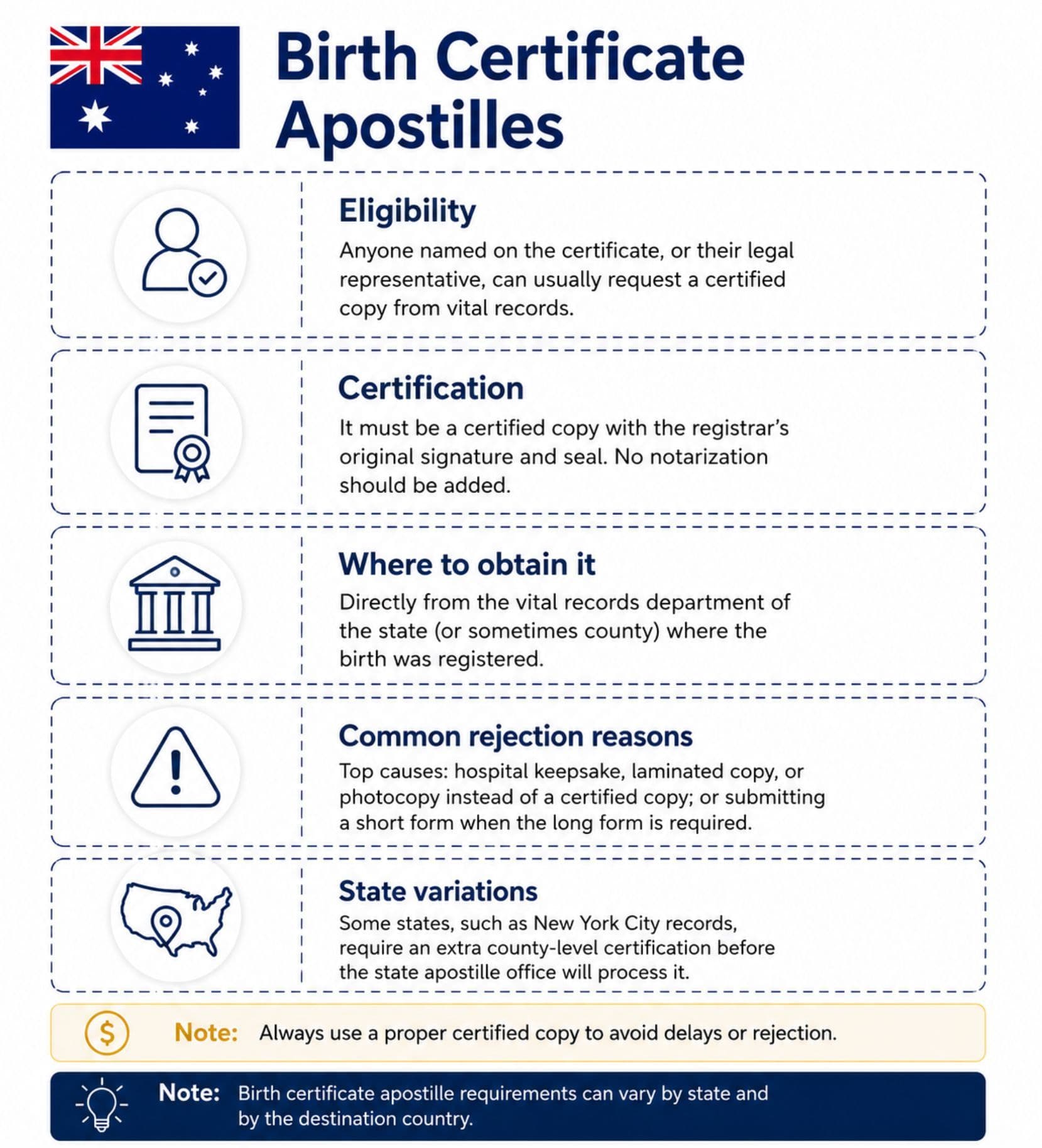
For more information correct document format and certificate and what that means read our guide here: Original Documents, Certified Copies and Notarized Copies- What You Need to Know for US Apostille
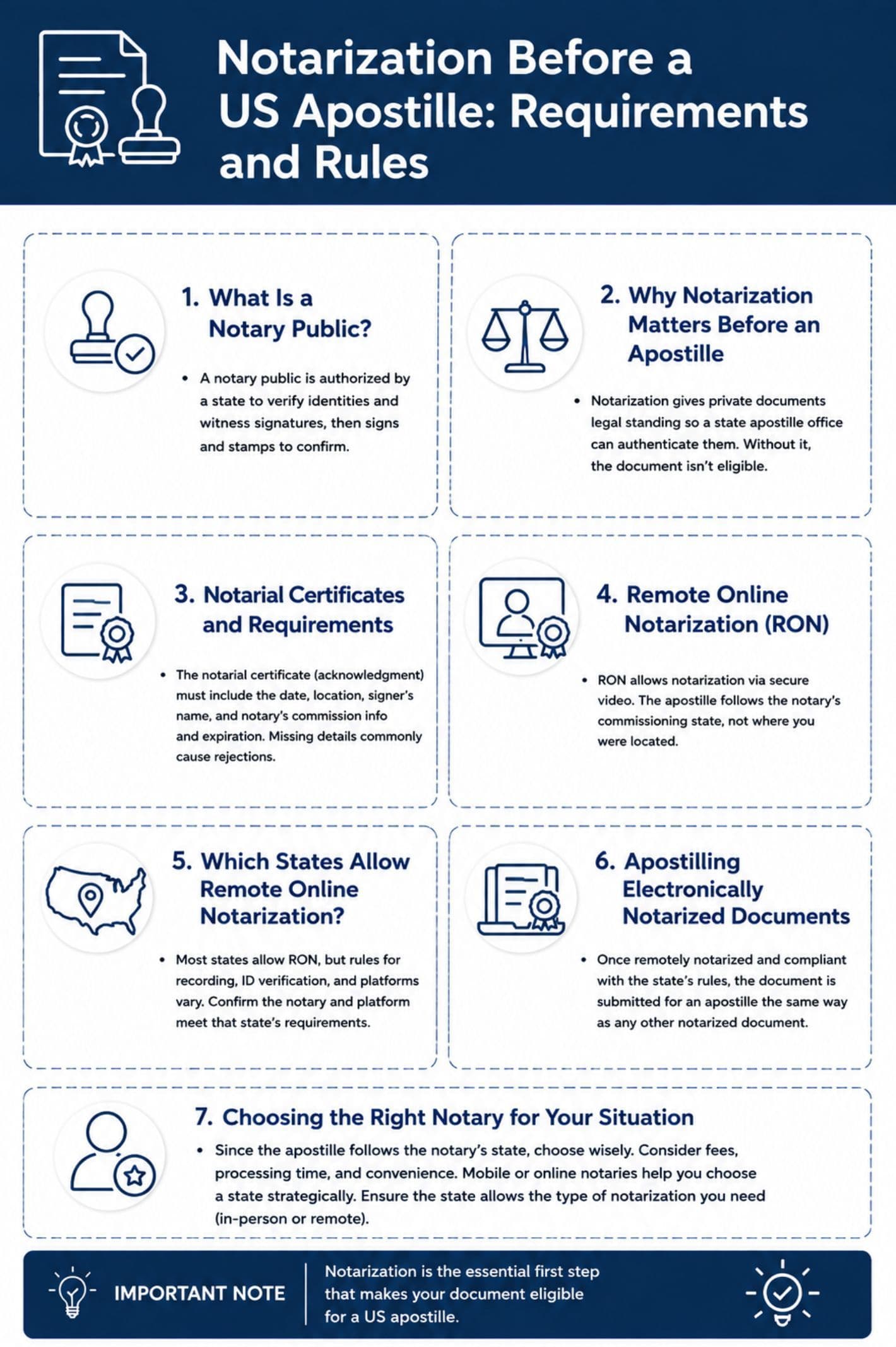
A notary public is someone authorized by a state government to witness signatures and confirm identities on official documents. When you sign something in front of a notary, they check your ID, watch you sign, and then add their own signature and stamp confirming the whole thing happened the way it should have.
Plenty of documents, like powers of attorney and affidavits, start out as private paperwork with no official standing at all. A notary's signature is what turns them into something a state apostille office can actually authenticate. Without that notarization, there's no official signature for the apostille to verify, so the document simply isn't eligible yet.
The notary's certificate, often called an acknowledgment, needs to include specific details: the date, the location, the signer's name, and the notary's commission information and expiration date. A missing or incomplete piece of this certificate is one of the most common reasons documents bounce back from the apostille office.
Remote online notarization lets a notary witness your signature over secure video instead of meeting in person. It's grown a lot in recent years, and a document notarized this way can absolutely be apostilled. The key detail to remember: the apostille follows wherever the notary is commissioned, not wherever you were physically sitting when you signed.
Most states now permit some form of RON, though the specific rules around recording, identity verification, and platform requirements vary from state to state. If you're planning to use a remote notary, confirm that both the notary's commission and the platform you're using meet that state's current requirements before you rely on it.
Once a document has been notarized remotely and meets the commissioning state's requirements, it's submitted for an apostille exactly like any other notarized document, through that state's apostille authority. The electronic notarization itself doesn't change anything about where the document goes next.
Since the apostille always follows the notary's commissioning state, picking the right notary is really picking which state will end up handling your apostille. If you have a choice, it often makes sense to use a notary in the state with the lowest fee, the fastest processing time, or a walk-in counter, rather than just whichever notary happens to be closest to you geographically. A mobile notary or an online notary becomes especially useful here, since it lets you choose a commissioning state strategically instead of being limited to wherever you physically are. Just remember that this only works if the notary's state actually permits the type of notarization you need, whether that's in-person or remote.
People often use these terms interchangeably, but they're not the same thing. Here's how they actually differ.
| Term | What It Actually Means |
| Apostille | The single certificate accepted by any Hague Convention country |
| Notarization | A notary witnessing your signature; usually the first step, not the final one |
| Certified copy | An office confirming a copy matches a record it holds |
| Authentication certificate | What the State Department issues for non-Hague countries instead of an apostille |
| Embassy legalization | A foreign embassy's own stamp, added after a US authentication certificate |
| Consular legalization | Another name for the same embassy step, used interchangeably with "embassy legalization" |
Notarization confirms a signature is genuine. An apostille confirms the notary's own signature and commission are genuine. They're two different steps in the same chain, not substitutes for each other.
A certified copy confirms a document matches an official record. For something like a birth certificate, the certified copy is what you submit for apostille, not a replacement for it.
These look similar but serve different destinations. An apostille works for Hague Convention countries. An authentication certificate is what the same federal or state office issues instead, specifically for countries outside the Convention.
An apostille is the entire process for Hague countries. Embassy legalization is an additional step required only for non-Hague countries, added on top of the authentication certificate.
These two terms mean the same thing. Some people say "embassy legalization," others say "consular legalization." Both describe the same final stamp from the destination country's diplomatic office in the US.
Beyond the core document types covered earlier, a long tail of less common paperwork shows up in specific situations. Each one follows the same federal-or-state logic as everything else in this guide, but since these come up less often, the preparation step is easy to get wrong.
| Document | State or federal | What it needs before apostille |
| Single status affidavit | State | Notarized statement confirming you're free to marry |
| Professional license verification | State | Certified letter from the state licensing board |
| GED or equivalency certificate | State | Certification from the state education agency |
| Vehicle title | State | Notarized copy; the original title itself is rarely submitted |
| Medical or vaccination record | State | Notarized after the provider certifies it |
| Bank or financial reference letter | State | Notarized signature of the issuing bank officer |
| Copyright registration | Federal | Certified copy from the US Copyright Office |
| Letter of invitation | State | Notarized signature of the person extending the invitation |
The pattern across all of these is the same one that runs through this entire guide: a private document becomes apostille-eligible only once a notary or the issuing office adds an official, verifiable signature to it.
Getting a document sent back isn't the end of the road, and a calm, methodical response gets you back on track fastest. Most offices include a brief explanation of why the document was returned, whether that's a missing certification, an expired notary commission, an uncertified copy, or a payment issue. Read that explanation carefully before doing anything else, since it tells you exactly what to fix rather than leaving you guessing.
Fix only the specific problem named, rather than redoing the entire submission from scratch, since everything else in the package was presumably fine. If the issue was a missing step, like a county certification or a Department of Justice seal on a federal court document, complete that step before resubmitting rather than mailing the same incomplete package a second time.
There's usually no penalty for resubmitting beyond paying the fee again, but you do go back to the end of the processing queue, which is exactly why catching problems before the first submission, using the mistakes table earlier in this guide, is worth the extra five minutes. If you're now up against a tighter deadline because of the delay, a walk-in counter or an in-person federal drop-off can help you recover lost time faster than mailing a second time would.
Two practical issues come up often enough to deserve their own mention, separate from the document-specific rules covered earlier.
A document with several pages, like a longer court record or a multi-page business filing, is apostilled as one bound and certified set rather than page by page. One apostille covers the whole packet as long as it's properly bound and certified together. Once it comes back, don't unstaple, reorder, or photocopy the set, since separating the pages can break the certified connection a foreign office is relying on.
It's common for someone's documents to carry different names across their life: a maiden name on an old birth certificate, a married name on a more recent diploma, or a name that changed through a legal court order.
A foreign registry receiving these documents can struggle to confirm they all belong to the same person unless the connecting document, usually a marriage certificate or a court-ordered name change, is also apostilled and included with the rest of the package.
If your documents span more than one name, it's worth assembling the full chain (old name to new name, with the connecting record included) before you submit anything, rather than letting a foreign office puzzle it out on their own.
For countries outside the Hague Convention, the same state or federal office that would normally issue an apostille instead issues something called an authentication certificate. It does the same basic job, confirming the document's signature and seal are real, but it's not the final step. A non-member country still needs to add its own legalization on top of it.
After you get the authentication certificate, you take it to the destination country's embassy or consulate here in the US. They review it and add their own legalization stamp, which is what actually makes the document usable in that country. Every embassy has its own procedure, some accept mail-in requests, some require an in-person appointment, so check the specific embassy's current process before you get to this stage.
The list of non-member countries keeps shrinking as more countries join the Convention, but as of now it includes places like the United Arab Emirates, Qatar, Kuwait, and Egypt, among others. Because this list changes, always confirm your destination's current status using the official Hague Conference member list rather than an older article, since a country that required legalization last year might accept a simple apostille today.
Here's the full sequence, since it involves more than four steps and is easy to lose track of:
1. Prepare your document
(notarize or certify it, just like for a regular apostille)
2. State-level certification
(your state authority signs off first)
3. US Department of State
(issues an authentication certificate, not an apostille)
4. Destination country's embassy or consulate in the US
(adds their own legalization stamp)
5. Document is ready to use abroad
(add a certified translation if required)
Each step has its own fee and its own timeline, and the embassy step is usually the slowest and least predictable part of the whole process. Build in extra time here if your destination falls outside the Convention.
Beyond the standard documents, certain life events bring their own document combinations and their own timing pressures. Here's what to expect in each one.
Children's documents most often come up as parental travel consent letters, used when a child is traveling internationally with only one parent or another adult. These are notarized documents, so they follow the standard notarization-then-apostille path. Birth certificates for minors are handled exactly like any adult's birth certificate.
The detail to get right is the wording, since many countries expect specific language naming the child, the traveling adult, and the travel dates. If both parents need to sign and they live in different states, you may end up notarizing two separate originals in two different states, which is fine as long as each one is apostilled by its own respective state.
Claiming citizenship through a parent or grandparent usually means building a paper trail: your birth certificate, a parent's or grandparent's birth and marriage records, and sometimes naturalization or death records, each apostilled separately.
Older records can be the hardest part to track down, since the original signing officials may no longer be on file with the state, so it's often faster to request fresh certified copies than to dig up decades-old paperwork.
Some countries, particularly in Europe, want the entire chain apostilled and translated together as one package, so check whether your destination's citizenship office wants a single combined submission or accepts documents as they're ready.
Immigration cases tend to need the broadest mix of documents: an FBI background check, a birth certificate, and a marriage certificate if applicable. Because the background check has a recency requirement in most countries, it's smart to request it last among the slower-to-prepare documents, so it doesn't expire before you actually file.
It also helps to make a simple checklist of every document the immigration office has requested, since missing even one item can delay an entire application by months while you go back and get it apostilled separately.
Getting married abroad, or registering a US marriage in a foreign country, usually calls for a single status affidavit (sometimes called a certificate of no impediment) along with a birth certificate. The affidavit is time-sensitive, often needing to be dated within a few months of the wedding, so it's usually the last document you prepare.
Some countries also want both partners' birth certificates apostilled, even when only one partner is a US citizen, so confirm the full list with the local registry well before the wedding date.
Foreign employers commonly want a diploma, transcript, and background check, sometimes alongside a professional license. Since diplomas and transcripts are private documents, remember they need notarization or registrar certification before they're apostille-eligible.
Regulated professions, like medicine, nursing, teaching, and engineering, often add a verification letter from the relevant state licensing board on top of the diploma, confirming your license is active and in good standing.
Adoption files often include sealed court records, home studies, and agency paperwork. Whether something routes to a state or a federal authority depends entirely on who issued it, and sealed records usually need a court order before a certified copy can even be requested for apostille.
International adoptions are also governed by a separate treaty, the 1993 Hague Adoption Convention, which sets safeguards for the adoption process itself. That treaty doesn't replace the apostille requirement; the court records and other paperwork from the adoption still need their own apostilles on top of meeting the treaty's standards.
Companies expanding internationally usually need articles of incorporation, a certificate of good standing, and sometimes board resolutions. Time the good standing certificate carefully, since most have a short shelf life abroad, often just three to six months.
If you're filing in more than one country at once, order a separate certified copy of each document for every country, since one original can't be apostilled and used in two places simultaneously.
Buying or inheriting property abroad most often involves a power of attorney, since you're rarely able to be present in person for every step. Make sure the document grants the exact powers your destination country's notary or land registry expects before you have it notarized, since the apostille can't fix wording problems after the fact.
Inheritance cases often add a death certificate and sometimes probate court records to the mix, each needing its own apostille based on whoever issued it.
Nurses, doctors, teachers, engineers, and other licensed professionals relocating for work often need more than just a diploma. A foreign licensing board frequently wants a verification letter from the US state board confirming the license is active and in good standing, on top of the usual diploma and transcript.
That verification letter is a state document, so it follows the same path as any other state-issued record, but it usually carries its own recency requirement, so order it close to when you'll actually submit your application rather than far in advance.
Retiring abroad or claiming a pension from outside the US sometimes requires a Social Security benefit verification letter, which is a federal document routed to the US Department of State, alongside civil records like a birth or marriage certificate, which follow the state path.
This is a common case where one person's document file splits between the federal and state systems at the same time, so double-check each document's routing separately rather than assuming they all go to one office.
If you're living overseas, you don't need to fly home to get a US document apostilled, but you do need to know one important limitation: a US embassy or consulate abroad cannot issue an apostille on a US document.
Their notarial section can notarize a signature for you, but the actual apostille still has to come from the issuing state or the federal Department of State office, both physically located in the US. This trips up a lot of expats who assume their nearest embassy can handle everything in one stop.
Since US offices usually return finished apostilles only to a US mailing address, your plan needs to include a US return point. Many people use a trusted relative or friend in the States, or a paid mail-forwarding service, to receive the finished document and send it on to wherever they actually are.
Build extra time into your plan for this leg, since it adds an additional international shipment on top of the apostille processing itself, and customs delays in some countries can add unpredictable extra days.
A paid apostille service can be especially useful from overseas, since they're already set up to receive, process, and re-ship documents internationally. If you're requesting an FBI background check while abroad, an FBI-approved Channeler can process fingerprints taken almost anywhere, often at a local police station, so you don't need to be physically present in the US for that step either.
For state vital records, ordering directly from the state's online portal and having it apostilled and shipped by a service can be faster than trying to coordinate everything yourself across multiple time zones.
Once your document is apostilled, you'll need a way to get it back to you internationally. Tracked international mail or a courier service like FedEx or DHL is worth the extra cost here, since losing an apostilled original means starting the entire process over, both the document request and the apostille itself.
Always request tracking and, where available, insurance on the package, since a lost original is far more costly in time than the few extra dollars a tracked shipping option adds.
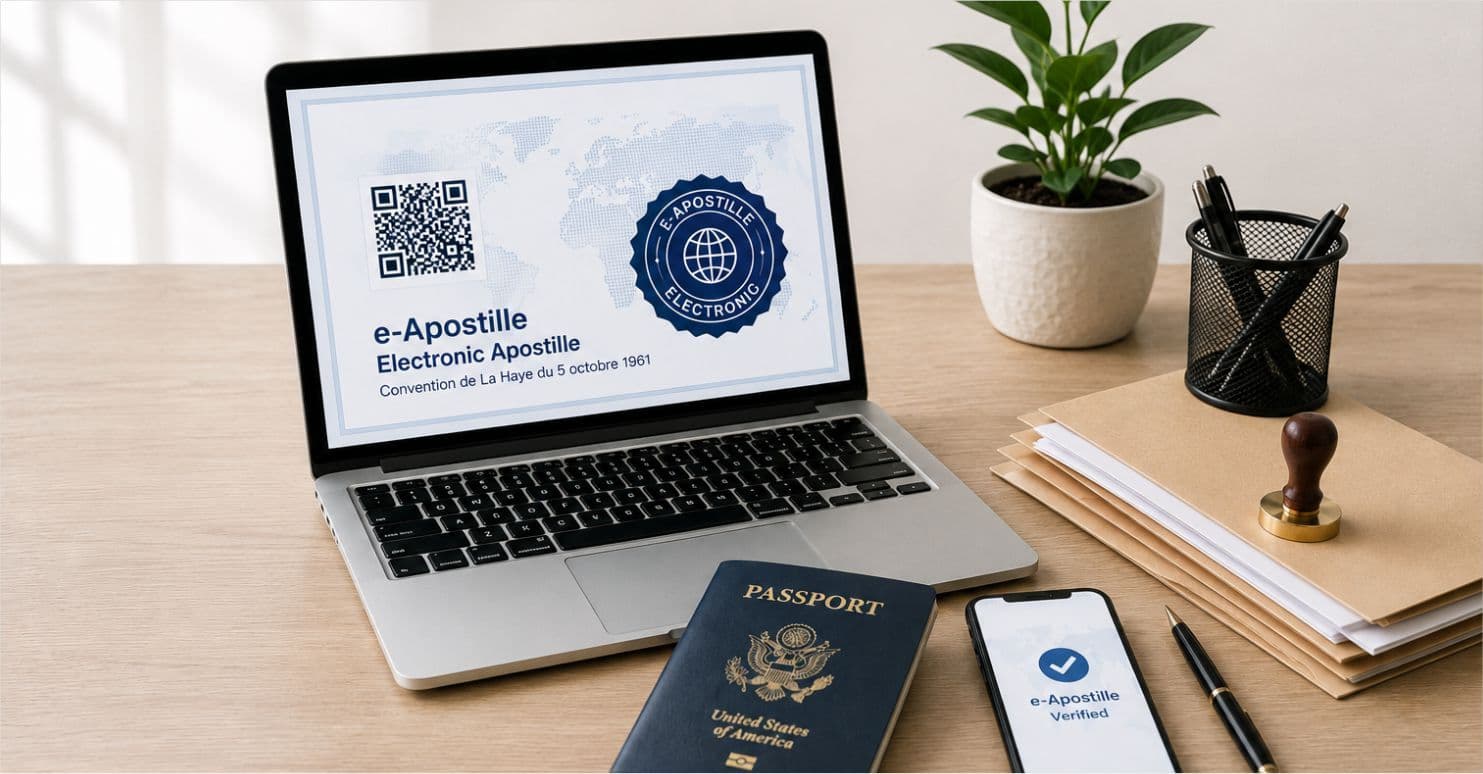
An e-apostille is a digital version of the same certificate, issued and verified electronically instead of on paper. It carries the same legal weight as a paper apostille under the Hague Convention, it's just delivered and authenticated differently. This system grew out of an international initiative called the Electronic Apostille Programme, designed to let countries issue and verify these certificates faster and with less risk of a physical document getting lost or damaged in transit.
Adoption of electronic apostilles varies a lot by state. Some states have built out full electronic registers and digital issuance, while others remain entirely paper-based. Check directly with your specific state's apostille office to see whether they currently offer this option for your document type, since even states that offer it sometimes limit it to certain kinds of records rather than all documents.
States that offer this option usually issue the apostille as a digital file along with an online verification system, so a foreign office receiving the document can check its authenticity directly through that state's online register using the certificate's reference number.
This removes the need for the receiving office to call or write to the issuing state to confirm a certificate is genuine, since they can check it themselves in seconds.
It depends entirely on the destination. Some countries are fully set up to accept and verify electronic apostilles, while others still expect a physical, paper certificate, even if the issuing state offers a digital option. Before relying on an electronic apostille, confirm that your destination office actually accepts that format, not just that your state can issue one.
When in doubt, request the paper version, since it's accepted everywhere a digital one is, but the reverse isn't always true.
This is a different question from the e-apostille itself: what happens when the underlying document, not the apostille, was issued digitally in the first place. More schools and agencies now issue electronic diplomas, transcripts, and even some vital records with a digital signature or a verification code instead of a wet-ink seal. Some apostille offices will accept a printed copy of that electronic original once a notary certifies the printout as accurate. Others insist that you order a traditional certified paper copy directly from the issuing office instead.
If your source document only exists digitally, it's worth calling the apostille office before you submit anything, just to confirm which approach they'll actually accept, since printing and notarizing a digital file that the office won't recognize wastes both the notary fee and the apostille fee.
| Territory | Apostille Authority | Official Page | Fee | Walk-In | Mail-In |
| Puerto Rico | Puerto Rico Department of State | https://www.statedepartment.pr.gov/apostilles | $3 per document (internal revenue stamp) | Yes | Yes |
| Guam | Guam Department of Administration | https://doa.guam.gov/apostille/ | $50 per document | Yes - by appointment only (Mon/Wed/Fri) | Yes |
| US Virgin Islands | Office of the Lieutenant Governor | https://ltg.gov.vi/wp-content/uploads/2023/08/Apostille-and-Certification-Instructions.pdf | $25 per document | Yes | Yes |
| American Samoa | Office of the Secretary of American Samoa | https://www.osas.as/copy-of-modernization | Confirm directly with office | Yes - walk-ins preferred; online also accepted | Yes |
| Northern Mariana Islands | Office of the Attorney General, CNMI | No dedicated apostille page - contact AG office directly | $50 per document (money order payable to CNMI Treasury) | No | Yes - mail only |
| Washington, D.C. | Office of the Secretary of the District of Columbia | https://os.dc.gov/service/authentications | $15 per document | Yes - same-day, morning walk-in hours, no appointment needed | Yes |
Puerto Rico has its own designated apostille authority for documents issued there. A document from Puerto Rico used in a foreign country needs an apostille from Puerto Rico's authority, the same as any state. The process mirrors the mainland states closely: certified copies for vital records, notarization for private documents, and mail-in submission as the standard method.
Guam similarly has its own apostille authority for locally issued documents headed to a foreign country. As with the other territories, the process follows the same basic structure as a state, just through Guam's own designated office rather than a state government.
The US Virgin Islands maintains its own apostille authority as well, separate from any mainland state office. Documents issued there, from vital records to notarized paperwork, are authenticated through the territory's own designated authority before they're recognized abroad.
American Samoa has a designated authority for apostilling documents issued within the territory. Given American Samoa's smaller population and government infrastructure, processing times can run longer than mainland states, so build in extra buffer if you're working with documents from there.
The Northern Mariana Islands also has its own designated apostille authority, following the same general process as the states. As with the other Pacific territories, confirm current processing times directly with the local office, since they can differ from mainland averages.
As covered earlier, D.C. has its own local apostille office, the Office of the Secretary of the District of Columbia, which is separate from the federal Department of State office, even though both happen to be located in Washington. It's easy to confuse the two since they're in the same city, but only D.C.-issued local documents go through the D.C. Secretary's office; anything federal still goes to the State Department's Office of Authentications.
One important note across all territories: an apostille is never needed to use a document within the United States or between US states and territories, since they all recognize each other's official records already. Apostilles only matter once a document is crossing an actual international border.
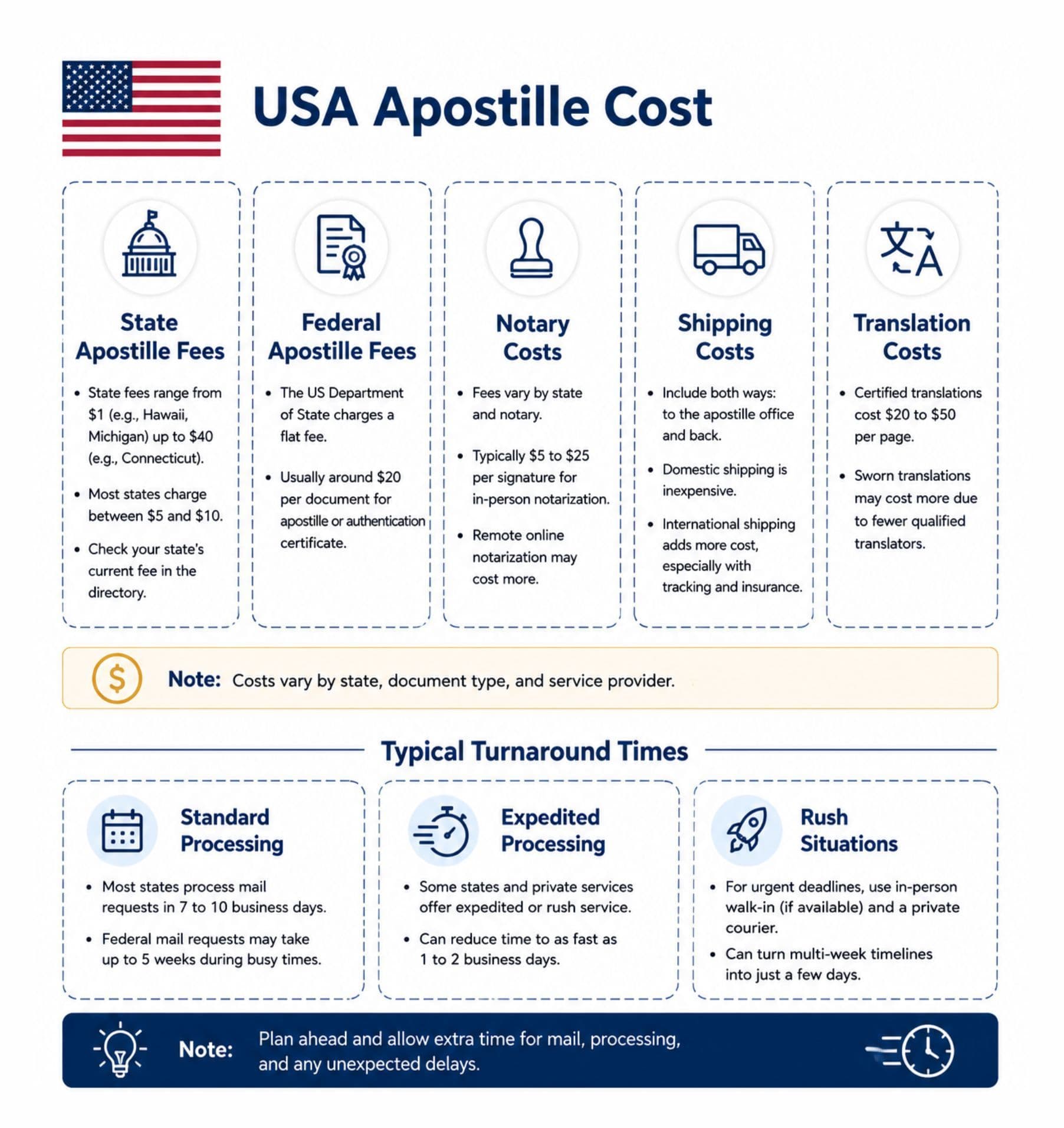
State fees range widely, from $1 in states like Hawaii and Michigan up to $40 in Connecticut. Most states land somewhere between $5 and $10. Check the state directory earlier in this guide for your specific state's current fee.
The US Department of State charges a flat fee, usually around $20 per document, whether you're getting an apostille for a Hague country or an authentication certificate for a non-member country.
Notary fees vary by state and by notary, but are usually fairly small, often somewhere between $5 and $25 per signature for an in-person notarization. Remote online notarization can sometimes cost more due to platform fees.
Don't forget to budget for shipping in both directions: getting your document to the apostille office and getting it back. Tracked domestic shipping is usually inexpensive, but international shipping for anyone living abroad adds a meaningful cost, especially if you want tracking and insurance on an irreplaceable original.
Certified translations usually run anywhere from $20 to $50 per page, depending on the language and the translator's certification level. Sworn translations, required by some countries, can cost more due to the smaller pool of qualified translators.
Most states process mail-in apostille requests in seven to ten business days. Federal mail requests can take much longer, sometimes up to five weeks during busy periods.
Some states and private services offer expedited or rush processing for an additional fee, which can cut the standard timeline significantly, sometimes down to a day or two.
If you're facing a true emergency deadline, in-person walk-in service (where available) combined with a private courier for shipping is usually your fastest possible path, often turning a multi-week process into a matter of days.
| Mistake | What Causes It | The Fix |
| Wrong document version | Souvenir copy or short-form sent instead of certified/long-form | Order the certified, long-form copy from the issuing office |
| Improper notarization | Expired commission or incomplete acknowledgment | Confirm the notary's commission and double-check the wording |
| Using photocopies | No real signature or seal to verify | Use an original, certified copy, or properly notarized document |
| Wrong authority | Federal document sent to a state, or vice versa | Match the document to its issuing office: federal to D.C., state to that state |
| Missing certifications | A required local or agency step was skipped | Complete county or DOJ steps before mailing |
| Damaged documents | Folding, staining, or altering the original | Handle and ship originals carefully, in a rigid envelope if possible |
| Wrong destination country info | Incorrect country listed on the request form | Double-check the destination country name before submitting |
This is the single most common rejection cause across every document type. A souvenir birth certificate, a short-form death certificate, or an opened transcript envelope all fail for the same basic reason: they're not the version the office can actually verify. The fix is almost always the same too: go back to the issuing office and request the specific certified version, long-form where applicable, rather than trying to make do with whatever copy you already have on hand.
An expired notary commission, a notary licensed in the wrong state, or an incomplete acknowledgment block are all common reasons a notarized document bounces back. Before you sign anything in front of a notary, it's worth asking them directly to confirm their commission is current and to walk through the acknowledgment wording with you, since a notary who does this daily will usually catch an issue before it becomes a problem.
A photocopy carries no original signature or seal, so there's nothing for the apostille office to check. Always submit a real original or properly certified copy. This includes scanned PDFs of a photocopy, which some people assume counts as "official" simply because it's a digital file, when really it's just a digital copy of the same unverifiable paper.
Federal documents sent to a state office, or state documents sent to the federal office, are returned untouched. The fix is always to match your document's issuing agency to the correct authority before mailing anything. If you're ever unsure, a quick call to the office you're about to mail to, asking whether they handle your specific document type, can save weeks of wasted transit time.
Some documents need an extra step before the apostille office will touch them, like a county certification for certain vital records, or the DOJ step for federal court documents. Skipping it means a guaranteed rejection. These extra steps are usually listed clearly on the issuing office's own website, so it's worth reading that page in full rather than assuming the process is the same as it was for a different document type you've apostilled before.
A torn, stained, or folded-beyond-recognition original can be rejected on condition alone. Mail your originals flat in a rigid envelope whenever possible, and avoid using paper clips or staples directly on certified documents, since some offices consider even minor physical alterations a reason for closer scrutiny.
Some apostille request forms ask you to list the destination country. Getting this wrong, or leaving it blank when required, can cause processing delays or an outright rejection depending on the state. This detail matters more than it might seem, since a few offices use it to determine whether you need an apostille at all or an authentication certificate instead.
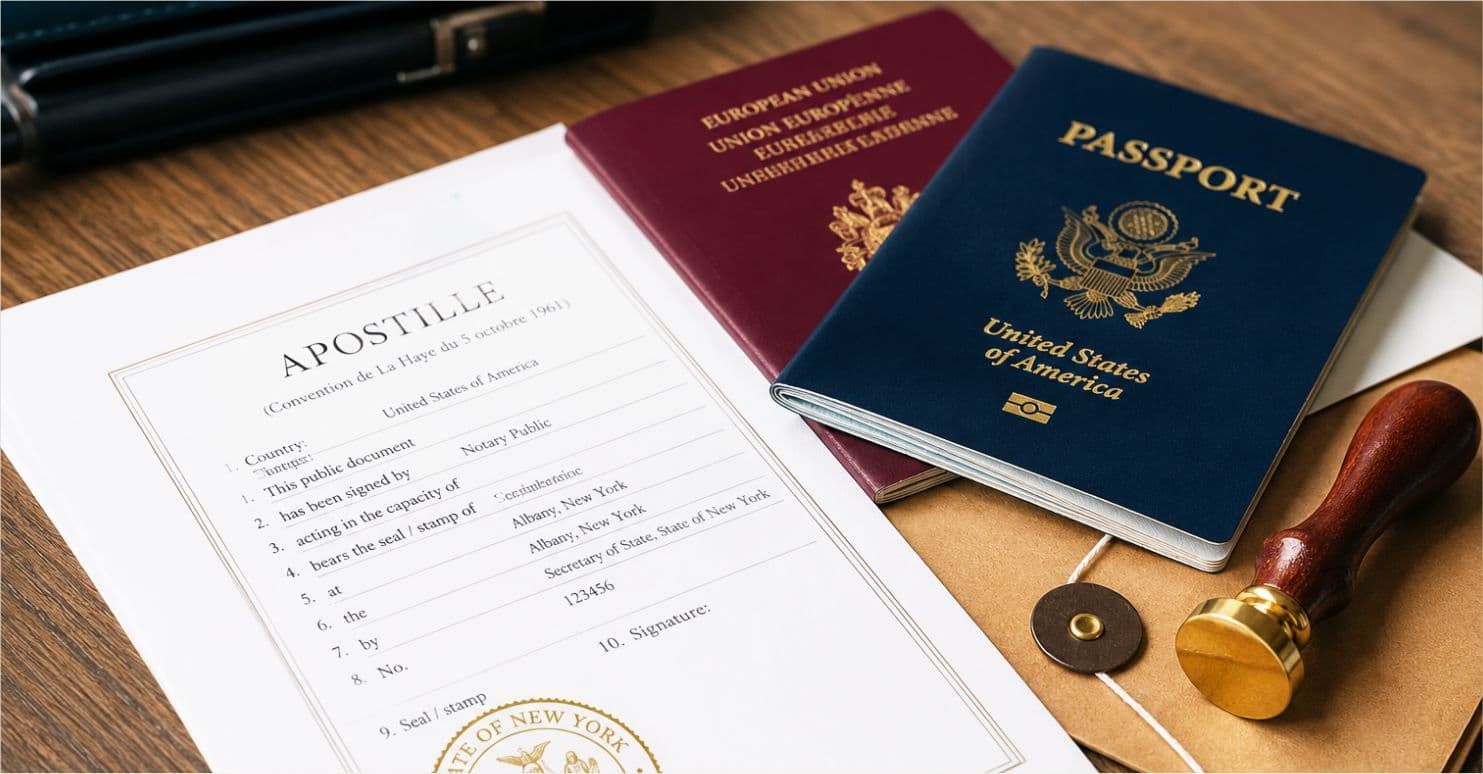
When your document comes back, you'll find a certificate attached to it, often as a separate page stapled or bound to your original. It looks essentially the same no matter which state or federal office issued it, because the format is fixed by the treaty itself. That's the whole point: an official in another country can recognize it without knowing anything about how the US government works.
You'll notice the word "Apostille" printed at the top in French, a holdover from the treaty's origins, followed by ten standard pieces of information. These cover the country of issue, who signed the original document, what position they held, which seal or stamp is on it, where and when it was certified, which authority issued the apostille, a registration number, and the signature and stamp of the certifying official.
When yours arrives, take a minute to check it over before filing it away. Confirm the country listed is the United States, that the named official matches whoever actually signed your document, and that the registration number is clearly printed and legible. Don't separate the apostille from your document, and don't staple over it, laminate it, or punch holes through it, since altering it can break the certified connection a foreign office is relying on.
If a receiving office abroad ever questions whether your apostille is genuine, that registration number is how they check. The issuing authority keeps a register of every apostille it has produced, and a phone call or, where available, an online lookup using that number is how a foreign clerk confirms it's real. This is the entire anti-fraud backbone of the system: a number, a date, and a register that anyone can verify against.
Most of the time, telling a state document from a federal one is obvious. A few document pairs cause real confusion because they sound alike or come from similarly named agencies, so it's worth calling these out directly.
A state police or state bureau of investigation background check is a state document, processed by that state's apostille authority. An FBI Identity History Summary is a federal document, processed only by the US Department of State. Some countries specifically ask for the FBI version because it's a national record, while others will accept the state-level check, so always confirm which one the destination actually wants before you order either.
2. A state tax document vs. an IRS document
A state tax clearance letter is a state record. The IRS Form 6166 confirming federal tax residency for treaty purposes is a federal record. They serve different purposes and go to entirely different offices.
3. A state court record vs. a federal court record
This one comes down to which courthouse issued the document. A state court divorce decree or judgment goes to that state's apostille authority. A federal district court record goes through the federal court process, including the Department of Justice certification step covered earlier.
4. A Consular Report of Birth Abroad vs. a regular birth certificate
If a US citizen was born overseas and the birth was registered with a US consulate, the resulting document is a federal record, issued and authenticated through the State Department's own Vital Records Section, not through any state. A regular birth certificate issued by a US state hospital or county, by contrast, is always a state document.
The rule that resolves all of these, no matter how similar the names sound, is to look at who actually signed and sealed the document. The agency's name tells you everything you need to know about where it goes.
A small number of documents fall outside the apostille system entirely, and it's worth knowing about them so you don't waste a fee trying.
Documents created by diplomats or consular officials, and paperwork dealing directly with commercial or customs transactions, are excluded by the treaty's own terms. A commercial invoice or a customs form isn't something an apostille office will process on its own; those usually go through a different certification path, often involving a chamber of commerce.
A plain photocopy with no real signature or seal has nothing for an apostille office to authenticate, so it's rejected outright rather than processed. The same goes for a document signed by someone whose signature the authority has no record of, like a notary whose commission expired years ago or who was never actually licensed in that state.
Private documents that haven't yet been made official also don't qualify. A diploma fresh out of the envelope, a company memo, or an unsigned draft of an affidavit can't be apostilled until a notary or another recognized official adds their certification. Once that step happens, it's the official's signature, not the private document itself, that becomes eligible.
A lot of countries, especially in Europe and Latin America, want your apostilled document translated into their official language before they'll accept it. This is separate from the apostille itself: the apostille proves the document is genuine, the translation makes it readable.
A document can be perfectly apostilled and still get rejected by a foreign office simply because no translation was attached, or because the translation wasn't done by someone they recognize.
This order is set by the destination country, not by you, and it goes both ways depending on where you're sending the document. Some countries want the original document apostilled first, then translated, so the translation covers both the document and the apostille. Others want the translation done and notarized first, with the apostille applied afterward to the notarized translation.
Getting this backwards can mean paying for the translation a second time, so confirm the order with the destination country's consulate or registry before you start. If you genuinely can't get a clear answer from the destination, apostilling first and translating second is the more common pattern and a reasonable default, but always try to confirm directly when you can.
A certified translation comes with a signed statement from the translator confirming it's accurate and complete. A sworn translation is a stricter version required by some countries, where the translator must be officially registered or licensed with that country's government, sometimes called a "traductor jurado" in Spanish-speaking countries or a similarly titled role elsewhere.
Always check which one your destination specifically requires, since they're not interchangeable, and a certified translation submitted where a sworn one was required will simply be turned away.
Translation requirements vary widely by country. Some accept any certified translator. Others maintain an official roster and will only accept a translation from someone on that list. Confirm this detail directly with your destination country's embassy or the receiving institution before paying for a translation, since using the wrong type of translator means doing it again. As a general pattern, civil-law countries in continental Europe and most of Latin America tend to be the strictest about sworn translators, while English-speaking Hague countries rarely require a translation at all if your original document is already in English.
Advantages
Doing it yourself is usually cheaper, since you're only paying the government fees and shipping, not a service markup. It also gives you full control and visibility over where your document is at every step, which some people find genuinely reassuring when dealing with an irreplaceable original.
Disadvantages
It takes more of your own time to research the right office, fill out the correct forms, and track the mail. If you make a routing or paperwork mistake, you're the one who has to catch and fix it, which can cost you weeks if it happens. For someone juggling multiple documents across multiple states or a non-Hague destination, the coordination alone can become a part-time job.
Advantages
A good service already knows the routing rules cold, can often hand-deliver documents to speed things up, and handles the logistics of international return shipping if you're abroad. This matters most when your situation is complicated, and it can be the difference between meeting a tight foreign deadline and missing it.
Disadvantages
You'll pay more, since the service fee sits on top of the government fee, sometimes adding a hundred dollars or more per document depending on the provider and the destination. You're also trusting someone else with your original documents, so it's worth checking reviews and confirming how they handle lost or damaged paperwork before you commit.
A service tends to be worth it when you're dealing with a federal document under a tight deadline, a non-Hague destination that needs full legalization, a stack of business documents, or a sealed adoption record that needs a court order first.
For a single notarized document going to a major Hague country, doing it yourself is usually the simpler and cheaper choice. A middle option worth knowing about: some people handle the document preparation themselves and only pay a courier or expediting service for the in-person drop-off step, splitting the difference between cost and speed.
If you're starting from scratch with about a month to work with, here's a simple way to pace yourself. In the first week, identify exactly which documents you need and confirm whether each is a state or federal document. In the second week, order any certified copies you don't already have, and get any notarizations done. In the third week, submit everything to the correct apostille authority, using walk-in service if it's available and you're in a hurry.
In the fourth week, build in buffer time for mail delays, and confirm with the receiving party abroad that everything meets their requirements before you ship it overseas. If at any point a document gets rejected and sent back, treat that as an immediate priority to fix and resubmit, since every day it sits is a day off your remaining buffer.
Immigration cases usually involve the most documents, so start with the items that take longest: certified vital records and any sealed court paperwork. Order your FBI background check closer to your filing date, since it has the strictest recency requirement of anything in a typical immigration file.
A reasonable rule of thumb is to work backward from your filing deadline: subtract your expected international shipping time, then the apostille processing time, then the time it takes to obtain the document itself, and that gives you the date you should actually start.
If you're applying to a university abroad, start your diploma and transcript notarization process at least six to eight weeks before the admissions deadline. Schools and credential evaluators can have unpredictable processing times on their end, separate from the apostille office's timeline, so build in extra room.
Some credential evaluation services also have their own intake queues that run separately from your apostille request, so check both timelines independently rather than assuming they'll run in parallel automatically.
Citizenship by descent cases often take the longest to prepare, since you may be tracking down records across multiple generations and sometimes multiple states. Start this process several months ahead if possible, especially if you suspect any of your family's older records might be hard to locate.
It often helps to request informal copies of older records first, just to confirm they exist and are legible, before paying for the certified versions you'll actually apostille.
For business filings abroad, time your certificate of good standing carefully since it has a short shelf life in most countries. Order it no more than a few weeks before you'll actually submit your full package, and apostille your other formation documents (articles of incorporation, bylaws) well ahead of time since those don't expire the same way.
If you're filing in multiple countries, coordinate your good-standing certificate order so it's still fresh by the time the slowest of your target countries actually processes the filing.
If there's one idea to walk away with, it's this: figure out whether your document is federal or state, then send it to the matching office. That single decision prevents the large majority of delays people run into with this process. From there, everything else is about details: getting the right version of the document, making sure any notary involved has a valid commission, and confirming your destination country's Hague Convention status before assuming an apostille is even the right tool for the job.
Most delays trace back to the same handful of causes covered throughout this guide: wrong office, wrong document version, missing notarization or certification, or an expired recency window on a status document like a background check. Running through the mistakes table earlier in this guide before you submit anything is the single fastest way to avoid losing weeks to a rejection and resubmission. Beyond that, always build in more time than the posted processing window suggests, especially around peak immigration and back-to-school seasons when offices tend to run behind.
Start by sorting your documents into federal and state piles, then check each state document against that state's specific rules in the directory above. From there, match each document to its preparation requirement, whether that's a certified copy, a notarization, or both, and confirm your destination country's Hague Convention status before you submit anything. If your situation involves multiple document types, a non-Hague destination, or a tight deadline, weigh whether a professional service is worth the added cost against the time and risk of handling it entirely on your own. However you approach it, the path forward is the same one this guide has walked through: identify the right office, prepare the document correctly, and give the process enough time to work.

Applying for a Schengen visa from India in 2026? Get the full process, document checklist, fees, processing times, and rejection-proof tips in one guide.

Planning a move to Portugal from the USA? Learn about visas, documents, housing, banking, taxes, healthcare, and settling in with a step-by-step guide.

Everything you need for a UK apostille in 2026 - FCDO process, fees, timelines, document types, non-Hague countries, and common rejection fixes.
Need help with your application or background check?
Contact us now and speak with a dedicated Globeia expert today.


