

Tax is the one area where getting things wrong has the most direct financial consequences. The good news is that Spain and the UK have a Double Taxation Treaty in place, which means you will not be taxed twice on the same income. But becoming a Spanish tax resident changes how and where your worldwide income is taxed, and the transition year which means the year you actually moved. This section explains the key tax concepts every UK national needs to understand before making the move.
Spain considers you a tax resident if you meet any one of the following conditions. You spend more than 183 days in Spain during a calendar year, Spain is the main base of your economic activities or business interests, or your spouse and dependent children are resident in Spain. The 183-day rule is the most straightforward trigger and the one most people are aware of, but the economic interests test means it is possible to become a Spanish tax resident even without spending the majority of your time there. Once you are a Spanish tax resident, Spain taxes your worldwide income, not just income earned in Spain.
Before you leave the UK, you need to notify HMRC that you are becoming non-resident. This is done by completing form P85 which is available on the GOV.UK website, which tells HMRC you are leaving the UK and triggers a review of your UK tax position. Getting this right matters because it determines whether you continue paying UK tax on certain income sources after you leave, and it affects your UK tax code. The UK-Spain Double Taxation Treaty governs how income is taxed between the two countries, and in most cases it determines that you pay tax in your country of residence.
However, some income sources, such as UK government pensions remain taxable in the UK regardless of where you live. A UK-based accountant with international experience can help you understand your specific position before you move.
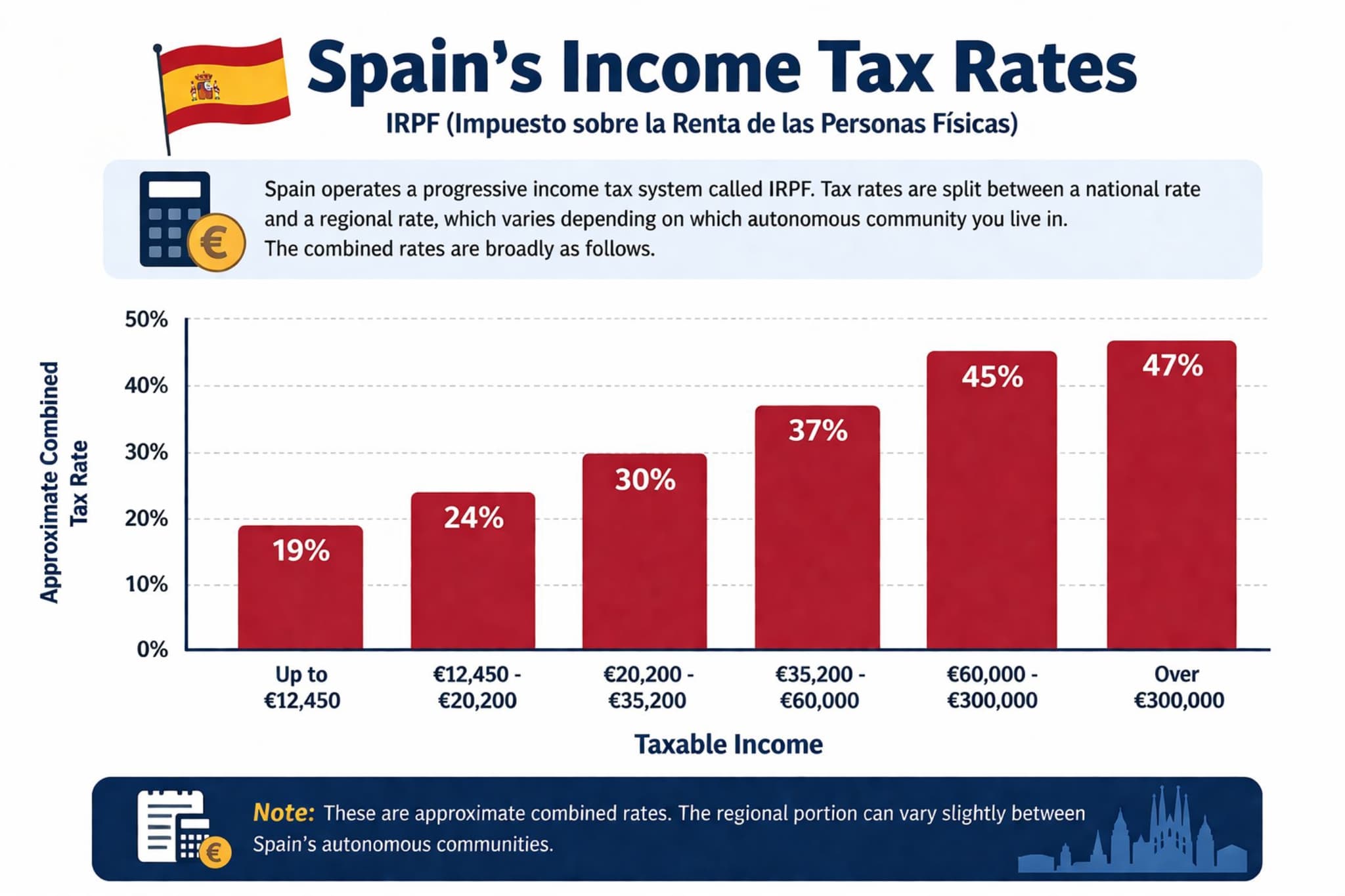
Spain operates a progressive income tax system called IRPF (Impuesto sobre la Renta de las Personas Físicas). Tax rates are split between a national rate and a regional rate, which varies depending on which autonomous community you live in. The combined rates are broadly as follows.
| Taxable Income | Approximate Combined Rate |
| Up to €12,450 | 19% |
| €12,450 - €20,200 | 24% |
| €20,200 - €35,200 | 30% |
| €35,200 - €60,000 | 37% |
| €60,000 - €300,000 | 45% |
| Over €300,000 | 47% |
These figures are a general guide and your actual tax liability will depend on your region, personal allowances, and income sources.
The Beckham Law formally known as the Regimen Especial de Impatriados, is a special tax regime that allows eligible new residents to pay a flat rate of 24% on Spanish-source income up to €600,000, rather than being taxed under Spain's standard progressive IRPF rates. It applies for the year of arrival plus the following five tax years, giving you up to six years of favourable tax treatment.
Who qualifies this law?
To be eligible you must not have been a Spanish tax resident in the five years prior to moving to Spain, you must move to Spain as a result of an employment contract, a job offer, or the acquisition of a management role in a company, or you must be a Digital Nomad Visa holder. The Beckham Law was extended to Digital Nomad Visa holders as part of Spain's Startup Act in 2023, which broadened its appeal for remote workers.
How to apply?
You must apply within six months of registering with Spanish social security. This deadline is absolute and there are no extensions and no exceptions. The application is made using form 149 submitted to the Spanish Tax Agency. Missing this window means losing the benefit for your entire stay, which for higher earners can represent a very significant financial loss.
The UK and Spain have a Double Taxation Treaty which determines which country has the right to tax specific types of income. The broad principle is that once you are a Spanish tax resident, most of your income is taxed in Spain. However there are important exceptions. UK government service pensions paid to former civil servants, military personnel, police, and teachers, remain taxable only in the UK regardless of your Spanish residency.
UK state pension income is taxable in Spain as a resident. UK rental income is taxable in both countries in principle, but the DTT provides for relief so you are not paying full tax in both- you declare it in both countries and claim credit for tax already paid. Private pension and annuity income is generally taxable only in your country of residence, meaning Spain once you are resident there. The treaty is detailed and income-specific, and understanding exactly how it applies to your personal income mix requires professional advice rather than a general overview.
If you hold assets outside Spain including UK bank accounts, property, investments, pension funds, or shares with a combined value exceeding €50,000, you are required to declare them to the Spanish tax authorities using Modelo 720. This is an informational declaration rather than a tax charge, but failing to submit it or submitting it incorrectly has historically attracted penalties in Spain. The declaration is submitted once initially and then only needs updating when asset values change by more than €20,000 from the previously declared figure. For most British people moving to Spain with UK property, savings, or pension pots, Modelo 720 will apply and should be factored into your first-year tax planning.
A gestor is a licensed administrative and tax professional unique to Spain - somewhere between an accountant, a tax advisor, and an administrative agent. For most British people in their first year in Spain, a gestor is not optional in any practical sense. They file your annual Spanish tax return, handle Modelo 720 declarations, register you with the Spanish tax authority, and deal with the considerable volume of administrative paperwork that the Spanish bureaucracy generates.
Fees for a straightforward annual tax return range from €150 to €400. For more complex situations involving multiple income sources, UK property, or pension income the fee will be higher but remains reasonable relative to the cost of getting it wrong. Finding a gestor who has experience working with British expats and ideally speaks English is worth prioritising - most major expat areas in Spain have several to choose from.
Need help with your application or background check?
Contact us now and speak with a dedicated Globeia expert today.

