

Not every British person moving to Spain has the same situation, and the visa that works perfectly for a retired couple in their sixties looks nothing like the right option for a 32-year-old freelance designer. Before diving into each visa individually, use this overview table to find where you likely belong then read that section in full.
| Visa Type | Best For | Min. Income / Investment | Can You Work? | Initial Duration |
| Non-Lucrative | Retirees, passive income holders | ~€28,800/yr (single) | No | 1 year |
| Digital Nomad | Remote workers, contractors | ~€2,849/month | Yes (non-Spanish clients) | 1 year |
| Work Visa | Those with a Spanish job offer | Employer-dependent | Yes | 1 year |
| Self-Employment | Freelancers, autonomous | Viable business plan + funds | Yes | 1 year |
| Student Visa | Full-time students | Proof of enrollment + funds | Limited (30hrs/week) | Course length |
| Family Reunification | Joining a legal Spanish resident | Sponsor's income threshold | Depends on permit | 1 year |
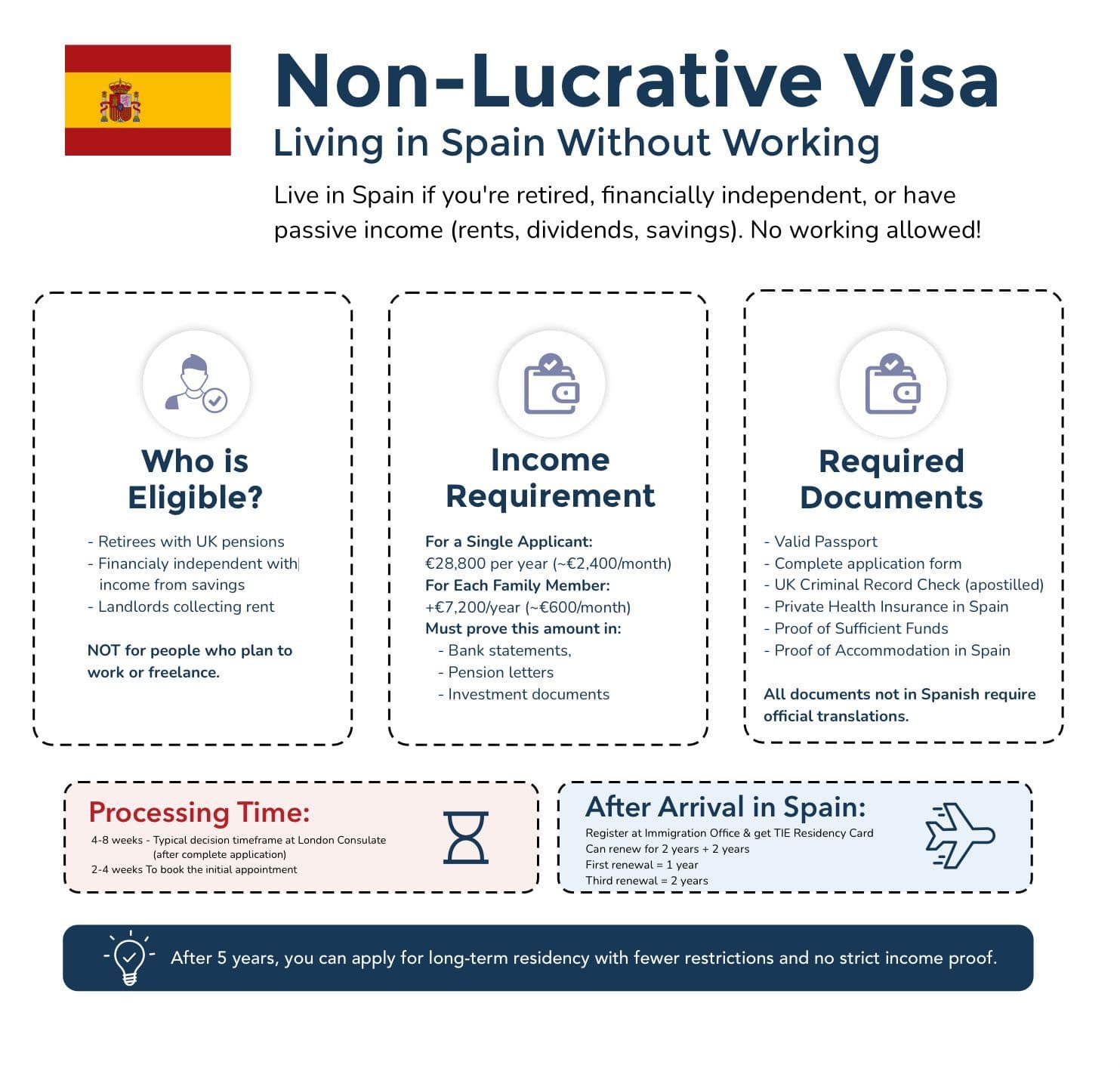
The Non-Lucrative Visa is the most commonly used route for British people moving to Spain who are retired, financially independent, or living off passive income such as rental earnings, dividends, or savings. The core idea of this visa is that Spain will allow you to live, provided you can prove you won't need to work to support yourself. In exchange, you are legally prohibited from taking up any employment or running a business while on this visa.
Who does it actually suit?
This visa is best suited to retirees, people with substantial savings or investment income, and anyone whose income arrives without them actively working - UK pension recipients, landlords collecting rent from UK properties, or those drawing down from an investment portfolio. It is not suitable for anyone who intends to work, consult, or freelance in any capacity.
What does Spain require financially?
The income threshold is tied to Spain's IPREM and is updated periodically. The requirement for a single applicant is approximately €28,800 per year, which works out to roughly €2,400 per month. For each additional family member included in the application, you add approximately 25% of that base figure. These figures need to be demonstrated through bank statements (typically the last 3-6 months), pension letters, investment statements, or a combination of sources. Passive income is acceptable but active employment income from a Spanish source is not.
Documents you will needing
Applications are submitted to the Spanish Consulate in the UK in London, Edinburgh, or Manchester depending on where you live. The core document list includes a valid passport with at least one year's validity remaining, a completed national visa application form, two recent passport photographs, a UK criminal record certificate issued within the last three months and apostilled, proof of sufficient financial means, proof of private health insurance with a Spanish-authorised provider, proof of accommodation in Spain (rental contract or property deed), and the consulate fee (currently around €80). Every document not originally in Spanish must be translated by a sworn translator. UK documents such as the criminal record certificate must carry an apostille stamp - this is a form of official authentication that can be obtained through the FCDO's Legalisation Office in the UK.
Realistic Processing Times
The official processing window is up to 3 months, but most applicants at the London Consulate receive a decision within 4-8 weeks, provided the application is complete. Incomplete applications are the biggest cause of delays. Booking the consulate appointment itself can take 2-4 weeks, so factor that into your timeline.
What happens after you arrive in Spain?
Once you land in Spain with your NLV, you have 30 days to register with the Oficina de Extranjería (Immigration Office) in your province and apply for your TIE card. The TIE is your physical residency card and the document you will use for almost every administrative process in Spain for opening a bank account, registering with a doctor, signing a rental contract, and more. You will also need to register on the Padron Municipal at your local town hall, which officially records you as a resident of that municipality.
Renewal and the long-term path
The initial NLV is valid for one year. After that, you renew for two years, then two years again. After five continuous years of legal residency in Spain, you become eligible to apply for long-term residency, which removes most restrictions and does not require you to keep proving income at the same threshold.
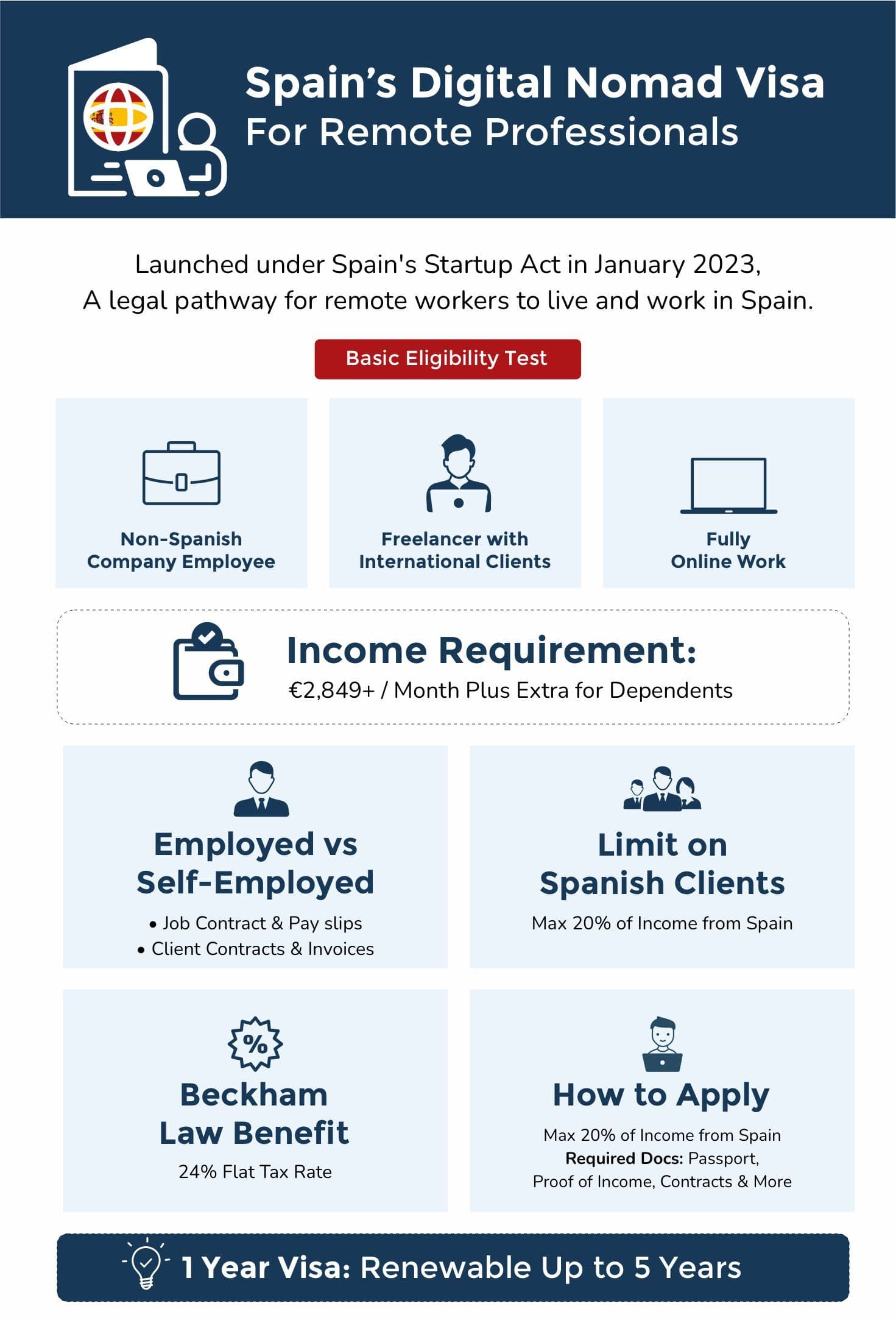
Launched under Spain's Startup Act in January 2023, the Digital Nomad Visa filled a gap that had become impossible to ignore. Thousands of people were already working remotely from Spain on tourist visas - technically illegal, financially risky, and leaving them with no legal residency status. The visa formalised what was already happening and gave remote workers a legitimate path to live and work in Spain without needing a Spanish employer.
Basic Eligibility Test
To qualify, you must be employed by or contracted to a company or companies based outside Spain, or work as a freelancer for clients based outside Spain. Your work must be capable of being done entirely online. The visa is explicitly designed for people whose professional life exists in the digital space - developers, designers, writers, marketers, consultants, project managers, and similar roles.
Income Threshold
The minimum income requirement is set at 200% of Spain's monthly minimum wage. Spain raised its minimum wage, making the Digital Nomad Visa income threshold approximately €2,849 per month. If you are bringing a spouse or partner, add 75% of the minimum wage for them. Each dependent child adds 25% of the minimum wage. These are minimums - consulate officers look at your actual income stability and contract terms, not just whether you technically clear the threshold.
Employed vs Self-employed Applicants
If you are employed by a UK company and working remotely, your application will centre on your employment contract, recent payslips, and a letter from your employer confirming the remote working arrangement and that the company is registered and operating outside Spain. If you are a freelancer or contractor, you will need to demonstrate existing contracts with non-Spanish clients, invoicing history, and evidence that your freelance activity is established rather than newly started. New freelancers with limited track records will find this harder to demonstrate convincingly.
One Important Rule on Spanish Clients
The Digital Nomad Visa does permit you to work for Spanish-based clients or companies, but this cannot exceed 20% of your total income. This rule exists to prevent the visa from being used as a backdoor work permit for those essentially working full-time for Spanish employers. In practice, most DNV holders keep their Spanish income well below this threshold.
How to Apply
Like the NLV, you apply at the Spanish Consulate in the UK before travelling. You can also apply from within Spain if you are already there on a valid short stay, which gives you some flexibility if you want to test the location first. The in-country application route goes through the Unidad de Grandes Empresas (UGE-CE), a specialist unit that handles DNV applications and tends to be faster than local Extranjería offices. Documents required include your passport, criminal record check (apostilled), proof of income, employment contract or client contracts, health insurance, and proof of accommodation.
Advantage of Beckham Law
This is the most important financial aspect of the Digital Nomad Visa. Holders of the DNV can apply for the Beckham Law , a special tax regime that taxes your Spanish-source income at a flat rate of 24% rather than Spain's progressive income tax rates, which climb to 47% at the top end. It applies for the year of arrival plus five subsequent years. For higher earners especially, this can represent a substantial annual saving compared to being taxed as a standard Spanish resident. Application for the Beckham Law regime must be made within six months of registering for Spanish social security. It is not automatic, you have to actively apply.
Validity and Renewals
The initial DNV is issued for 1 year. After that, you can renew for three years, then renew again. After 5 years of continuous legal residency in Spain, the same long-term residency pathway available to NLV holders opens up.
The standard work visa is the route for British people who have secured employment with a Spanish company and are being sponsored by that employer.
What is the Labour Market Test?
Spain requires employers to demonstrate that no suitable candidate from within the EU was available for the role before they can hire a third-country national. This process can take several weeks and adds a layer of administrative burden that many smaller Spanish employers simply don't want to deal with. This means the work visa route tends to work best for multinational companies already familiar with sponsoring foreign workers, specialised roles with demonstrable skill shortages, or senior positions where the specific individual's qualifications are the clear justification.
How Does the Process Work?
The employer initiates the work permit application in Spain, it is not something you apply for directly as the employee. Once the Spanish authorities approve the work permit, you then apply for the corresponding visa at the Spanish Consulate in the UK. The full process takes 3-6 months from start to finish, which means both you and your employer need to plan well ahead.
Sectors where it is needed most
Technology, engineering, healthcare, finance, and education (particularly English teaching through official programmes) are the areas where UK nationals most commonly succeed with this route. Spain has published lists of occupations with labour shortages where the market test is simplified, checking whether your profession appears on this list before pursuing the route is a worthwhile early step.
For those who want to work in Spain but don't have a Spanish employer, the self-employment visa is the alternative. This route suits people who are establishing their own business in Spain, offering professional services to Spanish clients, or setting up as sole traders operating locally.
Critical distinction from DNV
This is where many people get confused. If your clients and income are based outside Spain, the Digital Nomad Visa is almost certainly the better fit. The autonomo/self employed visa is designed for people actively working within the Spanish market like a personal trainer with Spanish clients, a builder taking local contracts, a therapist with a Spanish client base, or someone opening a restaurant. If you are working for Spanish people or Spanish businesses, this is your route. If your work is entirely remote and international, the DNV is cleaner.
Application Requirements
You need to present a genuine business plan demonstrating viability in the Spanish market, proof that you hold any professional qualifications or licences required for your activity in Spain, evidence of sufficient funds to support yourself during the establishment period, and private health insurance. The business plan is assessed by the consulate and needs to be credible. Vague plans with unrealistic revenue projections are a common reason applications fail.
Autonomo social security
Once in Spain as a self-employed worker, you register as autonomo and pay monthly social security contributions. As of 2025, Spain operates a new contribution system where autónomos pay based on their actual net income rather than a flat rate.
Spain is an increasingly popular destination for British students, whether for full degree programmes, language courses, or postgraduate study. The student visa is more straightforward than most other routes but comes with its own specific conditions.
Core Requirements
You need a confirmed letter of acceptance from a recognised Spanish educational institution, proof that the course is full-time (part-time courses generally do not qualify), evidence of sufficient funds to cover tuition and living costs without working, and private health insurance. The financial threshold for student visas is lower than other routes.
Working While Studying
Student visa holders can work part-time in Spain, but only up to 30 hours per week and only in activities that do not interfere with their studies. This has been a consistent rule but the enforcement approach and specific conditions are worth confirming at your consulate appointment, as interpretation can vary.
Using study as a longer-term residency strategy
Some people use the student visa as an entry point into Spain with the intention of transitioning to a work or self-employment visa once their studies are complete. This is a legitimate path and Spanish immigration law does allow for in-country status changes under certain conditions, though it requires careful planning and ideally legal advice to execute cleanly.
If you have a family member who is already a legal resident in Spain whether a Spanish national, an EU citizen resident, or a British expat with established residency, the family reunification visa allows you to join them. Sponsors can bring a spouse or registered partner, dependent children and dependent parents. The definition of "dependent" is taken seriously. You need to demonstrate financial or care dependency, not simply a family relationship.
What the sponsor must prove?
The resident family member applying to bring you to Spain must demonstrate that they have sufficient income to support the family unit. A multiple of the IPREM index based on family size and adequate accommodation. The sponsor's own residency status must be stable and in good standing.
Important note:
If you are joining a British family member who holds residency in Spain under the Withdrawal Agreement (pre-2021 residency), the rules for family reunification may differ from joining someone who arrived post-2021 under the new visa system. The Withdrawal Agreement has specific provisions around family reunification that are more favourable in some respects. Getting this distinction right is worth a consultation with an immigration lawyer before applying.This is one of the least talked-about visa options available to UK citizens, and it solves a very real problem. What do you do if you want to move to Spain for work but haven't secured a job offer yet? The standard work visa requires an employer to sponsor you before you travel. Spanish employers are often reluctant to go through the sponsorship process for someone still based in the UK, but you can't easily attend interviews, build local contacts, or demonstrate commitment from thousands of miles away.
Spain's Job Seeker Visa addresses this directly. It allows you to enter and remain in Spain legally for a defined period while you look for employment for self-employment without needing a job offer or business in place at the point of application.
Who this visa is designed for?
It is best suited to professionals with demonstrable qualifications and work experience who have a credible, realistic case for finding employment in Spain. This is not a visa for recent graduates with no track record or for people who simply want to try Spain out. The consulate wants to see that you have genuine employability in the Spanish market - either through your qualifications, language skills, sector experience, or some combination of the three.
What do you need to apply?
The requirements include a valid passport, proof of sufficient funds to support yourself during the job search period , private health insurance, a clean criminal record with apostille, and a personal statement or CV demonstrating your professional background and why you have realistic prospects of finding work or establishing a business in Spain. Some consulates also ask for evidence of active job searching - LinkedIn profiles, applications made, contacts in Spain, or sector-specific credentials.
Duration
The Job Seeker Visa is valid for up to 12 months. It does not automatically convert into a work permit- if you find employment during this period, your employer then initiates the work permit process. If you decide to go self-employed instead, you transition into the autónomo route. Planning the next step before the job seeker period expires is essential - leaving it too late creates a legal gap in your status.
For British professionals working at a multinational company with offices or subsidiaries in Spain, the Intra-Company Transfer Visa (ICT) is frequently the fastest route to legal residency and it is almost completely overlooked in most expat guides.
If your employer is relocating you to their Spanish office, or if you are requesting an internal transfer to work in Spain, this visa was built for exactly that situation. Rather than going through the standard labour market test that applies to external hires, the ICT route operates on the basis that you are already an established employee being moved within the same corporate structure.Who Qualifies
The visa applies to managers and executives, specialists with advanced technical knowledge or expertise critical to the company's operations, and trainees being moved as part of structured development programmes. You must have been employed by the company for a minimum of 3 months prior to the transfer request. The role you are moving into in Spain must fall into one of these categories, it cannot be a general or entry-level position.
How does the process work?
Unlike the standard work visa where the Spanish employer carries the administrative burden, the ICT application is handled jointly between the HR departments of the sending and receiving entities. The Spanish company files the application with the immigration authorities, and once approved, you apply for the visa at the Spanish Consulate in the UK. Because the labour market test is waived, processing times are generally faster than the standard work visa route.
Duration and Renewal
The ICT permit is initially issued for 1 year, or for the duration of the transfer if shorter. It can be renewed for up to 3 years for managers and specialists. Importantly, it also covers family members- your spouse or partner and dependent children can be included in the application and are entitled to work in Spain during the transfer period, which is an advantage over some other visa types.
Spain operates an accelerated immigration pathway for professionals in occupations where there is a recognised national shortage of qualified workers. This sits within the broader work visa framework, it shortens the labour market test that makes the standard work visa so cumbersome.
How Spain identifies shortage occupations?
The Spanish Public Employment Service (SEPE) publishes and periodically updates a catalogue of hard-to-fill occupations or sectors where demand consistently outpaces the available pool of EU workers. As of 2025, this list includes roles across technology and software development, healthcare and nursing, engineering disciplines, construction and skilled trades, maritime professions, and certain areas of education. If your profession appears on this list, your employer's path to sponsoring you is meaningfully shorter.
What does "highly skilled" mean?
Spain also participates in the EU Blue Card scheme, which provides a residence and work permit for highly qualified non-EU nationals. To qualify for the Blue Card in Spain, you need a university degree or equivalent higher education qualification and a binding job offer with a salary of at least 1.5 times the average gross annual salary in Spain which works out to approximately €40,000 per year. The Blue Card is issued for up to 3 years and is renewable, and it comes with the added benefit of facilitating mobility across other EU member states after 18 months of holding it.
Why does this route matter for UK professionals?
Post-Brexit, the EU Blue Card is now accessible to British nationals in a way it was not before when the UK was in the EU, its citizens had no need for it. For qualified professionals in the right fields earning above the salary threshold, it is the most straightforward work-based route to Spanish residency, particularly in the technology and healthcare sectors where Spanish employers are actively recruiting internationally. If you hold a relevant degree, work in a shortage sector, and have a Spanish employer willing to offer the qualifying salary, this route deserves serious consideration.
Spain's Golden Visa no longer exists and there is an amount of outdated information still circulating online. Several well-known expat blogs, YouTube channels, and guides still describe the Golden Visa as a live option. The Spanish government under Prime Minister Pedro Sanchez formally abolished the programme in early 2025, with the stated reason being the housing affordability crisis in major Spanish cities. The argument was straightforward, allowing wealthy foreign nationals to effectively buy residency through property was inflating prices in cities like Madrid, Barcelona, Valencia, and Malaga, pricing local residents out of the market.
The Golden Visa had been under political pressure since 2023 when abolition was first announced, and after clearing the necessary legislative process, it was closed. If you have landed on this guide after reading or watching something that recommends the Golden Visa as your route to Spanish residency, that content is out of date. For the overwhelming majority of British people wanting to move to Spain, the Non-Lucrative Visa, Digital Nomad Visa, or one of the work-based routes covered in this section are the relevant options.
Need help with your application or background check?
Contact us now and speak with a dedicated Globeia expert today.

