
By Ayushi Trivedi · Updated September 11, 2026
Reviewed by Vasu Singla
Brexit changed everything. What was once as simple as packing your bags and booking a flight now involves visa applications, income thresholds, apostilled documents, and decisions that if you get them wrong, can cost you months of delays or outright rejection. But the truth is thousands of British people are still making the move to Spain every single year, and with the right information, the process is far more manageable than it looks at first glance. This guide covers everything you need to know - from choosing the right visa for your situation to the step-by-step process of getting your TIE card, understanding how Spanish taxes work for UK residents, accessing healthcare, and eventually working towards permanent residency or Spanish citizenship. Whether you want to go to the Costa del Sol, work remotely from Barcelona, or relocate your whole family for a better quality of life, reading this guide you will learn how to move from the UK to Spain.
Before 2021, moving to Spain as a British citizen required nothing more than a decision. Brexit ended that entirely. UK nationals are now treated the same as any non-EU citizen which means visas, income thresholds, and a formal application process that did not exist before, for a move that millions of British people made freely for decades.
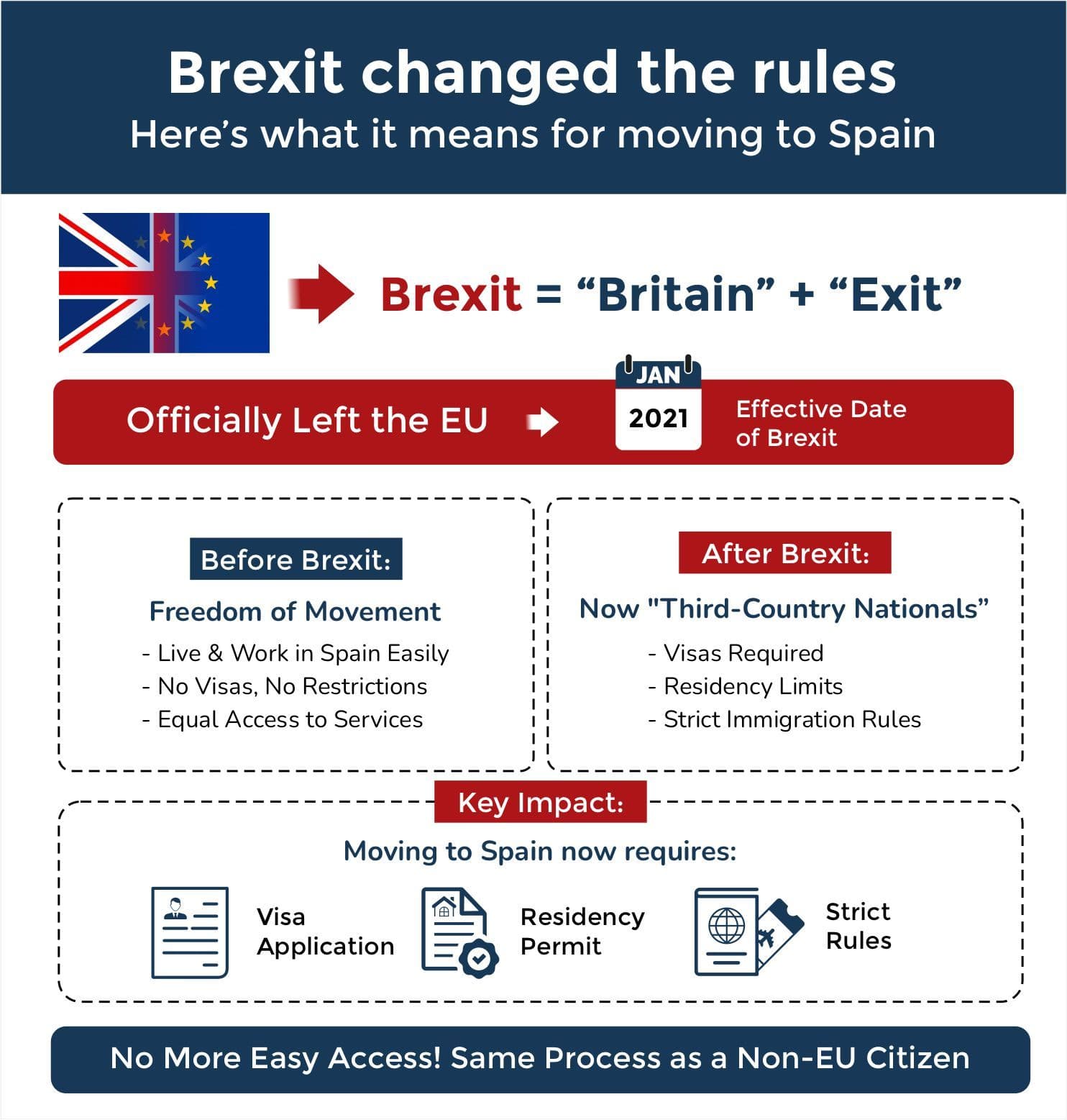
Brexit is the term used for the United Kingdom's decision to leave the European Union. The word is a blend of "Britain" and "exit." The UK voted in a referendum in June 2016 to leave the EU, and after years of political negotiations, the departure officially took effect on January 1, 2021. Before that date, the UK was a full member of the European Union.
Freedom of movement meant that any British citizen could pack up, move to any EU country including Spain, live there indefinitely, work without any special permission, and access public services like healthcare and education on the same terms as local citizens. No visa. No income thresholds. No paperwork beyond registering your address. Millions of British people took advantage of this over the decades.
When the UK left the EU, that freedom of movement ended. Britain negotiated its own separate deal with the EU - the Trade and Cooperation Agreement but it did not include freedom of movement for individuals. From January 1, 2021, British citizens became what immigration law calls "third-country nationals" in Spain, meaning they are treated the same way as someone arriving from the United States, Canada, or Australia. You are welcome to visit, but living there long-term now requires going through a formal visa process - the same as any non-EU citizen would. That is the single most important thing Brexit changed for anyone in the UK who wants to make Spain their home.
The 90/180-Day Rule Explained
If you've heard people say "you can only stay 90 days in Spain now," that's technically true but it's only half the picture, and misunderstanding it leads to a lot of unnecessary panic. Since January 1, 2021, UK citizens are subject to the Schengen Area's 90/180-day rule, which means you can spend a maximum of 90 days in any rolling 180-day period across the entire Schengen Zone without a visa. This isn't 90 days per country, it's 90 days across all 29 Schengen member states combined. So if you spent three weeks in France and two weeks in Portugal, those days count against your Spain allowance too. The rule applies to tourism, casual visits, and short stays. The moment you want to stay longer than 90 days, work, or establish your life in Spain, you need a long-stay visa. There are no grey areas, and border checks have become more thorough since Brexit.
What Rights Were Protected - The Withdrawal Agreement
Not everything changed overnight, and this is a critical point that many guides don't include. The UK-EU Withdrawal Agreement protected the rights of British citizens who were already legally resident in Spain before December 31, 2020. If you were living in Spain with registered residency (a green NIE certificate or TIE card) before that date, you fall under the Withdrawal Agreement and your rights are substantially preserved. You can continue to live, work, and access services in Spain under broadly the same conditions as before Brexit. You were required to exchange your old green residency certificate for the new biometric TIE card (Tarjeta de Identidad de Extranjero) - a process that was supposed to be completed by the end of June 2021. If you were resident before the cut-off but never made the switch, it is still worth seeking legal advice, as your status may be more complicated now. For everyone who arrived after January 1, 2021, the Withdrawal Agreement does not apply - the new visa system is the only route.
UK vs EU Citizens Moving to Spain
The contrast between what an EU citizen and a UK citizen can do when moving to Spain is stark, and understanding it removes any remaining confusion about why a visa is now required.
| Factor | EU Citizen | UK Citizen (Post-Brexit) |
| Visa required? | No | Yes (for stays over 90 days) |
| Right to work immediately? | Yes | Only with work-authorised visa |
| Public healthcare access | Yes (automatic) | Via S1 form, insurance, or employment |
| Time to apply before moving | None | 1-3 months minimum |
| Freedom of movement | Full Schengen | 90/180-day rule applies |
| Path to residency | EU registration certificate | TIE card via long-stay visa |
| Driving licence exchange | Not required | Required after 6 months residency |
| Voting rights (local elections) | Yes | No |
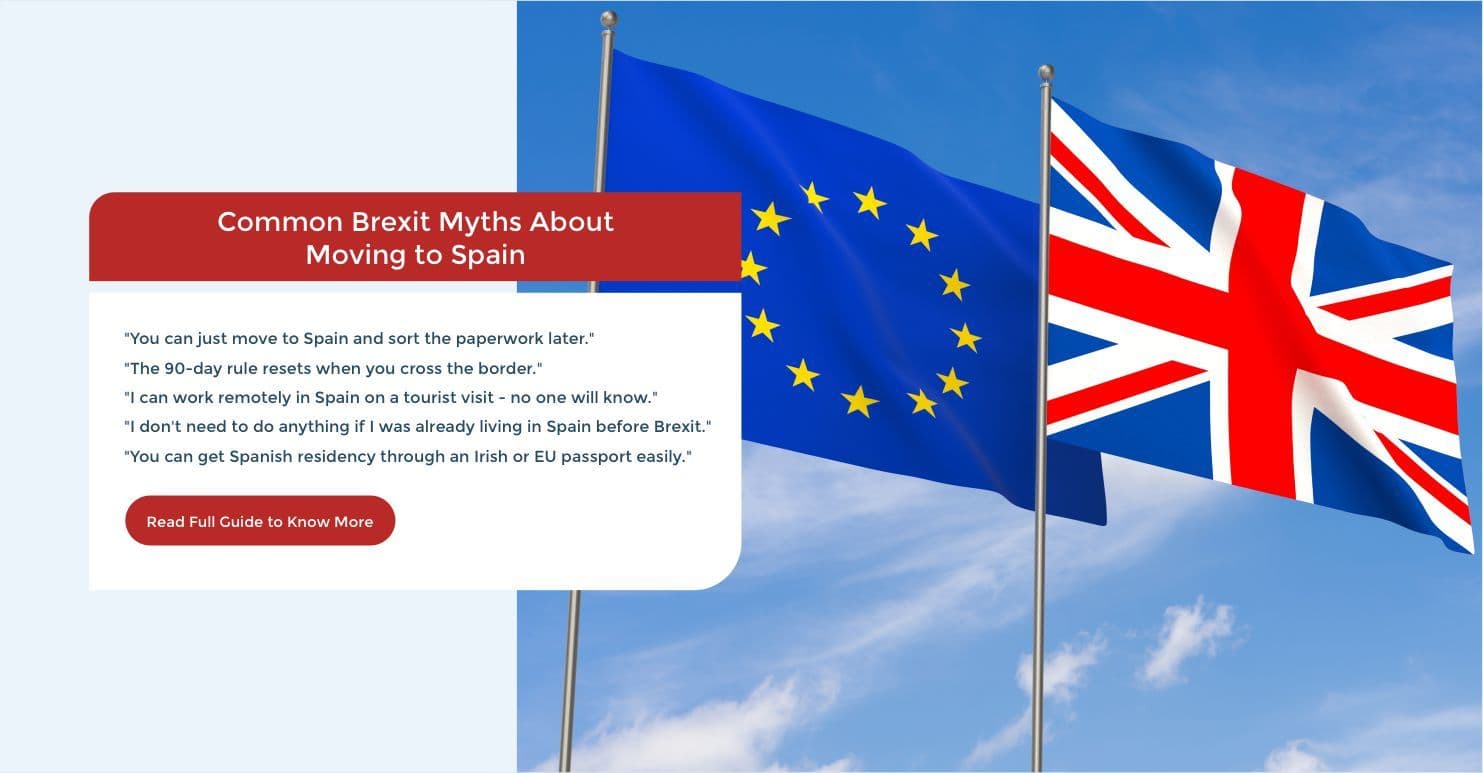
There's an enormous amount of outdated and wrong information circulating online about British people moving to Spain.
"You can just move to Spain and sort the paperwork later."
False. You must apply for and receive your long-stay visa from the Spanish Consulate in the UK before you travel. You cannot enter Spain as a tourist and then switch to a long-stay visa while already there. Attempting to do so will almost certainly result in your application being rejected and potentially complicating your immigration history.
"The 90-day rule resets when you cross the border."
False. The 90/180-day calculation is a rolling window, not a calendar reset on January 1. Spanish border authorities calculate it backward from any given date across the entire Schengen Area.
"I can work remotely in Spain on a tourist visit - no one will know."
Legally, this is working without authorisation in Spain, even if your employer and clients are based entirely in the UK. Tax residency rules also mean that if you spend more than 183 days in Spain in a calendar year, you become a Spanish tax resident regardless of whether you have a visa. The Spanish Digital Nomad Visa exists precisely to address this situation legitimately.
"I don't need to do anything if I was already living in Spain before Brexit."
Pre-Brexit residents are protected under the Withdrawal Agreement, but you were required to exchange your old green residency certificate for the new biometric TIE card. If you haven't done this, your legal position in Spain may be uncertain and you should take advice from an immigration lawyer.
"You can get Spanish residency through an Irish or EU passport easily."
If you hold dual UK-Irish citizenship and have a valid Irish passport, you do have full EU freedom of movement rights in Spain. However, obtaining an Irish passport solely as a workaround is a legal process in itself. It requires documented Irish ancestry and can take a year or more. It is not a quick fix, though it is a legitimate path worth exploring if you have Irish heritage.
Not every British person moving to Spain has the same situation, and the visa that works perfectly for a retired couple in their sixties looks nothing like the right option for a 32-year-old freelance designer. Before diving into each visa individually, use this overview table to find where you likely belong then read that section in full.
| Visa Type | Best For | Min. Income / Investment | Can You Work? | Initial Duration |
| Non-Lucrative | Retirees, passive income holders | ~€28,800/yr (single) | No | 1 year |
| Digital Nomad | Remote workers, contractors | ~€2,849/month | Yes (non-Spanish clients) | 1 year |
| Work Visa | Those with a Spanish job offer | Employer-dependent | Yes | 1 year |
| Self-Employment | Freelancers, autonomous | Viable business plan + funds | Yes | 1 year |
| Student Visa | Full-time students | Proof of enrollment + funds | Limited (30hrs/week) | Course length |
| Family Reunification | Joining a legal Spanish resident | Sponsor's income threshold | Depends on permit | 1 year |
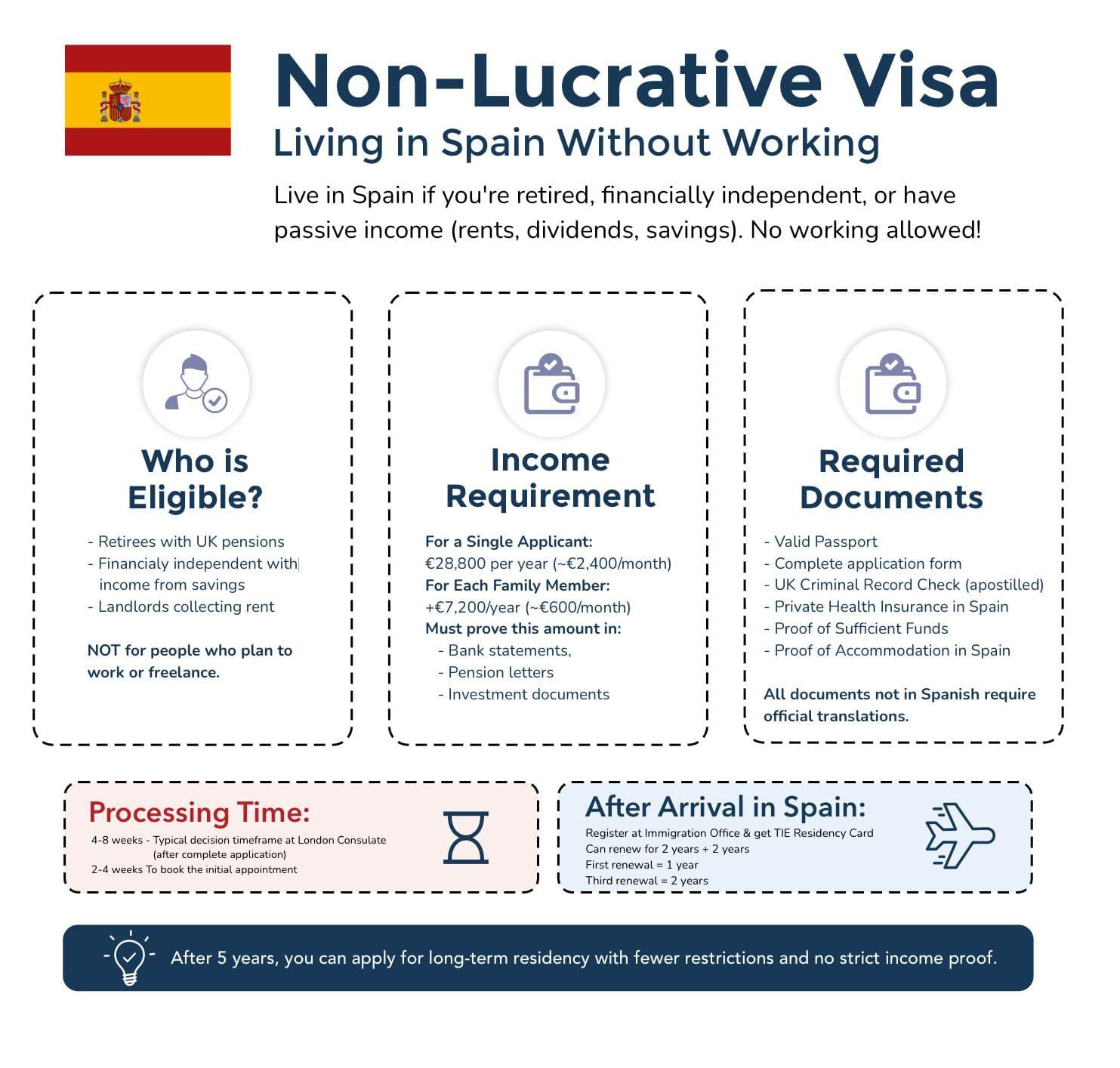
The Non-Lucrative Visa is the most commonly used route for British people moving to Spain who are retired, financially independent, or living off passive income such as rental earnings, dividends, or savings. The core idea of this visa is that Spain will allow you to live, provided you can prove you won't need to work to support yourself. In exchange, you are legally prohibited from taking up any employment or running a business while on this visa.
Who does it actually suit?
This visa is best suited to retirees, people with substantial savings or investment income, and anyone whose income arrives without them actively working - UK pension recipients, landlords collecting rent from UK properties, or those drawing down from an investment portfolio. It is not suitable for anyone who intends to work, consult, or freelance in any capacity.
What does Spain require financially?
The income threshold is tied to Spain's IPREM and is updated periodically. The requirement for a single applicant is approximately €28,800 per year, which works out to roughly €2,400 per month. For each additional family member included in the application, you add approximately 25% of that base figure. These figures need to be demonstrated through bank statements (typically the last 3-6 months), pension letters, investment statements, or a combination of sources. Passive income is acceptable but active employment income from a Spanish source is not.
Documents you will needing
Applications are submitted to the Spanish Consulate in the UK in London, Edinburgh, or Manchester depending on where you live. The core document list includes a valid passport with at least one year's validity remaining, a completed national visa application form, two recent passport photographs, a UK criminal record certificate issued within the last three months and apostilled, proof of sufficient financial means, proof of private health insurance with a Spanish-authorised provider, proof of accommodation in Spain (rental contract or property deed), and the consulate fee (currently around €80). Every document not originally in Spanish must be translated by a sworn translator. UK documents such as the criminal record certificate must carry an apostille stamp - this is a form of official authentication that can be obtained through the FCDO's Legalisation Office in the UK.
Realistic Processing Times
The official processing window is up to 3 months, but most applicants at the London Consulate receive a decision within 4-8 weeks, provided the application is complete. Incomplete applications are the biggest cause of delays. Booking the consulate appointment itself can take 2-4 weeks, so factor that into your timeline.
What happens after you arrive in Spain?
Once you land in Spain with your NLV, you have 30 days to register with the Oficina de Extranjería (Immigration Office) in your province and apply for your TIE card. The TIE is your physical residency card and the document you will use for almost every administrative process in Spain for opening a bank account, registering with a doctor, signing a rental contract, and more. You will also need to register on the Padron Municipal at your local town hall, which officially records you as a resident of that municipality.
Renewal and the long-term path
The initial NLV is valid for one year. After that, you renew for two years, then two years again. After five continuous years of legal residency in Spain, you become eligible to apply for long-term residency, which removes most restrictions and does not require you to keep proving income at the same threshold.
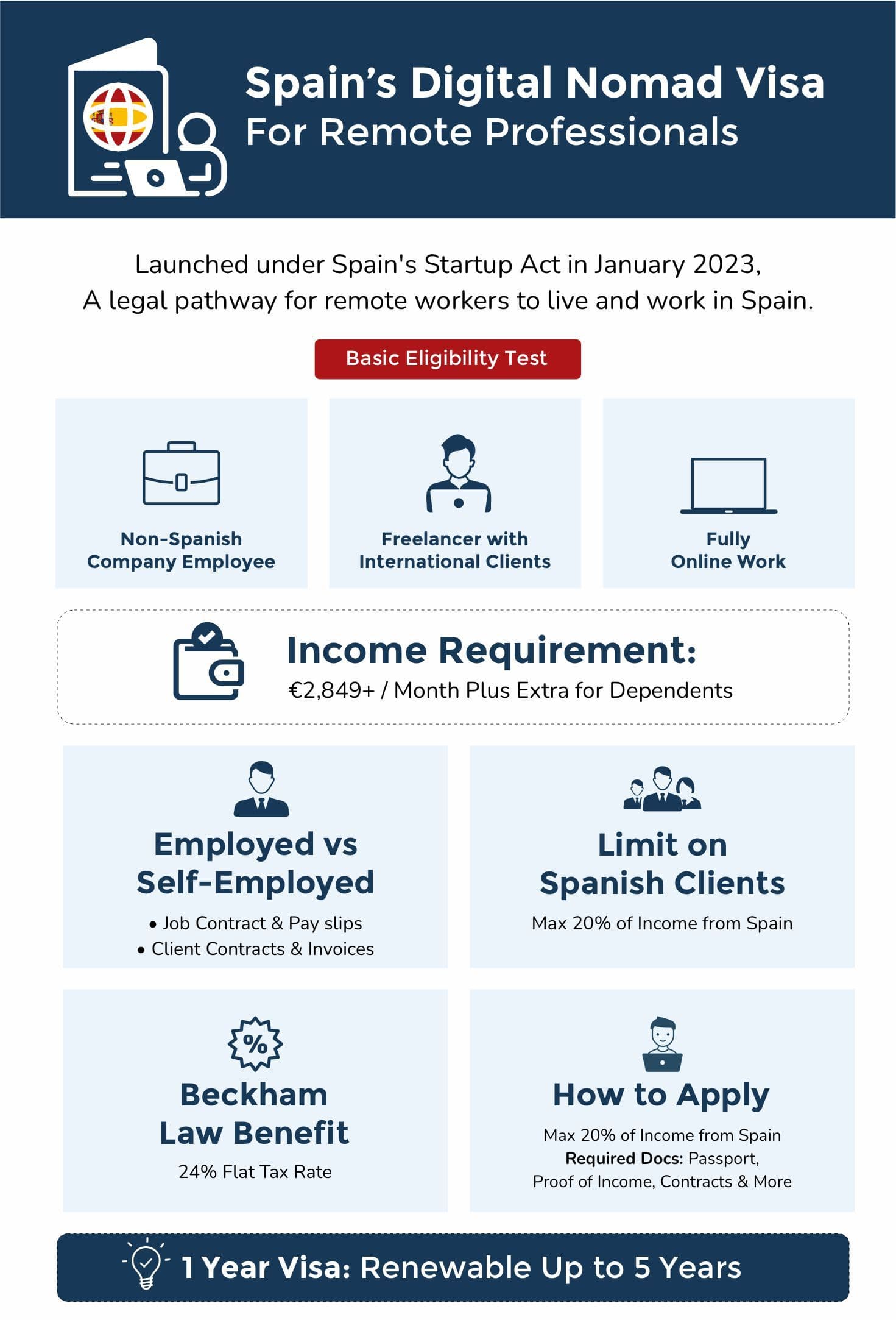
Launched under Spain's Startup Act in January 2023, the Digital Nomad Visa filled a gap that had become impossible to ignore. Thousands of people were already working remotely from Spain on tourist visas - technically illegal, financially risky, and leaving them with no legal residency status. The visa formalised what was already happening and gave remote workers a legitimate path to live and work in Spain without needing a Spanish employer.
Basic Eligibility Test
To qualify, you must be employed by or contracted to a company or companies based outside Spain, or work as a freelancer for clients based outside Spain. Your work must be capable of being done entirely online. The visa is explicitly designed for people whose professional life exists in the digital space - developers, designers, writers, marketers, consultants, project managers, and similar roles.
Income Threshold
The minimum income requirement is set at 200% of Spain's monthly minimum wage. Spain raised its minimum wage, making the Digital Nomad Visa income threshold approximately €2,849 per month. If you are bringing a spouse or partner, add 75% of the minimum wage for them. Each dependent child adds 25% of the minimum wage. These are minimums - consulate officers look at your actual income stability and contract terms, not just whether you technically clear the threshold.
Employed vs Self-employed Applicants
If you are employed by a UK company and working remotely, your application will centre on your employment contract, recent payslips, and a letter from your employer confirming the remote working arrangement and that the company is registered and operating outside Spain. If you are a freelancer or contractor, you will need to demonstrate existing contracts with non-Spanish clients, invoicing history, and evidence that your freelance activity is established rather than newly started. New freelancers with limited track records will find this harder to demonstrate convincingly.
One Important Rule on Spanish Clients
The Digital Nomad Visa does permit you to work for Spanish-based clients or companies, but this cannot exceed 20% of your total income. This rule exists to prevent the visa from being used as a backdoor work permit for those essentially working full-time for Spanish employers. In practice, most DNV holders keep their Spanish income well below this threshold.
How to Apply
Like the NLV, you apply at the Spanish Consulate in the UK before travelling. You can also apply from within Spain if you are already there on a valid short stay, which gives you some flexibility if you want to test the location first. The in-country application route goes through the Unidad de Grandes Empresas (UGE-CE), a specialist unit that handles DNV applications and tends to be faster than local Extranjería offices. Documents required include your passport, criminal record check (apostilled), proof of income, employment contract or client contracts, health insurance, and proof of accommodation.
Advantage of Beckham Law
This is the most important financial aspect of the Digital Nomad Visa. Holders of the DNV can apply for the Beckham Law , a special tax regime that taxes your Spanish-source income at a flat rate of 24% rather than Spain's progressive income tax rates, which climb to 47% at the top end. It applies for the year of arrival plus five subsequent years. For higher earners especially, this can represent a substantial annual saving compared to being taxed as a standard Spanish resident. Application for the Beckham Law regime must be made within six months of registering for Spanish social security. It is not automatic, you have to actively apply.
Validity and Renewals
The initial DNV is issued for 1 year. After that, you can renew for three years, then renew again. After 5 years of continuous legal residency in Spain, the same long-term residency pathway available to NLV holders opens up.
The standard work visa is the route for British people who have secured employment with a Spanish company and are being sponsored by that employer.
What is the Labour Market Test?
Spain requires employers to demonstrate that no suitable candidate from within the EU was available for the role before they can hire a third-country national. This process can take several weeks and adds a layer of administrative burden that many smaller Spanish employers simply don't want to deal with. This means the work visa route tends to work best for multinational companies already familiar with sponsoring foreign workers, specialised roles with demonstrable skill shortages, or senior positions where the specific individual's qualifications are the clear justification.
How Does the Process Work?
The employer initiates the work permit application in Spain, it is not something you apply for directly as the employee. Once the Spanish authorities approve the work permit, you then apply for the corresponding visa at the Spanish Consulate in the UK. The full process takes 3-6 months from start to finish, which means both you and your employer need to plan well ahead.
Sectors where it is needed most
Technology, engineering, healthcare, finance, and education (particularly English teaching through official programmes) are the areas where UK nationals most commonly succeed with this route. Spain has published lists of occupations with labour shortages where the market test is simplified, checking whether your profession appears on this list before pursuing the route is a worthwhile early step.
For those who want to work in Spain but don't have a Spanish employer, the self-employment visa is the alternative. This route suits people who are establishing their own business in Spain, offering professional services to Spanish clients, or setting up as sole traders operating locally.
Critical distinction from DNV
This is where many people get confused. If your clients and income are based outside Spain, the Digital Nomad Visa is almost certainly the better fit. The autonomo/self employed visa is designed for people actively working within the Spanish market like a personal trainer with Spanish clients, a builder taking local contracts, a therapist with a Spanish client base, or someone opening a restaurant. If you are working for Spanish people or Spanish businesses, this is your route. If your work is entirely remote and international, the DNV is cleaner.
Application Requirements
You need to present a genuine business plan demonstrating viability in the Spanish market, proof that you hold any professional qualifications or licences required for your activity in Spain, evidence of sufficient funds to support yourself during the establishment period, and private health insurance. The business plan is assessed by the consulate and needs to be credible. Vague plans with unrealistic revenue projections are a common reason applications fail.
Autonomo social security
Once in Spain as a self-employed worker, you register as autonomo and pay monthly social security contributions. As of 2025, Spain operates a new contribution system where autónomos pay based on their actual net income rather than a flat rate.
Spain is an increasingly popular destination for British students, whether for full degree programmes, language courses, or postgraduate study. The student visa is more straightforward than most other routes but comes with its own specific conditions.
Core Requirements
You need a confirmed letter of acceptance from a recognised Spanish educational institution, proof that the course is full-time (part-time courses generally do not qualify), evidence of sufficient funds to cover tuition and living costs without working, and private health insurance. The financial threshold for student visas is lower than other routes.
Working While Studying
Student visa holders can work part-time in Spain, but only up to 30 hours per week and only in activities that do not interfere with their studies. This has been a consistent rule but the enforcement approach and specific conditions are worth confirming at your consulate appointment, as interpretation can vary.
Using study as a longer-term residency strategy
Some people use the student visa as an entry point into Spain with the intention of transitioning to a work or self-employment visa once their studies are complete. This is a legitimate path and Spanish immigration law does allow for in-country status changes under certain conditions, though it requires careful planning and ideally legal advice to execute cleanly.
If you have a family member who is already a legal resident in Spain whether a Spanish national, an EU citizen resident, or a British expat with established residency, the family reunification visa allows you to join them. Sponsors can bring a spouse or registered partner, dependent children and dependent parents. The definition of "dependent" is taken seriously. You need to demonstrate financial or care dependency, not simply a family relationship.
What the sponsor must prove?
The resident family member applying to bring you to Spain must demonstrate that they have sufficient income to support the family unit. A multiple of the IPREM index based on family size and adequate accommodation. The sponsor's own residency status must be stable and in good standing.
Important note:
If you are joining a British family member who holds residency in Spain under the Withdrawal Agreement (pre-2021 residency), the rules for family reunification may differ from joining someone who arrived post-2021 under the new visa system. The Withdrawal Agreement has specific provisions around family reunification that are more favourable in some respects. Getting this distinction right is worth a consultation with an immigration lawyer before applying.This is one of the least talked-about visa options available to UK citizens, and it solves a very real problem. What do you do if you want to move to Spain for work but haven't secured a job offer yet? The standard work visa requires an employer to sponsor you before you travel. Spanish employers are often reluctant to go through the sponsorship process for someone still based in the UK, but you can't easily attend interviews, build local contacts, or demonstrate commitment from thousands of miles away.
Spain's Job Seeker Visa addresses this directly. It allows you to enter and remain in Spain legally for a defined period while you look for employment for self-employment without needing a job offer or business in place at the point of application.
Who this visa is designed for?
It is best suited to professionals with demonstrable qualifications and work experience who have a credible, realistic case for finding employment in Spain. This is not a visa for recent graduates with no track record or for people who simply want to try Spain out. The consulate wants to see that you have genuine employability in the Spanish market - either through your qualifications, language skills, sector experience, or some combination of the three.
What do you need to apply?
The requirements include a valid passport, proof of sufficient funds to support yourself during the job search period , private health insurance, a clean criminal record with apostille, and a personal statement or CV demonstrating your professional background and why you have realistic prospects of finding work or establishing a business in Spain. Some consulates also ask for evidence of active job searching - LinkedIn profiles, applications made, contacts in Spain, or sector-specific credentials.
Duration
The Job Seeker Visa is valid for up to 12 months. It does not automatically convert into a work permit- if you find employment during this period, your employer then initiates the work permit process. If you decide to go self-employed instead, you transition into the autónomo route. Planning the next step before the job seeker period expires is essential - leaving it too late creates a legal gap in your status.
For British professionals working at a multinational company with offices or subsidiaries in Spain, the Intra-Company Transfer Visa (ICT) is frequently the fastest route to legal residency and it is almost completely overlooked in most expat guides.
If your employer is relocating you to their Spanish office, or if you are requesting an internal transfer to work in Spain, this visa was built for exactly that situation. Rather than going through the standard labour market test that applies to external hires, the ICT route operates on the basis that you are already an established employee being moved within the same corporate structure.Who Qualifies
The visa applies to managers and executives, specialists with advanced technical knowledge or expertise critical to the company's operations, and trainees being moved as part of structured development programmes. You must have been employed by the company for a minimum of 3 months prior to the transfer request. The role you are moving into in Spain must fall into one of these categories, it cannot be a general or entry-level position.
How does the process work?
Unlike the standard work visa where the Spanish employer carries the administrative burden, the ICT application is handled jointly between the HR departments of the sending and receiving entities. The Spanish company files the application with the immigration authorities, and once approved, you apply for the visa at the Spanish Consulate in the UK. Because the labour market test is waived, processing times are generally faster than the standard work visa route.
Duration and Renewal
The ICT permit is initially issued for 1 year, or for the duration of the transfer if shorter. It can be renewed for up to 3 years for managers and specialists. Importantly, it also covers family members- your spouse or partner and dependent children can be included in the application and are entitled to work in Spain during the transfer period, which is an advantage over some other visa types.
Spain operates an accelerated immigration pathway for professionals in occupations where there is a recognised national shortage of qualified workers. This sits within the broader work visa framework, it shortens the labour market test that makes the standard work visa so cumbersome.
How Spain identifies shortage occupations?
The Spanish Public Employment Service (SEPE) publishes and periodically updates a catalogue of hard-to-fill occupations or sectors where demand consistently outpaces the available pool of EU workers. As of 2025, this list includes roles across technology and software development, healthcare and nursing, engineering disciplines, construction and skilled trades, maritime professions, and certain areas of education. If your profession appears on this list, your employer's path to sponsoring you is meaningfully shorter.
What does "highly skilled" mean?
Spain also participates in the EU Blue Card scheme, which provides a residence and work permit for highly qualified non-EU nationals. To qualify for the Blue Card in Spain, you need a university degree or equivalent higher education qualification and a binding job offer with a salary of at least 1.5 times the average gross annual salary in Spain which works out to approximately €40,000 per year. The Blue Card is issued for up to 3 years and is renewable, and it comes with the added benefit of facilitating mobility across other EU member states after 18 months of holding it.
Why does this route matter for UK professionals?
Post-Brexit, the EU Blue Card is now accessible to British nationals in a way it was not before when the UK was in the EU, its citizens had no need for it. For qualified professionals in the right fields earning above the salary threshold, it is the most straightforward work-based route to Spanish residency, particularly in the technology and healthcare sectors where Spanish employers are actively recruiting internationally. If you hold a relevant degree, work in a shortage sector, and have a Spanish employer willing to offer the qualifying salary, this route deserves serious consideration.
Spain's Golden Visa no longer exists and there is an amount of outdated information still circulating online. Several well-known expat blogs, YouTube channels, and guides still describe the Golden Visa as a live option. The Spanish government under Prime Minister Pedro Sanchez formally abolished the programme in early 2025, with the stated reason being the housing affordability crisis in major Spanish cities. The argument was straightforward, allowing wealthy foreign nationals to effectively buy residency through property was inflating prices in cities like Madrid, Barcelona, Valencia, and Malaga, pricing local residents out of the market.
The Golden Visa had been under political pressure since 2023 when abolition was first announced, and after clearing the necessary legislative process, it was closed. If you have landed on this guide after reading or watching something that recommends the Golden Visa as your route to Spanish residency, that content is out of date. For the overwhelming majority of British people wanting to move to Spain, the Non-Lucrative Visa, Digital Nomad Visa, or one of the work-based routes covered in this section are the relevant options.
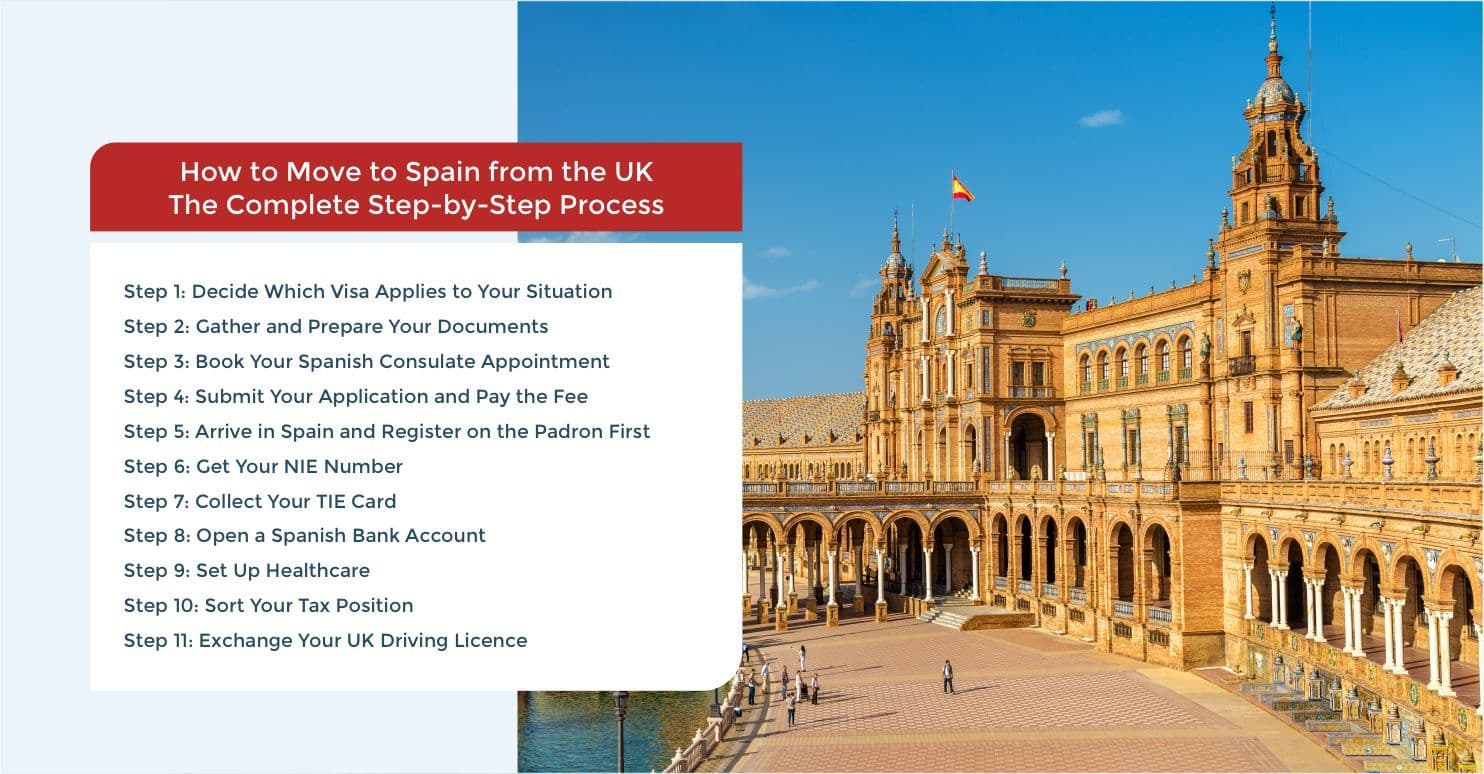
Most people who run into serious problems during their move to Spain don't fail because they chose the wrong visa or couldn't meet the financial requirements. They failed because they didn't understand the sequence. The Spanish immigration process has a specific order of operations, and doing things out of that order like applying for the wrong document first, arriving before your visa is issued, or missing a 30-day registration window, can set you back by months. This section walks through the entire process from the decision to move through to having your residency card in hand and your life set up in Spain.
Before you touch a single document, you need to be absolutely clear on which visa you are applying for. The visa determines every document you need, every threshold you must meet, and every consulate form you fill in. Applying for the Non-Lucrative Visa when your situation actually fits the Digital Nomad Visa or vice versa can wastes months and consulate fees.
If your situation is complex consult with a Spanish immigration lawyer before proceeding.
This is the step that takes the longest and where most delays happen. Give yourself a minimum of 6-7 weeks for document preparation, and longer if any of your documents are complicated to obtain. The exact list depends on your visa type but the documents that apply across almost all long-stay visa applications are as follows.
1. Valid Passport: Must be valid for at least one year beyond your intended stay and have a minimum of two blank pages remaining.
2. ACRO Criminal Records Certificate (Apostilled): The standard DBS check is not accepted, you specifically need the ACRO Criminal Records Certificate. Once obtained, it must be apostilled through the FCDO Legalisation Office. Apostilling takes approximately 2 weeks by post or can be done same-day in person.
3. Financial Evidence: Bank statements covering the last 3-6 months showing consistent income at or above the required threshold for your visa type. High balance on one statement date is not sufficient. Consulate officers look for regular, reliable income over time.
4. Private Health Insurance Policy: Must be from a provider authorised to operate in Spain, with no excess or copayments, and full coverage including hospitalisation and medical repatriation. The policy must be active from your intended date of entry into Spain. Providers commonly accepted by the Spanish Consulate include Sanitas, Cigna, AXA, and Allianz Care.
5. Proof of Accommodation in Spain: Accepted formats are a signed rental contract in your name, a property deed showing your ownership, or a letter of invitation from a host accompanied by their own proof of property ownership.
6. Certified Spanish Translations of All Non-Spanish Documents: Every document not originally issued in Spanish must be translated by a sworn translator (traductor jurado).
Long-stay visa applications for Spain must be submitted in person at the Spanish Consulate that covers your area of residence in the UK. The London Consulate covers England and Wales, the Edinburgh Consulate covers Scotland, and the Manchester Consulate covers Northern England.
You must apply at the consulate covering your registered address, you cannot choose based on convenience or availability. Appointment availability is one of the most frustrating parts of this process. The London Consulate runs backlogs, and appointment slots can be booked out 4-5 weeks in advance during busy periods.
When you attend your appointment, bring every document in both original and photocopy form. Consulate staff will retain the originals or certified copies of most documents. The appointment itself lasts 20 to 40 minutes.
At your consulate appointment, you submit your complete application pack, pay the visa fee. Check the specific payment method accepted before attending. The consulate will give you a receipt and a reference number to track your application.
From this point, the official processing window is up to 3 months. If the consulate requires additional documents or clarification, they will contact you - respond promptly as delays on your end extend the overall timeline. Once approved, you will be notified to collect your visa in person at the consulate. The visa is affixed directly into your passport as a sticker and will state the type of visa, the validity period, and the number of entries permitted.
The very first thing you do after arriving in Spain is registered on the Padron Municipal - Spain's official population register maintained by your local town hall (Ayuntamiento). This must happen before anything else because the Padron certificate proving your registered address is required for your NIE appointment and your TIE application. Without it you cannot move forward with either. Registration is free, done in person at your local Ayuntamiento, and requires your passport and proof of your address in Spain - a signed rental contract or property deed. The certificate of Empadronamiento is issued the same day or within a few days. Keep multiple certified copies as it will be requested repeatedly throughout your life in Spain.
With your Padron certificate in hand, your next step is obtaining your NIE (Número de Identidad de Extranjero)- your Spanish tax identification number. You cannot open a bank account, sign contracts, buy property, or handle any financial or legal matter in Spain without it. Book an appointment at your local Oficina de Extranjeria or Policia Nacional. You will need your passport, a completed EX-15 form, your Padron certificate, a brief written justification for needing the NIE, and the fee to be paid via Modelo 790 at a Spanish bank beforehand. Processing is same-day or within a few days.
With both your NIE and Padron certificate in hand, you can now apply for your TIE (Tarjeta de Identidad de Extranjero) - your physical residency card. You must do this within 30 days of arriving in Spain. Book your appointment at the Oficina de Extranjeria in your province as soon as you arrive - in larger cities slots can be 2-3weeks.
For the appointment you will need your passport and visa, your NIE number, your Padron certificate, one recent passport photograph, and the TIE fee paid via Modelo 790 Codigo 12 at a Spanish bank before the appointment. After submitting your application you will be given a collection date. In the meantime your passport with the long-stay visa serves as proof of your legal status. When you collect the TIE check all details carefully - name spelling, date of birth, and visa category must all be accurate
A Spanish bank account is not legally required immediately upon arrival, but you will eventually need one within weeks. Landlords expect rent paid from a Spanish account, utility direct debits require one, and many Spanish administrative payments cannot be made from a foreign account.
To open an account you will need your passport, TIE card or NIE number, proof of address , and in some cases proof of income or employment. The main high street banks like Santander, BBVA, CaixaBank, and Sabadell, all serve expat customers, though the experience and English-language support varies considerably by branch and city. During the transition period before your TIE arrives, some banks will open a non-resident account using your NIE number alone, which you can later upgrade to a resident account. International options like Wise and Revolut are useful for managing money during the transition but are not a substitute for a Spanish account for day-to-day life.
How you access healthcare in Spain depends on your visa type and personal situation. If you hold a Non-Lucrative Visa, your private health insurance, which you already needed for the visa application, is your primary healthcare arrangement. Some NLV holders also become entitled to access the Spanish public health system over time, particularly after paying into the Spanish social security system or via the S1 form route for UK state pensioners.
If you are working in Spain under any work-authorised visa, you will pay into Spanish social security from your salary or autonomo contributions, which entitles you to full SNS access.
Many people leave this step too late and find themselves in an unexpectedly complicated tax situation as a result. Spain considers you a tax resident if you spend more than 183 days in the country in a calendar year. Once you are a Spanish tax resident, Spain taxes your worldwide income including your UK salary, rental income, pension, and investments.
You must also notify HMRC that you are leaving the UK by completing a P85 form, which triggers an assessment of your UK tax position and results in a UK tax code change. The UK-Spain Double Taxation Treaty prevents you from being taxed twice on the same income, but the administrative process of claiming relief under the treaty requires proper advice.
If you qualify for the Beckham Law, apply for it within six months of registering with Spanish social security. This deadline is fixed and missing it means losing the benefit for your entire stay. Hiring a Spanish gestor (a licensed administrative professional) or tax advisor for your first year is strongly recommended.
If you plan to drive in Spain, you have 6 months from the date your residency is registered to exchange your UK driving licence for a Spanish one. After that window, your UK licence is no longer valid for driving in Spain as a resident. The exchange is handled through the Direccion General de Trafico (DGT) and requires your TIE card, Padron certificate, your original UK licence, a medical certificate from a DGT-authorised medical centre, and the exchange fee.
The medical examination includes vision, basic reflexes, and general fitness and costs approximately €35 to €50. You do not need to retake a driving test. Your UK licence is surrendered as part of the process, and the DGT notifies the DVLA in the UK. Processing times vary by province, during which you will be given a temporary authorisation document to carry with you when driving.
If you are applying for a Spanish long-stay visa from the UK, the word apostille will come up repeatedly and it is the areas where applicants make the most avoidable mistakes. A wrongly apostilled document, an expired certificate, or a document submitted without an apostille when one was required can result in your entire application being rejected. This section explains exactly what an apostille is, which of your UK documents need one, how to get them apostilled correctly, and the practical traps to avoid.
An apostille is an official authentication stamp or certificate attached to a public document that certifies the document is genuine and that the authority that issued or signed it is recognised. It does not verify the content of the document - it verifies that the issuing authority is legitimate.
The apostille system was created under the Hague Convention of 1961, an international treaty signed by over 120 countries, including both the UK and Spain. The convention established a standardised way for countries to recognise each other's official documents without requiring full diplomatic legalisation. Before the convention existed, getting a UK document recognised in Spain required going through both the UK Foreign Office and the Spanish Embassy, but this was a lengthy and expensive process. The apostille simplified this into a single step.
When the Spanish Consulate asks for an apostilled document, they are asking for proof that the UK authority who issued your document, whether that is the ACRO Police Certificate, a court, a registry office, or a university, is a genuine and recognised UK institution.
Not every document in your visa application requires an apostille, only those issued by UK public authorities. Private documents such as bank statements and insurance policies do not need apostilling. The following UK documents require an apostille for Spanish visa and residency applications.
In the United Kingdom, apostilles for England, Wales, and Northern Ireland are issued exclusively by the Foreign, Commonwealth and Development Office (FCDO) Legalisation Office. Scotland has its own process through the Scottish Government's Justice Directorate for documents issued by Scottish authorities.
The FCDO Legalisation Office has one physical location in the UK and handles all apostille requests either by post or by in-person same-day appointment.
The postal service
You send your original document to the FCDO Legalisation Office by post along with a cover letter, a completed application form from their website, and the fee. Current fees are £45 per document for the standard postal service. Processing time is approximately ten working days from receipt, though this can extend during busy periods. Use a tracked service when sending original documents by post, the FCDO is not responsible for documents lost in transit.
The in-person same-day service
The Milton Keynes office offers a same-day apostille service for documents brought in person. This is faster and useful if you are working to a tight consulate appointment deadline. It is important to note that the in-person same-day service requires a pre-booked appointment. You cannot simply walk in. Appointments are booked through the FCDO Legalisation Office website and availability varies. Book your appointment as soon as you know your consulate appointment date to ensure you have enough time.
What to send
The FCDO will only apostille original documents or certified copies issued directly by the relevant UK authority. They will not apostille photocopies, scans, or documents that have already been translated. The document must be in its original form as issued, so your ACRO Criminal Records Certificate, for example, must be the original printed certificate sent to you by ACRO, not a printed copy.
The apostille itself
The FCDO apostille takes the form of a certificate attached to or printed on the back of your document. It carries a unique reference number, the date of issue, the signature of the authorising FCDO official, and an embossed or printed seal. Spanish consulates verify apostilles by reference number if they wish to confirm authenticity.
Since 2021 the FCDO has been issuing digital apostilles (known as e-apostilles) for certain documents. A digital apostille is issued as an electronic certificate rather than a physical attachment, and documents apostilled digitally carry a verification code that can be checked online through the FCDO's verification portal.
Whether Spanish authorities accept digital apostilles is not uniformly consistent across all consulates and processes. The acceptance of these apostille varies by local authority. If you are given the option of a physical or digital apostille and you are applying for a Spanish visa or residency document, a physical apostille is the safer choice. If you have already received a digital apostille, check directly with your specific consulate before submission.
The Spanish Consulate will not process your application. In most cases they will identify the issue at the point of submission during your in-person appointment and return the document to you, which means you leave without your application being submitted and need to book a new appointment once the correct apostille is obtained. In some cases where the issue is only identified after submission, the consulate will contact you to request the corrected document but this delays the overall processing timeline.
If your ACRO certificate has expired before you manage to resubmit, you will need to apply for a new one and have it apostilled again, restarting that part of the process entirely. This is why getting the apostille process right the first time, with sufficient time built into your planning, is one of the most important administrative steps in the entire visa application.
Spain is more affordable than the UK across most spending categories, but it is worth being realistic about where the savings actually are. Rental prices in cities like Madrid, Barcelona, and popular coastal areas have risen considerably over the past two to three years, driven by housing demand and short-term rental pressures, so the cost advantage that existed before 2022 has narrowed in the major cities.
That said, day-to-day living costs like groceries, eating out, public transport, and utilities, remain noticeably lower than their UK equivalents. Fresh food is cheaper, eating out at a local Spanish restaurant is a fraction of what a comparable meal costs in the UK, and public transport both within cities and across the country is far more affordable than anything British commuters are used to.
Where Spain's cost advantage becomes most meaningful is in the lifestyle it affords rather than in raw number comparisons, which will always vary by city, neighbourhood, and personal habits. A couple living modestly in a mid-sized Spanish city like Valencia, Seville, or Alicante will almost certainly find their monthly outgoings lower than they were in the UK. The same couple in central Barcelona or on the Costa del Sol in a sought-after coastal town may find the gap considerably smaller. The honest takeaway is that Spain is cheaper than the UK, the savings are real, but where you choose to live within Spain matters just as much as the country itself.
Healthcare is the topic that causes more anxiety among British people planning a move to Spain than almost anything else. The NHS is the one thing most people worry about leaving behind. The good news is that Spain has one of the best public healthcare systems in Europe, consistently ranked among the top ten in the world. You can access high-quality medical care in Spain without it becoming a financial burden. But your route into that system depends entirely on your visa type, your age, and your employment status, and getting it wrong can leave you either uninsured or paying for coverage you didn't need to pay for.
Once you establish legal residency in Spain and are no longer ordinarily resident in the UK, you lose your entitlement to free NHS treatment. You can still access the NHS if you return to the UK for a visit, for urgent or emergency treatment, but you cannot continue using the NHS as your primary healthcare provider while living abroad. This is a point that confuses people, particularly those who assume they can simply fly back to the UK for GP appointments or planned treatments. HMRC and the NHS use residency status to determine entitlement, and once Spain is your primary residence, UK-based routine healthcare is no longer yours to use freely.
Spain's public health system, the Sistema Nacional de Salud (SNS), is funded through social security contributions and general taxation. Access for British expats depends on how you arrived in Spain and what your current status is.
If you are working in Spain under any work-authorised visa - employed by a Spanish company, registered as an autonomo, or working under a Digital Nomad Visa while paying into Spanish social security, you are entitled to full SNS access in the same way a Spanish citizen would be. Your social security contributions fund your healthcare, and you register with a local GP at your nearest health centre, using your TIE card and Padron certificate.
If you hold a Non-Lucrative Visa, the situation is different. The NLV explicitly prohibits work, which means you are not paying into social security, which means SNS access is not automatic. This is why private health insurance is a mandatory requirement for the NLV, it is your healthcare safety net for as long as you remain on that visa. Some NLV holders do eventually gain SNS access over time, particularly if they transition to a different visa type or reach retirement age, but it should not be assumed or relied upon in the early years.
The S1 form is one of the most valuable documents available to British retirees moving to Spain, and if you qualify for it, obtaining it before you leave the UK should be near the top of your to-do list.
S1 is issued by NHS Overseas Healthcare Services (part of the NHS Business Services Authority) and certifies that the UK government will cover the cost of your healthcare in Spain. This means you can register with the Spanish public health system - accessing GPs, specialists, hospitals, and prescriptions through the SNS with the UK paying Spain for those costs rather than you paying out of pocket or through insurance. It is available to UK state pensioners, people receiving certain UK benefits, and in some cases people who have taken early retirement and are still within the age bracket where UK social security covers them.
To apply for an S1, contact the NHS Overseas Healthcare Services team before you leave the UK. Once in Spain, you register the S1 at your local INSS (Social Security) office, and from that point you are entitled to SNS healthcare. For retirees who qualify, the S1 effectively eliminates the need for comprehensive private health insurance.
Whether it is mandatory for your visa or simply your preferred route to healthcare, private health insurance in Spain is a well-developed market with strong options at reasonable prices by UK standards. For Non-Lucrative Visa applicants especially, the policy must meet specific requirements - no excess, no co-payments, full coverage in Spain including hospitalisation and repatriation, and issued by a provider authorised to operate in Spain.
The main providers used by British expats in Spain are Sanitas, Adeslas, Asisa, AXA Spain, Cigna Global, and Allianz Care. Sanitas and Adeslas tend to have the most extensive networks of hospitals and clinics across Spain, which matters if you are living outside a major city. Cigna Global and Allianz Care are popular with people who want international coverage that works both in Spain and when travelling or spending time back in the UK.
The cost of private health insurance in Spain varies by age, health history, and the level of coverage you choose. A healthy person in their thirties or forties can expect to pay between £50 and £100 per month. Someone in their fifties will typically pay £100 to £200 per month, and those in their sixties and beyond should budget £200 to £400 per month or more, depending on pre-existing conditions and the insurer.
The Global Health Insurance Card (GHIC) replaced the European Health Insurance Card (EHIC) for UK citizens after Brexit. If you have an old EHIC, it remains valid until its expiry date, after which you apply for a GHIC as its replacement. Both cards entitle you to access state-provided healthcare in Spain at the same cost as a Spanish resident which for most treatment means free but only during temporary stays. Once you are a legal resident in Spain, the GHIC no longer applies to your situation. It is a card for visitors and travellers, not residents. Some people moving to Spain assume they can use the GHIC as a substitute for private health insurance or SNS registration but they cannot. It will not be accepted as proof of coverage for a visa application, and it does not cover ongoing or planned treatment for residents.
Tax is the one area where getting things wrong has the most direct financial consequences. The good news is that Spain and the UK have a Double Taxation Treaty in place, which means you will not be taxed twice on the same income. But becoming a Spanish tax resident changes how and where your worldwide income is taxed, and the transition year which means the year you actually moved. This section explains the key tax concepts every UK national needs to understand before making the move.
Spain considers you a tax resident if you meet any one of the following conditions. You spend more than 183 days in Spain during a calendar year, Spain is the main base of your economic activities or business interests, or your spouse and dependent children are resident in Spain. The 183-day rule is the most straightforward trigger and the one most people are aware of, but the economic interests test means it is possible to become a Spanish tax resident even without spending the majority of your time there. Once you are a Spanish tax resident, Spain taxes your worldwide income, not just income earned in Spain.
Before you leave the UK, you need to notify HMRC that you are becoming non-resident. This is done by completing form P85 which is available on the GOV.UK website, which tells HMRC you are leaving the UK and triggers a review of your UK tax position. Getting this right matters because it determines whether you continue paying UK tax on certain income sources after you leave, and it affects your UK tax code. The UK-Spain Double Taxation Treaty governs how income is taxed between the two countries, and in most cases it determines that you pay tax in your country of residence.
However, some income sources, such as UK government pensions remain taxable in the UK regardless of where you live. A UK-based accountant with international experience can help you understand your specific position before you move.
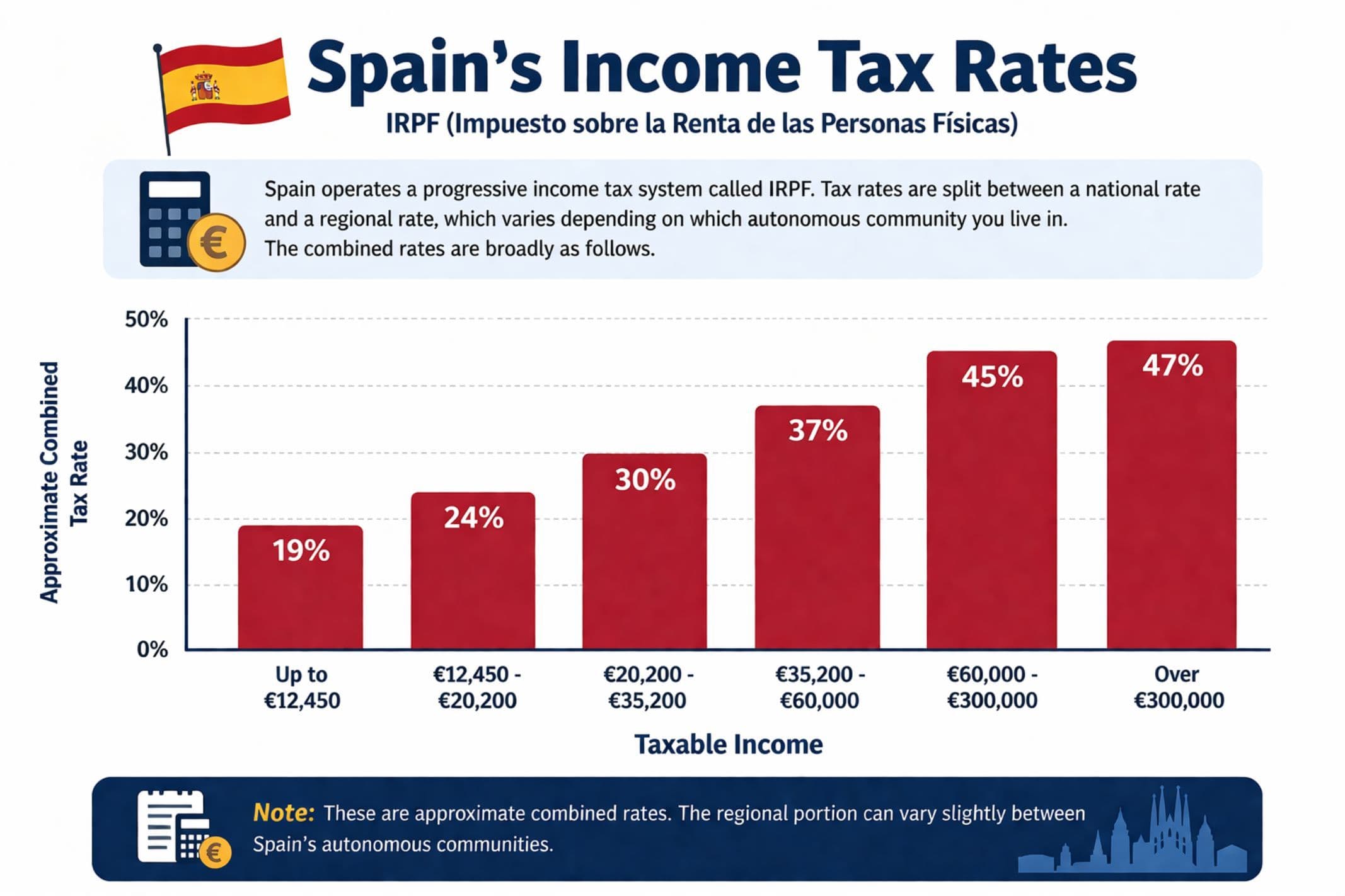
Spain operates a progressive income tax system called IRPF (Impuesto sobre la Renta de las Personas Físicas). Tax rates are split between a national rate and a regional rate, which varies depending on which autonomous community you live in. The combined rates are broadly as follows.
| Taxable Income | Approximate Combined Rate |
| Up to €12,450 | 19% |
| €12,450 - €20,200 | 24% |
| €20,200 - €35,200 | 30% |
| €35,200 - €60,000 | 37% |
| €60,000 - €300,000 | 45% |
| Over €300,000 | 47% |
These figures are a general guide and your actual tax liability will depend on your region, personal allowances, and income sources.
The Beckham Law formally known as the Regimen Especial de Impatriados, is a special tax regime that allows eligible new residents to pay a flat rate of 24% on Spanish-source income up to €600,000, rather than being taxed under Spain's standard progressive IRPF rates. It applies for the year of arrival plus the following five tax years, giving you up to six years of favourable tax treatment.
Who qualifies this law?
To be eligible you must not have been a Spanish tax resident in the five years prior to moving to Spain, you must move to Spain as a result of an employment contract, a job offer, or the acquisition of a management role in a company, or you must be a Digital Nomad Visa holder. The Beckham Law was extended to Digital Nomad Visa holders as part of Spain's Startup Act in 2023, which broadened its appeal for remote workers.
How to apply?
You must apply within six months of registering with Spanish social security. This deadline is absolute and there are no extensions and no exceptions. The application is made using form 149 submitted to the Spanish Tax Agency. Missing this window means losing the benefit for your entire stay, which for higher earners can represent a very significant financial loss.
The UK and Spain have a Double Taxation Treaty which determines which country has the right to tax specific types of income. The broad principle is that once you are a Spanish tax resident, most of your income is taxed in Spain. However there are important exceptions. UK government service pensions paid to former civil servants, military personnel, police, and teachers, remain taxable only in the UK regardless of your Spanish residency.
UK state pension income is taxable in Spain as a resident. UK rental income is taxable in both countries in principle, but the DTT provides for relief so you are not paying full tax in both- you declare it in both countries and claim credit for tax already paid. Private pension and annuity income is generally taxable only in your country of residence, meaning Spain once you are resident there. The treaty is detailed and income-specific, and understanding exactly how it applies to your personal income mix requires professional advice rather than a general overview.
If you hold assets outside Spain including UK bank accounts, property, investments, pension funds, or shares with a combined value exceeding €50,000, you are required to declare them to the Spanish tax authorities using Modelo 720. This is an informational declaration rather than a tax charge, but failing to submit it or submitting it incorrectly has historically attracted penalties in Spain. The declaration is submitted once initially and then only needs updating when asset values change by more than €20,000 from the previously declared figure. For most British people moving to Spain with UK property, savings, or pension pots, Modelo 720 will apply and should be factored into your first-year tax planning.
A gestor is a licensed administrative and tax professional unique to Spain - somewhere between an accountant, a tax advisor, and an administrative agent. For most British people in their first year in Spain, a gestor is not optional in any practical sense. They file your annual Spanish tax return, handle Modelo 720 declarations, register you with the Spanish tax authority, and deal with the considerable volume of administrative paperwork that the Spanish bureaucracy generates.
Fees for a straightforward annual tax return range from €150 to €400. For more complex situations involving multiple income sources, UK property, or pension income the fee will be higher but remains reasonable relative to the cost of getting it wrong. Finding a gestor who has experience working with British expats and ideally speaks English is worth prioritising - most major expat areas in Spain have several to choose from.
Getting your banking set up correctly and early makes everything else about the move smoother. Without a Spanish bank account you cannot pay rent by direct debit, set up utilities, receive a Spanish salary, or handle most day-to-day financial transactions the way residents are expected to.
Yes. Your NIE- NUmero de Identidad de Extranjero,is required to open a resident bank account in Spain. Without it, some banks will open a non-resident account as a temporary measure, which allows basic transactions but comes with limitations - higher fees, restricted services, and no direct debit facilities in most cases. Once you have your TIE card and NIE you should upgrade to a full resident account as soon as possible. The non-resident account is a bridge, not a long-term solution.
Spain has a well-developed retail banking sector and most major banks are accustomed to dealing with foreign residents. The four banks most commonly used by British expats are as follows.
For the transition period between arriving in Spain and getting your full resident account set up, and for ongoing management of money between the UK and Spain, digital banking options are very useful.
If you are moving funds from the UK to Spain to cover a property purchase, set up your initial life there, or move savings, the method you use to transfer matters financially. Bank-to-bank international transfers are the most straightforward but involve the exchange rates and the highest fees.
Wise is reliable for transfers up to mid-range amounts and offers real-time rate transparency. OFX, Currencies Direct, and Moneycorp are specialist currency brokers that are worth considering for larger transfers, particularly property purchases where even a small improvement in the exchange rate can represent thousands of pounds. These services also offer forward contracts, which allow you to lock in an exchange rate in advance if you are concerned about GBP/EUR fluctuations during a property purchase process that may take several months to complete.
Yes, UK citizens can obtain mortgages in Spain, but the terms differ depending on whether you are a resident or a non-resident at the time of application.
As a non-resident
This means you have not yet established legal residency in Spain. Spanish banks will lend up to 60% to 70% of the property's assessed value (loan to value), meaning you need a deposit of 30% to 40% plus the purchase costs on top. Interest rates for non-resident mortgages are generally slightly higher than for residents.
As a resident
Once you hold a TIE card and can demonstrate income and financial stability in Spain- lending conditions improve, with LTV ratios up to 80% available, though this varies by bank and individual financial profile.
The full mortgage application process in Spain takes 6-10 weeks from application to completion and requires a Spanish bank account, NIE number, proof of income, last two to three years of tax returns, and a valuation of the property by a bank-approved surveyor.Moving to Spain does not mean closing everything in the UK, and for most people maintaining some UK financial infrastructure makes sense, at least in the short term. Keep at least one UK bank account open, you will need it to receive UK pension payments, manage UK rental income if applicable, and handle financial matters that still run through UK systems. Some UK banks have closed accounts of customers who have moved abroad, citing residency requirements in their terms. If you are concerned about this, check your bank's policy before you move and consider opening an account with a bank that explicitly permits non-resident customers, such as some of the digital banks or private banking options.
Your UK ISA holdings are not affected by moving abroad in terms of existing balances - you can keep what you have but you cannot make new contributions to a UK ISA once you are no longer a UK tax resident. Existing ISA funds continue to grow free of UK tax within, but Spain may tax the gains depending on your tax position there, which is another reason to take proper tax advice before moving.
Where you live in Spain shapes everything like your cost of living, your social life, your access to English-speaking services, your children's schooling options, and how quickly you integrate. Spain is not a single experience. The pace of life, climate, culture, and infrastructure differ enormously between a city apartment in Madrid, a villa on the Costa del Sol, and a farmhouse in rural Extremadura. This section covers the most popular destinations for British expats including what works well and what the trade-offs are, so you can match the right location to your actual lifestyle and priorities.
The most established destination for British expats in Spain with excellent English-language infrastructure, reliable sunshine, and direct UK flights. Property prices have risen sharply in recent years and the heavily expat nature of the area makes genuine integration into Spanish life harder than elsewhere.
Spain's most cosmopolitan and internationally minded city with a strong job market and exceptional quality of life, though it is expensive by Spanish standards. Families should be aware that state schools teach predominantly in Catalan rather than Spanish.
Spain's capital offers a London-comparable lifestyle at lower cost with outstanding public transport and a strong employment market. The climate is continental with hot dry summers and cold winters and the Madrid region applies lower regional income tax rates than most of Spain. Strong international and British school offering and a large, well-organised expat community.
Widely regarded as the best overall option for British expats- Mediterranean climate, excellent beaches, authentic Spanish culture, and lower costs than Madrid or Barcelona. It has grown enough to offer good international schools and private healthcare while retaining a true Spanish character.
Home to one of the largest British communities in Europe with well-established English-language services and a lower cost of living than the Costa del Sol, making it particularly well suited to retirees. Smaller coastal towns can be very seasonal and quiet outside summer months.
A beautifully authentic Spanish city with a lower cost of living and a smaller expat community, meaning faster integration but fewer English-language services and international schools. Summers are extreme with temperatures regularly exceeding 40°C - a serious consideration.
Year-round warm climate, well-established British expat infrastructure, and a reduced local tax regime make the Canaries uniquely appealing particularly for retirees. Geographic remoteness from mainland Europe is a con worth considering for those wanting regular access to the continent.
Among the most expensive places to live in Spain with limited rental availability outside the tourist season, but exceptional natural beauty and quality of life for those with the budget. Mallorca suits established expat living, Menorca is quieter and more affordable, and Ibiza attracts a younger, more transient crowd.
Rural Spain has lower property costs and a genuine Spanish village experience that no coastal resort can replicate. Healthcare, international schools, and English-language services are limited or absent - this requires realistic expectations and functional Spanish. Broadband infrastructure is improving but still patchy in very remote areas. Best suited to those actively seeking authenticity and simplicity over expat convenience.
For many British people who move to Spain, the initial visa is just the starting point. After years of building a life there, the question of long-term legal security comes up. This section covers the path from temporary residency through to permanent residency and ultimately Spanish citizenship, including the requirements, timelines, and realities of each stage.
After five years of continuous legal residency in Spain, UK nationals can apply for long-term residency which is formally known as residencia de larga duración. This is a upgrade from the temporary visa-based residency you hold in your first years, and it removes most of the ongoing conditions attached to your original visa type. You no longer need to prove income at the NLV threshold, your right to remain is not tied to a specific visa category, and your residency becomes substantially more stable and permanent.
To qualify you must demonstrate five years of continuous legal residency. This means no absences from Spain exceeding six consecutive months, or a total of ten months across the five years. Gaps or extended absences can interrupt the continuity of your residency and reset or delay the five-year clock, so keeping track of time spent outside Spain during this period matters. The application is made at the Oficina de Extranjería and requires your current TIE card, evidence of continuous residency, proof of sufficient economic means, and a clean criminal record. Long-term residency is issued as a new TIE card valid for five years and renewable provided you continue to meet the basic requirements.
Spanish citizenship becomes available to UK nationals after ten years of continuous legal residency in Spain. This is the standard route for most nationalities. Spain does not have an accelerated citizenship pathway for British nationals equivalent to what some countries offer. The ten-year clock starts from your first date of legal residency in Spain, so the sooner you establish residency properly, the sooner the clock starts running.
The citizenship application requires evidence of ten years of continuous legal residency, a clean criminal record from both Spain and the UK, proof of economic means, and integration into Spanish society - which means passing two official tests.
To apply for Spanish citizenship you must pass two examinations administered by the Instituto Cervantes.
The CCSE (Conocimientos Constitucionales y Socioculturales de España) tests your knowledge of Spanish society, culture, history, geography, and the constitution. It consists of 25 multiple choice questions and you need to answer at least 15 correctly to pass. Study materials are provided by the Instituto Cervantes and the test is taken at their centres across Spain and internationally.
The DELE A2 is a Spanish language exam that certifies you have reached at least an A2 level of Spanish, which is a basic but functional level of communication. If you already hold a recognised Spanish language qualification at A2 or above, or if you have completed your education in Spanish, you may be exempt from this requirement. For most British people who have been living in Spain for ten years and engaging with Spanish daily life, reaching A2 level is realistic but if you have been living primarily within an English-speaking expat community, you may need to invest time in formal Spanish study before applying.
Both tests must be passed before submitting the citizenship application. They cannot be taken after the application is submitted.
Spain does not permit dual nationality with the UK. When you are granted Spanish citizenship you are required to renounce your British nationality as part of the process. The Spanish authorities do not always enforce this renunciation actively - there are British-Spanish dual nationals living in Spain but legally speaking, Spanish law does not recognise dual nationality with the UK as a right, and the UK similarly requires notification of acquiring another citizenship.
Spain does permit dual nationality with certain Latin American countries, Andorra, the Philippines, Equatorial Guinea, and a small number of other nations with historical ties but the UK is not on that list. This is a consideration for anyone thinking about the citizenship path, those with strong ties to the UK, property there, or family reasons to maintain British nationality. Taking legal advice before starting the citizenship process is strongly recommended.
British nationals who were legally resident in Spain before January 1, 2021 and obtained their TIE card under the Withdrawal Agreement have a different and more favourable legal position than those who arrived after that date. Their residency rights are protected under the terms of the Withdrawal Agreement and are not subject to the same visa conditions that apply to post-2021 arrivals. For Withdrawal Agreement residents, the path to long-term residency and citizenship follows the same five-year and ten-year timelines but from a more stable legal foundation. If you are in this category and have not yet formalised your status by obtaining the Withdrawal Agreement TIE card, doing so remains important - your rights exist in law but are much easier to exercise and demonstrate with the correct documentation in hand.
The honest answer is that Spain solves several problems at once, and most other countries only solve one or two.
The weather is real. After enough grey British winters, 300 days of sunshine stops being a perk and starts being a health decision. But weather alone doesn't explain why Spain consistently tops every survey of where British people want to live abroad. France has decent weather. Portugal has excellent weather. Spain keeps pulling people back for something harder to articulate. Two to three hours from most UK airports means that moving to Spain feels like a manageable distance. You can visit your parents and children. You fly back for weddings and funerals without it becoming a week-long process and planning. And then part of it is the food culture, which is very different from anywhere else in Europe. A decent meal out in Spain does not need a special occasion. It fits your budget with quality being high and price being low.
The most attractive aspect is the pace of life. Spain is not lazy. It is not inefficient. It is simply organised around different priorities. The afternoon is for living, not for grinding through emails. The evening starts later and goes longer. People are outside. Social life happens in public rather than in living rooms. For many British people who spent decades commuting, eating at their desks, and measuring productivity in hours worked rather than hours enjoyed, Spain represents a fundamentally different relationship with time.
The cost of living, while rising in major cities, is lower than comparable UK cities across most spending categories. The healthcare system is world-class and a genuine upgrade on what many people left behind in NHS waiting lists. For remote workers specifically, the Beckham Law creates a tax environment that is hard to match elsewhere in Europe- six years of flat-rate taxation at 24% while living in one of the continent's most liveable countries.
None of this means Spain is perfect or that the move is without friction. The bureaucracy is real. The language matters. The adjustment takes longer than most people expect. But the combination of climate, cost, culture, proximity to home, and the many other factors of the country is why Spain isn't just popular with British expats. It's where they consistently stay.
Below are the ones that come up repeatedly and are entirely avoidable with the right preparation.
You cannot enter Spain as a tourist and then apply for a long-stay visa from within the country. The long-stay visa must be obtained from the Spanish Consulate in the UK before you travel. People who arrive planning to sort it out on the ground find themselves in a legal grey area that is difficult and expensive to resolve.
Most people assume 2-3 weeks is enough to gather everything needed for a visa application. In reality, between obtaining the ACRO criminal record certificate, getting it apostilled, arranging sworn translations, securing the right health insurance, and booking a consulate appointment, 6-8 weeks is a minimum. Starting too late forces rushed decisions and increases the risk of errors.
The Non-Lucrative Visa and the Digital Nomad Visa are regularly confused, and the consequences of applying for the wrong one are months of wasted time and rejected applications. Someone who intends to work remotely and applies for the NLV will face problems the moment they start working.
The year you move is the most complex tax year you will have - you are a UK tax resident for part of it and a Spanish tax resident for part of it, with potential obligations in both countries. Many people assume it sorts itself out automatically. It does not. Failing to notify HMRC via P85, failing to file a Spanish tax return for the transition year, or failing to apply for the Beckham Law within the six-month window are all mistakes that have real financial consequences.
The Padron certificate is required for your NIE appointment, your TIE application, opening a bank account, registering with a doctor, and almost every other administrative process you will go through in Spain. Some people delay registering on the Padron because they are not sure where they will settle long-term. Register as soon as you have a fixed address, even if it is temporary rental accommodation.
In major expat areas and cities, getting by in English is possible. In most of Spain, a functional level of Spanish is essential for healthcare appointments, government offices, dealing with landlords, and daily life. People who arrive with no Spanish and no plan to learn it consistently report frustration with bureaucracy, social isolation, and in daily chores.
For Non-Lucrative Visa holders especially, private health insurance is a visa condition. Switching to a policy that does not meet Spanish requirements can jeopardise visa renewal. Keep insurance documentation current at all times and ensure any new policy meets the same standards as the original one required for the visa application.
The decision about what to do with your UK home is the most significant financial choice in the entire process, and it deserves careful thought rather than a default decision made in the rush of planning a move.
Keeping your UK property and letting it as a rental is the common choice and has many advantages. It provides ongoing passive income in pounds, maintains a UK asset base, and preserves the option of returning to the UK without needing to buy again. The income counts toward your NLV financial threshold. But complications are real- as a Spanish tax resident you must declare UK rental income in Spain and pay Spanish tax on it, with credit for any UK tax already paid. You also remain a UK landlord with all the legal responsibilities that entails, including compliance with increasingly demanding rental regulations. A UK-based letting agent who manages the property fully is almost essential unless you have trusted family or friends who can handle issues locally.
Selling before or shortly after moving gives you a clean break, releases capital that can fund your life in Spain, and removes the ongoing responsibilities of being a remote landlord. If the property has increased in value since you bought it, UK capital gains tax on the gain may apply- the timing of the sale relative to your UK non-residency status can affect your CGT position, and taking advice from a UK tax specialist before deciding when to sell is worthwhile. Once you are a Spanish tax resident, any gain on a UK property sale must also be declared in Spain, though the double tax treaty ensures you are not taxed in full in both countries simultaneously.
Leaving a UK property vacant while abroad is the least advisable option. Empty properties attract higher council tax in many UK councils, insurance becomes more difficult and expensive, and maintenance issues can go unnoticed. If you are uncertain about your long-term plans and do not want to sell or rent, having a trusted person check on the property regularly is the minimum sensible arrangement.
The weeks before you leave the UK are as administratively busy as the weeks after you arrive in Spain. These are the key tasks to complete before your departure date.
Immigration and legal:
HMRC and tax:
Financial:
Property:
Healthcare:
Documents to carry with you:
The most common reasons for rejection can be- Insufficient financial evidence is the leading cause, not meeting the income threshold, presenting inconsistent bank statements, or failing to demonstrate that income is passive and ongoing rather than a one-off balance. Health insurance that does not meet requirements is another frequent reason. Document issues such as expired apostilles, non-certified translations, or missing forms account for a significant proportion of rejections. In some cases the consulate simply requests additional information rather than issuing a formal rejection- responding promptly and completely to these requests often resolves the issue without a full re-application.
There is no mandatory waiting period before reapplying for a Spanish long-stay visa after a rejection, provided the reason for rejection has been addressed. Reapplying with the same documents that were already rejected will result in the same outcome. Take the time to understand and fix the specific issue, whether that means building up more months of consistent bank statements, obtaining a compliant health insurance policy, or redoing document preparation correctly.
You have the right to appeal a visa rejection through the administrative appeal process within one month of the rejection notice, or through a judicial appeal within two months. In practice, appeals are time-consuming and rarely successful unless there was a clear procedural error by the consulate. For most people the more practical route is to address the rejection reasons and reapply with a stronger application, ideally with the support of a Spanish immigration lawyer who can review everything before submission.
If your first application was made without legal support and was rejected, engaging a Spanish immigration lawyer for the second attempt is strongly advisable. A lawyer will identify weaknesses that are not always obvious to applicants and improve the odds of approval.
Brexit added paperwork to a move that used to require none but it did not close the door. Thousands of British people are making the move to Spain every year and building exactly the life they were after. You now have everything in this guide-n the right visa for your situation, the documents you need and how to get them right, what your taxes look like on both sides, how healthcare works, and what the first weeks on the ground actually involve. The process is more involved than it was before 2021, but it is entirely manageable with the right preparation and enough lead time. Start early, get the visa category right from the beginning, and take proper advice on the tax side before you leave.

Applying for a Schengen visa from India in 2026? Get the full process, document checklist, fees, processing times, and rejection-proof tips in one guide.

Planning a move to Portugal from the USA? Learn about visas, documents, housing, banking, taxes, healthcare, and settling in with a step-by-step guide.

Everything you need for a UK apostille in 2026 - FCDO process, fees, timelines, document types, non-Hague countries, and common rejection fixes.
Need help with your application or background check?
Contact us now and speak with a dedicated Globeia expert today.


