By Sejal Jain · Updated September 11, 2026
Reviewed by Vasu Singla
Many Canadians learn about the Canada apostille for Spain only after starting their visa or residency application. By then, timelines can be tight, and missing a step may delay your plans. Spain requires apostilled Canadian documents before accepting paperwork for Spain visas, residency permits, university admissions, and employment. Common documents include RCMP criminal record checks, birth certificates, marriage certificates, academic diplomas, and powers of attorney.
The Canada apostille process for Spain can vary depending on where your documents were issued. A BC birth certificate, Ontario university degree, and federal RCMP background check may each follow different submission routes and processing times. Sending documents to the wrong office, notarizing when it isn’t required, or translating before apostille often leads to delays.
Understanding Canadian document apostille requirements for Spain early helps avoid returned documents and missed deadlines, especially when applying for time-sensitive Spanish visas or residency.
| Feature | Traditional Authentication (Before 2024) | Canada Apostille (2024–2026) |
| Process Steps | Notarization → Authentication → Embassy Legalization → Translation | Notarization → Apostille → Translation |
| Number of Authorities | Multiple offices | One authority |
| Spanish Embassy Legalization | Required | Not required |
| Processing Time | 8–16 weeks (or longer) | A few weeks (Varies by authorities) |
| Complexity | More complicated | Simple process |
| Cost | Higher (multiple fees) | Lower overall cost |
| Risk of Delays | Higher | Lower |
| Acceptance in Spain | After legalization | Directly accepted |
Every Spanish long-stay visa for Canadians requires an apostilled RCMP criminal record check. That's the one constant across all visa types, everything else depends on which visa you're applying for.
Spanish employers in regulated fields, engineering, medicine, education, law, require apostilled credentials before they can process a foreign worker's licensing application. This isn't new, but enforcement has tightened since Spain joined the EU professional qualifications directive
Students enrolling in Spanish universities or long-term programs typically need apostilled diplomas, transcripts, and academic records for admission and credential recognition.
Canadians planning to marry in Spain, pursue family reunification, or navigate international adoption commonly need apostilled birth certificates, marriage and divorce records, and court documents.
Canadians on the Non-Lucrative Visa, the standard retirement and extended-stay route, need an apostilled RCMP check, civil documents, and a medical certificate. Financial records (bank statements, pension letters) are also need to be submitted.
Canadians starting a business, purchasing property, or managing legal affairs in Spain may need apostilled corporate documents, powers of attorney, affidavits, or identity records.
Canada has no single apostille office. Where you send your documents depends entirely on where they were issued, not where you live now. Getting this wrong means your package comes back unprocessed, costing you 3–6 weeks. Apostilles are issued at the federal level by Global Affairs Canada.
This office handles:
1. Documents issued by the Government of Canada
2. Documents originating from certain provinces and territories in:
| Manitoba | Newfoundland and Labrador | Nova Scotia | Prince Edward Island |
| New Brunswick | Northwest Territories | Nunavut | Yukon |
Global Affairs Canada
Authentication Services Section (JLAC)111 Sussex DriveOttawa, OntarioK1A 0G2CanadaSome provinces have their own designated authorities responsible for issuing apostilles. These include:
Here is the simple table you can follow to check the correct authority:
| Province / Territory | Apostille Authority | Address | In- person option | Website | Processing timeline |
| Ontario | Ontario Ministry of Public and Business Service Delivery | 222 Jarvis Street, Toronto, ON M7A 0B6 | Yes | https://www.ontario.ca/page/authenticate-document-use-outside-canada | Within 1 week |
| British Columbia | BC Ministry of Attorney General | 1401 Douglas Street, Victoria, BC V8W 2C1 | No | https://www2.gov.bc.ca/gov/content/governments/government-id/guide-to-the-authentication-of-documents/about | 3–4 weeks |
| Alberta | Alberta Ministry of Justice | 9833-109 Street NW, Edmonton, AB T5K 2E8 | No /Yes | https://eservices.alberta.ca/certificates-of-apostille.html | 1-2 weeks |
| Quebec | Ministère de la Justice du Québec | 1200 Route de l'Église, Quebec City, QC G1V 4M1 | No /Yes | https://www.quebec.ca/justice-et-etat-civil/services/apostille | 3–4 weeks |
| Saskatchewan | Saskatchewan Ministry of Justice | 1874 Scarth Street, Regina, SK S4P 4B3 | No /Yes | https://www.saskatchewan.ca/government/notarized-documents-legislation-maps/authenticating-notarized-documents | 1-2 weeks |
| Federal Government Documents | Global Affairs Canada | 111 Sussex Drive, Ottawa, ON K1A 0G2 | No | https://www.international.gc.ca/gac-amc/about-a_propos/services/authentication-authentification/index.aspx?lang=eng | 5-7 weeks |
| Manitoba, Nova Scotia, New Brunswick, Newfoundland and Labrador, Prince Edward Island, Yukon, Northwest Territories, Nunavut | Global Affairs Canada | 111 Sussex Drive, Ottawa, ON K1A 0G2 | No | https://www.international.gc.ca/gac-amc/about-a_propos/services/authentication-authentification/index.aspx?lang=eng | 5-7 weeks |
The documents you need to apostille depend on which Spanish visa you're applying for. Here are the most common routes Canadians take, and what each one typically requires.
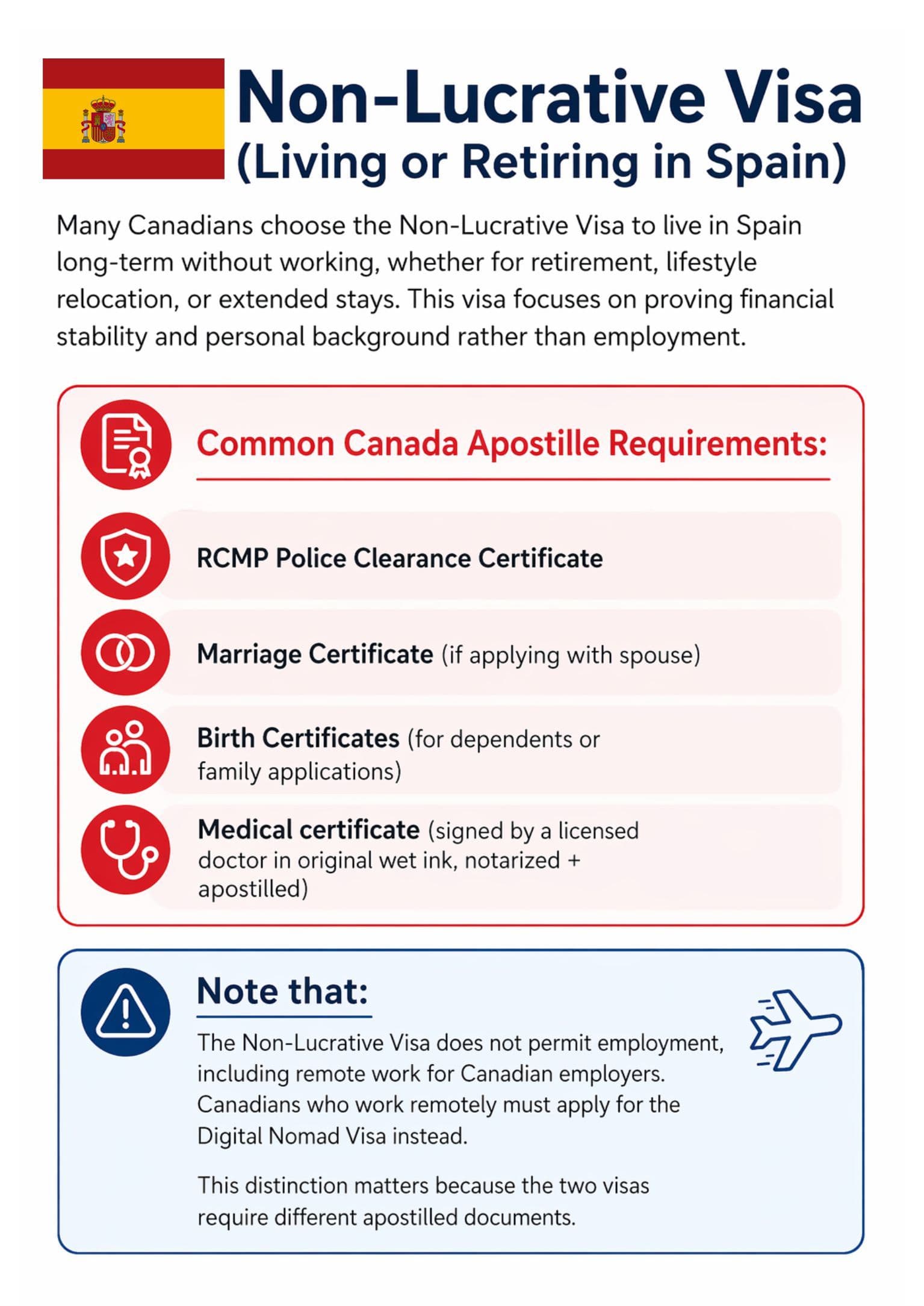
Many Canadians choose the Non-Lucrative Visa to live in Spain long-term without working, whether for retirement, lifestyle relocation, or extended stays. This visa focuses on proving financial stability and personal background rather than employment.
Common Canada Apostille Requirements:
Note that: The Non-Lucrative Visa does not permit employment, including remote work for Canadian employers. Canadians who work remotely must apply for the Digital Nomad Visa instead. This distinction matters because the two visas require different apostilled documents.
Spain’s Digital Nomad Visa has become increasingly popular among Canadians working remotely for Canadian or international employers. This visa was introduced in 2023 under Law 28/2022. It requires proof that at least 80% of your income comes from clients or employers outside Spain, and allows professionals, freelancers, and online business owners to live in Spain while working abroad.
Common Canada Apostille Requirements:
Important: The 80% income rule is enforced at the consulate stage. Employment verification letters and sometimes freelance contracts may require notarization before they can be apostilled if the consulate requests authentication.
Canadians planning to study at Spanish universities, colleges, or language schools may need apostilled documents to confirm academic history and identity, particularly for long-term programs.
Common Canada Apostille Requirements:
If you’re relocating to Spain for a job opportunity, Spanish authorities typically request background checks and professional credentials to verify employment eligibility.
Common Canada Apostille Requirements:
Canadians planning to start a business, freelance, or operate independently in Spain may need apostilled business and personal documents as part of their application.
Common Canada Apostille Requirements:
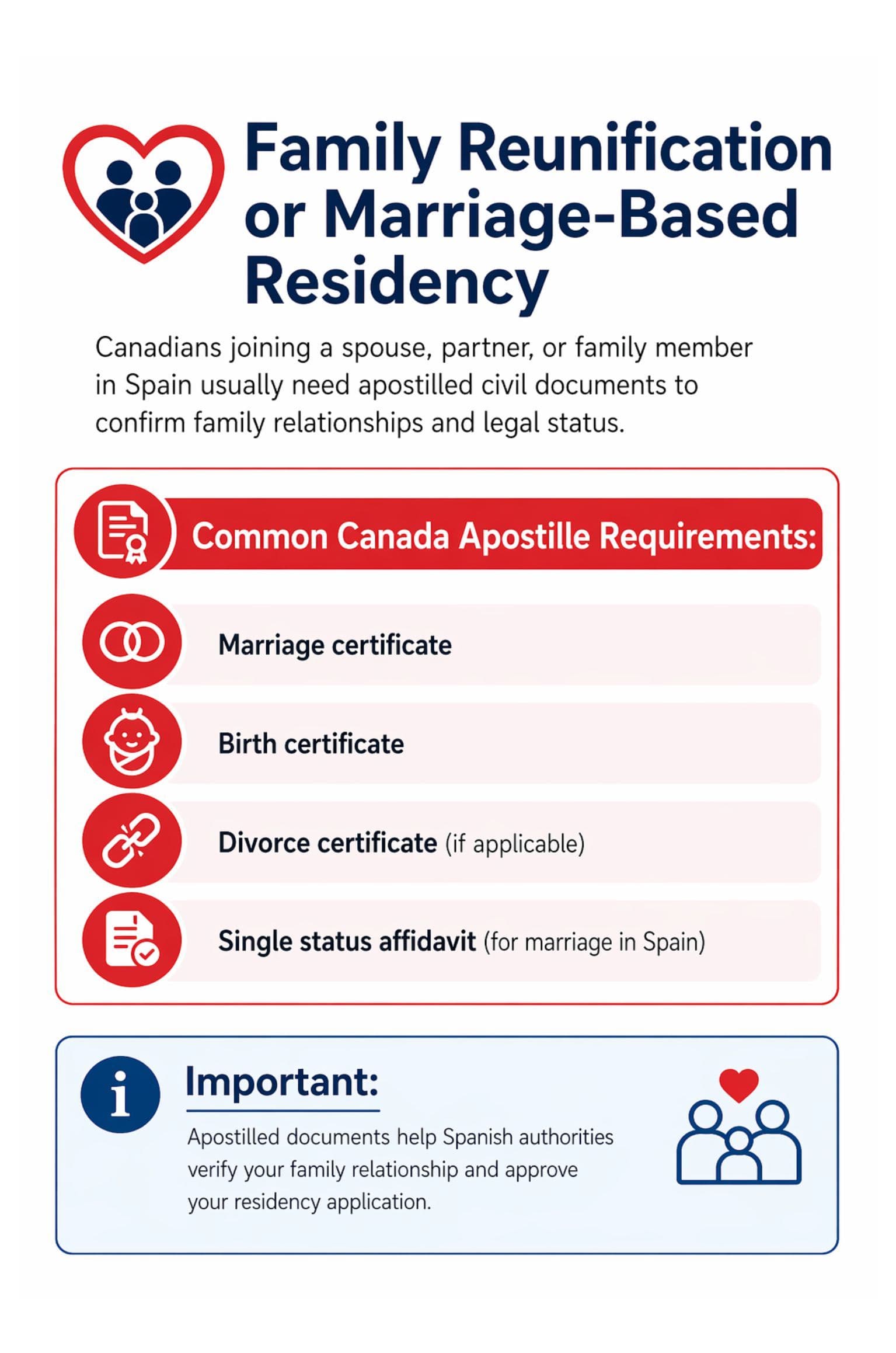
Canadians joining a spouse, partner, or family member in Spain usually need apostilled civil documents to confirm family relationships and legal status.
Common Canada Apostille Requirements:
Three document types come up in this process, and they are treated completely differently. Mixing them up, for example, sending a notarized copy of your birth certificate when a certified copy is required, is the most common reason GAC and provincial offices return packages.
Original documents are exactly what they sound like: the first copy issued by the authority, with original signatures and seals. For vital statistics documents, this is what provincial registries send you when you order a birth or marriage certificate. Examples include:
Why originals matter: For vital statistics documents, Spanish authorities and Canadian competent authorities will only accept the original or a certified copy from the issuing office. Taking your birth certificate to a notary for a 'certified copy.' This won't work. The apostille authority needs to authenticate the registry official's signature, not a notary's stamp over a photocopy. Your birth certificate goes directly to the provincial authority, no notary involved.
Don't submit an original you can't replace. Documents can get lost in transit. For anything that can be reordered from a provincial registry, order two certified copies and submit one.
Certified copies are official duplicates issued by the same government authority that created the original. They are not simple photocopies; they carry the authority’s current signature and official seal, giving them the same legal weight as the original. Examples include:
Why they are preferred: Order certified copies rather than submitting originals whenever possible. They're replaceable if lost in the mail. Originals are not. They ensure that the signature on the document matches the records that Global Affairs Canada or provincial authorities have on file.
When ordering certified copies, request at least two copies, one for the apostille and one as a backup in case of loss or issues during shipping.
A notarized copy is a photocopy of a document that a licensed notary public or commissioner of oaths has certified as a true and accurate reproduction of the original. The notary’s signature and seal on the copy are what the competent authority authenticates, not the original content of the document itself. Examples include:
Why notarized copies are needed: These are used mainly for private documents or non-government-issued documents. Since the issuing authority (like a university) is not on file with Global Affairs Canada, the notary acts as a trusted intermediary, certifying that the copy is a true representation of the original.
Important caution: Vital statistics documents, such as birth or marriage certificates, should never be notarized; the competent authority requires the original or certified copy issued by the government.
What they are: Certain Canadian provinces issue vital statistics documents (birth, marriage, and death certificates) on special security paper, often referred to as “blue paper.” This paper has embedded security features like watermarks, colored fibers, or holographic elements, designed to prevent forgery. Examples include:
Why they are special: The security paper itself is a form of authentication. The provincial competent authority can verify the document not only through the signature and seal but also by examining the security features.
Rules for handling blue paper documents:
Summary Table: Differences at a Glance
| Document Type | Who Issues It | Signature & Seal | When to Use an Apostille | Key Tips |
| Original | Government authority | Original official signature & seal | Vital statistics documents, RCMP checks | Must be undamaged, in most it should be recently issued not old |
| Certified Copy | Government authority/ University/ Courts | Current official signature & seal | Birth/marriage/death certificates, divorce decrees, transcripts,degrees, court orders | Safer than originals; replaceable; legally equal to original |
| Notarized Copy | Registered Notary Public | Notary signature & seal , Date | Personal documents, university diplomas, powers of attorney, affidavit | An apostille authenticates the notary, not the original document |
| Blue Polymer / Security Paper | Provincial vital statistics | Original signature | Birth certificates | Always submit the original Blue Polymer document and handle it carefully. Avoid notarising or photocopying once the apostille has been attached. The apostille sticker is typically fixed to the back using a blue polymer sheet, which helps prevent tearing or damage to the document. |
Some documents do not include a government signature, which is why they require an official seal and stamp from a commissioned notary public. This step is called notarization. Notarization confirms that the document is genuine or that the copy matches the original before it can move forward in the Canada apostille process.
For example, a university degree is typically signed by a university registrar, not a government official. Because of this, Global Affairs Canada (GAC) may not have the registrar’s signature on file. Before GAC can authenticate the document, a notary public reviews the original document and prepares a certified copy. The notary then confirms, in writing, that the copy is accurate and matches the original.
Once notarized, Global Affairs Canada can authenticate the notary’s signature, since notary signatures are registered and recognized. After authentication, the document can proceed for apostille or further use in
A notarized document is a copy or original that a licensed Canadian notary public or commissioner of oaths has certified as true and accurate. The notary:
The apostille then authenticates the notary’s signature and seal, not the content of the original document itself.
When Notarization is Required
You need notarization before apostille only for private or non-government documents:
Never notarize a birth, marriage, or death certificate before an apostille. Vital statistics documents go directly to the provincial authority as certified copies.
Notary rejections are almost always caused by the same five oversights. Check them before you leave the office :-
How Notarized Documents Are Used in the Apostille Process
Submitting documents by mail is a reliable and commonly used method for applicants who live far from a competent authority. Prepare your documents and ensure that all originals, certified copies, or notarized copies meet the requirements for signatures, seals, and security features. Include a completed application form, the correct payment, and a self-addressed return envelope. Tracked mail or courier services minimize the risk of loss. This method allows applicants to complete the process without traveling but requires careful attention to packaging and documentation to avoid delays or rejections.
Delivering your documents in person offers immediate verification and guidance. Skilled authority staff can review the documents on-site, confirm compliance with apostille requirements, and provide a receipt to submit. This method ensures the documents are prepared and reduces the risk of errors, making it ideal for applicants seeking the most secure and expedited processing. In-person submission is effective for original documents that are irreplaceable or require special handling.

Professional Apostille services make the apostille process smoother by serving as go-betweens for the applicant and the competent authority. These services check the completeness and authenticity of documents, submit them to the appropriate office, and return apostilled documents. This approach has particular advantages for applicants abroad, those with complex documentation requirements, or individuals who want to reduce administrative risk. While it involves extra fees, the service ensures compliance and cuts down on potential delays.
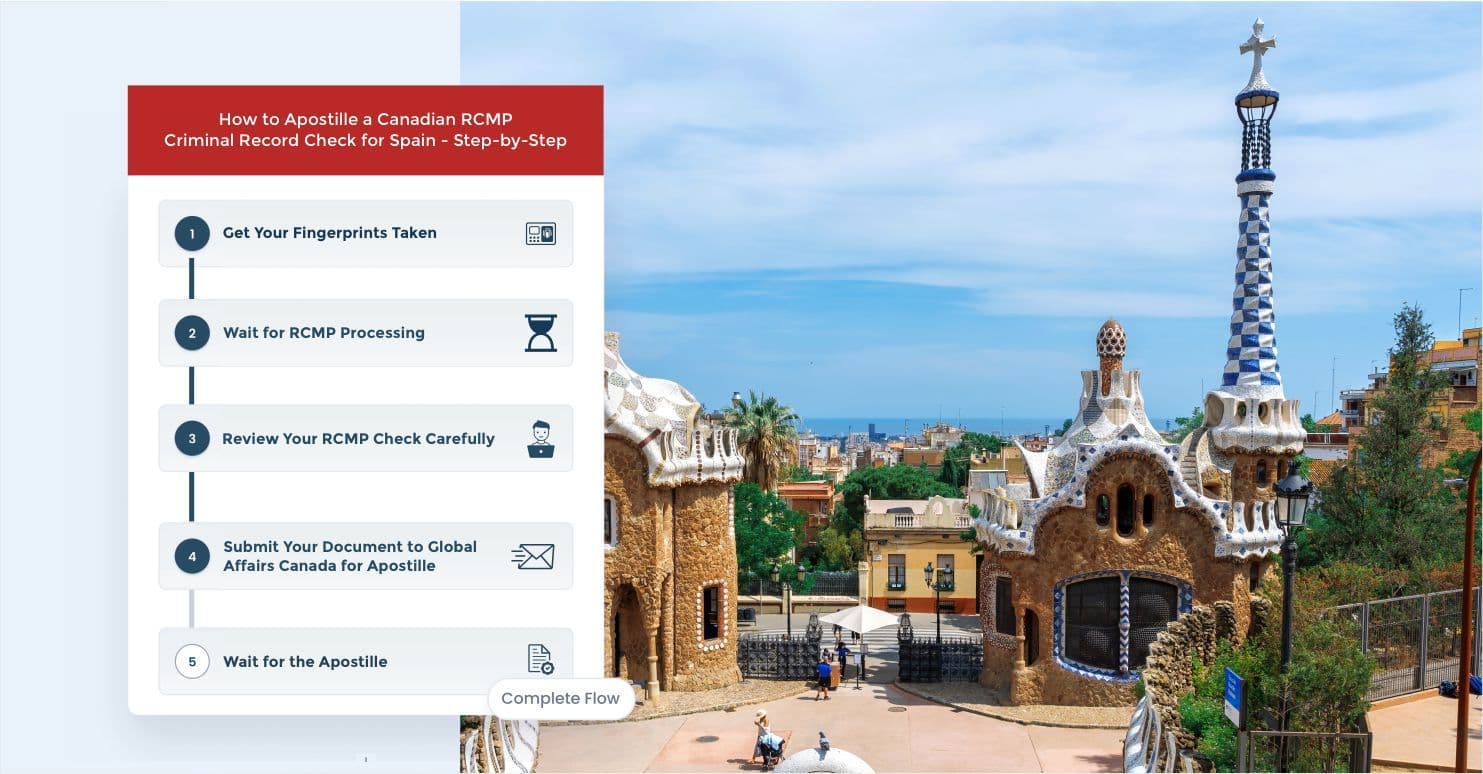
Get fingerprinted at an RCMP-accredited location, a police station, RCMP detachment, or private fingerprinting agency. Tell them specifically that the check is for international use, for a Spanish visa. This matters: if they submit it as a domestic name-based check instead of a fingerprint-based check, Spain will reject it outright, and you start from zero.
If you are outside Canada, RCMP-accredited fingerprinting services do exist internationally. Contact them, or use a service that provides ink-on-card fingerprint kits that can be mailed to an accredited Canadian agency.
RCMP headquarters in Ottawa runs your prints against the national criminal record database. Turnaround is 7–10 business days under normal conditions for a Canadian mailing address. The check is mailed directly to you from Ottawa.
RCMP sends results via Canada post in a non trackable postal service and it takes 2-3 weeks for delivery in the USA and Canada.
When your RCMP Criminal Record Check arrives, examine it carefully. Ensure your full legal name, including middle names if they appear on your passport, exactly matches. The RCMP check uses the name you provided during fingerprinting. For example, if your passport shows James Michael Robertson but your RCMP check says James Robertson, some consular officers may flag this as a discrepancy. Contact the RCMP immediately to correct any mismatch.
Also, confirm the issuing authority shown is RCMP Ottawa, and the result is negative if you have no record. If anything looks wrong, like name format, address, or contact, contact the RCMP immediately. Correcting an error at this stage takes days. Discovering it at the consulate takes months.
Mail the original RCMP check to Global Affairs Canada in Ottawa with three things: the completed EXT-2165 Authentication Request form, your payment ( by cheque payable to Receiver General for Canada), and a prepaid return envelope. No notarization needed, the RCMP is a federal body whose signature GAC already has on file.
Now you wait, and this is the part that catches most applicants off guard. Normal processing takes 5-7 weeks During peak periods (September through December), this regularly extends to 9-10 weeks. Check GAC's current posted processing estimate at international.gc.ca before planning your timeline; the estimate changes monthly. Plan so your document is ready and valid when you submit your visa application.
Once the apostilled RCMP check is in your hands, it goes to a traductor jurado, a sworn translator registered with Spain's Ministry of Foreign Affairs. The translation alone is sufficient; the apostille covers the original document. Do not commission this translation until the apostille arrives; the translator needs to translate the apostilled version, not an earlier copy.
Canada has no single national apostille process. Which office handles your documents and exactly how you need to prepare them depends entirely on which province issued them. Not where you live now. Where the document came from.
That distinction matters more than most applicants realize. A short-form Ontario birth certificate that works perfectly fine for a Canadian passport application gets rejected outright by a Spanish consulate. A Saskatchewan submission made by your immigration consultant without a signed authorization letter comes back untouched. Quebec documents translated before an apostille have to restart the entire process from scratch.
What follows are the genuinely province-specific rules, the ones that catch applicants off guard, not the generic guidance that applies everywhere.
Ontario processes more apostille requests for Spain than any other province which means the staff know what they're looking for and will return your package fast if something's wrong. Plan for 3–5 weeks ahead of time.
The rule that matters most for Spain: Spain requires Ontario birth certificates in long-form only. When ordering from ServiceOntario, request the certified copy of birth registration, the version that includes both parents' full names. The short-form summary and wallet-size card are rejected by Spanish consulates without exception. This single error is responsible for more Ontario resubmissions to Spain than any other mistake.
Other important Ontario rules:
BC is one of the few provinces with a genuine walk-in option in Victoria. If your consulate appointment is less than 10 weeks out, this matters, same-day or next-business-day processing is possible on certain document types.
The rule that matters most for Spain: BC's authentication office applies a stricter visual inspection of notary seals than most other provinces. A stamp that is smudged, faded, or partially cut off by a staple hole will be returned without processing. Check every seal under direct light before sealing your envelope. It sounds trivial. It is not.
Other important BC rules:
Alberta's authentication process is well-organized and consistent, but it applies firm rules around document condition. Prepare carefully, and the process moves smoothly. Cut corners on the condition of notarization quality, and the document comes back.
The rule that matters most for Spain: Alberta refuses laminated documents, no exceptions, no workarounds. If your birth certificate has been stored in a laminate pouch, you need a fresh certified copy from Alberta Vital Statistics before you can do anything else. This is the rule unique to Alberta that catches applicants from other provinces completely off guard.
Other important Alberta rules:
Quebec's civil law system means your vital records don't come from the same place as in other provinces. The Directeur de l'état civil (DEC) is the only valid source for Quebec birth, marriage, and death certificates, not hospitals, churches, or municipal offices.
The rule that matters most for Spain: Apostille always comes before translation in Quebec and in every other province too, but Quebec applicants trip on this more than anyone else because their documents are in French. The instinct is to translate them into Spanish first so they make sense to Spanish authorities. Do not do this. The apostille must be applied to the original French document. Translation happens after. Reversing the sequence means restarting the apostille process from the beginning.
Other important Quebec rules:
Saskatchewan processes fewer apostille requests than the larger provinces, which means the office is thorough and applies its rules consistently. Saskatchewan's office has requirements you won't find anywhere else in Canada.
The rule that matters most for Spain: Third-party submissions require a signed authorization letter from the document holder. If your immigration consultant, a family member, or anyone else is submitting on your behalf, Saskatchewan requires written authorization from you before the package will be processed. No other province has formalized this requirement. Immigration consultants unfamiliar with Saskatchewan's rules miss this constantly.
Other important Saskatchewan rules:
Some documents cannot be apostilled at the provincial level, regardless of where you live. Federal documents, including the RCMP criminal record check required for most Spanish visas, go exclusively through Global Affairs Canada’s authentication office in Ottawa.
Documents that always go to Global Affairs Canada:
GAC processing currently runs 5-7 weeks standard, up to 14 weeks during peak periods . This is almost always the longest step in the apostille process for Spain visa applicants. Submit your RCMP check to GAC the same week you begin your provincial submissions, not after.
Before submitting anywhere, these apply without exception:
Understanding province-specific requirements is one of the most important steps when preparing Canadian documents for Spain, especially for applicants working within strict visa timelines.
Not every Canadian document follows the same apostille process for Spain. Vital records go directly from the provincial registry to the authentication authority. University degrees require a notarization step first. Business documents vary depending on whether the company is federal or provincial. Medical certificates depend on the specific Spanish consulate handling your case.
This section explains each Canadian document apostille process for Spain, including what to order, what Spanish authorities require, and where delays usually happen.
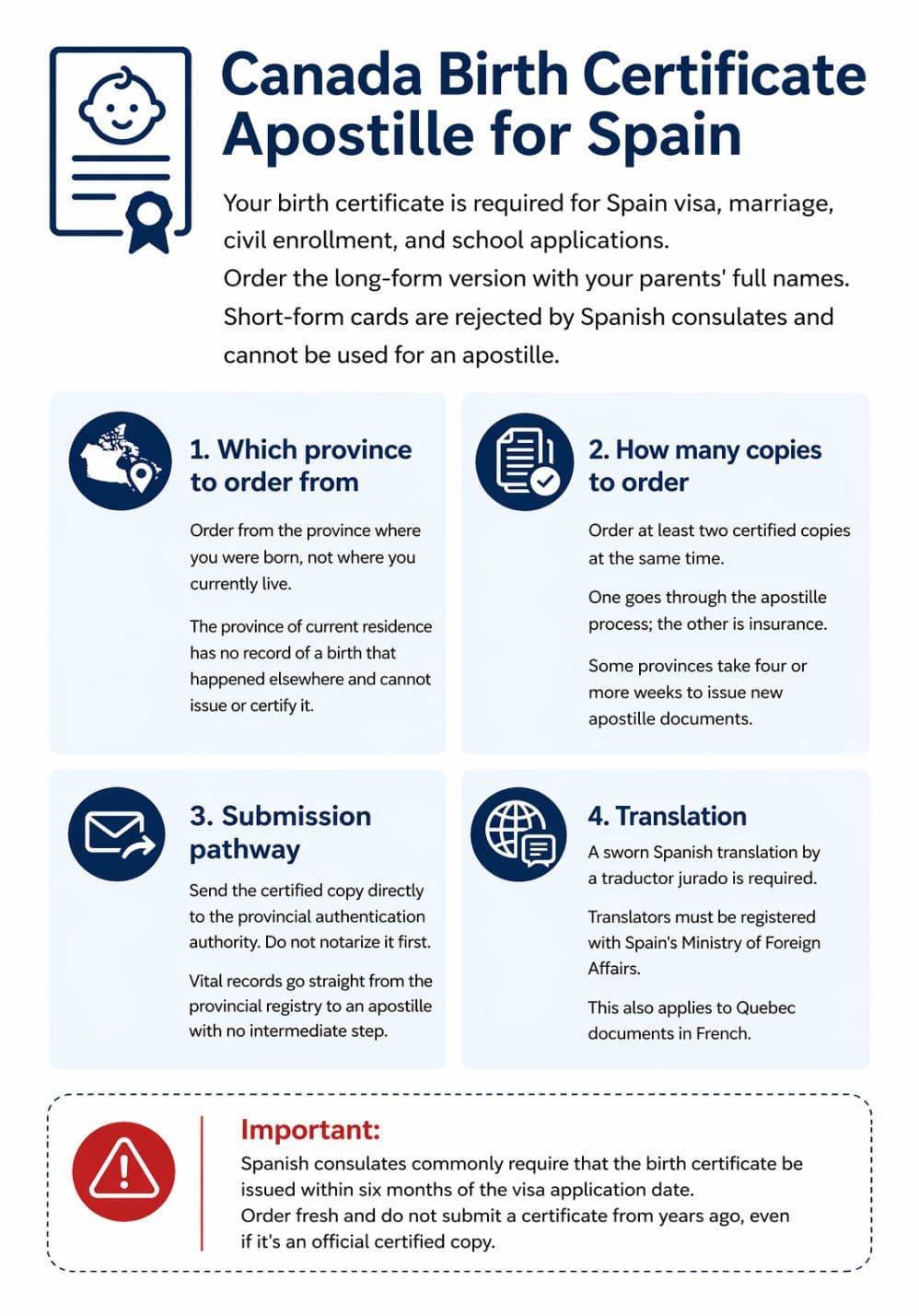
Your birth certificate comes up in more situations than almost any other document, including Spain visa applications, marriage registration in Spain, civil enrollment, and school applications. Order the long-form version specifically, the one that lists your parents' full names. The short-form card that works for Canadian government purposes is rejected by Spanish consulates and cannot be used for a birth certificate apostille for Spain.
Which province to order from
Order from the province where you were born, not where you currently live. Born in Manitoba but living in BC? That certificate comes from Manitoba Vital Statistics. The province of current residence has no record of a birth that happened elsewhere and cannot issue or certify it for a Canada apostille process.
How many copies to order
Order at least two certified copies at the same time. One goes through the apostille process; the other is insurance. If the first is lost in transit or returned with a correction request, you're set back weeks without a backup, and some provinces take four or more weeks to process a new order for apostille documents in Canada.
Submission pathway
Send the certified copy directly to the provincial authentication authority. Do not notarize it first. Private notarization of a provincial vital record is not part of the process and will cause the submission to be returned. Vital records go straight from the provincial registry to an apostille with no intermediate step in the Canada apostille process for Spain.
Translation
A sworn Spanish translation by a traductor jurado is required. Translators must be officially registered with Spain's Ministry of Foreign Affairs, not just any bilingual professional or certified translator for Canadian legal purposes. For Quebec documents in French, this applies equally to Spanish document translation requirements.
Important: Spanish consulates commonly require that the birth certificate be issued within six months of the visa application date. Order fresh and do not submit a certificate from years ago, even if it's an official certified copy for your Spain visa documentation.
Marriage certificates are required for spousal residency applications, family reunification visas, and civil registration in Spain, and they are one of the documents Spanish authorities scrutinize for name consistency during the apostille process for Spain.
The province of marriage is not the province of residence
Only the province where the marriage was registered can issue the official certificate. A certificate ordered from any other province, or a copy kept in a personal file, is not valid for apostille. Contact the registry of the province where the ceremony was registered, regardless of where you live now, to complete your marriage certificate apostille in Canada.
Name discrepancies: Address them before submission
If your name on the marriage certificate doesn't exactly match your passport, such as a missing middle name, a maiden name versus a married name, or a different hyphenation, attach a sworn statutory declaration explaining the discrepancy before submitting. Don't wait for the consulate to flag it. A discrepancy raised at the consulate stage can delay an appointment by months in your Spain visa application process.
Certificate age
Spain generally requires marriage certificates issued within six months of submission. The certificate you received on your wedding day, filed away for years, will not be accepted for Spanish immigration documents. Order a fresh certified copy.
Submission and translation
Submit directly to the provincial competent authority or Global Affairs Canada. No private notarization is added. A sworn Spanish translation by a traductor jurado is mandatory, following the same translator qualification standard as for birth certificates in the apostille process Canada to Spain.
Tip: If you are a divorced applicant remarrying in Spain, you need both the marriage certificate from the new marriage and an apostilled divorce decree from the prior one. Process them in parallel, as they often have the same six-month recency requirement for Spain legal document submission.
Death certificates come up in Canada and Spain apostille requests most often for estate and inheritance matters, not for standard visa applications. If a family member has died and held assets, property, or pension rights in Spain, the Spanish estate process requires an apostilled death certificate before proceedings can begin. If you are a visa applicant with no estate involvement, this section likely doesn't apply to you.
Who can request one
Provinces restrict access to death certificates. Immediate family members, estate executors, and legal representatives can generally obtain them, but eligibility rules vary. Confirm with the provincial registry before ordering, particularly if you are acting as an executor or a distant relative requesting a death certificate apostille in Canada.
What to order
A certified copy of the original death certificate, issued by the province where the death was registered. Photocopies and unofficial copies are not accepted. Order directly from the provincial vital statistics office for the apostille process in Canada.
Submission and translation
Submit the certified copy to the provincial competent authority or Global Affairs Canada. No notarization is added. A sworn Spanish translation by a traductor jurado is required for the Spanish estate process and Spanish legal documentation.
Important: Estate matters in Spain move on legal deadlines. Apostille processing plus translation adds 6 to 10 weeks minimum to an already complex process. Build that time in early and do not start the apostille process after you've already engaged a Spanish notary for the estate.
Spain needs official proof that a prior marriage was legally dissolved before it will register a new marital status, process certain visa types, or permit marriage on Spanish soil. A divorce decree that looks complete on its face but is missing pages or lacks the court's official seal will be turned away during the apostille process for Spain.
What 'court-certified' actually means
You need a copy issued by the court clerk with the original court seal and the clerk's original signature, not a photocopy of your personal copy, not a printout from an online court portal, and not a lawyer's file copy. Every page of the decree must be included. Incomplete decrees are the leading cause of rejection for this type of divorce decree apostille in Canada.
Submission pathway
Certified court copies go to the provincial competent authority or Global Affairs Canada. No additional notarization is required because the court certification itself is sufficient. A sworn Spanish translation is required for the submission of a Spanish legal document.
Older decrees
Courts processing requests for older cases can take several weeks, particularly if the records are archived offsite. Contact the court registry directly for a realistic timeline before assuming standard turnaround for your Canada apostille process.
Tip: If you are remarrying in Spain and were previously divorced, Spanish civil authorities will want the apostilled divorce decree alongside your new marriage documentation and your single status affidavit. Prepare all three in the same processing window for smooth Spain marriage documentation approval.
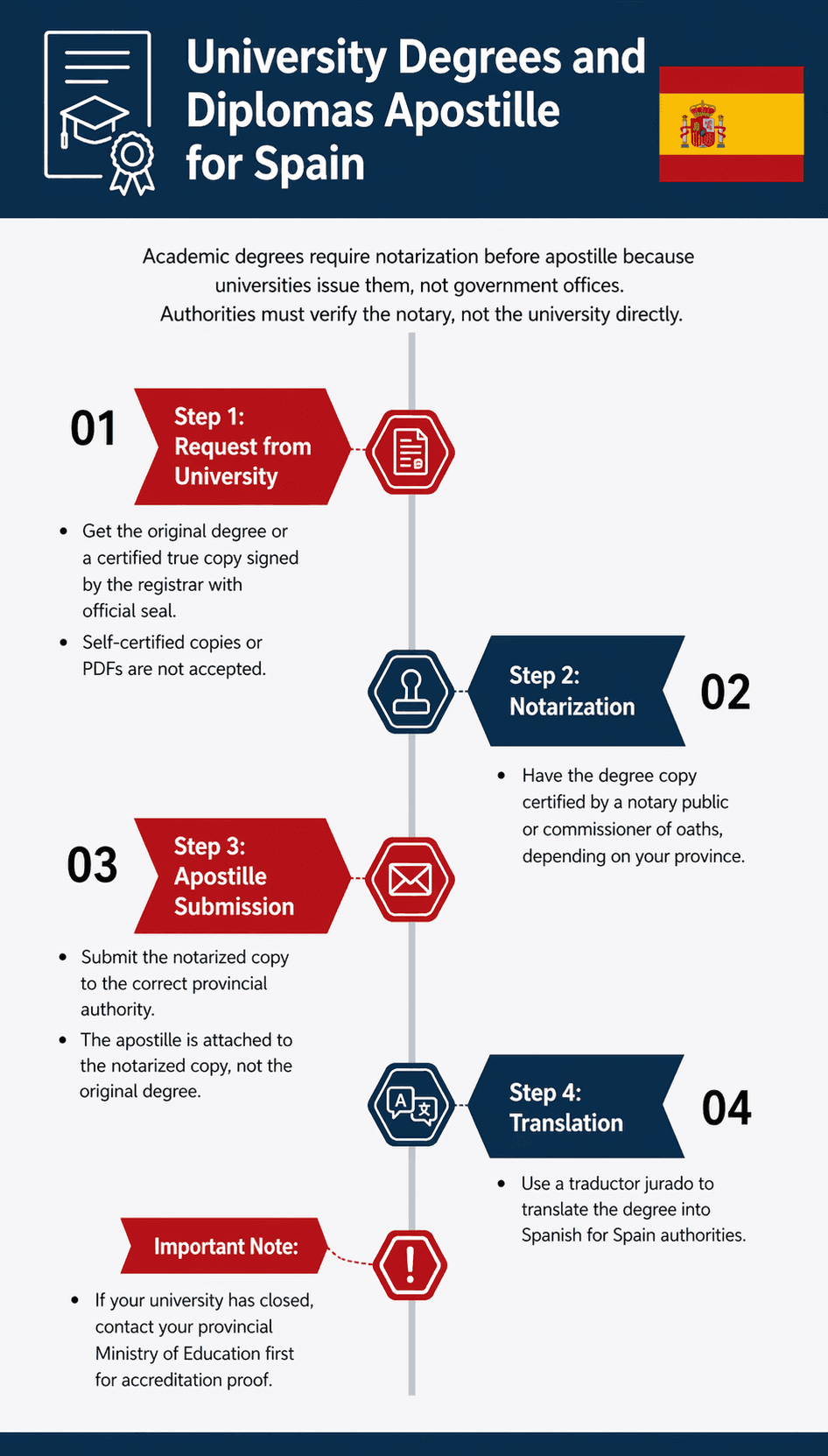
Academic credentials are the only major document category where notarization is built into the standard apostille process in Canada and Spain for everyone, not just in specific provinces or for specific visa types. This is because degrees are issued by institutions, not governments, so the apostille authority has no way to verify the original directly.
Step 1: What to request from the university
Ask the registrar for either the original degree or a certified true copy bearing the registrar's signature and the institution's official seal. A photocopy you certified yourself or a scanned PDF is not sufficient for a degree apostille in Canada.
Step 2: Notarization
Take the document to a notary public in BC and Quebec or a commissioner of oaths in other provinces to certify a true copy. This notarization is the bridge between your institution-issued document and the government authority that will issue the apostille. The apostille verifies the notary's credentials and confirms that the notary who certified the copy is legitimate, which, by extension, authenticates the degree for Spain education document verification.
Step 3: Apostille submission
Submit the notarized copy to the appropriate provincial competent authority. The apostille is placed on the notarized copy and not on the original degree certificate itself as part of the Canada apostille process for Spain.
Step 4: Translation
Have a traductor jurado translate the degree content into Spanish. This translation is attached to the apostilled document before submission to Spanish authorities for Spain document translation requirements.
Note: If your university has closed since you graduated, contact your province's Ministry of Education before attempting anything. Some provinces maintain records of dissolved institutions, while others require a letter from the ministry itself confirming the institution's accreditation history. Without this step, the notary has nothing verifiable to certify against for the apostille documents Canada process.
The apostille pathway for business documents depends entirely on how the company was incorporated. Federal and provincial corporations follow different routes, and private business documents such as contracts, agreements, and authorizations require notarization before they go anywhere near an authentication office for a business document apostille Canada.
Federal corporations
Certificates of incorporation, good standing, and existence for federally incorporated companies go to Global Affairs Canada and not to any provincial authority. This applies regardless of which province the business operates in for a corporate apostille in Canada.
Provincial corporations
Provincially incorporated businesses use the authentication authority of the province in which they are registered. An Alberta-incorporated company's certificate of good standing goes through Service Alberta and not through any federal channel for the apostille process in Canada.
Private documents, contracts, agreements, and authorizations
Shareholder agreements, power of attorney documents, and commercial contracts are not government-issued. They must be notarized first and then submitted to the provincial authority for an apostille. The notarization certifies the signatures and the apostille, then validates the notary for the legalization.
Important: Certificates of good standing have a short shelf life. Spanish authorities commonly require them to be dated within three months of submission. Do not order these early and time the request to your actual submission window for the Spain company registration documents.
Canada does not apostille passports. The original document is never submitted for authentication. When Spanish authorities ask for an apostilled passport, which happens occasionally for specific property or financial transactions and not for standard visa applications, what they actually need is a notarized copy of the passport with an apostille on the notarization for a passport copy apostille for Spain.
Take your passport to a notary public or commissioner of oaths, who will certify a true copy. That notarized copy is what goes to the provincial authentication authority. Translation is usually not required unless specifically requested for the Spain document submission.
Tip: Before going through this process, confirm it is actually necessary. Many Spanish authorities that initially list an apostilled passport copy in their requirements will accept a plain notarized copy or simply a photocopy once asked directly. The apostille adds weeks and cost, so verify before starting your apostille process from Canada to Spain.
Apostilling a driving licence is rare. It comes up occasionally for identity verification in residency-related processes and not for actually driving in Spain, where an International Driving Permit issued by CAA is the standard solution.
If an apostille is specifically requested, notarize a photocopy of your licence with a notary public or commissioner of oaths, and then submit the notarized copy to the provincial competent authority for authentication. The original licence is not submitted for the driving licence apostille in Canada.
Tip: If the underlying purpose is driving in Spain, get an International Driving Permit from CAA before you leave Canada. It is faster, costs around $25, and is recognized throughout Spain and the EU. The apostille route is for administrative identity purposes only.
Enrollment confirmations, student status letters, and academic verification documents are issued by educational institutions, which means they follow the same notarization first pathway as university degrees and not the direct submission pathway of vital records for the academic document apostille Canada.
The document must carry an original signature and the institution's official seal. A printout from a student portal or an unsigned template letter is not sufficient. Take the original signed letter to a notary or commissioner of oaths for certification, and then submit the notarized copy to the provincial authentication authority.
A sworn Spanish translation by a traductor jurado is required before submission to Spanish authorities for Spain academic document verification.
Note: Universities issue these letters routinely, but not all will include the specific language Spanish authorities expect, particularly around enrollment status, program name, and expected completion date. Ask the registrar whether there is a standard international enrollment confirmation format before accepting the default letter.
The Non-Lucrative Visa requires a medical certificate signed by a licensed Canadian physician in original wet ink. Printed or digital signatures are rejected. The certificate must confirm that you have no contagious or communicable diseases. Spanish consulates are specific about the wording required. A certificate that uses different phrasing, even if the underlying medical content is identical, may be sent back for correction during the medical certificate apostille Canada process.
Whether the medical certificate also needs to be apostilled depends on the consulate. Some require it while others accept a notarized copy. This is not standardized across Spanish consulates in Canada.
Important: Check with your specific consulate and not the general Spain visa guidance online before having the medical certificate notarized or apostilled. Applying the wrong authentication step wastes time and money, and recency requirements mean you may need to get the medical exam redone if too much time passes during the correction process.
Standard bank statements for most Spain visa applications do not require an apostille. A signed and stamped statement from a bank officer is generally accepted as is. Apostille on bank statements comes up primarily in financial verification for property transactions or specific residency processes, and not for Non-Lucrative or Digital Nomad visa applications, which have their own financial documentation standards.
If an apostille is requested, the bank must sign and stamp the statement, a notary certifies it, and the notarized copy goes to the provincial authentication authority. This is the same pattern as any private financial document and follows the bank statement apostille Canada process.
Tip: If you are applying for the Non-Lucrative Visa, confirm what financial documentation your specific consulate requires before assuming an apostille is needed. Most consulates specify bank statements, investment account summaries, or pension letters with specific balance thresholds, and an apostille is rarely part of that list.
If you plan to marry in Spain, Spanish civil authorities require proof that you are legally free to marry and that you have no existing marriage in Canada. A single status affidavit, also called a Certificate of No Impediment, is a sworn declaration that provides this confirmation for the single status affidavit apostille Canada.
How it is created
The affidavit must be executed before a notary public or commissioner of oaths. It becomes legally valid only when signed in their presence under oath. A self-drafted and signed document, or one signed outside a notary's presence, is not valid. The notary's certification of the oath is what gets apostilled and not the content of the affidavit itself.
Submission and translation
Submit the notarized affidavit to the provincial competent authority for apostille. A sworn Spanish translation by a traductor jurado is required for Spain marriage legal documents.
Important: If you are divorced, a single status affidavit alone is not sufficient. Spanish civil authorities want the apostilled divorce decree alongside it. This serves as proof that the prior marriage ended, and not just a sworn statement that you are currently single. Prepare both documents in the same processing window since they often have matching recency requirements.
Four problems derail Canada-to-Spain apostille applications more than anything else, and they show up in order, at predictable points in the process.
Handling a Canada-to-Spain apostille on your own can work if you only have a few straightforward documents and plenty of time. But even small mistakes sending a document to the wrong office, missing a notarization, or skipping a translation, can cause weeks of delays and stress. That’s why many applicants benefit from professional assistance.
Here’s how a service can help:
Using a professional service doesn’t remove your responsibility, but it reduces mistakes, stress, and wasted time, often making the difference between arriving on schedule and facing unexpected setbacks.
No, the apostille itself is a certification of the document’s authenticity, not its language. The apostille validates that the document is genuine and signed by the proper Canadian authority (provincial or federal).
A sworn translation by a MAEC-registered traductor jurado is not optional for any Spanish consulate submission. Documents translated by bilingual professionals, certified Canadian translators, or anyone without MAEC registration are rejected - no exceptions, no appeals.
Here’s what you need to know to get it right:
The total cost surprises people because it's not one fee, it's four separate payments to four separate parties, and they don't happen at the same time. Budget for document ordering, notarization, the apostille fee itself, and sworn translation independently. For a Non-Lucrative Visa application as a single applicant, budget CAD $350–$650 for everything except the consulate visa fee itself
For Spain visa applications, such as Non-Lucrative Visa, Digital Nomad Visa, Student Visa, Work Visa, or Family Reunification applicants are usually required to apostille civil documents, police clearance certificates, and educational or legal records. Because each document must be prepared separately, costs vary depending on your situation.
Documents from multiple provinces mean multiple submission packages, separate courier costs, separate return envelopes, and separate processing timelines.
| Service | Estimated Cost (CAD) |
| Certified Document Copies | $25 – $60 |
| Notarization | $25 – $100 per document |
| Apostille Authentication | $20 – $75 per document |
| RCMP Criminal Record Check | $50 – $100 |
| Spanish Sworn Translation | $80 – $200 per document |
| Courier / Shipping | $20 – $50 |
The apostille timeline depends on document type, province processing times, and translation requirements. While some documents can be prepared quickly, apostille processing often takes the longest, especially when submitted to Global Affairs Canada or provinces experiencing a backlog.
Applicants should also consider that different provinces have different processing speeds, and timelines may increase during peak seasons such as January to April or summer relocation periods.
| Step | Estimated Time |
| Order Certified Documents | 1–2 weeks |
| RCMP Criminal Record Check | 1–2 weeks |
| Notarization | 1–5 days |
| Apostille Processing | 3–12+ weeks |
| Spanish Translation | 3–7 business days |
| Final Review | 1–2 days |
Backlogs, high demand, staffing changes, and seasonal visa demand can all extend timelines unexpectedly, so building extra time into your plan is recommended. Applicants with multiple documents, name changes, or documents from different provinces should plan for longer timelines.
The process runs in a fixed sequence regardless of which documents you're preparing: order, notarize if required, submit for apostille, receive, translate. The only variable is which documents run through which authorities and how long each authority's current backlog is.
After apostille authentication is completed, documents are typically translated into Spanish by a sworn translator. This step is important because Spain authorities generally require official translations before visa submission.
The most important thing to expect: your documents will not all finish at the same time. RCMP, through GAC, takes 8–20 weeks. Provincial documents may take 3–8 weeks. Build your Spain visa package submission date around whichever finishes last. Planning for these steps helps ensure smoother processing.
The cost and timeline to apostille Canadian documents for Spain vary depending on the visa type, number of documents, and issuing province. Some applications require only 2–3 documents, while others involve multiple records such as RCMP checks, civil certificates, and educational documents, which can increase both cost and processing time.
Processing times may also increase due to provincial backlogs, peak travel seasons, or additional verification requirements. For example, documents processed through federal authorities or multiple provinces often take longer than those handled within a single province.
Below is a practical overview to help you plan your Spain apostille process more effectively.
| Visa type | Typical documents | Est. cost (CAD) | Est. timeline |
| Non-Lucrative (single) | 2–3 | $350–$650 | 14–18 weeks |
| Non-Lucrative (couple) | 4–6 | $650–$1,100 | 14–18 weeks |
| Digital Nomad | 3–4 | $400–$700 | 12–16 weeks |
| Student Visa | 2–3 | $300–$600 | 10–14 weeks |
| Work Visa | 3–4 | $400–$750 | 12–16 weeks |
These estimates include document ordering, notarization (if required), apostille processing, and Spanish translation. If documents are issued in different provinces, timelines may extend by 1–3 additional weeks depending on processing volumes.
Note: These estimates do not include Spanish consulate visa fees, which are separate from apostille costs. The consulate fee for most Spanish long-stay visas is approximately $80–$160, depending on visa type. Budget for this separately.
One of the biggest mistakes applicants make when preparing Canadian documents for Spain is assuming all documents follow the same timeline. The truth? Each type of document has its own validity window, and getting the timing wrong can mean delays, rejections, or having to redo steps, costing you time, money, and stress.
| Document | Validity Window | Notes |
| RCMP Criminal Record Check | 3–6 months | Toronto usually requires 3 months; some consulates may accept up to 6 months |
| Medical Certificate | 3 months | Needed for Non-Lucrative Visa applications |
| Birth Certificate | 6 months (some consulates) | Certified copies are often accepted regardless of issue date |
| Marriage Certificate | 6 months (some consulates) | Always double-check with your consulate |
| University Degree / Diploma | No strict limit | An apostille is still required |
| Corporate Documents | Certificate of Good Standing: 3 months | Other corporate documents often have no strict timeframe |
It’s easy to think “I’ll get everything done early,” but starting too soon can be just as risky as starting late:
Expert Tip: Schedule your RCMP fingerprinting so the final check arrives 10–12 weeks before your consulate appointment. This leaves enough time for GAC apostille processing (8–14 weeks) while keeping the document valid for submission.
Let’s assume :
| Visa Appointment | Start Fingerprinting | RCMP check Submission | Submit to GAC | Receive Apostilled Docs | Translation Completed |
| 21st June 2026 | March 2026 | 21st April 2026 (2 weeks) | May 2026(5-6 weeks) | June 2nd week | 1-2 business days |
Pro Tip: Always add a 2–3 week buffer for unexpected delays, whether it’s provincial backlogs, courier issues, or translation scheduling.
By planning carefully around document validity, you can ensure your Spain visa documents are accepted on time, avoid costly reprocessing, and keep your consulate appointment stress-free.
The Spanish consulate you submit to depends on where you live in Canada, and the four main consulates don't all operate the same way.
Many applicants were born outside Canada and need foreign documents apostilled for Spain. Canadian authorities cannot apostille foreign-issued documents; they only process Canadian documents or those notarized by Canadian-commissioned notaries.
Options for foreign documents:
Naturalized Canadians often need both the Canadian RCMP check (through GAC) and a foreign birth certificate apostille simultaneously. Plan for different timelines, as foreign authorities may take longer than Canadian authorities.
Pro Tip: Double-check the issuing authority, complete all forms, pay accurately, notarize private documents, and always use tracked return shipping.
Stage 1: Before Ordering
Stage 2: Getting Documents
Stage 3: Notarization
Stage 4: Submission Prep
Stage 5: Mailing & Tracking
Stage 6: Translations
Stage 7: Final Verification & Assembly
Apostilling Canadian documents for Spain is straightforward, but timing and order matter. Most delays happen when documents are ordered too late, notarized unnecessarily, or translated too early. If your consulate appointment is already booked and you have fewer than 14 weeks, start with a tight timeline immediately.
Vital statistics documents like birth, marriage, and death certificates usually go directly for an apostille. Educational and private documents, such as degrees or affidavits, typically require notarization first. RCMP criminal record checks must always be submitted to Global Affairs Canada.
Sworn Spanish translations should generally be completed after an apostille to avoid having to redo them. Following a clear checklist and timeline helps prevent mistakes and missed appointments.
For complex cases or tight deadlines, professional apostille services can help coordinate submissions and reduce delays. If your consulate appointment is already scheduled and you're reading this now, don't panic, start with the RCMP fingerprinting today and submit to GAC this week. That's the one step with the longest tail, and everything else can run in parallel.

Applying for a Schengen visa from India in 2026? Get the full process, document checklist, fees, processing times, and rejection-proof tips in one guide.

Planning a move to Portugal from the USA? Learn about visas, documents, housing, banking, taxes, healthcare, and settling in with a step-by-step guide.

Everything you need for a UK apostille in 2026 - FCDO process, fees, timelines, document types, non-Hague countries, and common rejection fixes.
Need help with your application or background check?
Contact us now and speak with a dedicated Globeia expert today.


