

Guide for Canadians Moving to Spain


Every Spain Visa Option for Indians in 2026
Below section we will cover all eight routes that are available to Indians, in the depth you actually need to make an informed decision.
Spain Digital Nomad Visa
The Digital Nomad Visa (DNV), came into force under Spain's 2023 Startup Act . It was created to solve a very specific problem for thousands of remote workers who were already living in Spain on tourist stays, working for foreign companies, and existing in a legal grey zone. The DNV formalised this, gave it a legal structure, and made Spain one of the first major EU countries to have a dedicated remote work visa.
For Indians, a large percentage of work in technology, consulting, and digital services for US, UK, or European employers- this visa arrived at exactly the right moment.
Who Qualifies - Three Core Conditions
Getting the DNV approved comes down to satisfying three conditions clearly and completely:
Condition 1: You work remotely for a company or clients based outside Spain.
You must be employed by a foreign company or working as a freelancer serving clients based outside Spain. If you are employed, your employer must have been operating for at least one year. You can work for Spanish companies or clients, but only up to 20% of your total income can come from Spanish sources, the remaining 80% must come from abroad.
Condition 2: You meet the income threshold.
The minimum income requirement is set at 200% of Spain's Minimum Interprofessional Wage (SMI). Based on the 2025 SMI, approximately €2,849 per month. If you bring family members, the threshold increases- an additional 75% of SMI for a spouse or partner, and 25% of SMI for each dependent child. These are minimum figures; consulate officers often look more favourably on applications that demonstrate income comfortably above the threshold.
Condition 3: You have no criminal record and valid health insurance.
A clean criminal record certificate from India and private health insurance covering Spain are mandatory. The health insurance must cover the full duration of your initial stay.
How to Apply for DNV in 2026?
The DNV is applied for at the Spanish Consulate General in your jurisdiction in India- New Delhi, Mumbai, Chennai, or whichever consulate covers your home state. You apply before travelling to Spain, not from within Spain.
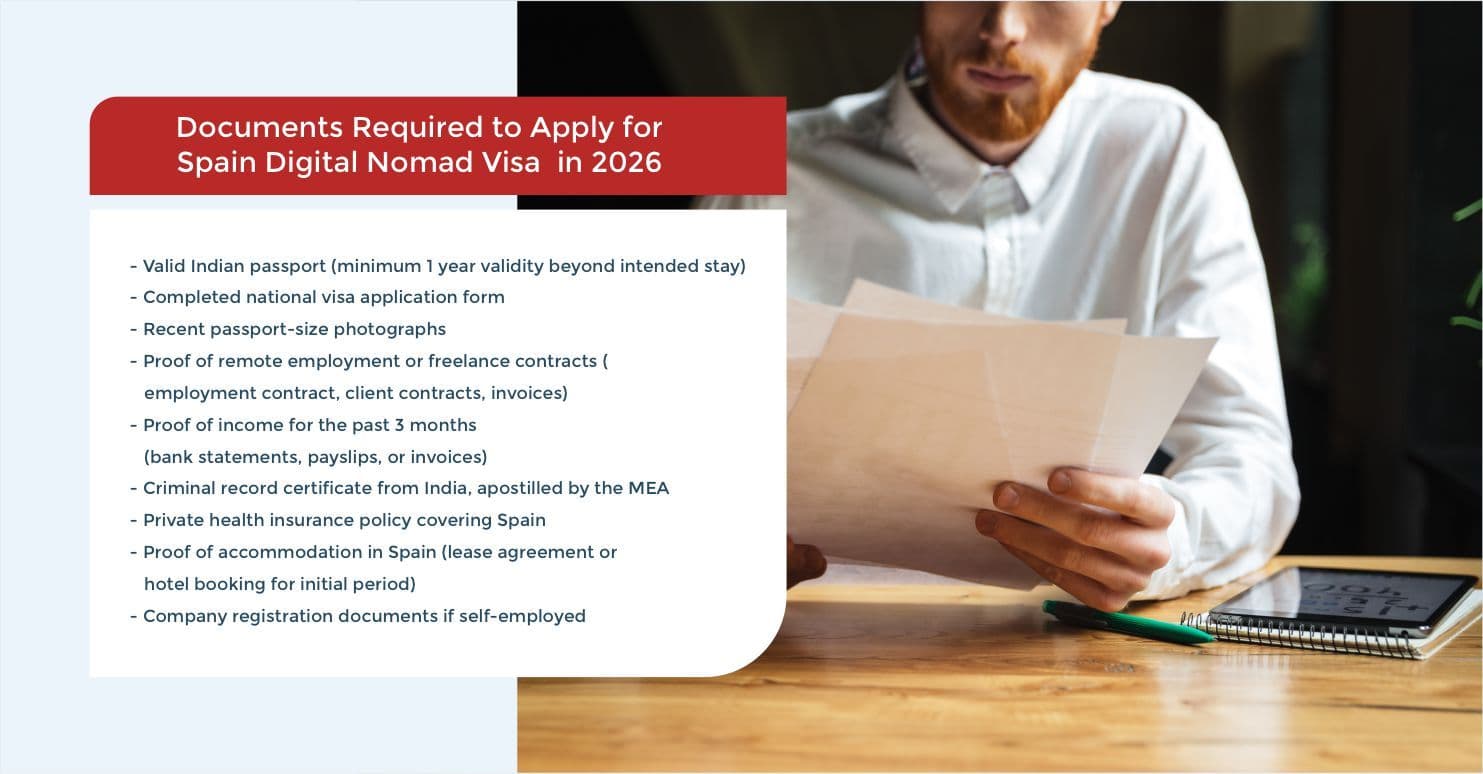
Core documents required:
- Valid Indian passport (minimum 1 year validity beyond intended stay)
- Completed national visa application form
- Recent passport-size photographs
- Proof of remote employment or freelance contracts (employment contract, client contracts, invoices)
- Proof of income for the past 3 months (bank statements, payslips, or invoices)
- Criminal record certificate from India, apostilled by the MEA
- Private health insurance policy covering Spain
- Proof of accommodation in Spain (lease agreement or hotel booking for initial period)
- Company registration documents if self-employed
Processing time: 2 to 4 weeks from a Spanish consulate in India, though appointment wait times at busy consulates like Mumbai and New Delhi can push the overall timeline to 6-10 weeks. Apply well in advance.
After Arrival- Converting to Residency
The DNV is initially granted for 1 year. Once in Spain, you apply for your TIE within 30 days of arrival. After the first year, you can renew for a 2-year period, then renew again for another 2 years. After 5 years of continuous legal residence in Spain, you become eligible for long-term EU residency. After 10 years, Spanish citizenship.
Can Your Family Come With You?
Yes. The DNV includes family reunification from the outset like your spouse or civil partner and dependent children can apply alongside you or join you later. Family members on the DNV are permitted to work in Spain, which is an advantage over some other visa categories.
Beckham Law Eligibility
DNV holders who are newly arriving in Spain may qualify for Spain's Beckham Law, which allows qualifying new residents to pay a flat 24% tax rate on Spanish-sourced income up to €600,000 for the first 6 years, rather than the standard progressive rates which go up to 47%.
Work Visa
The standard Spanish work visa is employer-sponsored. This means a Spanish company must not only offer you a job but must go through a formal government process to hire you. It is not the fastest or easiest route, but for Indians who secure a role with a Spanish employer, it is the most common path into the Spanish job market.
What is the Labour Market Test and When It Applies?
Before a Spanish employer can hire a non-EU national, they must demonstrate that no qualified Spanish or EU/EEA candidate was available for the role. This involves advertising the position through Spain's public employment service (SEPE) and waiting for a defined period.
This is important for Indians in skilled roles, the labour market test is waived for occupations on Spain's official shortage list. This list includes certain engineering specialties, data science and AI roles, specific healthcare positions, and other technical profiles where Spain has documented shortages. If your occupation is on the shortage list, your employer can hire you without going through the full labour market test, which speeds up the process.
What Your Spanish Employer Must Do
The employer, not the candidate, initiates most of the work permit process in Spain. Your employer files the application with the regional immigration authority in the province where you will work. The employer must demonstrate financial solvency- proof that they can sustain the salary they are offering and provide the employment contract, company registration details, and evidence of the job offer.
Once the work permit is approved on the Spanish side, the file is transferred to the Spanish consulate in India, where you apply for the actual visa. The entire employer-side process takes 2 to 4 months before it reaches the consulate stage.
What You Need to Prepare in India
- Valid passport
- Apostilled degree and professional qualification certificates from India
- Apostilled Criminal Record Check
- Medical certificate (apostilled if required by consulate)
- Curriculum vitae in Spanish (strongly recommended)
- Any professional registration certificates relevant to your field
Degree recognition is a separate process worth understanding. For regulated professions like medicine, nursing, law, architecture, teaching, your Indian degree must be formally recognised by the Spanish Ministry of Education before you can practise. This process can take 6 to 18 months and should be initiated well before your visa application. For non-regulated professions (IT, finance, consulting, marketing), formal homologación is generally not required, though employers may ask for transcript evaluations.
Salary and Duration the work visa is initially granted for 1 year, it is renewable. Your salary must meet or exceed Spain's minimum wage (SMI) around €1,221 /month, most skilled professional roles pay above this. After 5 years of legal residence, you qualify for long-term EU residency.
Self-Employment Visa (Autónomo Visa)
If you are a freelancer working for clients based outside Spain, the DNV is your route. If you want to set up a freelance practice or small business in Spain and serve Spanish clients or if you want to register as autónomo (self-employed) in Spain and operate within the Spanish economy, the Autónomo visa/ Self-employment visa is what applies.
For Indian entrepreneurs who want to physically establish a business in Spain, hire local staff, or build a client base within Spain, this is the correct visa category.
What Spain Requires You to Prove
This visa has no single income threshold the way the DNV does. Instead, you must demonstrate economic viability through a business plan and financial projections. The Spanish consulate and immigration authority evaluate whether your proposed business or freelance activity is commercially credible, whether you have sufficient funds to sustain yourself while building it, and whether your activity is legal and registered in Spain. Key requirements:
- A detailed business plan in Spanish, demonstrating market need, revenue projections, and operational plan.
- Proof of professional qualifications relevant to your business activity.
- Evidence of sufficient financial means (at least 12 months of living expenses as a minimum).
- Proof that you have completed or initiated the registration of your business activity with Spain's Tax Agency and Social Security
- Criminal record certificate (apostilled)
- Health insurance
Important Note for Indians to Know
Once registered as autónomo in Spain, you are required to pay monthly Social Security contributions regardless of your income level in the early months. Spain has a progressive contribution system for autónomos based on actual income. Lower-earning autónomos pay lower contributions. New autónomos also benefit from a flat rate for the first 12 months, which is approx €80/month- before moving to the income-based contribution system.
Student Visa
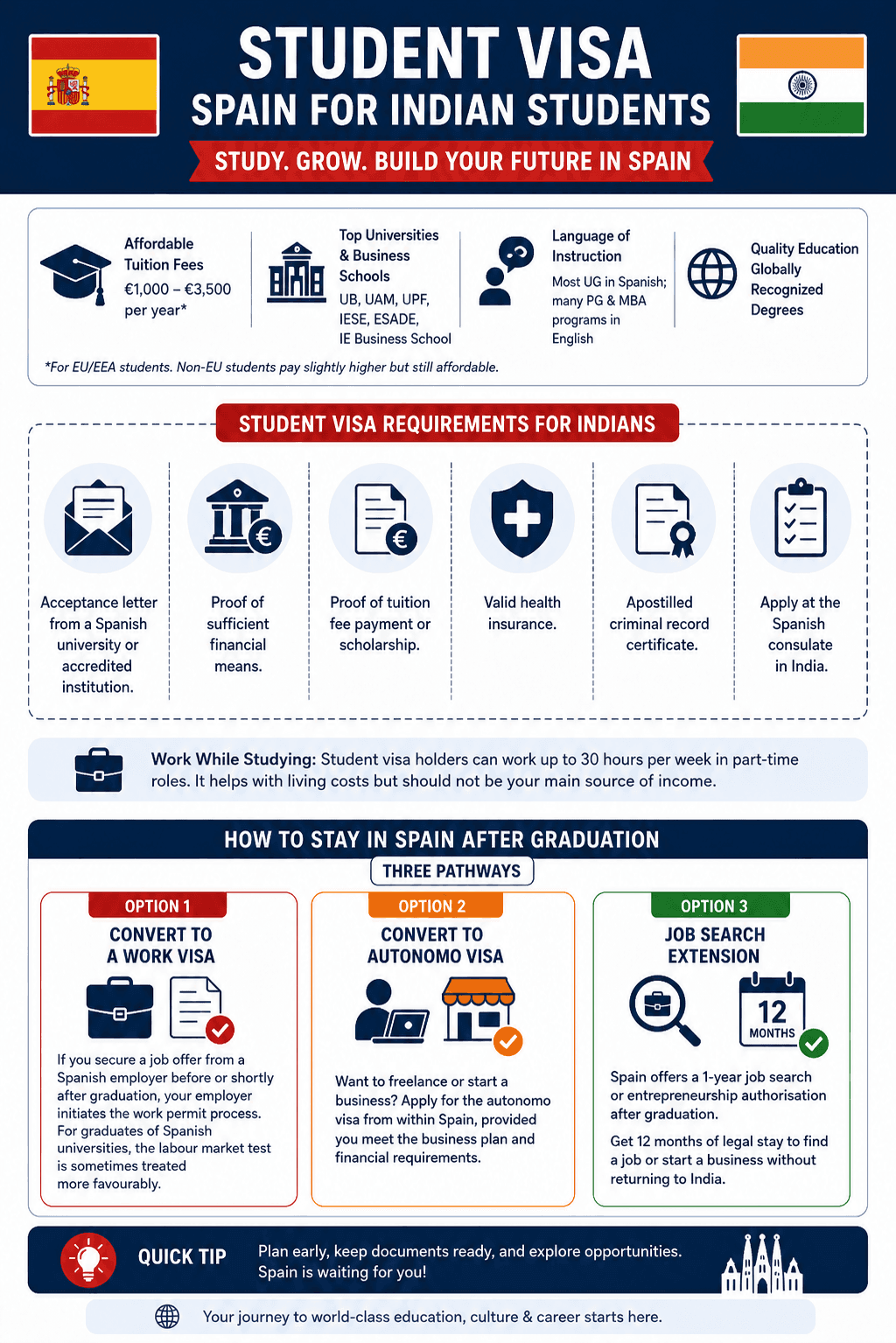
Spain is underrated as a study destination for Indians. Tuition fees at Spanish public universities are substantially lower than UK, Australian, or US institutions. Typically between €1,000 and €3,500 per year for EU/EEA students and somewhat higher for non-EU students, but still more affordable than comparable destinations. Spain has several globally ranked universities, including Universidad de Barcelona, Universidad Autónoma de Madrid, and Universidad Pompeu Fabra, as well as strong private business schools like IESE, ESADE, and IE Business School- the latter two being well-regarded for MBA programs and actively recruiting Indian students.
But language of instruction matters, most undergraduate programs are in Spanish, while postgraduate programs like MBAs, engineering master's degrees, and data science programs increasingly offer full English-medium instruction.
Student Visa Requirements for Indians
The student visa is applied for at the Spanish consulate in India. You must have:
- A formal acceptance letter from a Spanish university or accredited institution.
- Proof of sufficient financial means for the duration of studies.
- Proof of tuition fee payment or scholarship.
- Valid health insurance
- Apostilled criminal record certificate
The student visa does not automatically permit full-time work. Student visa holders in Spain can work up to 30 hours per week in part-time roles, which is useful for supplementing living costs but should not be relied on as a primary income source.
How to Stay in Spain After Graduation
There are three pathways:
- Option 1: Convert to a Work Visa: If you secure a job offer from a Spanish employer before or shortly after graduation, your employer initiates the work permit process. For graduates of Spanish universities, the labour market test is sometimes treated more favourably.
- Option 2: Convert to Autonomo Visa: If you want to freelance or start a business after graduation, you can apply for the autonomo visa from within Spain, provided you meet the business plan and financial requirements.
- Option 3: Job Search Extension: Spain allows students who have completed their degree to apply for a one-year job search or entrepreneurship authorisation after graduation. This gives you 12 months of legal stay to find employment or establish a business without needing to return to India.
Non-Lucrative Visa (NLV)
This visa is for people who want to live in Spain full-time without working in the Spanish economy. It is the right visa if you have sufficient savings, a pension, rental income from Indian properties, dividend income, or any other passive income stream that can sustain your life in Spain without employment. It is popular among:
- Retired Indian professionals with pension or investment income.
- Indians with passive income from property or investments in India.
- Individuals who intend to take a career break in Spain.
- Family members accompanying a primary visa holder who do not need to work.
The critical restriction: NLV holders cannot work in Spain- not for a Spanish employer, not as autonomo, not remotely for a foreign company. Violating this condition is treated seriously and can jeopardise your entire residency. If there is any chance you will work during your stay in Spain, then NLV is not your visa.
Income Requirements
The NLV income threshold is based on Spain's IPREM (Public Income Indicator for Multiple Effects). The main applicant must demonstrate passive income of at least 400% of the monthly IPREM which is approximately €2,400 per month (€28,800 annually) for a single applicant. For each additional family member, you must demonstrate an additional 100% of the monthly IPREM (approximately €600/month per person).
These funds must be demonstrated through bank statements, pension documents, investment portfolio statements, or rental income documentation- all covering the previous 6 to 12 months.
Practical Considerations for Indians
Spanish consulates want to see recurring income, not just a large bank balance. If your income comes from Indian fixed deposits, property rental in India, or stock dividends, you will need to document these clearly and have them translated by a sworn translator.
The NLV is initially granted for 1 year, renewable for 2-year periods. After 5 years, you can apply for long-term EU residency but note that during this time you still cannot work, which is a constraint for those who are not fully retired.
EU Blue Card / Highly-Skilled Work Visa
The EU Blue Card is a pan-European work permit designed specifically for highly qualified non-EU professionals. It is employer-sponsored, like the standard work visa, but comes with better conditions like a faster processing track, higher mobility rights within the EU, and a faster path to long-term EU residency.
For Indian professionals who qualify, it is often a superior option to the standard work visa and worth requesting from a Spanish employer.
Qualification Requirements
To qualify for the EU Blue Card in Spain, you must meet all three of the following conditions:
1. Higher education qualification: A university degree or equivalent professional qualification requiring at least three years of full-time study. Indian bachelor's degrees (B.Tech, MBBS, CA, MBA) generally qualify, but your specific degree may need to be evaluated for equivalence.
2. A valid employment contract or binding job offer for at least one year with a Spanish employer.3. A salary threshold: Your gross annual salary must be at least 1.5 times the average gross annual salary in Spain. The average gross annual salary in Spain is approximately €27,000 - €29,000, meaning the Blue Card salary threshold is roughly €40,000 - €43,500 gross annually.Why Does the Mobility Advantage Matter?
A feature of the EU Blue Card that standard Spanish work visas do not offer is EU mobility. After 18 months of holding a Blue Card in Spain, you can move to another EU member state for work without going through a full new immigration process from scratch. For Indian professionals whose career ambitions extend beyond Spain to Germany, the Netherlands, or elsewhere in the EU, this is a meaningful long-term advantage.
Path to Long-Term Residency
EU Blue Card holders in Spain qualify for long-term EU residency after 5 years of legal residence in EU member states but the calculation can include time spent in other EU countries on a Blue Card, not just Spain. This makes the Blue Card advantageous for internationally mobile professionals.
Intra-Company Transfer Visa
If you are an Indian professional currently employed by a multinational company like an IT services firm, a consulting company, a bank, a technology company and your employer is transferring you to their Spanish office or a client engagement in Spain, then this Intra-Company Transfer visa is your route.
This is the most common pathways for Indian IT professionals entering Spain, given the large number of Indian IT services companies (TCS, Infosys, Wipro, HCL, Tech Mahindra and others) with operations and client engagements in Spain, as well as multinational companies with offices in both India and Spain.
Requirements and Process
The ICT visa requires that:
You have been employed by the company (or within the same corporate group) for at least 3 months prior to the transfer.
The transfer is for a specific professional purpose: manager, specialist, or trainee.Your salary in Spain meets or exceeds the equivalent role's market rate in Spain.The transfer is for a defined period.Your application is initiated by the Spanish entity of your employer and your company's Spanish office files the transfer request with Spanish immigration authorities. Processing is faster than a standard work visa, and many large multinationals have dedicated HR or immigration teams that manage this process routinely.
Duration and Renewal
This visa is granted for the duration of the assignment, up to a maximum of 3 years for managers and specialists and 1 year for trainees. It is renewable if the assignment continues. Time spent in Spain on an ICT visa counts toward the 5-year long-term residency requirement, which is important if you are considering making Spain a longer-term base beyond your initial assignment.
Family Reunification
Family reunification in Spain is not a standalone visa category. It is a residency authorization that the primary visa holder, already legally resident in Spain, applies for on behalf of their family from within Spain. Once approved, the family member then applies for the reunification visa at the Spanish consulate in India. This two-stage process- Spain approval first, India consulate application second. You cannot simply bring your family on your visa. The process must be formally initiated and completed before they travel.
Who Qualifies
- Spouse or legally registered partner: religious marriages conducted in India are accepted if registered with civil authorities and documented with an apostilled marriage certificate.
- Dependent children: biological, legally adopted, or stepchildren
- Dependent parents: over 65 years old who are financially dependent on the sponsor and reside in India.
Can the Spouse Work?
Yes and this is something many guides get wrong. A spouse admitted under family reunification receives a TIE that includes full work authorization. This allows them to work in Spain both as an employee and as a self-employed professional without needing a separate work permit. For dual-income families, this is a financial advantage.
Timeline and Duration
The process takes 4-6 months, involving a 1-3 month authorization in Spain by the sponsor, followed by a 4-8 week visa application by the family in India at BLS International. Family reunification visas for Indians in Spain are granted for 1 year initially, matching the sponsor's residency, and are renewable for up to 4 more years.
Indian Documents Needed
Marriage certificate, spouse's birth certificate, children's birth certificates, spouse's Criminal Record Check (Criminal Record Check), and adoption documents if applicable. Allow 4 to 8 weeks for the apostille process in India before the consulate stage.
Children's Rights in Spain
Children admitted under family reunification have full access to free public education and public healthcare in Spain from the moment their TIE is issued, the same rights as Spanish children.
Golden Visa
This is the section where most guides currently circulating on the internet are out of date, and it matters. Spain's real estate-based Golden Visa which previously allowed non-EU nationals to obtain residency by purchasing Spanish property worth at least €500,000 was officially abolished in April 2025. The Spanish government announced the closure of this route citing housing affordability concerns.
Indian investors who were planning to use the property route must note that this option no longer exists as of April 2025. Applications that were submitted before the closure deadline were processed, but no new property-based Golden Visa applications are being accepted.
Need help with your application or background check?
Contact us now and speak with a dedicated Globeia expert today.