
By Ayushi Trivedi · Updated September 11, 2026
Reviewed by Vasu Singla
Moving to Spain from the US is achievable but the information available online makes it harder than it needs to be. Outdated guides, European-focused advice, income figures that no longer apply, and references to a Golden Visa that closed in April 2025 have sent more than a few Americans down the wrong path. The rules changed significantly in 2025 and 2026 and most resources have not kept up.
This guide was built to fix that. Written specifically for US citizens and verified against current 2026 regulations, it covers every visa option available to Americans, the exact documents required, the fees, the regulatory changes that matter, what healthcare and taxes actually look like as a US resident in Spain, and a clear picture of what your first weeks on the ground should look like. If you are seriously considering the move, this is the right place to start.
Spain is a diverse country in southwestern Europe, combining historic cities, stunning coastlines, and vibrant culture. For Americans considering moving to Spain, understanding these foundational facts helps you plan your relocation and choose the right city or region to settle in.
Spain is located on the Iberian Peninsula, sharing borders with Portugal, France, Andorra, and Gibraltar. Its diverse landscapes include mountains, beaches, plains, and islands, offering options for different lifestyles. You have major capital city life in Madrid which is known for culture, business opportunities, and international schools. Then Barcelona which is famous for its mediterranean beaches, architecture, and vibrant urban life. And many other cities like Valencia, Seville, Malaga , Costa del Sol which give you an affordable cost of living and lifestyle.
The official language is Spanish, known locally as Castilian. Some regions also have their own co-official languages but Spanish gets you everywhere. If you are planning to move, learning basic Spanish before you arrive is worth the effort. Government offices, healthcare appointments, landlords, and everyday local life all run in Spanish, and even a conversational level makes the transition significantly smoother.
Spain has a population of around 49.5 million, uses the Euro, and operates as a parliamentary constitutional monarchy. For Americans, the most relevant administrative detail is that Spain and the US have a double taxation agreement. Something that becomes important once you establish residency and start navigating tax obligations in both countries.
The reasons Americans give for moving to Spain consistently fall into five broad categories.
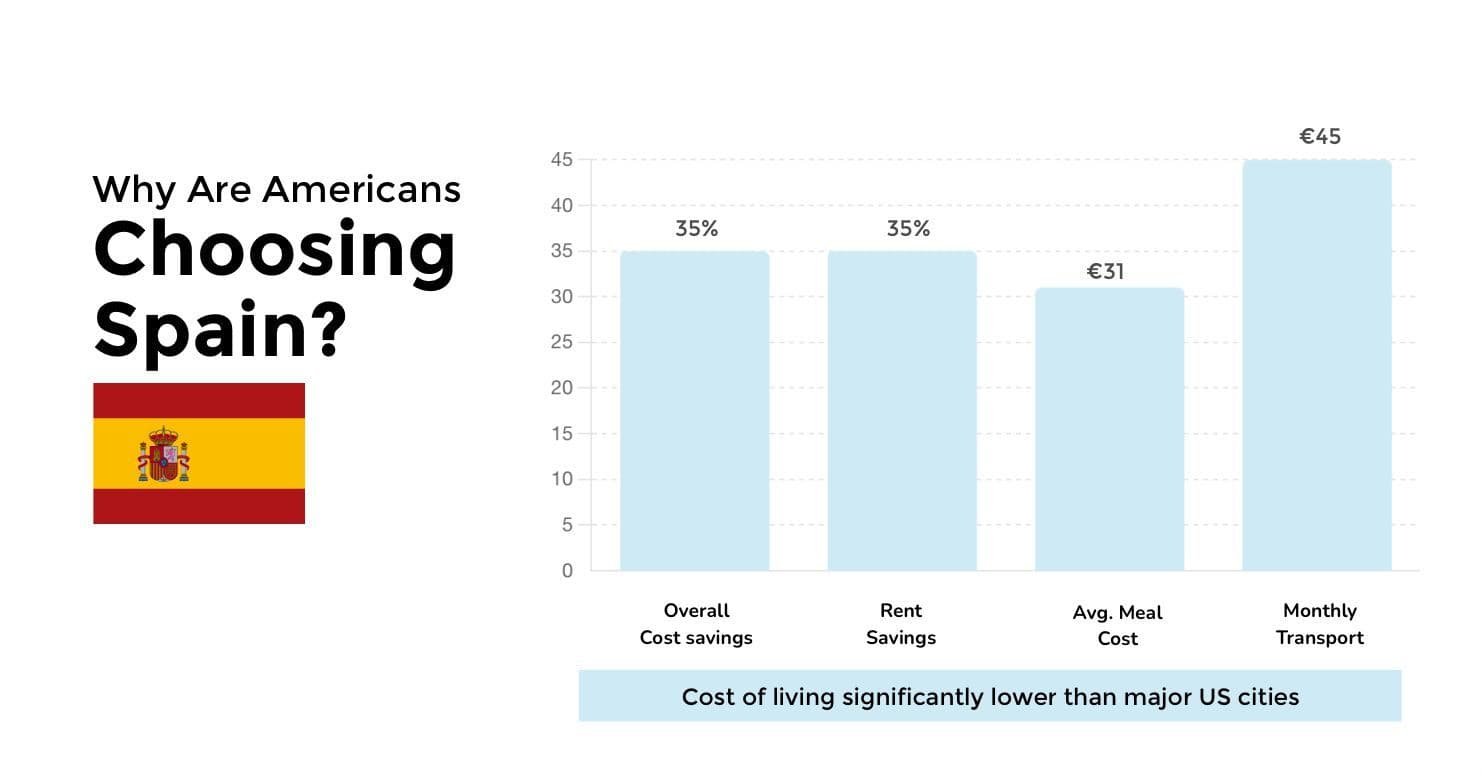
Spain costs meaningfully less than most major American cities. On average, overall living expenses in Spain run roughly 25 to 40 percent lower than in cities like New York, San Francisco, Los Angeles, or Miami. To put that in concrete terms - rent in mid-sized cities like Valencia or Seville runs 25 to 40 percent cheaper than equivalent US cities, a meal at a decent restaurant costs €12 to €50, and a monthly public transport pass typically comes to €30 to €60.
Spain consistently ranks among the best healthcare systems in Europe and the world. The public system covers general consultations, specialist referrals, hospitalization, emergency care, surgery, and subsidized prescription medication. Wait times, while not instant, are reasonable for non-emergency care. For Americans accustomed to the complexity and cost of the US healthcare system, Spain's model is often described as a revelation.
Spain offers a pace of daily life that many Americans find deeply appealing after years in the high-pressure of US cities. The combination of cuisine, pleasant weather, outdoor activities, and rich cultural experiences makes Spain appealing for families, retirees, and working professionals.
Spain is consistently ranked among the safest countries in the world. The 2024 Global Peace Index places Spain in the top 30 safest nations globally. Spain continues to maintain a high-ranking, stable position in subsequent 2025/2026 reports. Crime rates in most Spanish cities are significantly lower than their US equivalents, and violent crime is rare. For families with children or retirees considering the move, this is often cited as one of the most important factors.
Spain's membership in the Schengen Area means that legal residents can travel freely across much of Europe. From Madrid or Barcelona, you are two to three hours by plane from dozens of major European cities. Spain also sits at the geographic crossroads of Europe, North Africa, and the Atlantic - making it one of the most connected countries in the world for international travel.
Spain’s real estate market has attracted Americans looking for property investments, vacation homes, or relocation opportunities. Even with the closure of the Golden Visa program in April 2025, property investment remains a strong motivator for relocation, especially for those seeking long-term residence.
Spain has become a hub for digital nomads and international remote workers, thanks to recent visa reforms. Each visa has its own income requirements and conditions. Spain has built a visa framework that actually reflects how modern professionals work.
Spain's official records show over 41,000 Americans registered as residents but anyone who has spent time in Madrid, Barcelona, or Valencia knows the real number feels much higher. Official statistics only count people who have gone through the full residency process. The Americans still navigating their visa, staying short-term, or simply living under the radar do not show up in that figure.
The established expat hubs are where you would expect - Madrid, Barcelona, Valencia, Seville, and Malaga carry the largest American communities. But walk through the coastal towns of the Costa del Sol, the Balearic Islands, or the Costa Brava and you will find Americans there too, just in smaller pockets.What has changed noticeably in the last couple of years is where new arrivals are heading. Valencia and Malaga in particular have seen a real surge of Americans showing up - younger, mostly remote workers, drawn by lower rents than Madrid or Barcelona and a quality of life that is hard to argue with. Spain's Digital Nomad Visa launching in 2023 accelerated that shift significantly and the trend has not slowed down.Before you can choose the right visa or residency pathway, you need to understand the legal framework that governs how non-EU citizens like Americans can enter, stay, and live in Spain.
As a US citizen you can enter Spain and the broader Schengen Area without a visa. You don’t need any paperwork, no appointment, just your passport. But this comes with a hard limit that a surprising number of people misread. You get 90 days. Not 90 days per country. 90 days total across all 29 Schengen member states combined. So if you spent three weeks in Portugal, a week in France, and then flew to Madrid, that time is already counting. Spain did not reset anything when you landed. The clock started the moment you entered any Schengen country and it does not stop until you leave the zone entirely.
The mistake people make is thinking they can hop between European countries to extend their stay. It does not work that way. The only thing that resets the 90-day clock is leaving the Schengen Area completely. Also waiting until the 180-day window rolls over in your favor.The document that governs short stays across Europe is called the Schengen visa. This is a Type C visa required by citizens of countries without visa-free access to the zone. As an American you are exempt from needing one. But the 90-day rule applies to your entry in exactly the same way it applies to Schengen visa holders. The exemption covers the paperwork, not the time limit. If you want to stay beyond 90 days for any reason like retirement, remote work, study, etc., you need one of the long-stay visas.
As of early 2026, ETIAS is not yet active. Americans do not need it right now.
ETIAS (European Travel Information and Authorisation System) is Europe's upcoming pre-travel authorization system - essentially the EU's equivalent of the US ESTA program that foreign visitors to America already u se. It has been in development since 2016, has been delayed multiple times, and the current target launch date is the fourth quarter of 2026, though that date is not guaranteed and could slip into 2027.Why has it been delayed? ETIAS cannot launch until a separate but connected system called the EES (Entry/Exit System) is fully operational. The EES is a digital biometric database that records travelers' entries and exits across the Schengen Area, replacing traditional passport stamping with facial images and fingerprints. ETIAS depends on EES being fully functional first. Building this interconnected infrastructure across dozens of countries with different border systems has proven far more complex than originally anticipated, which is why both systems have faced repeated delays.What ETIAS will mean for Americans when it launches:
What this means practically for Americans moving to Spain:
If you are planning your move in 2026, ETIAS is very unlikely to be in effect when you first travel to Spain. However, if you are traveling after the fourth quarter of 2026, check whether ETIAS has officially launched before booking your flight. Once live, apply at least a few days before departure to avoid any last-minute issues.The recommendation is simple: follow only official EU announcements for the confirmed launch date. Do not rely on guides or social media posts that claim ETIAS is already required - it is not, as of early 2026.
These two terms are used interchangeably, but they mean different things in the Spanish immigration system and confusing them can cause real problems in your application process.
A visa is a document issued by a Spanish consulate or embassy in your home country. It authorizes you to travel to Spain and pass through immigration at the border. Most long-stay visas issued to Americans are valid for 90 days from the date of issue. This means you must enter Spain within that window.A residence permit (or residency authorization) is the document that allows you to legally stay in Spain beyond the initial visa period. Once you arrive in Spain on your long-stay visa, you have 30 days to apply for your residence permit at the relevant immigration office or police station. The residence permit is what gives you the right to remain in Spain for one year, two years, or longer depending on your visa type.In practice, the process works like this:The TIE (Tarjeta de Identidad de Extranjero) is your foreign identity card. It is a physical card that contains your photograph, NIE number, visa category, and residency validity dates. It functions as your primary form of identification in Spain for almost every administrative purpose - opening a bank account, signing a lease, registering with a doctor, enrolling children in school, and more.
Applying for your TIE is one of the first and most important tasks after arriving in Spain.There are eight active visa options for Americans who want to live in Spain. One closed permanently in April 2025. Each one is designed for a specific situation - choose the wrong one and your application will fail. Here is exactly what each visa is, who it is for, and what you need to qualify.
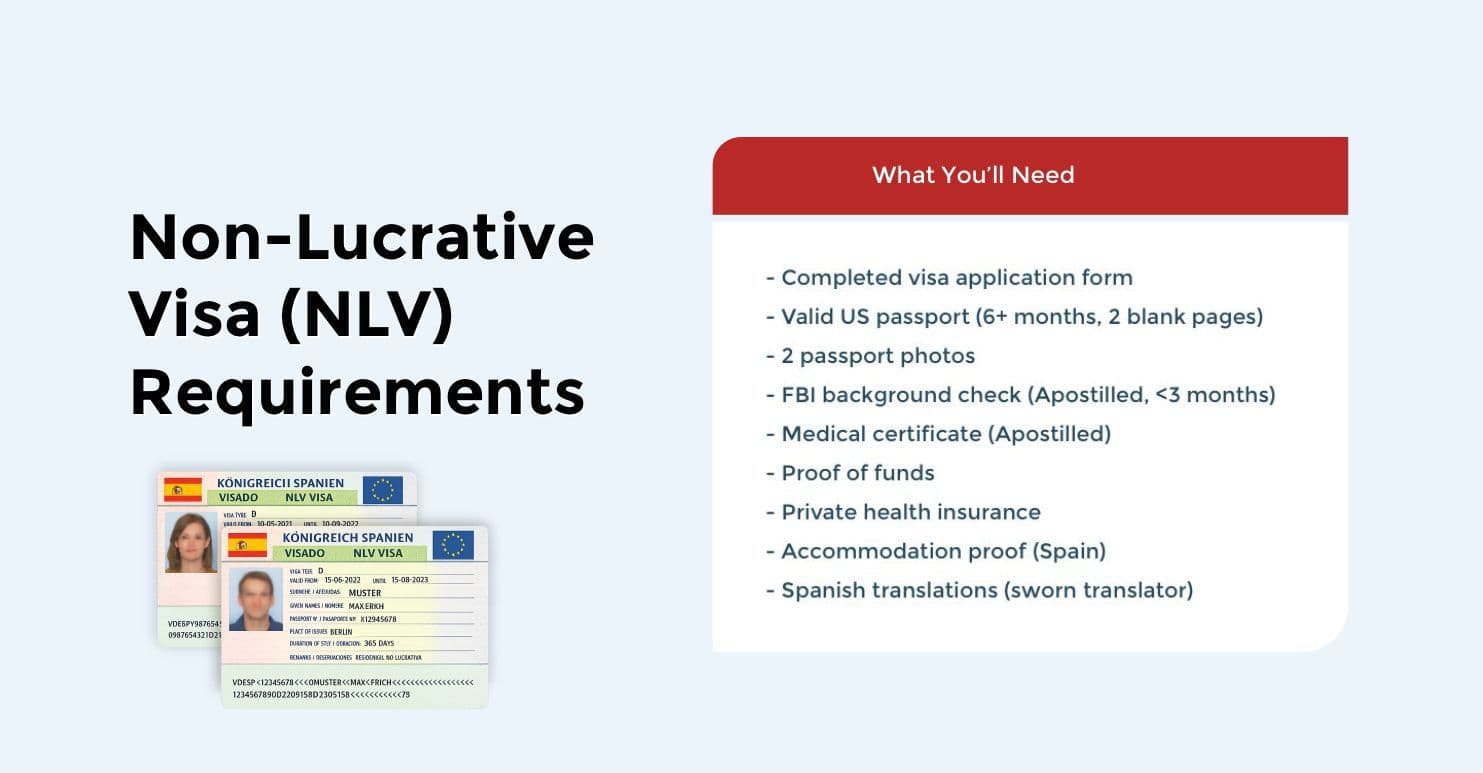
The Non-Lucrative Visa is the most popular route to Spanish residency for American retirees. Spain will grant you residency as long as you can prove you will not become a financial burden on the state. In return you agree not to work for anyone. Not for a Spanish employer, not as a freelancer, not remotely for a US company. If your income comes from a pension, investments, Social Security, rental properties, or dividends and you do not need a Spanish paycheck to get by, this is likely your visa.
Under Royal Decree 1155/2024, anyone renewing their NLV from 2026 onwards must demonstrate they have physically lived in Spain for at least 183 days in the preceding year. This threshold of 183 days is exactly the point at which Spain considers you a tax resident. In other words, renewing your visa now automatically triggers Spanish tax residency, which means Spain taxes your worldwide income.
For many retirees this is manageable. Spain's tax rates on pension income are not punishing. And the US-Spain double taxation treaty means you won't be taxed in full by both countries. But if you have significant investment income, rental income from US properties, or other passive streams, you need to sit down with a cross-border tax adviser before you apply - not after. The financial picture is very different for someone drawing $40,000 a year in Social Security versus someone drawing $120,000 from a brokerage account.The minimum is €28,800 per year in passive income for a single applicant, which is roughly €2,400 per month. Each dependent adds €7,200 per year to that threshold. Salary, freelance income, or any form of active earnings don't count and are not permitted under this visa. Acceptable sources are pension payments, Social Security, rental income, dividends, and investment returns. A large bank balance can support your application but won't substitute for demonstrated ongoing income. Consular officers want to see that the money keeps coming in, not just that you have an amount.
Health Insurance RequirementYou must have comprehensive private health insurance from a provider authorized to operate in Spain. The policy must meet all of the following conditions:
You must apply in person at the Spanish consulate that has jurisdiction over your US state of residence. You cannot apply online or at a consulate outside your jurisdiction. Book your appointment as early as possible - appointments at major consulates such as New York and Los Angeles can be booked out several weeks in advance.
4 to 8 weeks from the date of your appointment, though this varies by consulate and time of year.
Spain introduced the Digital Nomad Visa in 2023 under the Startup Act (Law 28/2022). This visa filled a gap that had existed for years. Americans working remotely for US companies or international clients finally had a legal, clearly defined route to Spanish residency that reflected how they actually worked - rather than having to squeeze into visa categories that were never designed for them.
If you earn your income from a company or clients outside Spain and you want to live in Spain legally - this is your visa. It is the only correct legal route for remote workers. Using a tourist visa or the Non-Lucrative Visa while working remotely is not permitted under Spanish law regardless of where your employer is based or where the money comes from. Who qualifiesYou must demonstrate one of the following. Either a university degree / postgraduate qualification from a recognized institution or a minimum of 3 years of documented professional experience in your field.
Employment DocumentationIf employed by a company then a work contract with a foreign employer that is at least 3 months old, plus written confirmation from the employer that remote work is permitted. And if self-employed or freelance then contracts or agreements with international clients demonstrating ongoing work and income.
Duration and RenewalsApproximately 20 working days when applied for at a Spanish consulate. Faster when applied for directly in Spain through the Large Business Unit (Unidad de Grandes Empresas - UGE).
This visa only works if a Spanish employer wants to hire you and is willing to do the paperwork to prove it. The company has to apply on your behalf first. You cannot initiate this process yourself. And they have to demonstrate either that your role fills a shortage occupation or that they could not find a qualified EU candidate. It is a high bar. Americans with a confirmed job offer from a Spanish employer in a specialized or in-demand role need a work visa.
How the process worksThe Work Visa process has two distinct phases:
Phase 1: Your Spanish employer applies for work authorization from Spanish immigration authorities. You must be in the US during this phase.Phase 2: Once approved, you apply for your entry visa at your Spanish consulate. You travel to Spain, sign the contract officially, and apply for your TIE and social security registration.Employment conditionsSpanish labor law sets the floor at approximately €1,323 per month (paid across 14 payments per year, which is the Spanish standard). You're entitled to a minimum of 30 days paid annual leave and the full protections of the Spanish labor code - significantly more employee-protective than most US employment law. Healthcare through the public system becomes available once you're registered with social security.
Duration and RenewalsGetting a Spanish work visa as an American is very competitive. Spanish employers face bureaucratic hurdles in hiring non-EU workers and must justify the hire to immigration authorities. Your chances improve significantly if you have highly specialized skills not readily available in the EU labor market, are fluent in Spanish, or are being transferred within a multinational company.
Documents RequiredThe Highly Skilled Professional Visa runs on a completely different track. Where the standard Work Visa takes months and requires your employer to prove they couldn't find a European for the job, this one processes in 10 to 20 business days and skips the EU candidate search requirement entirely. For the right person, it's one of the cleanest paths into Spain that exists.
The right person is fairly specific though. You need to be coming in as a manager or senior professional at a medium or large Spanish company earning at least €54,000 gross per year. Also as a researcher, lecturer, or scientist hired by a university or government institution at a minimum of €40,000. The salary thresholds are not flexible - if the offered compensation falls below them, you'll need the standard Work Visa route instead.One practical difference from the standard work visa is you can already be in Spain when your employer starts the application. You don't have to be sitting in the US waiting for paperwork to clear. For people who are already in Spain exploring opportunities, this matters.The document list mirrors the standard work visa with three additions: written evidence of your seniority or research role, salary confirmation from your employer, and verification of company size. Beyond those, the core requirements are the same - valid US passport, FBI background check (apostilled), medical certificate (apostilled), employment contract, academic or professional credentials, and sworn translations of all non-Spanish documents.
Visa fee: $183-$190 for US citizens.
Duration: Initial permit is 2 years, renewable, with permanent residency eligibility after 5 continuous years of legal residence.This visa is for Americans who want to build a business within Spain - serving Spanish and international clients as a registered autónomo or through a Spanish company. It is different from the Digital Nomad Visa which is for people earning from outside Spain. This one is for people who want to plant a commercial flag in Spain itself.
Core RequirementsYou need to demonstrate professional qualifications to operate in your sector, have sufficient personal funding to support yourself and launch the business, and submit a detailed business plan covering your services or products, target market, projected revenue, funding sources, and intended impact. Compliance with Spanish business registration and licensing requirements for your specific sector also applies from day one.
Duration and Renewals1 year initially, renewable up to four times (one additional year per renewal). At each renewal you must show the business is viable and still generating positive local impact. Permanent residency eligibility after 5 continuous years.
Visa Fee$200-$260 for US citizens - the highest fee in the Spanish visa schedule for Americans, due to the reciprocal fee agreement.
The Student Visa is for Americans who have been accepted into a qualifying educational program in Spain like university degrees, postgraduate programs, accredited language courses, research programs, and unpaid internships. It is also one of the most common entry points for younger Americans who eventually want to work in Spain, as it can lead directly to the Job Search Visa upon graduation and from there to a work visa or permanent residency.
There are three categories depending on your program length. Programs up to 90 days fall under the Schengen Student Visa and require no residence permit. Programs between 90 and 180 days use the Short-term Student Visa. Anything over 6 months which covers most university degrees, master's programs, and longer language courses requires the Long-term Student Visa. This is the category most American students will need.The 2025 work hour changesThe Student Visa saw the most significant rule changes in 2025 and the distinction now matters depending on what you are studying.
University-level students who are pursuing bachelor's, master's, and PhD programs, can now work up to 30 hours per week, up from the previous 20-hour limit. This is a meaningful change for anyone planning to support themselves partially through part-time work while studying. Work authorization must be obtained from Spanish immigration before you start employment, applied through your TIE application.Students enrolled in Spanish language courses are treated differently following the 2025 update. Work remains capped at 20 hours per week and this category now faces stricter restrictions overall. Language courses are no longer treated the same as tertiary qualifications. If you were planning to use a language course as a route to working rights in Spain, the rules have changed and that pathway is more limited than it used to be.
What Is needed to applyValid US passport, your acceptance or enrollment letter from the Spanish institution, proof of sufficient funds to cover tuition and living costs, private health insurance valid in Spain, FBI background check (apostilled), medical certificate (apostilled), proof of accommodation, and sworn translations of all non-Spanish documents.
Apply at your jurisdictional US consulate up to 3 months before your program start date - processing takes 2 to 4 weeks.Visa fee: $150–$160 for US citizens.
The Job Search Visa is a bridging visa that allows Americans who have completed a qualifying degree at a Spanish university to remain in Spain after graduation while they search for employment. It is important to understand what this visa is and what it is not: it is not a work permit. It does not authorize employment. It is a legal status that keeps you in Spain while you transition from student to worker.
Once you find a job, you must then apply for the appropriate work visa or permit before you begin working.Eligibility RequirementsFollowing the 2025 update to this visa, eligibility has been tightened:
This is valid for 1 year which is a non-renewable visa. If you have not secured employment and the appropriate work authorization within this year, you must leave Spain. The processing time is approximately 20 working days from application.
Documents RequiredVisa fee: approximately $135
Most of this guide is written for people making the move on their own terms - their own visa, their own income, their own application. The Family Reunification Visa works differently. Here, someone else's legal status in Spain is what makes your move possible.
If a close family member is already legally resident in Spain and has been for at least a year, they can sponsor you to join them. The visa grants you the right to both live and work in Spain which makes it one of the more generous visa categories in terms of what it allows and your validity is tied directly to theirs. When they renew, you renew. If their status lapses, yours becomes complicated.
The sponsor must have held legal residency for at least one year and must demonstrate they have enough income to support both themselves and you. The qualifying relationships are: spouse or legally recognized civil partner, children under 18, children over 18 who are dependent due to disability, and parents or parents-in-law aged 65 or over who are financially dependent on the sponsor. The income threshold is assessed against Spain's IPREM (public income indicator) and varies by family size.
The Family Reunification Visa is valid for as long as the sponsoring family member's own residence permit or TIE card remains valid. When the sponsor renews their residency, the family member's status is renewed accordingly.
Documents RequiredThe Spanish Golden Visa, formally known as the Investor Visa, previously allowed non-EU citizens including Americans to obtain Spanish residency by making a qualifying investment in Spain. The most common route was a minimum real estate investment of €500,000. Other qualifying routes included €1 million in company shares or bank deposits, €2 million in Spanish treasury bonds, or a significant investment in a new business creating local employment.
The Golden Visa was popular among Americans for several reasons: it included work authorization, allowed dependent family members to join immediately, did not require the holder to actually live in Spain for most of the year, and provided a relatively fast path to residency.The Spanish government, under Prime Minister Pedro Sanchez, announced the closure of the Golden Visa program citing concerns about its contribution to housing unaffordability in major Spanish cities, particularly Madrid and Barcelona. The program formally closed to new applications on April 3, 2025.
If you have seen the Golden Visa mentioned as an active option in other guides or websites, please note that those sources are outdated. This program is permanently closed to new applicants.
Understanding which visa is right for you is one thing. Actually applying for it successfully is another. The Spanish visa application process is thorough, document-heavy, and unforgiving of errors or omissions. A single missing apostille, an expired background check, or a document submitted without a sworn translation can result in your application being refused and in some cases, a refusal affects future applications.
You must apply at the consulate that has jurisdiction over the US state where you currently reside. You cannot choose freely between consulates, and applying at the wrong one will result in your application being rejected outright regardless of how strong your documents are. Each consulate operates slightly differently - processing times vary, some have specific document formatting preferences, and appointment availability differs significantly between locations.
Finding your consulate: Visit the official website of the Spanish Ministry of Foreign Affairs or search "Spanish consulate" followed by your state to identify the correct office.
All Spanish long-stay visa applications require an in-person appointment at your jurisdictional consulate. You cannot submit documents by mail for a long-stay visa. Walk-in appointments are not accepted.
Appointment availability varies significantly by location and time of year. At busy consulates such as New York and Los Angeles, appointments can be booked out 4 to 8 weeks in advance, sometimes longer during peak periods in spring and summer. At smaller consulates such as Boston or Houston, appointments may be available within 1 to 2 weeks.Practical advice: Book your appointment the moment you decide to apply - even before you have gathered all your documents. Appointment slots fill up quickly and you can always cancel if your plans change. Many Americans lose valuable months simply because they waited until their documents were ready before booking.
This is the most time-consuming part of the process. Every Spanish long-stay visa requires a set of core documents, plus additional documents specific to your visa type. Below is the complete master checklist.
Core Documents Required for All Visa TypesAs a US citizen, you pay higher visa fees than most other nationalities due to a reciprocal fee arrangement between the United States and Spain.
Fees are paid at the consulate at the time of your appointment, mostly in cash or money order. Credit cards are not accepted at most consulates. Check your specific consulate's payment instructions in advance.Note that the visa fee is separate from other costs you will incur during the process, including apostille fees, sworn translation fees, health insurance premiums, and legal fees if you use an immigration lawyer. The total out-of-pocket cost for the application process ranges from $1,500 to $5,000 depending on visa type, number of documents requiring translation and apostille, and whether you use professional assistance.On the day of your appointment, arrive on time with your complete document package. Spanish consulates are strict about appointment times and will not accommodate late arrivals.
Bring the following to your appointment:The consular officer will review your documents, ask questions about your intended stay and situation, and collect your application. The appointment itself takes 20 to 45 minutes. Be prepared to answer questions about your income sources, accommodation plans, and reasons for choosing Spain.
Important: If your documents are incomplete or fail to meet requirements, the consulate may refuse to accept your application on the spot. This is not a rejection of your visa - it means you need to correct the issue and return with a new appointment. However, it does cost you significant time. Thoroughness in Step 3 is the best investment you can make in this process.After your appointment, processing begins. Standard processing times by visa type are different for every visa. The Highly Skilled Professional Visa is the fastest at 10 to 20 business days. The Student Visa typically comes back in 2 to 4 weeks. The Digital Nomad and Job Search visas run around 20 working days. The Non-Lucrative Visa, Work Visa, and Family Reunification Visa all sit in the 4 to 8 week range.
These are typical ranges - actual processing times vary by consulate, time of year, and individual application complexity. If your application is approved, you will be notified to collect your visa from the consulate. If it is refused, you have the right to appeal the decision or reapply with corrected or additional documentation.
Once your visa is issued it is valid for 90 days - meaning you must enter Spain within 90 days of the visa issue date. Do not delay your travel unnecessarily.
Upon arriving in Spain, your process is not complete. You have a series of registrations and applications to complete within your first 30 days. The most time-sensitive are:The first 30 days are an administrative sprint and the order matters - each step unlocks the next. Start by confirming your address and registering on the Padron at your local town hall, free and takes 20 minutes - request several certified copies immediately. Next get your NIE, your permanent foreign ID number used for every official transaction in Spain, booked through sede.administracionespublicas.gob.es. Once that is done apply for your TIE residence card within 30 days of arrival - this is a legal requirement. It takes 4 to 6 weeks to arrive but your appointment receipt covers you in the meantime. Open a Spanish bank account as soon as your NIE is ready - BBVA, Santander, and CaixaBank are the most foreigner-friendly and grab a local SIM card in your first few days since government portals require a Spanish number.
A few practical things worth sorting early: your US driving licence is only valid for six months after obtaining residency, after which you must pass the full Spanish theory and practical exam - start that process early as it takes 2 to 4 months and costs €500 to €1,500. If you have children, enroll them promptly - public schools are free but taught entirely in Spanish, international schools run €8,000 to €15,000 per year, and concertado schools offer a middle ground at €100 to €400 per month. And if the bureaucracy starts feeling overwhelming, which it will - hire a gestor, a licensed agent who handles Spanish admin on your behalf for €50 to €200 per task. Worth every cent.Taxes are one of the most important and most misunderstood aspects of moving to Spain as an American. The key thing to understand is that moving to Spain does not end your US tax obligations. You will have tax responsibilities in both countries simultaneously.
As a US citizen you are required to file a federal tax return every single year regardless of where in the world you live - that obligation never stops. At the same time, once you spend more than 183 days per year in Spain you become a Spanish tax resident, and Spain taxes your worldwide income. Two countries, two sets of obligations, running at the same time.
The US-Spain double taxation treaty prevents you from being taxed in full by both countries on the same income but it does not eliminate your filing requirements on either side. This is one area where getting a cross-border tax specialist involved before you move pays for itself many times over.Once you are a Spanish tax resident, Spain taxes your income on a progressive scale ranging from 19% to 47% depending on your total earnings. Your annual Spanish tax return called the Declaración de la Renta, is filed between April and June each year through Spain's tax agency, the Agencia Tributaria.
This is the most important tax conversation to have before you arrive in Spain - and the one most people find out about too late.
If you have not been a Spanish tax resident in the previous five years and you are moving for employment, remote work, or entrepreneurship, you can elect to be taxed under the Beckham Law regime. What that means in practice:For many Americans who move to Spain, the initial visa is just the beginning. After five years of continuous and legal residence in Spain, US citizens become eligible to apply for Spanish Permanent Residency (PR). This is one of the most significant milestones in your life in Spain - permanent residency grants you the right to live and work in Spain indefinitely, without restriction, on equal footing with Spanish nationals for most practical purposes.
Permanent residency is not tied to any specific visa type. Whether you arrived on a Non-Lucrative Visa, a Digital Nomad Visa, a Work Visa, or any other qualifying long-stay visa, the five-year clock runs from the date you first established legal residency in Spain.The five years must be continuous and uninterrupted. This does not mean you cannot leave Spain - you can travel freely but extended absences can break the continuity of your residency. As a general rule, absences of more than 6 consecutive months, or absences totaling more than 10 months across the five-year period, can reset or interrupt the clock. If you travel frequently or spend significant time in the US, keep careful records of your entry and exit dates.One important exception: If you held a student visa for part of your time in Spain, only 50% of your student visa period counts toward the five-year permanent residency calculation. A student who spent two years on a student visa and then three years on a work visa would have four years counted toward PR not five and would need to wait an additional year.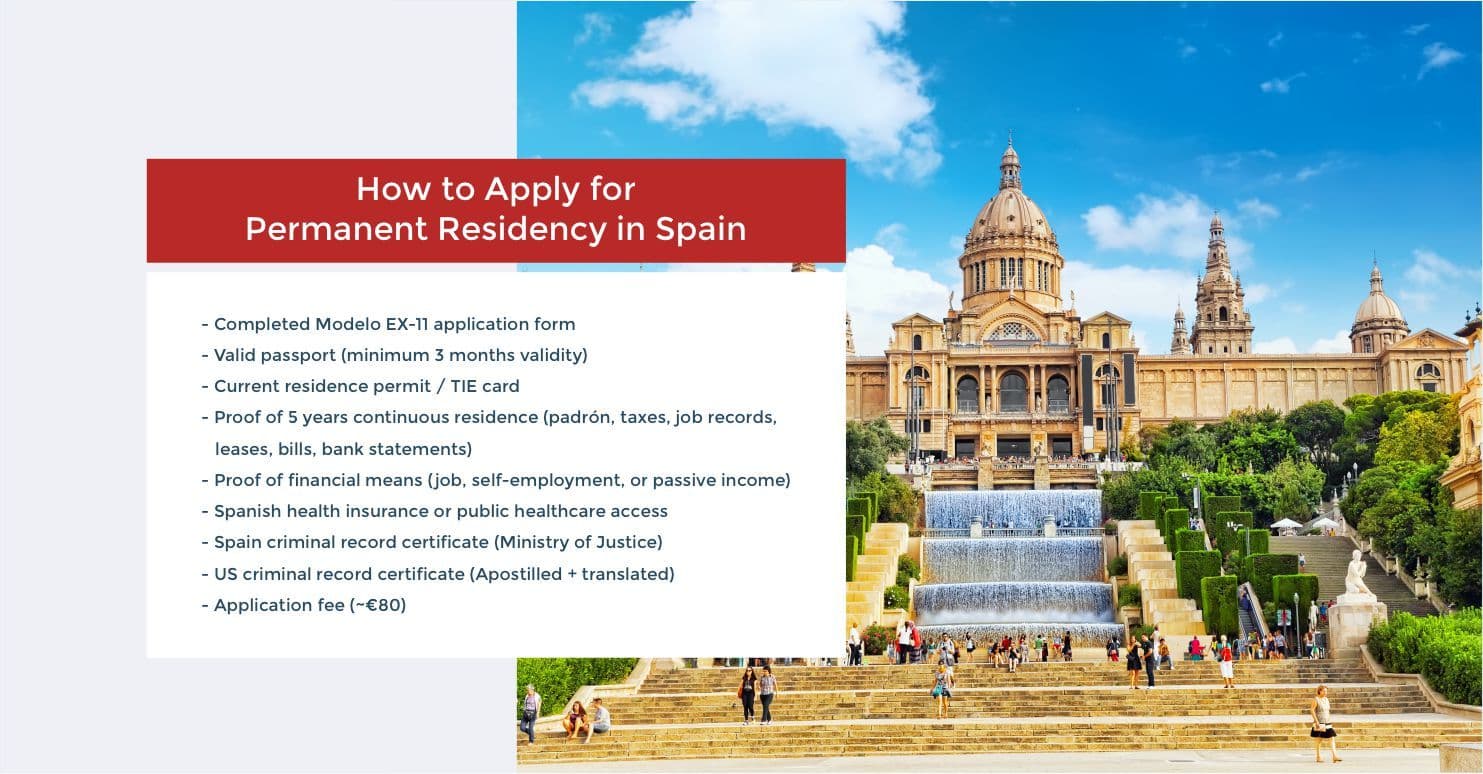
The permanent residency application is filed in person at the immigration office in the province where you live. It cannot be submitted online or through a consulate. Here is what you need:
Documents RequiredPermanent residency applications are processed within 3 to 6 months. You will receive written notification of the decision. If approved, your permanent residency card is valid for 5 years and is renewable indefinitely - renewal is largely administrative and does not require you to requalify from scratch.
Permanent residency removes the limitations that come with a temporary visa. You can live in Spain indefinitely without renewing a specific visa category, work in any capacity - employed, self-employed, or as a business owner, regardless of what your original visa permitted, and access Spain's public healthcare system on the same basis as Spanish nationals. You also gain the right to travel freely across the Schengen Area and access the same social benefits and protections available to other Spanish residents.
After ten continuous years of legal residence, US citizens can apply for Spanish citizenship by naturalization. Requirements beyond residency include passing the CCSE civic knowledge exam and the DELE A2 Spanish language exam, and maintaining a clean criminal record throughout. Processing times are long - 1 to 3 years from submission. Those married to a Spanish citizen qualify after just 1 year of residence. The dual citizenship situation between the US and Spain is complex and not guaranteed - anyone seriously considering Spanish nationality should consult both a Spanish immigration lawyer and a US expatriate citizenship attorney before proceeding.
This is where many Americans pause and for good reason.
The United States and Spain do not have a dual citizenship agreement. Spain's general rule requires naturalizing citizens to renounce their previous citizenship. The US does not automatically strip citizenship from Americans who naturalize elsewhere, but taking an oath of allegiance to a foreign state with the intention of giving up US citizenship is one of the specific acts that can result in loss of US nationality under US law.Many Americans have successfully obtained Spanish citizenship while retaining their US passport by demonstrating they did not intend to relinquish their American nationality. However, this outcome is not guaranteed and depends entirely on individual circumstances. If you are seriously considering Spanish citizenship, consult both a Spanish immigration lawyer and a US immigration attorney who specializes in expatriate citizenship before taking any steps. This is not a decision to make based on general information.The Americans who successfully make the move to Spain are not the ones with the most money or the most time. They are the ones who understood the process, started early, and did not let the paperwork put them off. You now have everything you need to be one of those people. The visa options, the documents, the timelines, the tax implications, the first 30 days - it is all covered in this guide.

Applying for a Schengen visa from India in 2026? Get the full process, document checklist, fees, processing times, and rejection-proof tips in one guide.

Planning a move to Portugal from the USA? Learn about visas, documents, housing, banking, taxes, healthcare, and settling in with a step-by-step guide.

Everything you need for a UK apostille in 2026 - FCDO process, fees, timelines, document types, non-Hague countries, and common rejection fixes.
Need help with your application or background check?
Contact us now and speak with a dedicated Globeia expert today.


