
By Sejal Jain · Updated September 11, 2026
Reviewed by Vasu Singla
Americans moving to New Zealand is more achievable than most people think but it requires real preparation. Unlike Australia, New Zealand has no special visa agreement with the United States. That means US citizens go through the same immigration pathways as most other nationalities, and skipping steps will cost you months.
This guide walks you through everything from New Zealand visa options for US citizens to document apostille requirements, cost of living comparisons, and which cities suit American expats best. Whether you're moving to New Zealand from America for work, family, or a lifestyle change, the process follows a clear order. This guide gives you that order step by step, without the fluff.
Every few years, searches for "Americans moving to New Zealand" spike sharply. It happened in 2017. Again in 2021. And it's happening in 2026. But the Americans who actually make the move aren't doing it on impulse, most have been thinking about it for years.
According to Statistics New Zealand, around 28,000 Americans currently live in New Zealand as residents or long-term visa holders, and increasing every year. That number has grown steadily, driven not by politics alone, but by a simple question more Americans are asking: Is there somewhere that offers a better balance?
Europe is the first destination most American expats consider. But language barriers, complex visa systems across 27 countries, and cultural adjustment make it harder than it on paper.
Australia is the obvious English-speaking alternative. So why do thousands still choose New Zealand? Because New Zealand offers something different. It's smaller, quieter, and, for many Americans, a better fit.
New Zealand checks several boxes that matter to Americans making a permanent move:
For Americans who grew up near mountains, open water, or wide open space, living in New Zealand as an American doesn't feel like starting over. It feels familiar - with a slower pace.
New Zealand is one of the harder developed countries to immigrate to permanently. There is no bilateral work visa between the US and New Zealand. The primary residency pathway the Skilled Migrant Category which is points-based, competitive, and in most practical cases requires a confirmed job offer before you can apply.
Processing times are long. Document requirements are strict. And unlike the EU, there is no backdoor route. Moving to New Zealand from America is worth it for the right person, with the right skills, in the right situation. The rest of this guide will help you figure out exactly where you stand and what steps to take next.
For Americans weighing up a permanent move abroad, New Zealand keeps coming up and not just because it's beautiful. The country offers a specific combination of safety, stability, English-speaking culture, and quality of life that's hard to find in one place. But it's not perfect, and the drawbacks are real.
New Zealand ranked 4th on the 2024 Global Peace Index, published by the Institute for Economics and Peace. That puts it ahead of nearly every other country Americans would consider moving to, including Canada, Australia, and most of Western Europe.
Violent crime rates are low. Gun laws are strict tightened further after the 2019 Christchurch attacks. Political transitions happen without instability. There are no military conflicts within the region, and the country has no enemies in any meaningful geopolitical sense.
For Americans used to checking their surroundings in public spaces, the shift feels noticeable within weeks.
New Zealand is one of the most geographically varied countries on earth for its size. The North Island has volcanic terrain, geothermal hot springs, and long stretches of coastline. The South Island has the Southern Alps, Fiordland, and some of the best ski terrain in the Southern Hemisphere.
Queenstown is the hub for skiing, snowboarding, and adventure sports. The Abel Tasman and Tongariro Alpine Crossing draw serious hikers year-round. Surfing is active on both coasts.
What makes it different from other outdoor destinations is access. Most of this is public land. You don't need permits for most trails, and national parks are open.
New Zealand law follows the English common law tradition the same foundation as US law. Contracts, property rights, employment law, and the court system all operate on principles Americans will recognize.
English is the primary language. There's no adjustment period, no language class required, and no cultural wall to climb when dealing with government agencies, doctors, or employers.
For American expats living in New Zealand, this makes daily life and legal matters considerably more straightforward than in most non-English-speaking countries.
New Zealand has a publicly funded health system. Most GP visits, hospital stays, and specialist care are subsidized or free for residents. The Accident Compensation Corporation (ACC) covers injury treatment, including for accidents that happen outside of work at no cost to the patient.
Wait times for non-urgent procedures can be long, and some Americans opt for private health insurance to access faster specialist care. But for everyday health needs, the system works and doesn't produce medical debt.
Public schools are free for residents. Universities are government-subsidized, and international student fees while higher are still below US private university rates.
New Zealand labor law requires a minimum of four weeks of paid annual leave for full-time employees. The standard workweek culture leans toward leaving on time. Overtime expectations are lower than in the US.
The four-day workweek conversation is further along in New Zealand than in most countries. Perpetual Guardian, a New Zealand company, ran one of the first documented four-day trials in 2018. The results were studied internationally, and the model has continued spreading through New Zealand's business culture.
This isn't universal high-pressure industries exist here too. But the baseline expectation around work hours is different.
New Zealand legalized same-sex marriage in 2013, becoming the first country in the Asia-Pacific region to do so. Adoption rights, workplace protections, and legal recognition are established and enforced.
The social climate in major cities Auckland, Wellington, Christchurch is openly inclusive. This matters practically for LGBTQ+ Americans considering living in New Zealand long-term.
New Zealand sits far from every active conflict zone. It has no land borders. It's not positioned near contested straits, disputed territories, or regional military tensions.
This is partly why the Global Peace Index ranks it so highly. For Americans who factor geopolitical risk into where they live and raise families, New Zealand's position in the South Pacific is a real advantage.
New Zealand's quality of life is high but the country has genuine drawbacks that matter for Americans making a permanent move.
Geographic isolation is the biggest one. Auckland to Los Angeles is a 12-hour flight minimum. Visiting family in the US is expensive and exhausting, and the time zone difference makes regular contact difficult.
The cost of living is high, particularly in Auckland. Housing prices relative to income are among the worst in the developed world. Groceries, dining, and imported goods cost more than in most US cities.
The job market is small. New Zealand has a population of just over 5 million. Certain professions medicine, engineering, IT, trades have strong demand. Other fields are simply too small to absorb American job-seekers easily.
Biosecurity rules are strict. Bringing food, plant material, or certain goods into New Zealand is heavily restricted. Customs enforcement is serious. This catches Americans off guard more often than anything else at the border.
Both are English-speaking, safe, and high-quality destinations for American expats. But they're not the same.
| Factor | New Zealand | Australia |
| Global Peace Index (2024) | 4th | 22nd |
| Population | ~5.1 million | ~26 million |
| US work visa | No bilateral pathway | Visa available |
| Public healthcare | Yes (ACC + public health) | Yes (Medicare) |
| Cost of living | High (Auckland comparable to Sydney) | High (Sydney, Melbourne) |
| Job market size | Limited | Significantly larger |
| Climate | Cooler, wetter overall | Warmer, more varied |
| Natural disaster risk | Earthquakes, volcanic activity | Bushfires, flooding |
| LGBTQ+ rights | Strong - legalized 2013 | Strong -legalized 2017 |
| Work-life balance culture | Strong | Moderate |
| Geographic isolation | Extreme | High |
For Americans who qualify for the Australian visa, it is often easier to get into and offers a larger job market. New Zealand suits Americans who prioritize safety, environment, and lifestyle over career scale and who don't have family ties pulling them back to the US frequently.
The first question most Americans ask is: do I need a visa to visit New Zealand? No US citizens get 90 days visa-free as tourists. But staying longer, working, or building a life there is a different conversation entirely.
New Zealand has no bilateral work agreement with the United States. No fast lane, no special treaty. Americans go through the same immigration system as everyone else. That system is structured, points-driven, and employer-dependent in most cases but it's navigable if you know which door applies to you.
These don't lead directly to residency. Think of them as your first foot in the door a way to live in New Zealand, figure out the country, and often set up the next step.
Who it's for: Americans aged 18 to 30.
This is the easiest visa New Zealand offers. No job offer needed, no employer required. You apply, you get approved, and you can live and work in New Zealand for up to 12 months. You can work for any employer, in almost any job.
The main restriction is that you can't work for a single employer for more than 3 months, the visa is designed to keep you moving and exploring, not settling into one permanent role. It's also a one-time visa, so once you've used it, you can't apply for the same scheme again.
For Americans in their 20s who want to try New Zealand before committing to a residency pathway, this is the obvious starting point. Many people who eventually get residency started here. They found a job, impressed an employer, got sponsored, and moved into the Accredited Employer Work Visa from there.
One thing worth knowing the New Zealand working holiday visa for Americans is in demand. Applications open in specific windows. Check Immigration New Zealand's current calendar before assuming you can apply anytime.
2. Visitor Visa
Who it's for: Anyone who wants to stay beyond 90 days without working.
US passport holders can stay 90 days without applying for anything. If you need up to 9 months to look for work, scope out neighbourhoods, or handle a family situation you can apply for a Visitor Visa.No work rights. No study beyond short courses. This is a scouting visa, not a settling one. Some Americans use this period to line up a job offer before applying for a work visa. That's a legitimate strategy, as long as you don't start working before your work visa is approved.
3. Student Visa
Who it's for: Americans enrolling in a New Zealand institution.
If you're accepted into a New Zealand university, polytechnic, or registered private training provider, you can apply for a Student Visa. It covers the duration of your course.
You can work up to 20 hours per week during term time, and full-time during scheduled breaks. Some programs particularly postgraduate and research degrees come with pathways to post-study work visas, which can then lead toward residency.
This is a slower route but a real one, especially for Americans who want to establish qualifications that put them on the Green List.
4. Specific Purpose Work Visa
Who it's for: Skilled professionals coming for a defined, short-term role.
This covers situations that don't fit the standard employer-sponsored model visiting specialists, religious workers, people fulfilling a specific contract, researchers collaborating with NZ institutions. The visa is tied to that specific purpose and doesn't extend beyond it.
Not a pathway to residency, but useful for Americans whose work brings them to New Zealand on a short-term basis.
If you're planning to move to New Zealand for work, this is the section that actually applies to you. Most Americans who successfully immigrate come through one of these three pathways.
Who it's for: Americans with a job offer from a New Zealand employer.
This replaced several older work visas in 2022 and is now the primary New Zealand work visa for Americans going through the employer route.
The way it works: your employer must be accredited with Immigration New Zealand before they can hire you on this visa. Not every employer bothers getting accredited so one of the first things to ask a potential NZ employer is whether they're INZ-accredited or willing to become so.
The visa is tied to that employer. If you change jobs, you need to update your visa. Pay must meet minimum thresholds set by INZ, and the role needs to meet skill level requirements.
This visa can last up to 3 years and, for eligible occupations, leads into the Residence from Work pathway after 24 months.
This is the most practical answer to "how to get New Zealand residency through a job offer" you start here, then move to residence once you've met the time and occupation requirements.
2. Green List - Work to Residence
Who it's for: Americans in specific in-demand occupations.
Immigration New Zealand publishes a Green List a set of occupations New Zealand actively needs. If your job is on that list at Tier 2, you get a 2-year work visa. After those 2 years, you can apply for residence directly, without going through the points-based system.
This is a advantage over the standard AEWV route. The path is more defined and doesn't depend on accumulating points.
The Tier 2 Green List includes roles like civil engineers, construction project managers, early childhood teachers, and a range of healthcare and trades positions. The list updates check the current INZ Green List before assuming your occupation qualifies.
3. Green List - Straight to Residence
Who it's for: Americans in the highest-demand roles New Zealand has.
Tier 1 of the Green List skips the work visa stage entirely. If your occupation is on Tier 1 which currently includes specialist doctors, surgeons, psychiatrists, and senior nurses among others you can apply for a resident visa immediately, as long as you have a job offer and meet character and health requirements.
This is the fastest residency pathway available to Americans and one of the most direct answers to "what visa do Americans need to move to New Zealand permanently" if your profession qualifies.
Who it's for: Skilled Americans who meet the points threshold.
This is the New Zealand skilled migrant visa the points-based system at the centre of NZ immigration. You need 160 points to receive an Invitation to Apply (ITA). Points come from your age, qualifications, work experience, job offer, and whether that job is in a region outside Auckland.
Having a skilled job offer in New Zealand is not technically required but, it contributes enough points that most successful applicants have one.
Processing takes several months after receiving an ITA. The SMC has gone through policy changes since 2022 and the current settings are more restrictive than they were five years ago. Check Immigration New Zealand directly for current point values they adjust.
2. Residence from Work
Who it's for: Americans already on an AEWV in an eligible occupation.
After 24 months on the Accredited Employer Work Visa, workers in eligible skilled roles can apply for residence without going through the Skilled Migrant points system. Your employer's accreditation and your occupation level are what matter here.
This is the most straightforward residency route for Americans who came through the employer-sponsored path you do the time, meet the criteria, and apply.
3. Partner of a New Zealand Citizen or Resident
Who it's for: Americans in a genuine relationship with a NZ citizen or resident.
"Can I get New Zealand residency through marriage?" yes, through this pathway. But Immigration New Zealand investigates thoroughly. You'll need evidence of a genuine, stable relationship: shared finances, communication history, time spent together, statutory declarations. Sham relationships are taken seriously and applications are declined where the relationship doesn't hold up.
The process starts with a partnership-based work visa, which moves to residence after the relationship meets the required duration thresholds. De facto relationships (living together without marriage) qualify under the same rules.
4. Parent Retirement Resident Visa
Who it's for: American parents of adult New Zealand citizens or residents.
This visa requires an adult child who is a NZ citizen or resident, an investment of NZD 1 million in New Zealand for a minimum of 4 years, and proof of an annual income stream of at least NZD 60,000. You must also meet health and character requirements.It's not a visa for everyone the financial threshold is important. But for Americans retiring with substantial assets whose children have already settled in New Zealand, it's a clean, direct pathway.
5. Family (Parent) Category
Who it's for: Parents of NZ residents or citizens who don't meet the Retirement Visa thresholds.
This pathway exists but is heavily oversubscribed. Places are limited each year, and the waiting list has historically stretched years long. Don't plan your immigration timeline around this route unless you have a clear confirmation from INZ about current wait times.
Who it's for: Americans with capital to invest in New Zealand.
This replaced the older Investor 1 and 2 categories. The minimum is NZD 5 million, held in acceptable investments in New Zealand over 5 years. Acceptable investments include managed funds, listed equities, bonds, and some direct investments but not passive residential property.
The visa requires a minimum number of days spent in New Zealand during the investment period. It leads to residence and eventually citizenship eligibility.
For Americans asking about the New Zealand investor visa this is currently the only active investor pathway. A lower-tier option was removed in recent policy changes.
2. Entrepreneur Work Visa → Entrepreneur Resident Visa
Who it's for: Americans who want to start or buy a business in New Zealand.
This is a two-stage pathway. First, you apply for the Entrepreneur Work Visa with a business plan. Immigration New Zealand assesses whether the business is viable, whether it benefits New Zealand, and whether you have the experience to run it. If approved, you get a work visa to establish the business.
After operating the business for a minimum period and meeting revenue and employment benchmarks, you can apply for the Entrepreneur Resident Visa. There's no fixed minimum investment, but INZ expects a substantive business, not a vehicle for immigration.
For Americans exploring New Zealand entrepreneur visa requirements, the key documents are the business plan, proof of funds, and evidence of relevant business experience.
| Visa | Who It's For | Leads to Residency? | Approx. Processing |
| Working Holiday | Ages 18–30, no job needed | No | 2–4 weeks |
| Visitor Visa | Scouting, family stays up to 9 months | No | 2–6 weeks |
| Student Visa | Enrolled in NZ institution | Indirectly via post-study | 4–8 weeks |
| Accredited Employer Work Visa | Job offer from INZ-accredited employer | Yes - after 24 months | 4–8 weeks |
| Green List - Work to Residence | In-demand occupation (Tier 2) | Yes - after 2 years | 4–6 weeks |
| Green List - Straight to Residence | Highest-need roles (Tier 1) | Yes - immediately | 4–8 weeks |
| Skilled Migrant Category | 160+ points, skilled occupation | Yes - direct residence | 6–12 months |
| Residence from Work | 24 months on AEWV | Yes | 3–6 months |
| Partner of NZ Citizen/Resident | Genuine relationship | Yes | 6–12 months |
| Parent Retirement Resident | NZD 1M investment, adult NZ child | Yes | 3–6 months |
| Active Investor Plus | NZD 5M investment over 5 years | Yes | 3–6 months |
| Entrepreneur Work → Resident | Own NZ business | Yes - two-stage | 6–18 months |
Processing times are estimates based on current INZ data and change based on application volumes. Check Immigration New Zealand's website for live processing timeframes before applying.
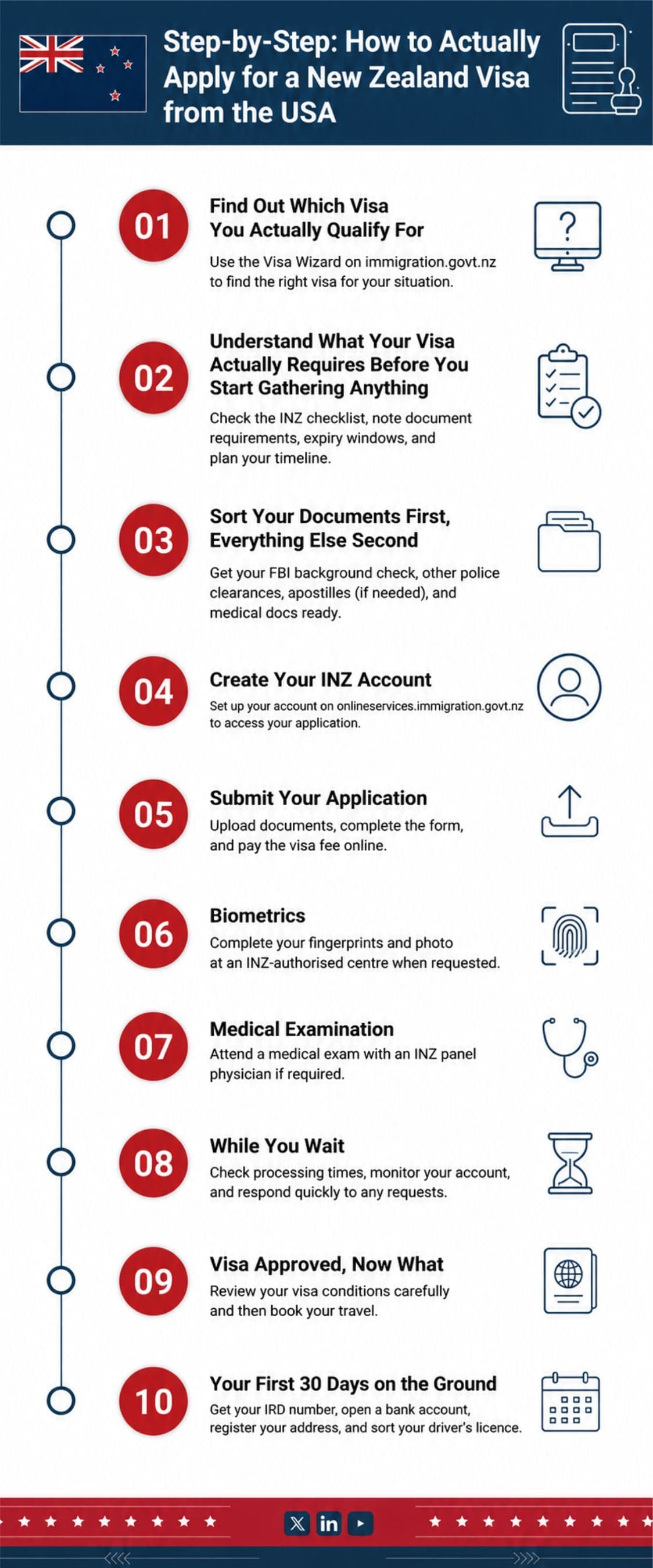
Applying for a New Zealand visa from the USA isn't complicated once you understand the sequence. Most people overthink it or waste months preparing the wrong documents for the wrong visa. The process itself is straightforward the main thing is knowing what order to do things in, and what to have ready before you start.
This is the full process, from your first search to your first month on the ground.
Before anything else, go to immigration.govt.nz and use the Visa Wizard. It asks you a series of questions your nationality, purpose of visit, how long you plan to stay, whether you have a job offer and narrows down which visa applies to your situation.
It takes about five minutes. Most people skip this and spend weeks researching visas that don't apply to them.
If the Visa Wizard points you somewhere unexpected, trust it. The New Zealand immigration process for Americans catches a lot of people off guard - particularly those who assume the skilled migrant route is their only option when the Green List or employer-sponsored pathway would get them there faster.
Once you know your visa category, the rest of the process follows a clear sequence.
Every visa has a specific document checklist on the INZ website. Pull it up before you start collecting anything.
The reason this matters: some documents have expiry windows. An FBI background check, for example, is only accepted if it's recent and getting one through the standard FBI mail-in process takes anywhere from 4-8 weeks. If you request it too early, it could expire before your application is ready. If you request it too late, it delays everything.
Read the requirements for your specific visa type. Note which documents need to be apostilled, which need certified translations, and which have date restrictions. Build a simple checklist and work backward from when you want to submit.
This is where the New Zealand immigration steps for Americans take longer than expected not because the process is difficult, but because American-specific documents take time.
FBI Background Check
Required for most residence and long-stay work visas. You have two options:
The first is going directly through the FBI you submit fingerprints by mail and wait. The standard turnaround is 4-8 weeks. Results come back on paper.
The second is using an FBI-approved channeler a private service that processes the same check faster, usually in 2 to 4 weeks. It costs more, but for most people applying for a New Zealand skilled migrant visa from the USA, the time saving is worth the cost. IdentoGO is one of the largest approved channelers in the US.
Some visas also require a state-level police clearance. Check whether your specific visa needs this alongside the FBI check requirements vary by visa category and how long you've lived in each state.
Documents That Need Apostille
New Zealand is a member of the Hague Apostille Convention, but INZ does not routinely require apostilles on US documents for standard visa applications. Original certified copies from the issuing authority are generally accepted. An apostille may be required in specific circumstances, confirm with INZ or your immigration adviser whether your situation requires one before going through the process
The apostille is issued by the Secretary of State in the state where the document was issued, or by the US Department of State for federal documents like the FBI check. This step adds time if you leave it late, so build it into your timeline early.
Medical Documents
Some visa categories require an upfront medical examination. Others only request it after the application is submitted. INZ uses a system called eMedical you'll be directed to a panel physician in the USA who submits results directly to INZ through that system. You can't just bring a note from your doctor.
Check the INZ website for the current list of approved panel physicians in the US. They're in most major cities.
Go to onlineservices.immigration.govt.nz and create an account. This is where your entire application lives documents, correspondence, decisions, everything.
The account setup is simple. You'll need a valid email address, your passport details, and basic personal information. Don't use a work email address you might lose access to partway through the process. Use a personal email you check regularly.
Once your account is set up, you can see the application form for your visa type and understand exactly what fields need to be completed before you start filling anything in.
Once documents are gathered, apostilled where required, and your form is complete you submit through the INZ online portal.
Pay the visa fee at the time of submission. Fees vary by visa type and are listed in NZD on the INZ website. Convert the amount before you submit the charge will go through on your card at the current exchange rate.
After submission, you'll get a confirmation email with an application number. Save it. Every time you contact INZ about your application, you'll need to reference it.
A few things to check before you hit submit: make sure every document is a clear, readable scan. INZ regularly requests resubmission of documents that are blurry, cut off at the edges, or difficult to read. It's a simple thing that delays applications unnecessarily.
Most visa types require biometrics, fingerprints and a photograph. After submitting your application, INZ will send you a biometrics request through your online account if it's needed for your visa type. The request includes instructions on where and how to complete it.
Don't try to get this done before you receive the request. Biometrics have a validity window, and submitting them too early creates processing problems you don't want mid-application.
INZ works with authorised biometric collection centres across the United States. Major cities are covered, if you're in a smaller city or rural area, factor in the possibility of travelling to the nearest centre when you're planning your overall timeline.
Once your appointment is done, the results go directly to INZ. You don't need to submit anything separately.
If your visa requires an upfront medical, or if INZ requests one after submission, you'll be directed to a panel physician.
The examination covers general health, chest X-ray, and in some cases blood work, depending on the countries you've lived in and your intended stay length. Results go directly from the doctor to INZ through the eMedical system. You don't handle the paperwork yourself.
Book the appointment promptly once requested. Panel physician availability varies by city, and delays here can extend overall New Zealand visa processing time.
Processing times vary. The INZ website publishes current estimated timeframes by visa type, check them regularly, as they fluctuate with application volumes.
While your application is being processed, don't book non-refundable flights. Don't resign from your job. Don't give notice on your apartment. Processing estimates are not guarantees.If INZ requests additional information during processing, you'll receive a notification through your online account. Respond promptly and completely. Partial responses or delayed replies are one of the most common reasons applications stall.
If your application is taking longer than the published estimate, you can contact INZ through your online account to request an update. Don't do this repeatedly one follow-up after the estimate has passed is appropriate.
When your visa is approved, the decision comes through your INZ online account. Your visa is linked digitally to your passport there's no physical sticker or stamp for most visa types. Border officers can see it when you arrive.
Before you book anything, read the visa conditions carefully. They'll specify your start date, end date, any work restrictions, and which employer you're tied to if it's employer-sponsored. Breaching visa conditions, even accidentally, can affect future applications.
Now book your flights. New Zealand is a long way from anywhere in the continental US. Auckland to LA is around 12 hours minimum. Most Americans flying from the East Coast are looking at 17 to 20 hours with a connection. Factor that into your moving timeline, arrival day is not a functional day.
Landing in New Zealand with a visa is the beginning of the admin, not the end of it. Here's what to sort in your first month.
IRD Number
This is your Inland Revenue Department tax number the equivalent of a US Social Security Number for tax purposes. You cannot legally work without it.
Apply through the IRD website at ird.govt.nz. You'll need your passport and visa details. Processing usually takes 8 to 10 working days. Apply as soon as you arrive some employers will let you start work while waiting, but you'll need to declare you've applied.Bank Account
Most New Zealand banks ANZ, ASB, Westpac, BNZ, Kiwibank allow immigrants to open accounts before arrival or within the first week. You'll need your passport, proof of address in New Zealand, and your visa details.
If you don't have an NZ address yet, some banks will accept a hostel or temporary accommodation address to get the account open. Sort this in week one. You'll need it for your employer's payroll, for rent payments, and for pretty much everything else.
Address Registration
New Zealand doesn't have a formal national address registration system the way some countries do, but your address is connected to your IRD record, your bank account, and eventually your driver's licence. Keep it updated as you move, particularly with IRD, as that's how your tax code and any rebates are handled.
Driver's Licence
US licence holders can drive in New Zealand for up to 12 months on their American licence alongside an English translation if the licence isn't in English. After 12 months, you'll need to convert to a New Zealand licence. Start that process before the 12 months are up the conversion involves a theory test for most applicants.
From the day you decide to apply to the day you land, most Americans are looking at a minimum of 6 to 9 months when factoring in document collection, FBI background check processing, apostille steps, and visa processing time.
For residence visas, the timeline extends further. The Skilled Migrant Category alone can take 12 months or more from submission to decision.
| Stage | Estimated Time |
| FBI background check (channeler) | 2–4 weeks |
| FBI background check (direct mail) | 3–4 months |
| Apostille processing (state level) | 1–6 weeks depending on state |
| Apostille processing (federal) | 6–8 weeks |
| Visa application processing (work visas) | 4–8 weeks |
| Visa application processing (residence) | 3–12 months |
| Biometrics appointment | 1–2 weeks after request |
| Medical examination | 1–2 weeks after request |
All timeframes are current estimates and subject to change. Verify on the INZ website before planning your timeline.
Most Americans moving to New Zealand spend weeks focused on the visa application itself and barely think about the documents until the last minute. That's where timelines fall apart.
Document preparation particularly the apostille process is the part of New Zealand immigration for Americans that takes the longest and trips people up the most. Some documents take months to get right. Get ahead of this early and your application moves smoothly. Leave it late and you're looking at delays you could have avoided entirely.
Requirements vary by visa type, but across most work and residence applications, Immigration New Zealand expects the following:
New Zealand is a member of the Hague Apostille Convention. That fact gets repeated a lot in immigration content, usually in a way that implies you need to apostille everything before applying. That's not accurate, and acting on it wastes time and money.
Being part of the Hague Convention simply means New Zealand will recognise an apostille if one is provided. It does not mean Immigration New Zealand requires one as standard.
INZ accepts original official US documents for most visa applications FBI background checks, birth certificates, degree certificates, marriage certificates without any apostille attached. What matters is that the document is an official, certified original from the issuing authority. A certified copy of your birth certificate ordered directly from your state's vital records office is sufficient. An original FBI Identity History Summary result is accepted as-is.
Apostilles become relevant in specific situations when INZ has authenticity concerns about a particular document, for certain high-level visa categories where additional verification is required, or when a document is being used in a legal or property context outside of the standard visa process such as a Power of Attorney.
Australia follows the same approach. Despite also being a Hague Convention member, the Department of Home Affairs routinely accepts original US documents without apostilles for standard immigration applications.
The two apostille authorities in the US - for reference if you ever do need one:
If INZ specifically requests an apostille, or your situation falls into a category that requires one, here's who issues them:
Don't apostille anything unless INZ specifically asks for it or your immigration adviser confirms it's needed for your situation. It adds cost, adds weeks to your timeline, and in most standard applications, it isn't necessary.
Healthcare is the single biggest relief Americans report after moving to New Zealand. Coming from a system built around insurance networks, deductibles, and surprise billing, the shift to New Zealand's model takes some mental adjustment. But once you understand how it actually works, most Americans find it far better than what they left behind.
New Zealand runs a publicly funded health system through Health New Zealand | Te Whatu Ora. For people who qualify, hospital care, specialist referrals, maternity services, and emergency treatment are either free or heavily subsidised. You do not receive a bill after surgery. You do not argue with an insurer about whether a procedure was covered.
The system is funded through general taxation. Nobody opts in or out. Everyone in New Zealand contributes through their taxes, and eligible residents benefit from it.
This is where Americans need to pay attention. Access to publicly funded healthcare is not automatic the moment you land. Eligibility depends on your visa type and length.
New Zealand citizens and permanent residents qualify immediately. Work visa holders qualify if their visa runs for two years or longer at the time of issue. Short-term visa holders visitors, students, people on working holiday visas most of the time do not qualify and must carry private health insurance instead.
Immigration New Zealand confirms that most people with resident visas who live in New Zealand can access publicly funded care. For work visa holders, the two-year threshold is the key test. If your Accredited Employer Work Visa is issued for 24 months or more, your partner and children under 20 are also covered.
GP visits are subsidised, not free. Expect to pay roughly NZD $19 to $55 per consultation at a standard practice, depending on whether your GP participates in the Very Low Cost Access scheme. From July 2024, prescription co-payments are capped at NZD $5 per item. Children under 13 pay nothing for prescriptions or GP visits at participating practices.
New Zealand has something no other country quite replicates: the Accident Compensation Corporation, or ACC.
ACC covers treatment costs for anyone injured in an accident residents, visitors, and tourists alike. If you slip down stairs at a shopping mall, get hit by a car crossing the road, or tear a tendon playing weekend rugby, ACC steps in. Your doctor files the claim. ACC covers medical treatment, rehabilitation, some income replacement, and home help. You cannot sue the person who caused your accident New Zealanders traded away the right to litigate in exchange for universal accident cover.
For Americans used to personal injury lawsuits, this feels strange at first. It removes enormous financial risk from accidents that would otherwise result in catastrophic US-style medical bills. ACC's official website has full details on what is and is not covered.
You cannot simply walk into any doctor's office. New Zealand operates a GP enrollment system. When you arrive, find a local medical centre, register as a patient, and that practice becomes your primary care provider. Registration is straightforward bring your visa, passport, and proof of address. Being enrolled usually means lower consultation fees. Use HealthPoint to find a GP practice near you that is accepting new patients.
The public system does triage. If you need a hip replacement that is not life-threatening, you may wait months. If you have cancer or a cardiac emergency, you will not wait. New Zealanders accept this tradeoff; it is not always easy for Americans to adjust to.
Private health insurance in New Zealand addresses this gap. It gives you access to private hospitals, faster elective surgery, and specialist appointments without referral wait times. Major providers include Southern Cross, nib, and Unimed. Monthly premiums for a healthy 35-year-old, run NZD $60 to $150 depending on coverage level and provider. It is optional for residents who qualify for the public system but for peace of mind during the transition period, many American expats opt in.
Your US Medicare does not work in New Zealand. Not at all. If you are a retiree who spent 40 years paying into Medicare, those benefits stop at the US border. You will need to plan for New Zealand healthcare costs separately. The good news is that New Zealand's private premiums and out-of-pocket costs are dramatically lower than equivalent US coverage.
If you are moving with children, understanding New Zealand's education system early saves a lot of stress. It’s good-really good-but it works differently from the US K–12 system in ways that often surprise parents.
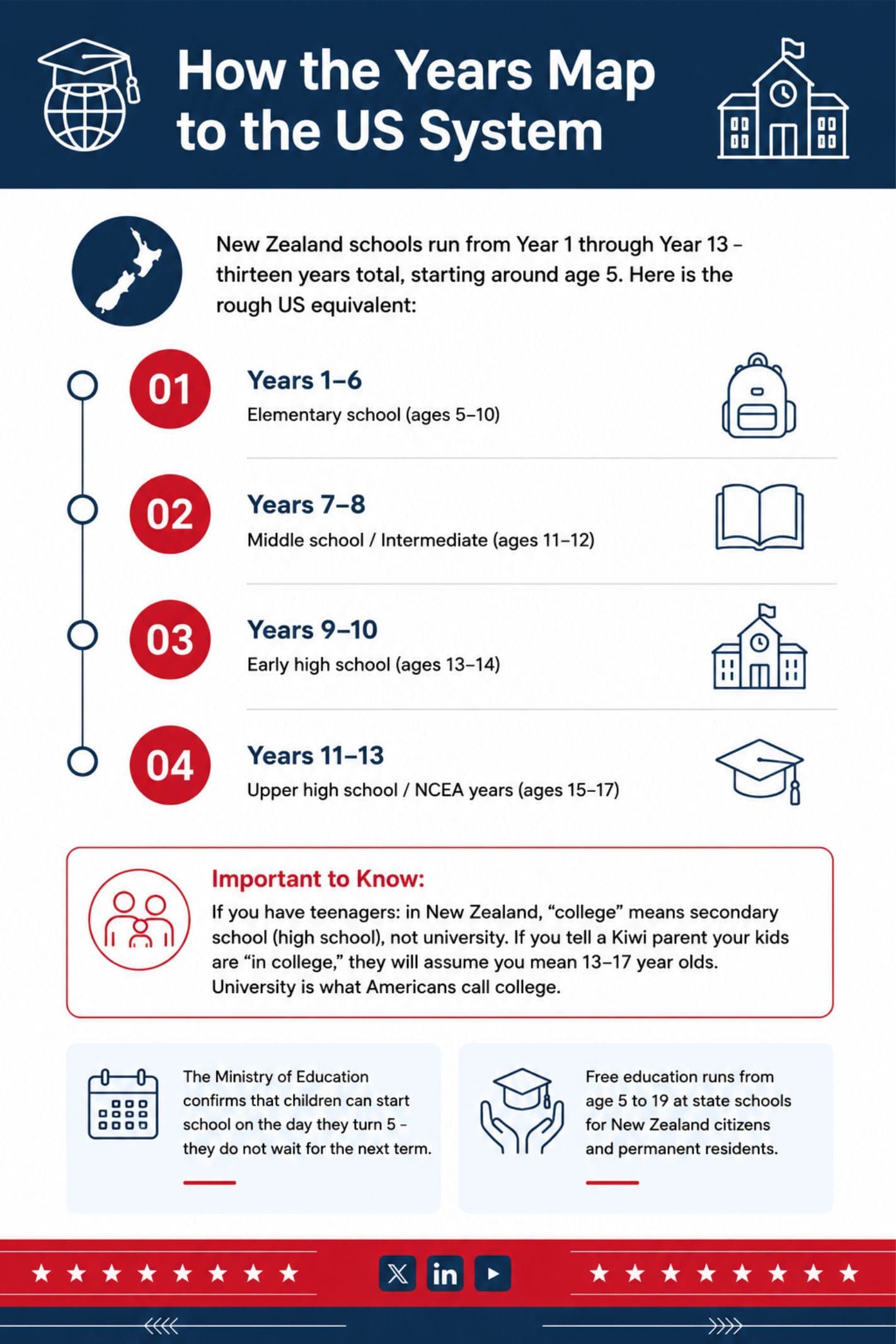
New Zealand schools run from Year 1 through Year 13 - thirteen years total, starting around age 5. Here is the rough US equivalent:
One thing to know immediately if you have teenagers: in New Zealand, "college" means secondary school (high school), not university. If you tell a Kiwi parent your kids are "in college," they will assume you mean 13–17 year olds. University is what Americans call college.
The Ministry of Education confirms that children can start school on the day they turn 5 they do not wait for the next term. Free education runs from age 5 to 19 at state schools for New Zealand citizens and permanent residents.
State schools are government-owned and fully funded. They are free for residents. Parents pay for uniforms, stationery, and school trips.
State-integrated schools are funded by the government but have a particular character often religious, like Catholic or Anglican. They charge a compulsory "attendance due" on top of the government funding.
Private schools charge tuition set by the school. They receive some government funding but operate independently. They offer better facilities and more extracurricular options but can cost NZD $15,000 to $30,000+ per year at secondary level.
There are also international schools in Auckland and Wellington that teach the American, IB, or Cambridge curriculum useful if your stay is temporary and you want continuity for your child.
Most popular state schools operate on a zoning system. If you live in a school's zone, your child has guaranteed enrollment. Outside the zone, you are on a waiting list. This directly affects where many families choose to rent or buy. Research the school zones for your preferred area before signing a lease.
The Ministry of Education's school finder lets you search schools by location and check zone boundaries.
The National Certificate of Educational Achievement (NCEA) is New Zealand's main secondary qualification, administered by the New Zealand Qualifications Authority (NZQA). Students work toward it in Years 11, 12, and 13 at Levels 1, 2, and 3 respectively.
NCEA differs fundamentally from US high school diplomas. Instead of letter grades per subject, students earn credits throughout the year via internal assignments and external exams. They need a minimum number of credits at each level to achieve that NCEA level. Level 3 with sufficient credits and literacy/numeracy requirements earns University Entrance the equivalent of being qualified to apply to a New Zealand university.
Note: the New Zealand government announced in 2025 plans to phase out NCEA between 2028 and 2030 and replace it with subject-based certificates. If your child is in the NZ system now, they will likely still complete NCEA. Keep an eye on NZQA's news page for updates.
NCEA Level 3 is recognised by overseas universities including in the US. Your child does not lose global options by studying in New Zealand.
New Zealand universities do consider US high school transcripts, AP scores, and SAT/ACT results during admissions. They do not run a direct Year 11/12 credit transfer system, but they look at the whole academic picture. If your child is in Years 11–13 and switching mid-stream, talk to NZQA and the receiving school about credit recognition.
New Zealand has eight universities. All are public and government-funded. Fees for domestic students (those with residency or citizenship) are substantially lower than international student fees NZD $7,000 to $9,000 per year for undergraduates. International student fees run NZD $25,000 to $45,000 per year depending on the field.
The moment your children qualify for NZ residency, they access domestic tuition rates. That alone is a financial consideration for families moving permanently.
The eight universities are: University of Auckland, AUT (Auckland University of Technology), Waikato, Massey, Victoria University of Wellington, Canterbury, Lincoln, and Otago.
New Zealand subsidises early childhood education (ECE) heavily. Children aged 3 to 5 receive up to 20 hours per week of subsidised ECE at approved providers. This reduces the cost of childcare, which surprises many American parents used to paying $2,000+ per month for full-time daycare.
This section will be the most uncomfortable for many Americans to read. It contains no comfortable surprises. But knowing this before you move, rather than discovering it two years in -saves money, avoids penalties, and removes a lot of stress.
The United States is one of only two countries in the world (along with Eritrea) that taxes its citizens based on citizenship rather than residency. This means that even if you live full-time in Auckland, work for a New Zealand employer, and spend zero days in the US, you must still file a US federal tax return every year reporting your worldwide income. Moving to New Zealand does not change this.
This surprises many Americans who assume that once they leave, the IRS no longer has a claim on their income. It does.
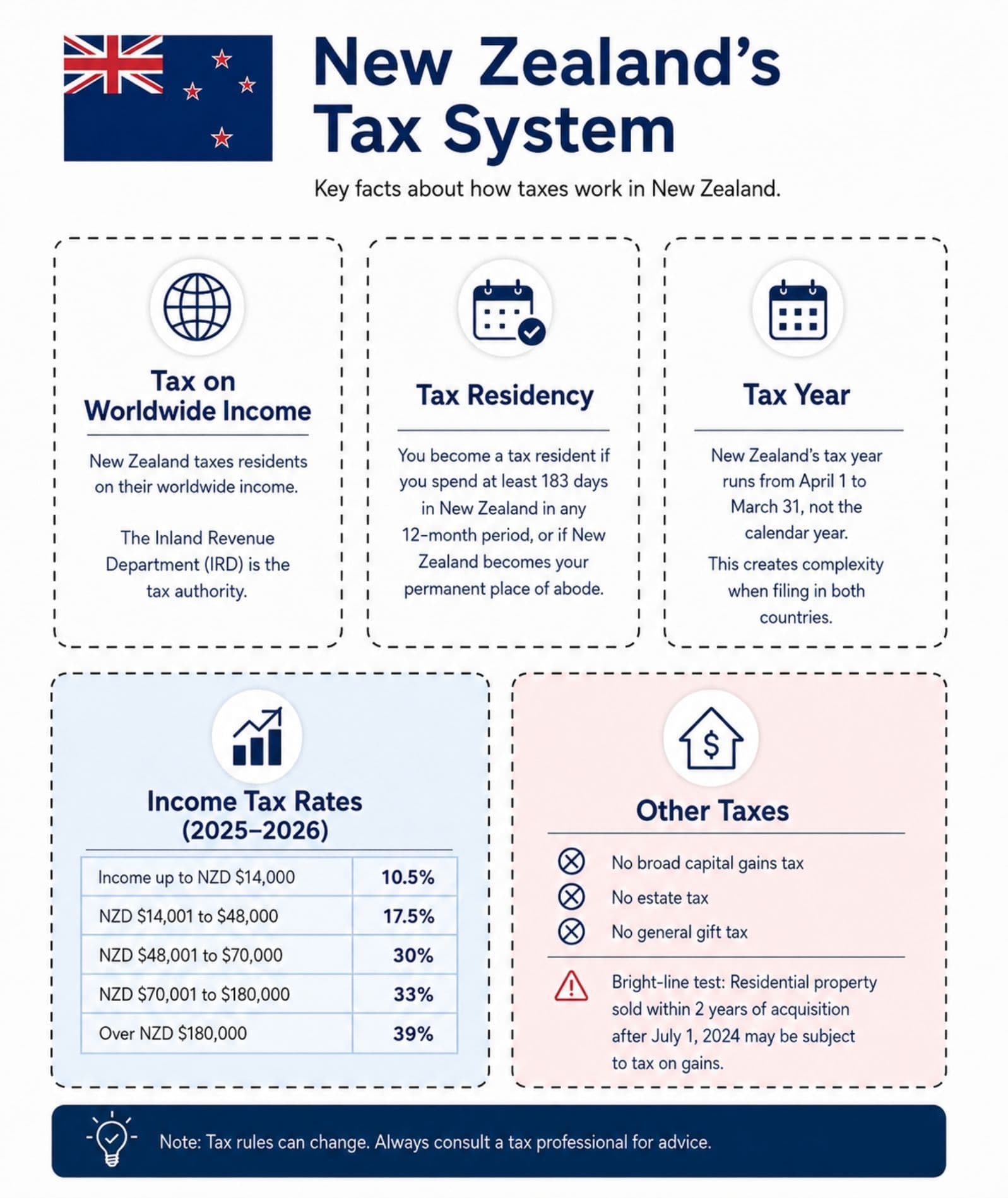
New Zealand taxes residents on worldwide income. New Zealand's Inland Revenue (IRD) is the tax authority. You become a New Zealand tax resident if you spend at least 183 days in the country within a 12-month period, or if New Zealand becomes your permanent place of abode.
New Zealand's tax year runs April 1 to March 31 not the calendar year. This creates coordination complexity when filing in both countries.
New Zealand income tax rates for individuals in the 2025–2026 year:
New Zealand has no broad capital gains tax, no estate tax, and no general gift tax. However, there is a bright-line test for residential property sold within 2 years of acquisition after July 1, 2024 may be subject to tax on gains.
The US and New Zealand have a tax treaty in place. The IRS maintains treaty documents here. The treaty establishes which country has primary taxing rights on different types of income employment income, pensions, dividends, interest, and royalties.
However, the treaty contains a saving clause that preserves the US right to tax its own citizens as if the treaty did not exist. This limits how useful the treaty is for ordinary American expats. It functions mainly as a backstop rather than a shield.
Two mechanisms help most Americans living in New Zealand reduce or eliminate double taxation:
Foreign Earned Income Exclusion (FEIE): Form 2555 lets you exclude up to $130,000 of foreign earned income from US taxation in 2025. To qualify, you must pass either the Physical Presence Test (330 days outside the US in a 12-month period) or the Bona Fide Residence Test (established residency in a foreign country for a full tax year). The FEIE covers earned income only wages and self-employment income. It does not cover investment income, rental income, or pension income.
Foreign Tax Credit (FTC): Form 1116 lets you claim a dollar-for-dollar credit on income taxes already paid to New Zealand. Because New Zealand's tax rates are often higher than US rates on equivalent income, the FTC frequently eliminates the US tax bill entirely for NZ residents.
Many US expats in New Zealand find the FTC more effective than the FEIE, particularly at higher income levels. Some use both but not on the same income.
If you open a New Zealand bank account and you will and the aggregate balance across all your foreign accounts exceeds $10,000 at any point during the year, you must file FinCEN Form 114 (FBAR) by April 15 (extendable to October 15). This includes checking accounts, savings accounts, KiwiSaver, and investment accounts.
Missing the FBAR filing triggers steep penalties up to $10,000 per violation for non-willful failures. This is not theoretical. The IRS enforces it.
The Foreign Account Tax Compliance Act requires foreign financial institutions to report US account holders to the IRS. New Zealand banks comply. ANZ, ASB, BNZ, Westpac, and Kiwibank all report US citizen account holders to the IRS automatically. You do not need to do anything to trigger this it happens regardless. What you need to do is make sure your own FBAR and Form 8938 filings match what the banks are reporting.
KiwiSaver is New Zealand's workplace retirement scheme. Employees contribute 3%, 4%, 6%, 8%, or 10% of their gross salary. Employers must contribute at least 3%. The government used to contribute NZD $521 per year; from July 2025 that was reduced to NZD $260.72 with an income cap of NZD $180,000.
The problem for Americans: the US does not treat KiwiSaver as a tax-deferred retirement account. The IRS may classify it as a foreign grantor trust or a passive foreign investment company (PFIC), triggering annual US tax on gains inside the account and requiring Forms 3520 and 3520-A. These forms carry large penalties when filed late even if no additional tax is owed.
Some Americans contribute only the minimum to keep the employer contribution, then halt further contributions. Others contribute more and manage the reporting. Both approaches are valid but the decision should be made with a US-qualified expat tax advisor, not in isolation.
The US and New Zealand do not have a Social Security Totalization Agreement. Multiple sources including the IRS confirm this. This means self-employed Americans in New Zealand can face US self-employment tax (15.3% on net earnings above the threshold) even while also paying New Zealand income tax and ACC levies. Employees working for a New Zealand employer are not subject to US FICA, but contractors and the self-employed face more complexity.
Hire a US expat tax specialist before you move not after. Not six months after you arrive and have already made decisions. Before. Firms like Taxes for Expats, Bright!Tax, H&R Block Expat, and Greenback Tax all specialise in this. Fees are $500 to $1,500 per year for straightforward returns. The cost of getting it wrong is far higher.
Banking in New Zealand works well. The banks are stable, online banking is excellent, and the five major banks cover the country comprehensively. The challenge for Americans specifically is a single word: FATCA.
The Foreign Account Tax Compliance Act requires all foreign financial institutions to identify US account holders and report their accounts to the IRS. This creates compliance paperwork for banks. Some smaller banks globally refuse US citizen accounts entirely to avoid the burden. In New Zealand, the five main banks do accept American customers but they will ask you to declare your US citizenship and complete a W-9 form. Do not try to hide it. The banks report automatically regardless.

New Zealand's banking market is dominated by five institutions:
ANZ Bank New Zealand : The largest bank in NZ, a subsidiary of ANZ Group. Full retail banking, investment products, and a strong expat setup service. ANZ lets you open an account up to 90 days before you arrive. anz.co.nz
ASB Bank: Owned by the Commonwealth Bank of Australia. Popular with new migrants. ASB offers an offshore account opening service, you can start the process from the US with a certified passport copy and proof of overseas address, getting online banking access before you land. asb.co.nz
Bank of New Zealand (BNZ): Owned by National Australia Bank. Strong digital banking. Also allows pre-arrival applications. bnz.co.nz
Westpac New Zealand: 1.5 million customers. Solid everyday banking with strong digital tools. westpac.co.nz
Kiwibank: The only major New Zealand-owned bank, established in 2002 and now government-owned. Smaller branch network but competitive products. kiwibank.co.nz
Both ANZ and ASB actively market to arriving migrants and allow you to start the account setup process from overseas. For ASB, documents must be certified copies. For ANZ, the pre-arrival window is 90 days before your planned arrival date.
To open an account, you will need: a valid US passport, your visa, and proof of New Zealand address (either a signed tenancy agreement or a letter from your employer or future landlord). Once in New Zealand, you will also need your IRD number the New Zealand tax number to activate full banking features.
Apply for your IRD number through Inland Revenue online once you have arrived and have a valid visa.
Bank wire transfers between the US and New Zealand are expensive, fees of $25–$50 per transfer plus unfavorable exchange rates are common. Better options exist.
Wise (formerly TransferWise) uses the mid-market exchange rate and charges a transparent percentage fee, 0.5–1%. For regular salary transfers or large initial moves of savings, this is cheaper than bank wires.
OFX offers competitive rates for larger transfers (above $10,000) and is particularly popular for one-off large transactions like initial relocation funds.
Both services are legitimate, widely used by expats, and cheaper than bank-to-bank wires. wise.com, ofx.com
KiwiSaver is New Zealand's workplace retirement scheme. Your employer contributes 3% on top of your salary if you participate. That is free money. The problem, as covered in Section 9, is the US tax complexity. Before enrolling or increasing contributions beyond the minimum to capture employer matching, talk to a US expat tax advisor.
If you decide not to join KiwiSaver, opt out within the first 56 days of employment before you are automatically enrolled. After that window, you can still suspend contributions but cannot fully opt out until age 65.
Keeping your Fidelity, Schwab, or Vanguard accounts after moving to New Zealand is straightforward in theory. Some US brokerages restrict services to non-residents restricting new purchases while allowing the existing portfolio to remain. Schwab is basically most accommodating of expats. Check directly with your brokerage before you move.
Any gains from these accounts are still reportable on your US tax return. They may also be taxable in New Zealand, depending on the account type. Coordination between the two systems matters here.
The New Zealand job market is small. There are roughly 5 million people in the entire country the population of metropolitan Atlanta. The job market reflects this. It is less competitive than the US in raw volume, but it is also less liquid. There are fewer roles, fewer companies, and fewer corporate ladder rungs to climb. That said, in certain sectors, the demand is persistent and the pathways to work are clear.
Immigration New Zealand's Green List is the single most important document to check if you are a skilled worker. It is updated regularly and identifies occupations New Zealand cannot fill from its domestic workforce.
The Green List has two tiers:
Tier 1 - Straight to Residence: Secure a job offer in a Tier 1 role and you can apply for a resident visa immediately. You skip the two-year work visa stage entirely. Core Tier 1 roles include: specialist doctors (nearly all categories), registered nurses, midwives, medical radiation technologists, dental specialists, and certain engineering roles.
Tier 2 - Work to Residence: Work in a Tier 2 role for 24 months and you qualify for residency. As of August 2025, ten additional trades were added to this tier, Metal Fabricator, Welder, Fitter, Panel Beater, Vehicle Painter, and others. Immigration NZ confirmed this in official news.
The current median wage threshold (updated March 2026) is NZD $35.00 per hour for Green List purposes, based on June 2025 Statistics New Zealand data.
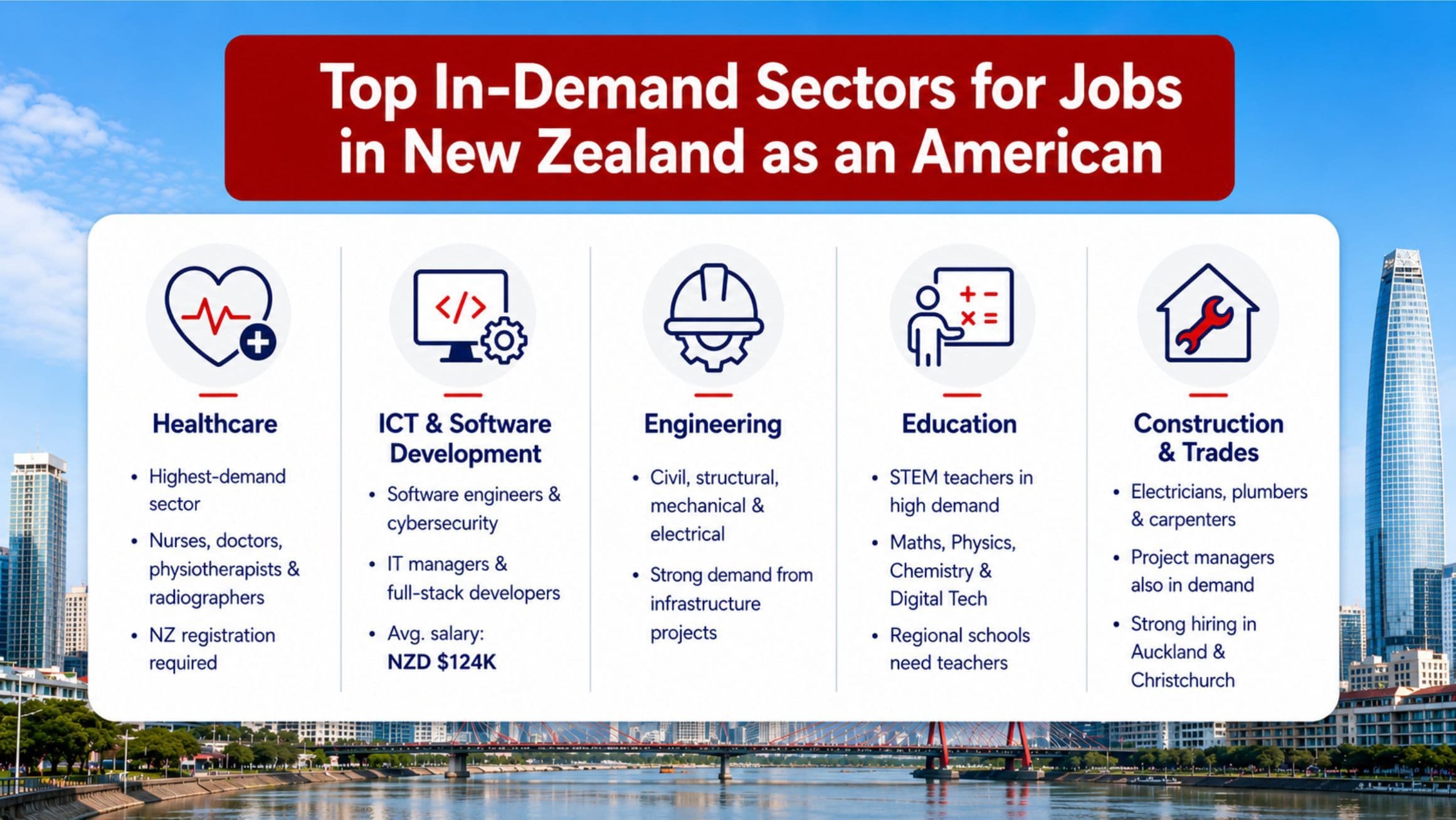
One thing to understand clearly: New Zealand salaries are lower in nominal terms than equivalent US salaries. A software engineer earning $150,000 in the Bay Area might earn NZD $120,000 to $140,000 in Auckland, which at current exchange rates (roughly USD $0.58 per NZD) translates to around USD $70,000 to $80,000. The gap is real.
What partially offsets this: lower healthcare costs, subsidised education, no student loan crisis at the family level, lower crime, and a completely different quality of life. Many Americans take the pay cut consciously and do not regret it. But go in with eyes open.
The main platforms are:
Seek NZ: the dominant job board in New Zealand
Trade Me Jobs: New Zealand's local classifieds/jobs platform
LinkedIn: works well for professional and corporate roles
Careers.govt.nz: government careers and labour market information
For healthcare roles specifically, Health New Zealand's careers site posts roles directly.
Many Americans want to know if they can simply keep working remotely for a US employer while living in New Zealand. The short answer is: sometimes, with caveats.
Visa: A working holiday visa lets you work freely, including remotely, for a US employer. An Accredited Employer Work Visa does not, it ties you to a specific New Zealand employer. Visitor visas prohibit work entirely.Taxes: If you are tax resident in New Zealand and working remotely for a US company, your income may be taxable in New Zealand. This is complex and depends on the structure of your employment and residency status. Get tax advice before assuming remote work from NZ is clean.
New Zealand does not automatically recognise all US degrees and professional credentials. If your occupation requires registration (medicine, nursing, law, engineering, teaching), you need to go through the relevant New Zealand registration body.
For academic credentials, NZQA (New Zealand Qualifications Authority) offers overseas qualification recognition assessments. This tells you how your US degree ranks on the New Zealand Qualifications and Credentials Framework.
New Zealand has no single dominant coastal metropolis like Los Angeles. No New York. The choices are fewer, the cities are smaller, and the quality of each depends heavily on what matters to you.
Auckland is where most immigrants land and where most stay. It is home to roughly 1.7 million people, about a third of New Zealand's entire population. The international airport, the biggest job market, the most corporate offices, and the most diverse expat community are all here.
The downsides: Auckland is expensive. Housing costs have moderated since the peak of 2021 but remain high. Traffic is really bad, Auckland was built for cars and has not fully adapted to its size. The city sprawls across a narrow isthmus between two harbours, which limits road options.
What Auckland has that other NZ cities lack: global cuisine, a larger concert and arts scene, more professional opportunities in finance, tech, and management consulting, and the only direct flights from the US.
American expat communities are concentrated in the North Shore and in inner-city suburbs like Parnell, Remuera, and Ponsonby. Median weekly rent for a 3-bedroom house in Auckland: approximately NZD $750–$900 (mid-2025 data).
Wellington is New Zealand's capital and its second-largest urban area, with around 440,000 people. It is walkable in a way Auckland is not. You can walk from the train station to Parliament to Cuba Street's cafes in 20 minutes.
Wellington is the home of New Zealand's public service, the creative industries (Weta Workshop, New Zealand's film sector), and an outsized food and coffee culture. It consistently ranks as one of the world's most liveable small cities.
The catch: Wellington is windy. Not sometimes windy consistently, often aggressively windy. The harbour is beautiful; the gusts can hit 90km/h. Locals call it "Windy Wellington" without irony. If you hate wind, factor this in.
Salaries in Wellington are driven partly by public sector rates, which are competitive. Housing is cheaper than Auckland. A 3-bedroom in the suburbs runs NZD $600–$750 per week.
Christchurch is New Zealand's third-largest city, on the South Island's east coast. It suffered devastating earthquakes in 2010 and 2011. What came out of the rebuild is a city with some of the newest infrastructure and urban design in the Southern Hemisphere.
Christchurch is the most affordable major city in New Zealand. Housing costs are the lowest of the main centres. The Canterbury Plains offer space, farmland, and skiing within two hours. The city attracts engineers, construction professionals, and people who value the outdoors over urban culture.
American expats living here consistently describe it as underrated. It has a growing food and arts scene, a large university, and easy access to the Southern Alps. Median weekly rent for 3-bedroom house: approximately NZD $550–$650.
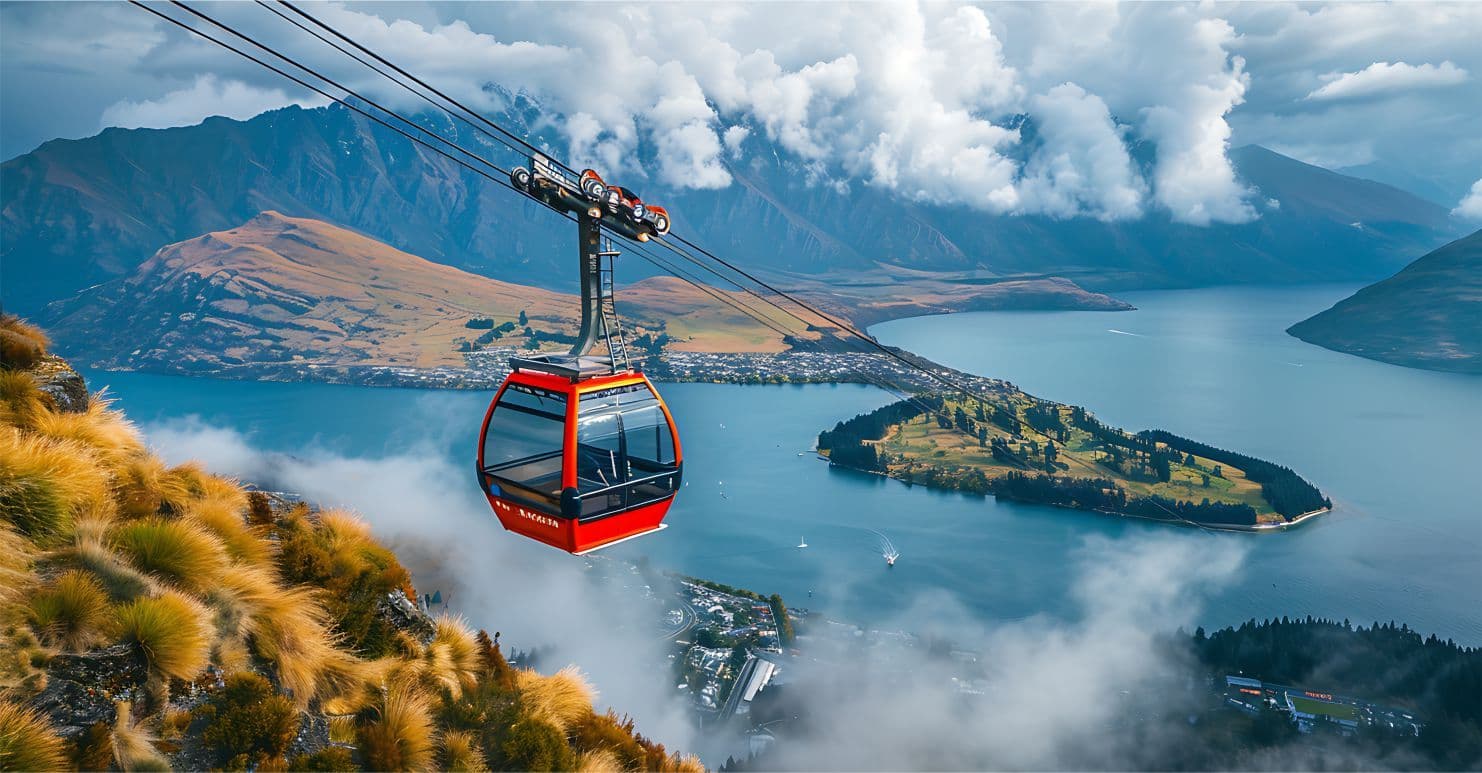
Queenstown is the adventure capital. It is truly absurdly beautiful - sitting on Lake Wakatipu beneath the Remarkables mountain range. Skiing, bungee jumping, mountain biking, and tramping are all within reach year-round.
The housing market is driven by tourism and short-term rentals. Long-term accommodation is expensive and scarce. Average wages outside hospitality and tourism are limited. Queenstown is a real option for people who can work remotely or own their business, but building a professional career there is difficult. Median weekly rent for a 3-bedroom: NZD $750–$900.
Dunedin in the southern South Island is one of New Zealand's most affordable cities. It has a university, a lively arts scene, Victorian and Edwardian architecture, and a distinct personality shaped by its Scottish heritage. Winters are cold. The pace is slow. For families who want space, low cost, and community, Dunedin makes a compelling case.
Hamilton, Tauranga, and Napier tend to be overlooked by new arrivals but offer good infrastructure, lower costs, and proximity to Auckland (Hamilton is 1.5 hours south). Tauranga has strong sun, a beach lifestyle, and a growing retirement and professional population. Napier has a spectacular Art Deco cityscape and a wine region on its doorstep.
The North Island has the larger population, warmer weather (particularly in Northland and the Bay of Plenty), and the main employment markets. The South Island has the dramatic alpine scenery, more space, lower costs, and a quieter pace. Many Americans choose the North Island for practicality and the South Island for lifestyle.
Property ownership in New Zealand is not straightforward for non-residents. The rules changed in 2018 and are misunderstood in many online articles. Here is what is actually true.
The Overseas Investment Act 2018 restricts foreign nationals from buying certain types of New Zealand land. "Sensitive land" which includes residential land cannot be purchased by overseas persons without consent from the Overseas Investment Office (OIO).
Who counts as an "overseas person"? Anyone who is not a New Zealand citizen, a New Zealand permanent resident ordinarily resident in New Zealand, or an Australian citizen or certain Australian permanent residents.
If you arrive in New Zealand on a work visa even a long-term one you are an overseas person under the Act. You cannot buy a standard residential property. Full stop.
Once you have been granted New Zealand permanent residency AND you are actually living in New Zealand ("ordinarily resident"), you become eligible to purchase without OIO consent. This is the pathway: arrive on a work visa, transition to residency, then buy property.
There is one important exception. Overseas persons can purchase new dwellings in qualifying new residential developments without OIO consent. This means off-the-plan apartments or newly built houses. The exemption exists to encourage housing supply. It is a legitimate way for someone on a work visa to enter the property market, though the available options are limited to new builds.
For most Americans arriving in New Zealand, renting is the starting point. The rental market works differently from the US. Key differences:
Tenancy agreements are commonly week-to-week rolling or fixed-term (12 months). Bond (security deposit) is capped at 4 weeks' rent by law, less than the 2+ month deposits common in US cities.
Pets are a real issue. New Zealand landlords are not legally required to accept pets, and many do not. If you are bringing animals, this limits your rental pool.
As a newcomer, you will have no New Zealand rental history or credit score. Bring supporting documentation: your employment contract, a reference from a previous landlord, bank statements, and proof of income. A good letting agent (called a property manager in NZ) can help navigate this.
Trade Me Property is New Zealand's primary property platform and where most listings appear. realestate.co.nz is the second major platform. For buy/sell, both are used, but Trade Me has historically dominated rentals.
You speak English. The legal system is familiar. The food is recognisable. It feels close to home. Then, over the first few months, subtle things start to surface ways Kiwis think and interact that do not match American defaults. None of them are bad. But some of them are unexpected.
This is the cultural concept for Americans to understand before arriving.
In New Zealand, publicly talking about your achievements, salary, title, or success makes people uncomfortable. Kiwis call this "crowing" or "blowing your own trumpet." The cultural expectation is modesty, even understatement. Someone who self-promotes aggressively is said to be a "tall poppy" and Kiwis cut tall poppies down.
Americans, who are culturally taught to market themselves confidently, sell their personal brand, and discuss accomplishments openly, often come across as arrogant to Kiwis in the first weeks. This is a misread in both directions. Knowing about tall poppy syndrome means you can calibrate not suppress who you are, but adapt your communication style in professional settings.
New Zealand workplaces are less hierarchical than American ones. First names are used with bosses, CEOs, and government ministers. The relationship between managers and staff is more collegial. Workplace meetings tend toward consensus rather than directive decision-making.
New Zealanders do not socialise with a hard sell or aggressive networking. Business relationships develop slowly. Patience works better than an American-style direct push.
New Zealand is officially bicultural under Te Tiriti o Waitangi (the Treaty of Waitangi, signed in 1840). This is not just historical context it shapes everyday New Zealand life. Government agencies use Māori names. Formal events open with karakia (prayers) and pōwhiri (welcome ceremonies). Te Reo Māori (the Māori language) is an official language.
You will encounter Māori language frequently on road signs, in government communications, in workplaces. Learning a few phrases (kia ora for hello, ngā mihi for thanks, Ka kite for goodbye) is appreciated and signals respect.
This is not performative inclusivity. Biculturalism is part of how New Zealand works, but it’s also debated. Understanding the Treaty and why it still matters helps you see the country as it really is, not a simplified version.
Rugby union is the national sport and the primary social glue for many Kiwis. The All Blacks are a cultural institution. Even people who do not follow sport closely know the results and can discuss the game. An interest in rugby or at least a willingness to watch a test match opens social doors quickly.
New Zealand's social calendar revolves heavily around the outdoors. Barbecues (called barbies or "BBQs"), beach days, camping, and weekend tramping trips are the default social formats. Cities have long summers with excellent light. People use outdoor spaces constantly.
Americans are sometimes surprised by New Zealand's approach to firearms. After the Christchurch mosque shootings in March 2019, New Zealand banned military-style semi-automatic weapons within weeks. Firearms ownership still exists hunting rifles and shotguns are permitted with a licence but gun culture as Americans know it does not exist here. A Kiwi home does not have a handgun for protection. The police are largely unarmed. This is not a conversation point in the way it is in America; it is simply the environment.
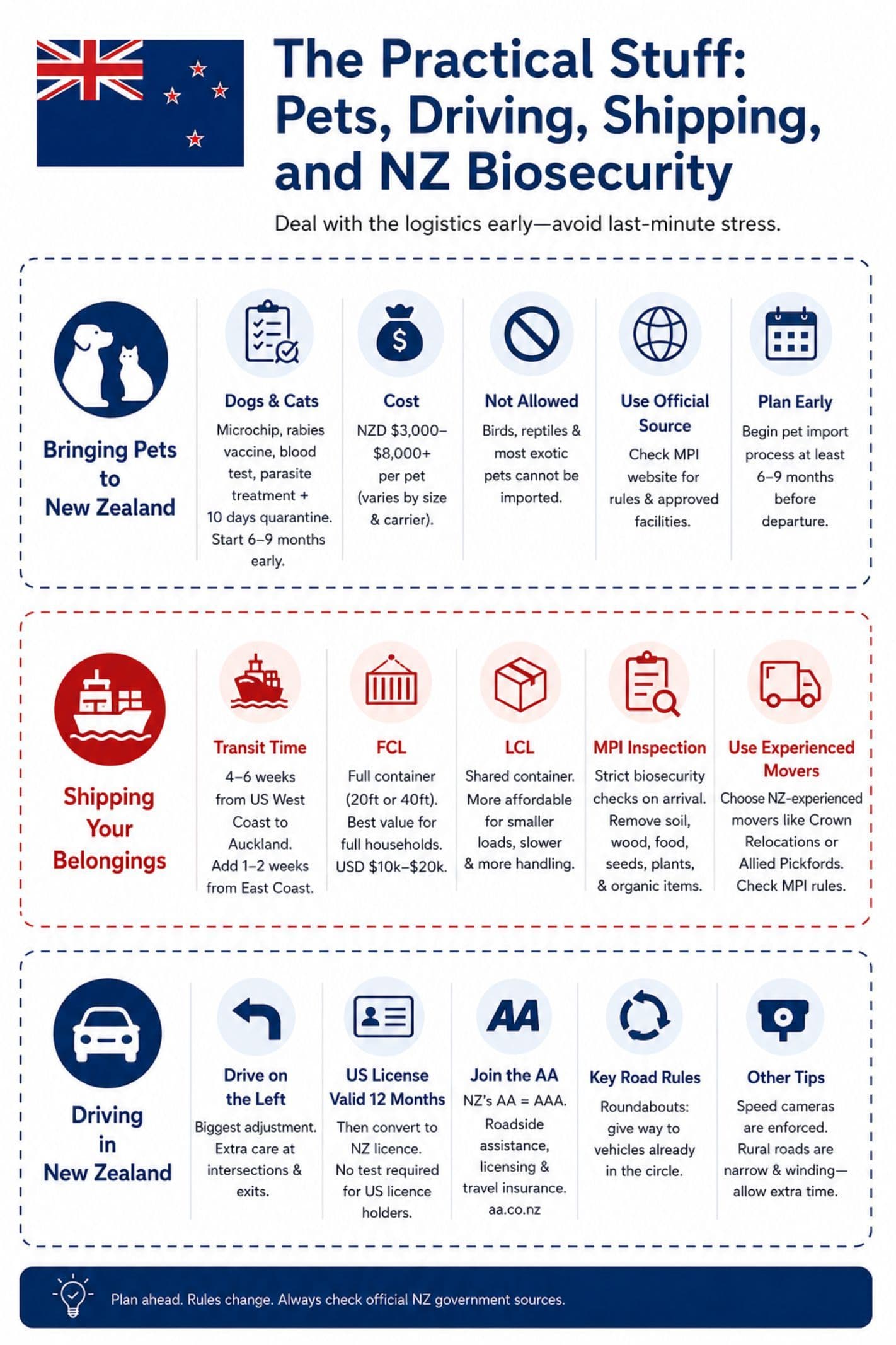
These are the logistics most people underestimate until they are three months from departure and suddenly panicking. Deal with them early.
New Zealand has some of the strictest biosecurity requirements in the world for animal imports. The country has been geographically isolated for 80 million years and maintains strict controls to protect its unique ecosystem. When it comes to pets, "strict" understates it.
Dogs: Your dog must be microchipped, vaccinated against rabies, have a certified rabies neutralising antibody titre test (RNATT) showing adequate immunity, and undergo treatments for parasites. After meeting all pre-departure requirements, dogs must spend a minimum of 10 days in an MPI-approved quarantine facility in New Zealand on arrival. The entire process, from starting treatment to arrival, takes at least six months. Starting early is not optional it is required.
Cats: Similar requirements apply. Microchipping, rabies vaccination, RNATT testing, parasite treatment, and mandatory quarantine in an MPI-approved cattery.
Cost: Plan for NZD $3,000 to $8,000 or more per pet, including quarantine facility fees, vet preparation costs, and international freight. The variation depends on the size of the animal and the freight carrier.
Birds, reptiles, and most exotic pets: These pets cannot be imported into New Zealand. New Zealand's biosecurity rules are strict enough that many species cannot enter at all, regardless of how long you have owned them or what documentation you provide.
MPI's official page on importing pets has the full requirements and approved facilities list. Use this as your primary source the rules update regularly.
Begin the pet import process at least 6–9 months before your planned departure date.
The sea journey from the US West Coast to Auckland takes roughly 4–6 weeks. From the East Coast, add another 1–2 weeks.
Full container (FCL) - you fill a 20-foot or 40-foot container with your household goods. Best value if you have a full household of furniture. Cost: USD $10,000–$20,000 depending on origin port and container size.
Shared container (LCL) - your goods share space with others. More affordable for smaller loads but slower and with more handling, which increases the risk of damage.
When your goods arrive in New Zealand, they go through MPI (Ministry for Primary Industries) inspection at the port. MPI is serious about what enters the country. Items that trigger inspection or seizure include: soil on anything (clean your garden tools obsessively), wood products with bark or soil, untreated wooden pallets, certain food items, dried flowers, seeds, and anything with organic material attached. A good international shipping company with NZ experience will brief you on what to clean, treat, or simply leave behind.
Recommended international movers with New Zealand routes include Crown Relocations and Allied Pickfords both experienced in MPI compliance documentation.
MPI's import requirements for household goods covers prohibited and restricted items in detail.
New Zealand drives on the left. This is the biggest practical adjustment for Americans and it really takes concentration for the first few weeks. The highest-risk moments are intersections and parking lot exits when you have not built new habits.
Your US license is valid for 12 months after you become a New Zealand resident. After that, you must convert to a New Zealand driver licence. Conversion from a US licence does not require a test you present your US licence and pay a fee at an AA (Automobile Association) office. Full details at NZTA.
New Zealand's AA is the equivalent of AAA in the US. aa.co.nz membership provides roadside assistance, licensing services, and travel insurance.
Road rules to know: New Zealand uses roundabouts extensively vehicles already in the roundabout have right of way. Speed cameras are common and widely enforced. Rural roads are narrower than US roads and often winding. Do not underestimate driving times in rural NZ.
New Zealand sits in the Southern Hemisphere. This means its seasons are reversed from the US. Summer runs December through February. Winter runs June through August. Christmas is a beach day. July is when you go skiing.
The country spans roughly 1,600 km (1,000 miles) from north to south. The climate difference between Northland and Southland is dramatic.
The Northland region (north of Auckland) is subtropical humid, warm, with average summer temperatures around 24–26°C (75–79°F). The Bay of Plenty on the east coast gets more sunshine hours than almost anywhere else in the country.
Auckland has a temperate climate warm summers, mild winters (rarely below 5°C), and rainfall spread throughout the year. It rarely snows in Auckland.
Wellington sits at the southern tip of the North Island and is noticeably cooler and windier than Auckland. Summer averages 20°C (68°F); winter drops to around 8–13°C (46–55°F).
The central North Island around Taupo and Rotorua has a continental interior climate colder winters than the coasts, hot summers.
The South Island is divided by the Southern Alps, creating dramatically different climates on each side. The west coast (around Westland and Fiordland) receives enormous amounts of rainfall some areas average 5–6 meters of rain per year. The landscapes are spectacular for exactly this reason.
The east coast (Canterbury Plains and Otago) is drier and sunnier. Christchurch has a relatively flat, continental climate warm summers, cold winters, frost is common. Queenstown and the Southern Lakes get the most consistent ski conditions in the Southern Hemisphere, with reliable snow from June through October. Southland is cold, wet, and sparsely populated. Beautiful but demanding.
New Zealand sits on the Pacific Ring of Fire. Earthquake risk is real and should be treated seriously.
The Canterbury region near Christchurch experienced a 7.1 magnitude earthquake in September 2010 and a devastating 6.3 magnitude event in February 2011 that killed 185 people. Christchurch has rebuilt substantially since then and new construction meets high seismic standards.
The Alpine Fault on the South Island is capable of generating a magnitude 8+ earthquake. Scientists assess a roughly 75% probability of a major Alpine Fault rupture in the next 50 years. Wellington also sits near active faults.
Volcanic risk exists on the North Island. Whakaari (White Island) erupted in December 2019, killing 22 people. The Tongariro volcanic complex includes active volcanoes. The Rotorua region sits atop a geothermal system with occasional eruptions.
None of this makes New Zealand uninhabitable millions of people live here safely. But unlike Americans who mentally file earthquakes as a California problem, New Zealand residents benefit from taking earthquake preparedness seriously. GeoNet provides real-time monitoring of seismic and volcanic activity.
UV radiation in New Zealand is among the highest in the world due to the thin ozone layer over the Southern Hemisphere. UV index of 13+ (extreme) on summer days is common. Melanoma rates are high. Sunscreen is a daily necessity, not a beach-day extra.
This section answers one of the most common questions among Americans approaching retirement who are considering New Zealand. The answer has important nuance.
New Zealand Superannuation (NZ Super) is a universal government pension, not employment-related. You do not need to have worked in New Zealand to receive it. You qualify based on age and residency, not on contributions. Work and Income administers NZ Super.
To qualify, you must:
Note: the qualifying residence period is being phased from 10 to 20 years based on date of birth, in response to fiscal sustainability concerns. If you arrive in New Zealand in your 50s, this timeline matters for your planning.
The payment is made fortnightly. Rates adjust annually each April, as of April 2026, the New Zealand government updated superannuation rates in line with the 3.11% CPI increase from the December 2025 quarter.
Yes. You can receive US Social Security payments while living in New Zealand. The US Social Security Administration pays benefits to citizens living in most countries, and New Zealand is not on the restricted list. SSA's international payments page has country-specific details.
Payments can be made by direct deposit to a New Zealand bank account or a US bank account. There is no US restriction on receiving Social Security abroad.
Here is the complication: if you receive US Social Security, New Zealand will reduce your NZ Super on a dollar-for-dollar basis. For many Americans, whose Social Security payments are larger than the NZ Super rate, this effectively wipes out NZ Super entirely. New Zealand treats US Social Security as an equivalent overseas pension and applies the offset accordingly.
This does not mean NZ Super is worthless to Americans, for those who moved to New Zealand young, earned primarily in New Zealand, and receive relatively modest US Social Security, some NZ Super may still come through. But Americans who worked their entire careers in the US and only moved to New Zealand at retirement should not count on meaningful NZ Super payments.
The US and New Zealand have no Social Security Totalization Agreement. The US has totalization agreements with 30 countries, New Zealand is not among them. This means:
Self-employed Americans in New Zealand may pay US self-employment tax (covering Social Security and Medicare) even while also paying New Zealand taxes and ACC levies. Employees of NZ-based employers are exempt from US FICA contributions, but contractors are not.
As discussed in Section 9, KiwiSaver creates complex US tax reporting. For Americans in their 50s or 60s, the calculation is different from younger workers. If you have a short window to retirement, employer contributions may not offset the filing complexity. Talk to a US expat tax advisor before enrolling.
For Americans over 65 who want to retire near adult children living in New Zealand, the Parent Retirement Resident Visa is the main pathway.
Requirements include: having an adult child who is a New Zealand citizen or resident, maintaining a minimum investment of NZD $1 million in New Zealand, having a minimum settlement funds requirement, meeting health and character requirements, and being able to support yourself financially. This is not a cheap pathway, it is designed for people with substantial assets.
There is no dedicated retirement visa for people without NZ-resident children. Non-sponsored retirees without a specific occupation must pursue residency through other pathways.
Your US Medicare coverage does not extend to New Zealand. Period. For retirees, this means planning for:
Run the numbers carefully before assuming retirement in New Zealand is cheaper than staying in the US. For some people it is. For others, especially those with US Social Security income that reduces NZ Super to zero and with complex private health insurance needs, the situation is tighter than expected.
There is no single answer. The range is 6 months to 2 years depending on your visa pathway, how organised you are, and whether complications arise. Here is how the process unfolds, phase by phase.
The first 90 days are research and planning. This is where most people waste time by starting in the wrong order. Start here:
This phase takes longer than most people expect. Documents required for New Zealand immigration include originals or certified copies with potential apostille requirements. Key documents to gather and apostille (if needed):
For apostille requirements, see Section 5 of this guide (the dedicated document and apostille section, which precedes this section in the complete article).
Also during this phase: begin your pet import process if relevant. Six months is the minimum from first vet treatment to arrival in New Zealand. Do not delay this.
Visa application submission through Immigration New Zealand's online portal. Processing times vary by visa type. INZ publishes current processing times here. Green List Tier 1 applications often process faster. AEWV applications depend on employer accreditation and job offer.
Biometric collection (fingerprints and photo) is required for some visa types and can be done at a USCIS Application Support Center in the US.
Medical examinations for certain visa types must be done by an INZ-approved physician.
Once your visa is granted, the logistics clock starts. Key tasks in this phase:
The first month is administrative sprint mode:
If your occupation is on the Green List Tier 1 and you have a job offer from an NZ accredited employer, it is possible to compress the entire process to 4–6 months. Medical professionals and engineers in critical shortage areas often report approval in this timeframe. It is possible but requires no delays in documents, fast employer accreditation, and smooth INZ processing.
Common delays: incomplete apostille documentation (the FBI background check apostille is particularly time-consuming, request the FBI Identity History Summary from the FBI's website, then send for apostille from the US State Department, which can take 6–8 weeks combined), NZQA credential assessments for regulated professions, INZ requests for further information, and pet import preparation.
Organised by timeline. Bookmark this and work through it.
Before you go, have in hand:
Moving from the US to New Zealand means managing two systems at once. NZ controls your visa, tax residency, healthcare, and property rights. The US continues taxing you, requiring FBAR and FATCA filings, and applying PFIC rules to foreign investments citizenship-based, no exceptions.
Five visa routes carry most Americans: Skilled Migrant Category, Accredited Employer Work Visa, Active Investor Plus, Working Holiday, and Partner of a New Zealander. The Green List fast-tracks residence for in-demand occupations.
Track four statuses separately visa, NZ tax residency, ordinary residence, and US tax status. They change on different timelines and trigger different obligations.Use the four-year transitional resident exemption to restructure US assets before full NZ tax exposure kicks in. That window does not extend. Citizenship takes five years of careful day-counting. Dual citizenship is fine on both sides. Read the official sources. Most problems come from skipping steps.

Applying for a Schengen visa from India in 2026? Get the full process, document checklist, fees, processing times, and rejection-proof tips in one guide.

Planning a move to Portugal from the USA? Learn about visas, documents, housing, banking, taxes, healthcare, and settling in with a step-by-step guide.

Everything you need for a UK apostille in 2026 - FCDO process, fees, timelines, document types, non-Hague countries, and common rejection fixes.
Need help with your application or background check?
Contact us now and speak with a dedicated Globeia expert today.


