

Obtaining your FBI Identity History Summary or state clearance is only part of the process for many international applicants. Before a foreign government, immigration authority, or employer will accept a U.S. Criminal Record Check as a legally valid document, it may need to go through an additional authentication step.
An apostille is a standardized certificate that verifies the authenticity of a public document for use in another country. It confirms that the signature, seal, or stamp on the document is legit and was issued by a recognized authority. It does not validate the content of the document itself whereas it authenticates its origin.
The apostille system was created under the Hague Convention Abolishing the Requirement of Legalisation for Foreign Public Documents, commonly known as the Hague Apostille Convention, which entered into force in 1965. The convention established a single, internationally recognized certificate which is called the apostille, that member countries agree to accept as sufficient proof of a document's authenticity, eliminating the need for lengthy chain of authentication processes between member states.
For U.S. Criminal Record Checks specifically, an apostille tells the receiving foreign authority that this document was genuinely issued by the FBI or by a U.S. state authority, and the signature and seal on it are legitimate.
As of 2026, 125+ countries are members of the Hague Apostille Convention. If the country requesting your U.S. Criminal Record Check is a member, an apostille is the correct authentication method. A full and current list of member countries is maintained by the Hague Conference on Private International Law (HCCH).
Countries that commonly request apostilled U.S. Criminal Record Checks include:
Important: Being a Hague member does not automatically mean the country requires an apostille on every document. Some member countries waive the apostille requirement for Criminal Record Checks specifically, or have bilateral agreements that simplify the process. Always confirm the exact requirement with the requesting authority before proceeding.
You need an apostille on your U.S. Criminal Record Check when the document is being submitted to a country that is a member of the Hague Apostille Convention and the requesting authority such as an immigration office, employer, or licensing body, requires foreign public documents to be formally authenticated. If the destination country is not part of the convention, an apostille will not be accepted and the document must go through a full authentication and legalization process instead. There are also situations where an apostille may not be required, such as when the requesting authority explicitly waives it for Criminal Record Checks or when the document is being used within the United States.
The authority responsible for apostilling U.S. federal government documents is the U.S. Department of State Office of Authentications.
Step 1: Obtain your official FBI Identity History Summary
The document must be the original, issued directly by the FBI. Photocopies are not accepted for apostille under any circumstances.
Step 2: Prepare your submission package
Your package must include:
Step 3: Submit to the U.S. Department of State Office of Authentications
By mail (recommended for most applicants):
Office of Authentications
U.S. Department of State
44132 Mercure Circle
P.O. Box 1206
Sterling, VA 20166-1206
In person (urgent cases only):
600 19th Street NW
Washington, D.C.
Step 4: Processing Timelines
Disclaimer: Processing times are estimates and subject to change. Emergency appointments are not guaranteed and depend on availability at the time of request. Always verify current timelines at travel.state.gov before submitting.
Step 5: Receive your apostilled document
The apostille certificate is attached to your FBI report. You must submit this combined document (FBI report + apostille) to the requesting authority.
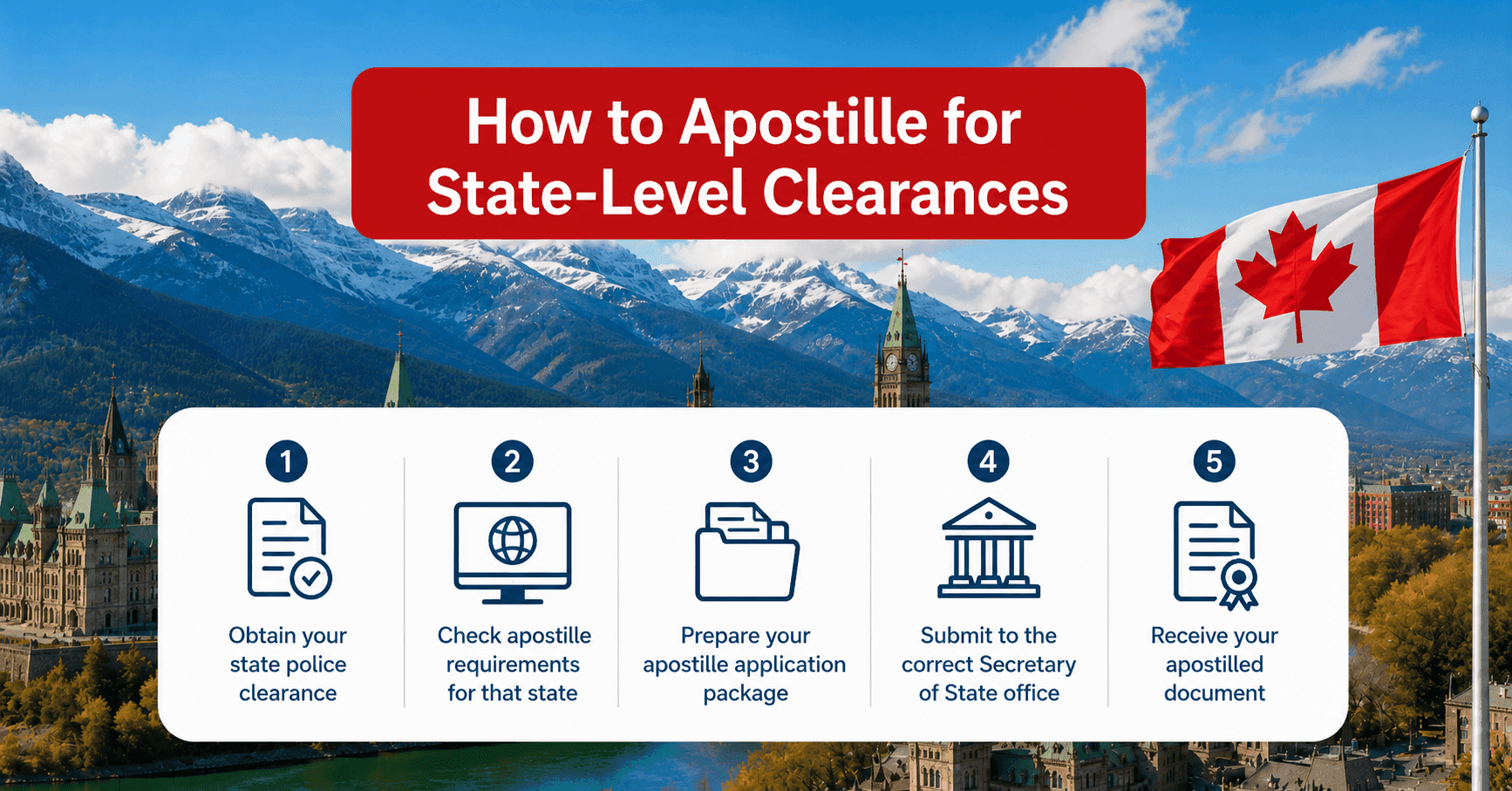
State-issued clearances are apostilled by the Secretary of State of the state that issued the document and not the U.S. Department of State. This is a common point of confusion and can lead to delays if documents are sent to the wrong authority.
Each state has its own apostille process, fee structure, and processing timeline. The general process is consistent:
Step 1: Obtain your state Criminal Record Check
Request your criminal history record from the relevant state authority. Depending on the state, you may receive an original document or a certified copy.
Step 2: Check apostille requirements for that state
Visit the official Secretary of State website for the issuing state to confirm current apostille rules, required forms, fees, and whether mail-in or in-person submission is allowed.
Step 3: Prepare your apostille application package
Include the state-issued clearance, completed apostille request form, applicable fee, and any required return envelope or shipping label (if required by that state).
Step 4: Submit to the correct Secretary of State office
Send or submit your documents to the Secretary of State of the same state that issued the clearance. Each state processes its own apostilles separately.
Step 5: Receive the apostilled document
The Secretary of State attaches the apostille certificate to your state Criminal Record Check and returns it to you by mail or in person, depending on the option selected.
Step 6: e-Apostille (where applicable)
Some U.S. states participate in the Hague e-Apostille Programme (e-APP), which allows apostilles to be issued and verified electronically rather than on paper. If the issuing state participates, you may receive an electronic apostille instead of a physical one. Check the HCCH e-apostille register at hcch.net to see whether your state is enrolled.
If the country requesting your U.S. Criminal Record Check is not a member of the Hague Apostille Convention, an apostille cannot be used. Instead, the document must go through a full legalization process involving both U.S. authorities and the destination country’s embassy.
Step 1: U.S. Department of State Authentication
Submit your original FBI Identity History Summary to the U.S. Department of State Office of Authentications. In this case, the Department of State does not issue an apostille but instead certifies the authenticity of the FBI’s signature and seal. The submission process is similar to apostille requests, but the cover letter must clearly state that authentication is required for a non-Hague country.
Step 2: Embassy Legalization
Once the authenticated document is returned, it must be submitted to the embassy or consulate of the destination country in the United States. The embassy verifies the U.S. Department of State authentication and applies its own legalization stamp or seal. Some countries may require an additional step at their Ministry of Foreign Affairs after embassy legalization.
Processing times and fees vary widely by country. Embassy legalization may take a few days to several weeks, and most embassies require either appointments or mail-in submissions.
Many countries require the FBI Identity History Summary and sometimes the authenticated or apostilled version to be translated into the official language of the destination country by a certified or sworn translator. This step is completed after authentication or apostille, not before.
Requirements differ depending on the country. Some require sworn translators, others require embassy-approved translators, and some accept certified translations without additional verification. It is essential to confirm the exact translation rules with the requesting authority before proceeding, as this can affect both timelines and document acceptance.
| Situation | Required Steps |
| Hague member country (standard requirement) | FBI Identity History Summary → U.S. Department of State apostille |
| Hague member country (translation required) | FBI Identity History Summary → U.S. Department of State apostille → Certified translation (as per destination rules) |
| Non-Hague country (standard requirement) | FBI Identity History Summary → U.S. Department of State authentication → Embassy/consulate legalization |
| Non-Hague country (translation required) | FBI Identity History Summary → U.S. Department of State authentication → Embassy/consulate legalization → Certified translation (as required) |
| State clearance (Hague country) | State Criminal Record Check → Apostille by Secretary of State of issuing state |
| FBI + State clearance (Hague country) | FBI Identity History Summary → U.S. Department of State apostille + State clearance → Apostille by respective State Secretary of State |
These are the errors that cause the most delays and rejections at the apostille stage:
Need help with your application or background check?
Contact us now and speak with a dedicated Globeia expert today.

