
By Himani Daryani · Updated July 22, 2026
Fingerprinting in India is no longer something that only happens for visa applicants. It touches nearly every major life event. Your fingerprints are being registered in many databases now. If you have Aadhaar, they're in UIDAI's Central Identities Data Repository. If you've registered a property recently, they're part of the Sub-Registrar's digital record. If you've applied for a passport, they're on an embedded chip. And yet most people have almost no idea how the process or system works, who can access their data, and what rights they actually have. In a country where biometric identity is becoming the backbone of public services, it's something every resident should know.
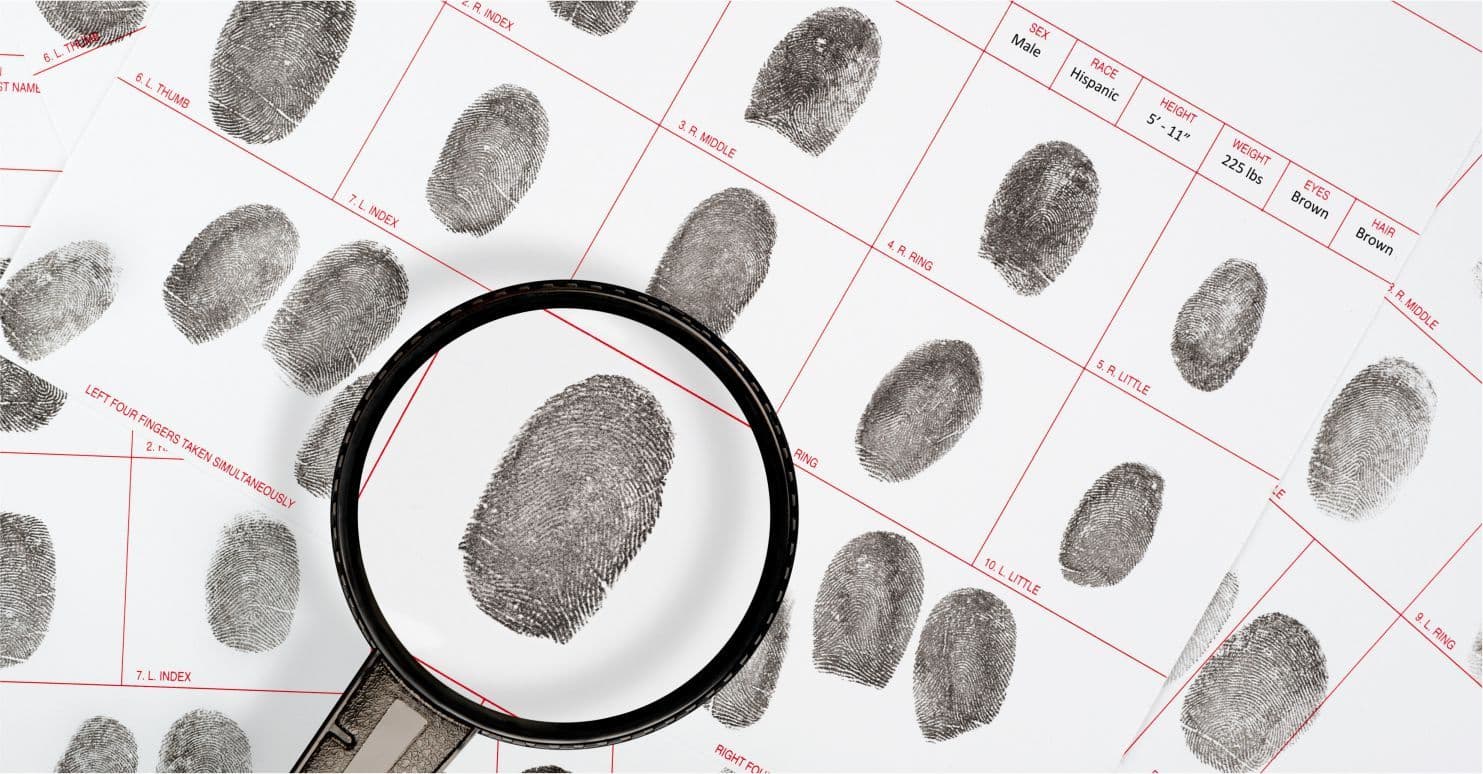
Long before fingerprints became a tool for catching criminals or verifying identities for Aadhaar and Passport, the idea that every individual has unique fingerprint patterns already existed in ancient Indian thought and traditions. Whether in ancient scripture, on royal treaties, or in the records of colonial administrators, India's relationship with fingerprinting dates back to centuries. We usually think of fingerprinting as a modern police tool, but India was actually the birthplace of the world’s first official fingerprint bureau. Today, fingerprint identification in India has become fully digital and touches nearly every aspect of civil life, making it one of the most widely used tools for establishing who a person is.
Below is the timeline that traces the entire journey of Fingerprinting in India, from its earliest philosophical roots all the way to the digital databases:
The story begins with the Samudra Shastra, an ancient Indian scripture authored by Samudra Rishi. Although the text was primarily concerned with astrology and the reading of a person's character, it contained very detailed observations about fingerprint patterns. The scripture identified three types of patterns on the fingertip: "sankhas," "chakras," and "seeps," which are similar almost exactly to what modern science calls loops, whorls, and arches.
The text went even further, noting finer details within these patterns, like "apuran java," "puran java," "padam," and "aax," terms that align with what forensic scientists today call forks, lakes, hooks, and islands. His work reflects a clear and early understanding that every individual's fingerprints are unique.

During the medieval period, handprints were used as a powerful symbol of authority and personal commitment. Ordinary documents were signed in the usual manner with a pen, but when something very important was being decided, such as a royal edict or a peace treaty, a handprint was used instead.
Mughal Emperor Shah Jahan used his handprints to show royal favor. Defeated rulers such as Shahuji Bhosle and Amar Singh Sisodia were required to provide handprints onto treaties as a formal sign of submission to the Mughal throne. This tradition carried forward into the 19th century as well, with Maharaja Ranjit Singh leaving his handprint on an important treaty. At that time, the handprint was not yet a forensic tool but it was already serving as a meaningful form of personal identification.
The practical use of fingerprints began in 1858 with Sir William Herschel, a British administrator working in the Hooghly district of Bengal, India. When dealing with a local contractor named Rajyadhar Konai, Herschel asked him to press his handprint onto their contract as a form of authentication. Curious about what he'd stumbled on, he kept going.
Herschel began exploring fingerprints as a way to prevent fraud in government dealings. He introduced a system where government employees and pensioners had their thumb impressions recorded, ensuring that pensions and payments reached the right people. He also made it a requirement for individuals to include their fingerprints on legal documents.
By 1877, the practice had expanded. In Hoogly, near Calcutta, fingerprints were being used on contracts, legal documents, and pension records as a matter of standard procedure. This helped ensure that government pensions were only collected by the rightful recipients, even after the original pensioner had passed away.
In 1897, the Bengal Fingerprint Bureau was established in Calcutta's Writer's Building, becoming the first fingerprint bureau anywhere on the globe. Its purpose was to bring consistency and scientific rigour to the entire process of fingerprint work, covering the recording, detection, classification, development, and preservation of fingerprint evidence.
Two Indian police sub-inspectors, Khan Bahadur Azizul Haque and Rai Bahadur Hem Chandra Bose, played an important role in advancing fingerprint science during this period.
Hem Chandra Bose created a more detailed way of organizing fingerprint patterns, along with a system for sending fingerprint information through telegraph messages and a method for classifying fingerprints using single digits.
Azizul Haque developed a mathematical formula that helped Sir Edward Henry create a practical system for sorting fingerprint records based on their patterns. This eventually became known as the Henry Classification System, which went on to be adopted by police forces around the world.
The development of fingerprint records continued rapidly even after India gained independence.
In 1955, the Central Fingerprint Bureau was established in Calcutta. Initially, the bureau operated under the Intelligence Bureau. It was later transferred to the Central Bureau of Investigation (CBI). In 1986, the bureau came under the control of the National Crime Records Bureau (NCRB) and was moved to New Delhi.
The bureau became the central authority for fingerprint data collection, criminal identification, and forensic support across India.
As the years went by, India moved away from paper-based fingerprint records to advanced digital databases. Today, fingerprint identification in India is managed through the National Automated Fingerprint Identification System (NAFIS), operated by the Ministry of Home Affairs under the NCRB. This is a massive, country-wide database that allows police from different states to share and search fingerprint records instantly. India didn't adopt fingerprint science. It invented the modern version of it.
NAFIS (National Automated Fingerprint Identification System) is a digital system used in India to store, manage, and match fingerprint records of criminals in a central database. It helps law enforcement agencies identify people using fingerprint data. Although it is operated by the National Crime Records Bureau (NCRB) in New Delhi, it also has a Disaster Recovery Centre set up at NDC, Bhubaneswar, to prevent any data loss.
Around 1,381 fingerprint workstations and related equipment of NAFIS have been installed at every district, police commissionerate, and fingerprint bureau across all 36 States and Union Territories. Three central law enforcement agencies, the CBI, NIA, and NCB, are also part of the network. Each of them have their own dedicated space in the NAFIS database. So, they have full rights to edit their own data, while other stakeholders can only read it for search purposes.
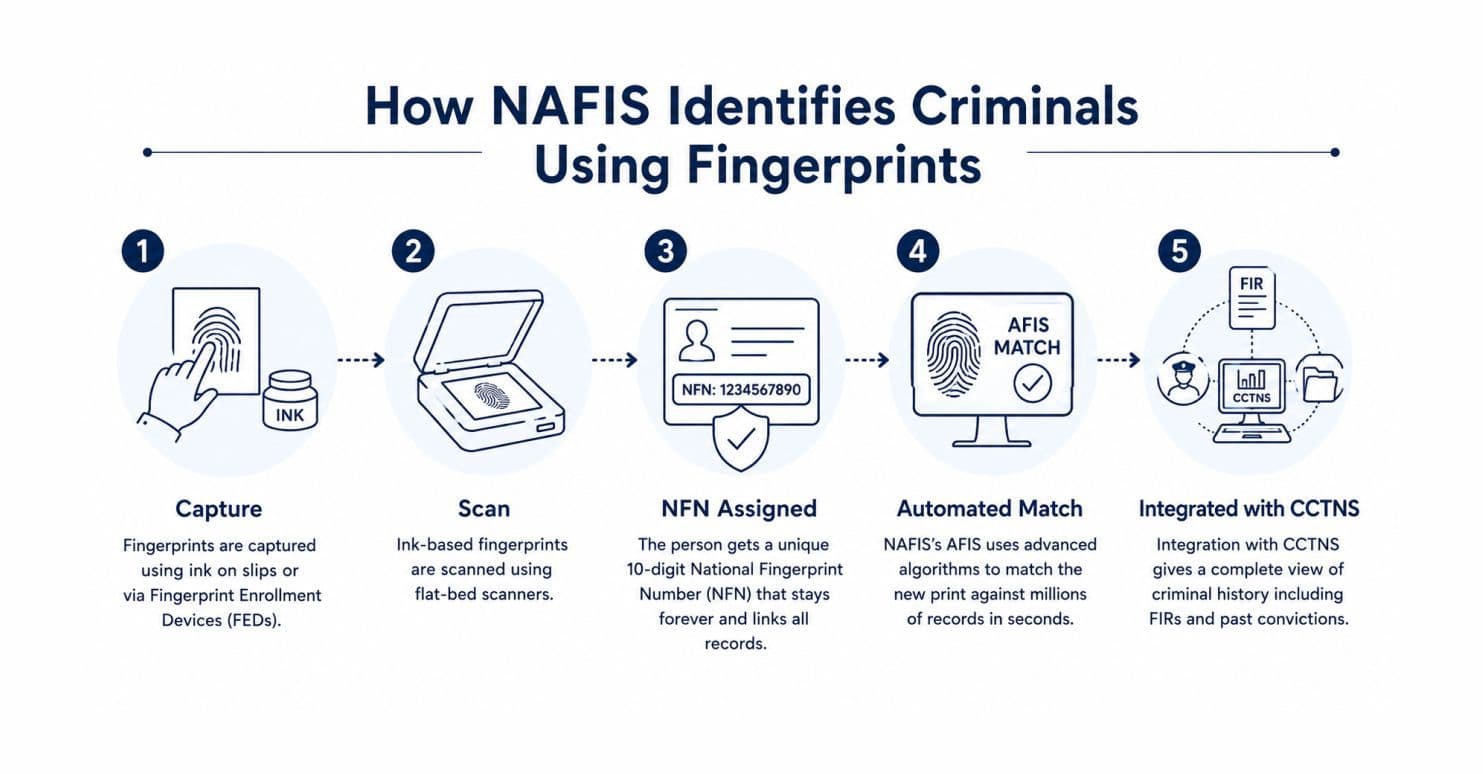
Before NAFIS came into the picture, managing fingerprint data in India was a very slow and manual process. When a person was arrested, states and union territories would create duplicate fingerprint slips. One copy would be kept in the state or UT's own database, and the other would be sent to the Central Fingerprint Bureau at NCRB to maintain a national repository of physical slips. Whenever a criminal identification or antecedent search was needed, these physical slips had to be physically sent to NCRB for a manual search through an enormous collection of records.
This process had several obvious problems. It was slow, paper-heavy, and the success rate of matching fingerprints, known as the trace percentage, was very low. The system also created large amounts of paperwork because duplicate slips had to be maintained at multiple levels. Over time, many physical slips were damaged due to wear and tear, which sometimes led to the loss of important fingerprint details.
India did try to digitize this process earlier using a system called FACTS (Fingerprint and Criminal Tracking System), which was an Automated Fingerprint Identification System. However, FACTS could not fully eliminate manual intervention, as states and UTs still needed to send physical slips. On top of that, there was no standardization in how fingerprints were collected across different states, and FACTS operated as a standalone system without any national connectivity.
It became clear that the country needed a fully digital, standardized, and nationally connected fingerprint system. This is what led to the creation of NAFIS.
NAFIS was introduced by the NCRB with the aim of building a centralized, searchable criminal fingerprint database that law enforcement agencies across the country could access through workstations in real time for investigation purposes. The system automated important parts of the fingerprint management process, including fingerprint capture, enrollment, storage, retrieval and matching. This significantly improved the speed and efficiency of criminal identification/investigation while also improving the trace percentage of fingerprint records.
NAFIS has had a meaningful and lasting impact on how criminal cases are investigated and resolved across the country.
As a centralized repository of criminal fingerprint data, the system allows states, union territories, and central law enforcement agencies to quickly identify suspects from chance prints found at crime scenes. What would have earlier taken days or weeks through manual searches can now be done in a fraction of the time, directly improving the chances of solving cases.
Some more major improvements seen under the NAFIS system are:
Faster identification through chance fingerprints. Since criminal fingerprint records are available in a single national database, investigators can now search fingerprints in real time, helping them identify suspects more quickly from chance prints found at crime scenes.
Addressing interstate crimes. Criminal networks usually operate across state borders, which made tracking them difficult when each state maintained its own isolated records. NAFIS’s single and nationally connected database helps identify individuals with criminal records across different states much more easily. For example, a police officer in Kerala can instantly check if a suspect has a criminal record in Punjab.
Reopening of closed cases. Those unresolved cases with preserved fingerprint evidence can now be matched against the national database, giving investigators a renewed opportunity to find leads that were not available earlier.
Better support for court proceedings. Since fingerprint matching has become quicker and more reliable under NAFIS, investigators can present stronger forensic evidence in court. This helps speed up trials and improves the chances of successful convictions in criminal cases.Fingerprint analysis is no longer limited to simple identification. It now is a tool for deeper forensic examination, improving both the accuracy and the methods used in criminal investigations over time.
There is another small yet powerful improvement to note - the deterrence effect. When people are aware that their fingerprints can be easily matched to past crimes, it naturally discourages unlawful activity.
The ability to identify criminals and security threats accurately and without delay has directly contributed to a broader sense of public safety. NAFIS, in this sense, is a system that supports the well-being of communities at large
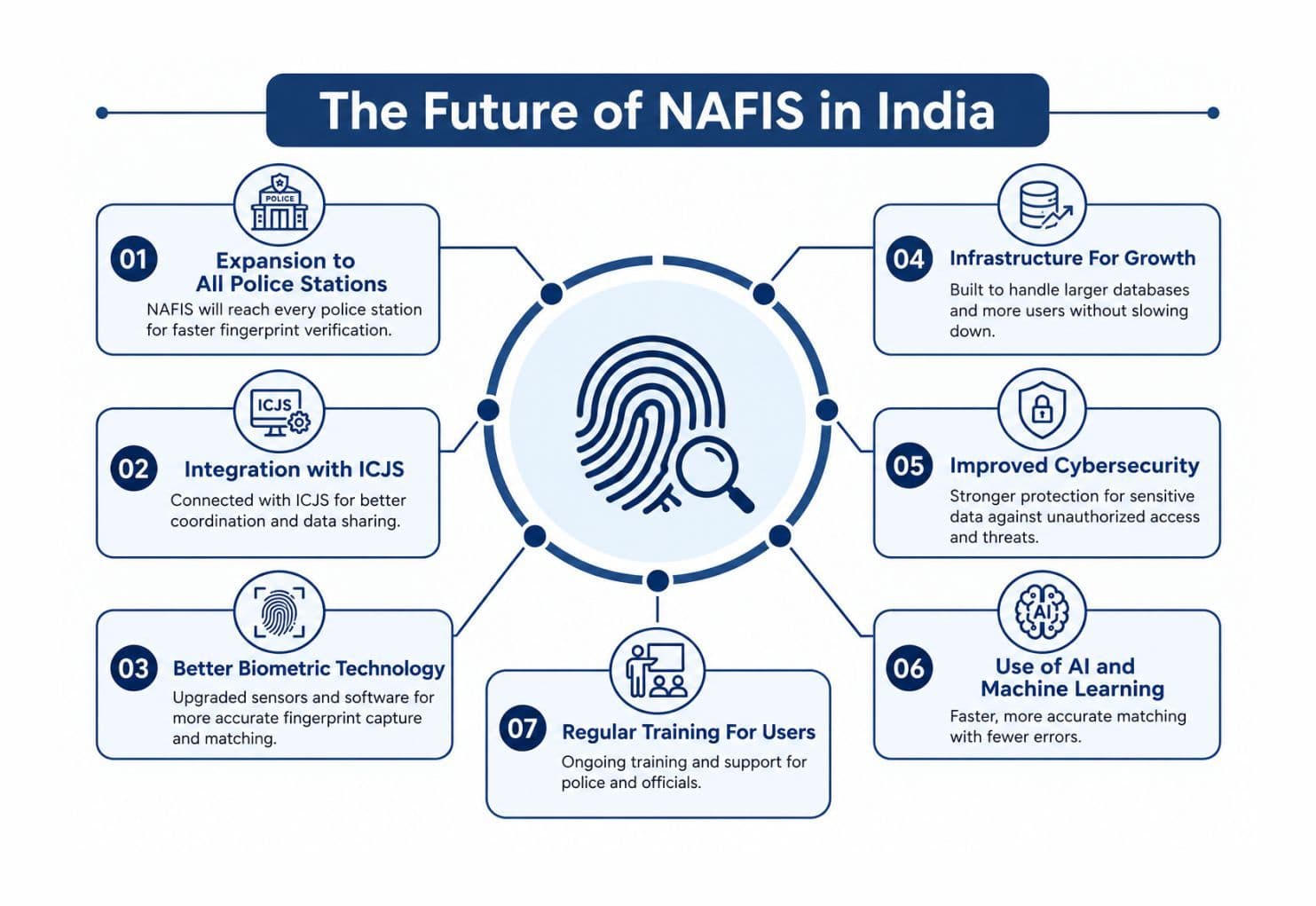
NAFIS is still growing, and several developments are planned to make the system more capable and wide-reaching in the years ahead.
Fingerprints are one of the oldest tools in criminal investigation, but their role in India today has grown to much more than that. They are now used for Aadhaar enrollment, employee attendance systems, background checks, professional licensing, and many other identity verification processes.
As fingerprint collection has grown more widespread, so have debates around privacy and individual rights. A fundamental question has been repeatedly raised by citizens, civil society groups, and the judiciary alike: does compulsory fingerprinting violate the right to privacy? The Aadhaar biometric enrollment program became the most visible point for this debate.
In response, India has built a layered legal framework governing every stage of the fingerprinting process: who can collect prints, under what authority, how long they can be stored, when they are admissible in court, and what rights individuals retain over their own biometric identity.
Protection Against Self-Incrimination (Article 20(3))
Per this article of the Indian Constitution, people cannot be forced to testify against themselves in criminal cases. But courts have clarified that providing fingerprints does not count as self-incrimination. This is because fingerprints are physical identifiers, not statements or personal testimony. As a result, law enforcement agencies can legally collect fingerprints when required by the law.
Right to Privacy (Article 21)
The right to privacy is a fundamental right in India. Since fingerprints are personal biometric data, authorities must ensure that their collection and storage follows legal procedures, and that their use is reasonable and proportionate to the purpose for which it is collected.
The CPI Act, 2022, is the primary law governing the collection of fingerprints and other biometric information in India. It replaced the older Identification of Prisoners Act, 1920, and expanded the government's authority to collect and store biometric data.
The Bharatiya Sakshya Adhiniyam, 2023, which replaced the Indian Evidence Act, sets out the rules for how fingerprint evidence can be used in Indian courts. There are two main requirements that allow fingerprints to be accepted as evidence:
Expert Verification
Fingerprint matches are not automatically treated as proof in court. A qualified fingerprint expert must examine and compare the prints and provide an opinion on whether they belong to the same person. The court can consider this expert opinion as valid evidence when deciding a case.
Authentication of Digital Records
Today, most fingerprint records are stored and analyzed digitally through systems such as NAFIS. Because these records are electronic, courts require proof that the data is genuine and has not been altered. For this, authorities have to provide a certificate confirming that the system was functioning properly and that the electronic records are authentic and reliable.
The Bharatiya Nagarik Suraksha Sanhita, 2023, which replaced the Criminal Procedure Code (CrPC), lays down the procedures that investigating authorities must follow while collecting and handling fingerprints as evidence.
While the CPI Act, 2022 gives authorities the power to collect fingerprints, the BNSS governs how that process must be carried out during an investigation. It lays down the legal procedures for collecting, documenting, and preserving fingerprint evidence. The law also helps ensure that fingerprint records are properly handled from the time they are collected until they are presented in court.
Under India's IT Rules, biometric information, including fingerprints, is classified as sensitive personal data or information. This means that the organizations and authorities collecting or storing fingerprint data are expected to handle it with a higher level of care and security than ordinary personal information. And since fingerprint records are increasingly being stored and processed through digital systems now, protecting this information from unauthorized access becomes much more important. The Information Technology Act, 2000, contains provisions that address unauthorized access, data breaches, hacking, and misuse of electronic records.
The Section 29 of the Aadhaar Act, 2016 contains strict rules to protect the privacy and security of biometric information collected for Aadhaar enrolment and authentication. Given below are some of the rules laid down under this section:
Right to Alternative Biometrics When Fingerprints Fail
Fingerprint scanning does not always work. Sometimes factors such as old age, worn fingerprints, some skin conditions, injuries, or medical conditions can make fingerprints difficult or impossible to capture. To address this issue, UIDAI regulations require authentication agencies to use alternative biometric methods when fingerprints cannot be read. You cannot be denied a license or service solely because your fingerprints are unreadable. Indian authorities are legally obligated to offer iris and face scanning or OTP authentication as a backup.
Many private organizations are increasingly using fingerprint-based systems for employee attendance, access control, identity verification, and security. The Digital Personal Data Protection Act, 2023 includes rules for how such biometric data must be handled.
Most of us are familiar with the fingerprinting scene common in Indian cinema, where a person presses their thumb or fingers onto an ink pad and then marks the impressions on a document. It is, in fact, one of the oldest methods of fingerprinting, and it is still used in certain situations. In practice, fingerprinting in India extends well beyond this image.
Many procedures such as Aadhaar enrollment, passport issuance, visa applications, and immigration screening each rely on different fingerprinting methods tailored to their specific requirements. With one of the world's largest and most diverse populations to serve, fingerprinting methods in India have also evolved to meet the different needs.
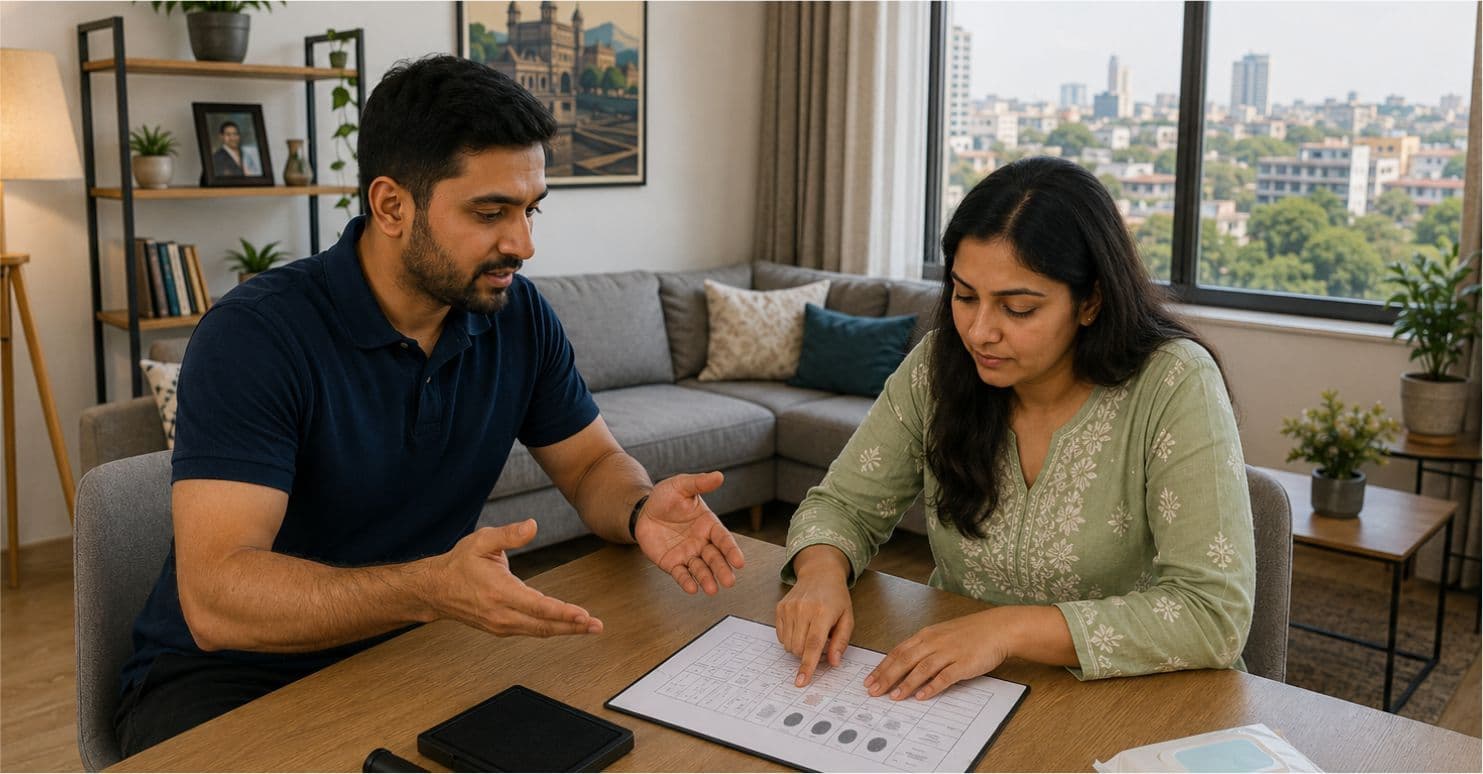
Fingerprinting using a black ink is one of the oldest and most reliable ways to identify a person in India. Even with the rise of digital scanners, the traditional ink-based fingerprinting method is a standard practice for many legal and official procedures. The ink used is a thick, oil-based black ink, similar in consistency to a printer's ink. It is designed to transfer cleanly onto paper without smudging or spreading too much.
The traditional ink-based fingerprinting in India is still used for many important purposes:
At a standard ink-based fingerprinting appointment, you will see some tools like a small roller or ink pad to apply ink evenly onto the finger, a hard, flat surface for rolling the ink out, and a ten-print fingerprint card, with clearly marked boxes for each finger, labeled in order. It also has spaces for personal details such as the person's name, date of birth, signature, and physical characteristics like height, weight, and eye colour.
There are two types of impressions taken under ink-based fingerprints, and both are recorded on the same card.
For rolled impressions, a thin layer of black forensic ink is spread. Your finger is then rolled over the ink from one side of the nail to the other. The inked finger is placed on the designated square of the fingerprint card. The technician rolls your finger firmly but gently to capture the full pattern of the ridges. This nail-to-nail rolling motion captures the full surface of the fingertip, including the sides, giving the most complete picture of the ridge pattern.
Rolled impressions are taken for all ten fingers, starting with the right thumb, followed by the right index, middle, ring, and little finger, and then the same sequence for the left hand.
After rolled impressions are taken, plain impressions are also recorded. For these, your finger will be pressed straight down onto the card and lifted, without any rolling. You will notice the impressions are narrower since they only capture the central contact area of the fingertip.
The four fingers of the right hand are pressed together, then the four fingers of the left hand, and then at last both thumbs side by side. These group impressions appear at the bottom of the fingerprint card and serve as a check to confirm that the rolled prints above them are in the correct order.
The impressions of all your ten fingers will occupy the upper portion of the card, arranged in two rows of five. The plain impressions will occupy the lower portion. This allows the expert reviewing your card to compare both sets of fingerprints and check that the sequence and print quality are correct.
The live scan or digital method of collection is a much modern type of fingerprinting in India; fingerprints are captured electronically without using ink or paper. As opposed to the ink-based method, where fingers are rolled in ink and pressed onto a card, in this method, the finger is placed on a glass or sensor surface. The device reads the ridge pattern and converts it into a digital image. That image is then stored, transmitted, or processed depending on the purpose for which it was taken.
A live scan fingerprinting device uses either an optical sensor or a capacitive sensor to read the surface of the fingertip:
| Type of Sensor | Description |
| Optical Sensor | Works like a camera; light is projected onto the finger, and the sensor captures the reflected image. The ridges and valleys of the fingerprint reflect light differently, which is how the pattern is recorded. |
| Capacitive Sensor | Works through electrical charge; ridges of the fingerprint make contact with the sensor surface and conduct a small electrical signal, while the valleys do not. The sensor reads this difference across thousands of tiny points and constructs the fingerprint image from it. |
In both cases, the result is a high-resolution digital image of your fingerprint. Many modern devices used in government programs in India capture at 500 dots per inch as the standard, though some use higher resolutions for more detailed records.
When you enter the room for getting your digital fingerprinting done, you will notice a fingerprint scanner, which is the hardware device with the sensing surface. The size of those scanners can vary and range from small, single-finger USB scanners to larger ones that can capture all four fingers of one hand simultaneously, known as four-finger slap scanners. There are also some scanners that can capture all ten fingerprints in one session. A computer or processing unit is also connected to the scanner, which runs the capture software and handles image quality checks.
You have to place each finger on the scanner surface as instructed by the operator. The device will capture the image, while the software immediately checks whether the quality is sufficient. If the impression is too faint, blurred, or incomplete, the software will prompt a retake before moving on.
Once all impressions are accepted by the software, the complete set will be transmitted to the relevant database or authority.
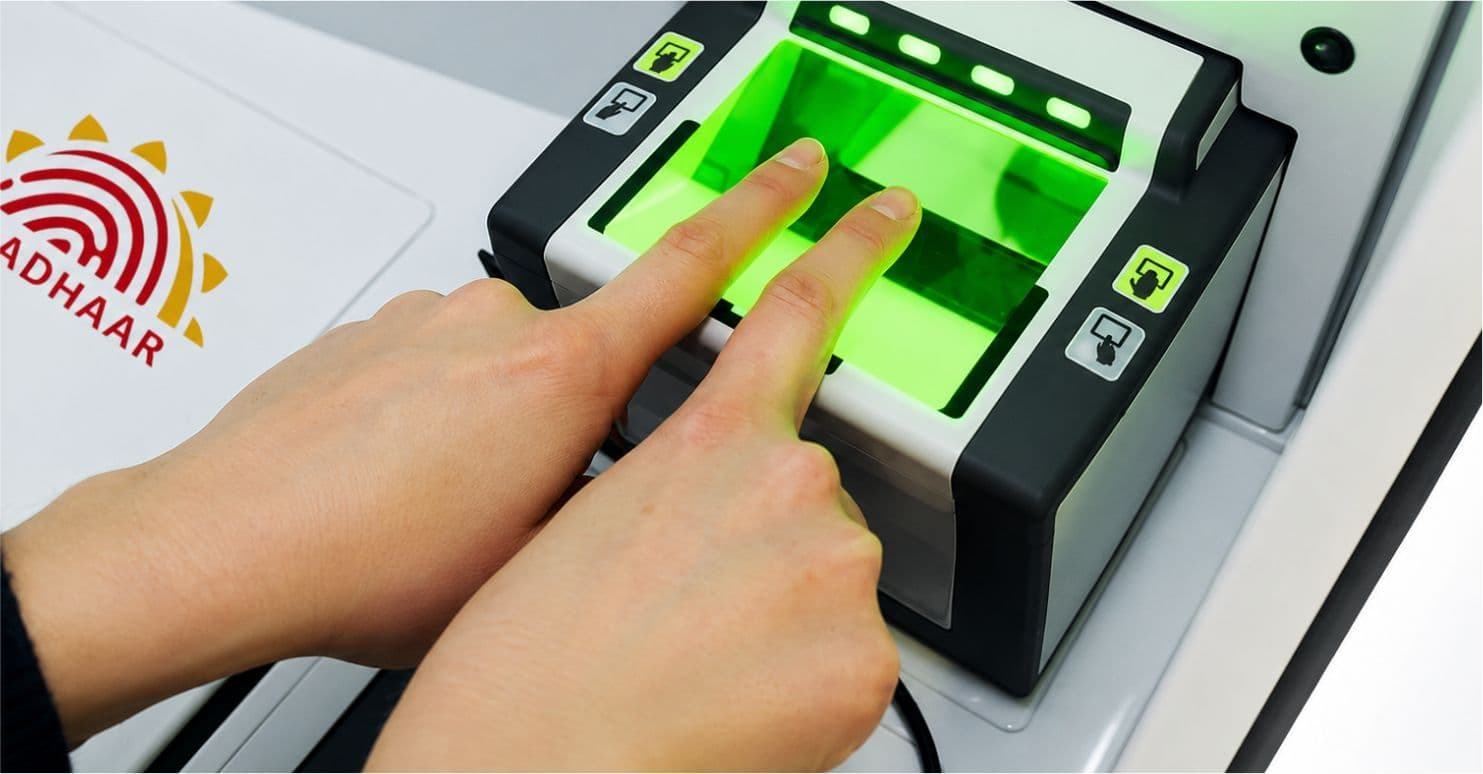
Aadhaar Enrollment
The largest application of live scan fingerprinting in India is the Aadhaar program, administered by the Unique Identification Authority of India (UIDAI). The fingerprint images captured during enrollment are stored in the central UIDAI database and linked to each individual's Aadhaar number.
Since almost all major administrative and government services in India are tied to Aadhaar, your enrolled fingerprints can be used to verify your identity wherever Aadhaar-based authentication is required. This includes, but is not limited to:
NAFIS Criminal Database
This form of fingerprinting is also being adopted for submission to the NAFIS. Many state police departments are now using live scan devices for recording fingerprints of arrested individuals. Compared to scanning ink-based paper cards, which requires an additional digitization step, live scan submission to NAFIS helps with faster searching and matching against existing records.
Voter ID Verification
Did you know that the Election Commission of India is working on getting live scan devices at polling stations? As per The Hindu, the Supreme Court of India proposed a notice to the government for integrating biometric data into the electoral roll process in April 2026. If this is successfully implemented, you would no longer need to rely solely on your voter ID card; instead, fingerprints or iris scans would be used to verify your identity. Using unique physical markers like fingerprints ensures that only the real person is allowed to vote. And this could drastically reduce the problem of duplicate or fraudulent voting.
Other Applications
Beyond these major uses, live scan fingerprinting is also widely employed across several other processes in India, including:
The Live Scan technology is being adopted more and more in India, mainly due to its accuracy. Since the software provides on the spot feedback, there is almost no risk of sending bad prints that might be rejected later. It is also much faster than the ink method because there is no paper to mail and no ink to dry. And, digital prints are easier to store and search. This way, authorities can verify a person's identity in seconds.
Biometrics refers to the measurement and recording of physical or behavioural characteristics that are unique to a person and can be used to identify them. Common biometric identifiers include fingerprints, iris patterns, facial features, voice, and even the way a person walks.
Fingerprinting is just a small part of a much bigger system designed for identity verification, access control, or authentication. It is not just about recording your biometrics and filing them away. It involves capturing, processing into a digital format, storing them in a database, and then using them repeatedly over time to confirm a person's identity.
How is it different from general fingerprinting?
Any kind of fingerprinting, whether ink-based or live scan, focuses on just recording a fingerprint at a given point in time. The record is then stored and may be referred to later when needed.
Biometric fingerprinting is a broader concept. The fingerprint is not just recorded but enrolled into a system where it will be used repeatedly. Every time you scan your fingerprint or interact with that system, it confirms your identity. You can think of it as an ongoing credential, much like a password, except that it cannot be shared, stolen, or lost.
This is the usual process of biometric fingerprinting in India:
First, during enrollment, a live scan device captures your fingerprints and creates a high-quality digital template that the system will use for all future comparisons.
Once enrolled, your fingerprints can be used in two ways: verification and identification.In verification, you provide an ID, such as your Aadhaar number, and touch the sensor for a fresh scan. The system checks your scan only against the template linked to that ID, confirming you are who you claim to be.
In identification, no ID is needed; it is done based just on your fingerprint. The system searches its entire database to find a match. This is how fingerprint evidence works in criminal investigations, where a print from a crime scene is run against all records on file.
Both types of matching are used in India, depending on the context.
Common Uses of Biometric Fingerprinting in India
Again, Aadhaar is the most significant example of biometric identity at scale in India. Every resident who enrolls provides fingerprints from all ten fingers, iris scans from both eyes, and a photograph, all stored in the Central Identities Data Repository and used to authenticate identity when accessing government services.
Biometric fingerprinting is also used across a wide range of other contexts, including submission to NAFIS for criminal database searches, disbursement of welfare benefits like pensions and scholarships, tracking the entry, exit, and visa compliance of foreign nationals, verifying suspects during investigations, recording attendance across government offices, schools, and private organisations, authorising UPI transactions in place of a PIN, and even unlocking personal devices and apps.
Why It Has Grown So Rapidly
The reason biometric fingerprinting has grown so much is, since your fingerprint is always with you, there is nothing to remember (like a password) and nothing to lose (like an ID card). In a big country like India, it provides a very efficient way to serve millions of people quickly. It also adds a high level of security because, while a password can be shared or stolen, a biometric signature is unique to the individual.
A latent fingerprint is an invisible or barely visible mark. Your fingertips have tiny pores that constantly release sweat and oils. When you touch any object, like a glass, a doorknob, or a piece of paper, you leave behind a unique chemical trail in the shape of your finger ridges.
So, latent fingerprinting is the forensic science of finding and collecting those hidden fingerprints left behind at a scene. Unlike the ink or digital methods where you intentionally give your prints, a latent print is not meant to be left behind, and it is usually not visible to the naked eye under ordinary conditions. It has to be found, developed, and recorded through specific techniques before it can be examined or used.
In India, this is a critical tool for the police and forensic experts to solve crimes and identify people who were present at a specific location.
Why Latent Fingerprints Matter in Investigations
When a crime takes place, people usually do not leave behind any intentional proof of their identity. However, simply touching surfaces, holding objects, or moving around a location can leave trace evidence. While a person can easily deny being at a location or touching an object, their latent fingerprints provide physical, scientific proof of their presence.
After a latent fingerprint is found and developed, investigators compare it with reference fingerprints. These may belong to a suspect, a person who legally had access to the location, or records stored in databases such as NAFIS. These prints are also admissible in courts
Latent fingerprints are not just limited to crime scenes; they can be helpful in multiple situations:
Latent fingerprint examinations in India are carried out by state fingerprint bureaus, the Central Fingerprint Bureau under the NCRB, and government-run Forensic Science Laboratories. These agencies use trained experts, specialised comparison infrastructure, and digital fingerprint databases to help law enforcement investigate and resolve both criminal and civil cases.
A fingerprint card, as the name suggests, is a physical document onto which a person's fingerprints are captured. It is printed on heavy cardstock to prevent ink smudging. Any basic or standard fingerprint card provides fields for ten rolled impressions, flat impressions, and personal data like name, DOB, citizenship, signature, etc. Once completed, the card is signed and quality-checked by the technician, then submitted to the respective fingerprint repositories, depending on the document or process for which the prints were taken.
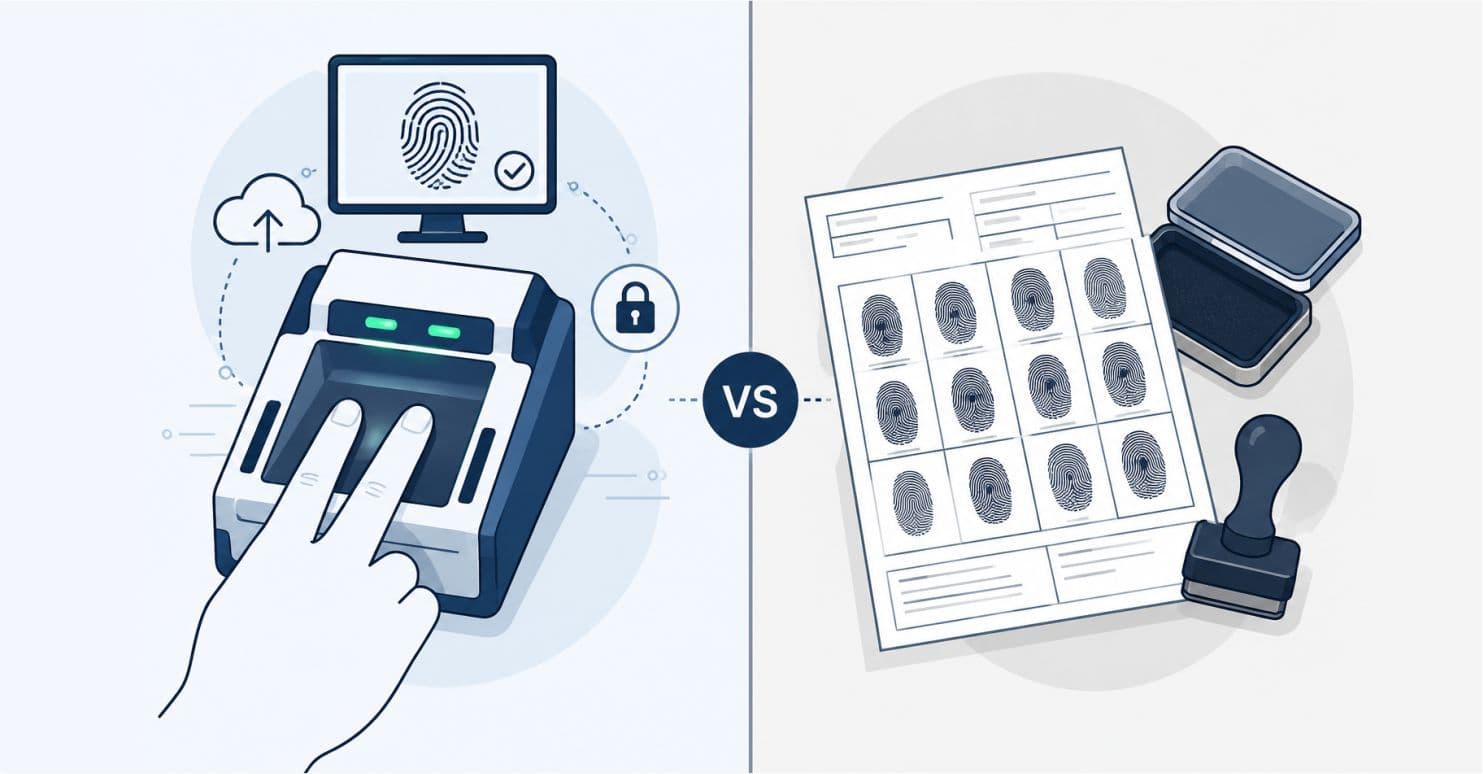
Fingerprints in India are captured using two main methods: ink-and-roll and digital live scan. The process and involvement of fingerprint cards in both is a bit different:
In India, fingerprinting cards are mainly used for three major purposes: maintaining criminal records, police verification, and international background checks. For local Criminal Record Checks (PCCs), fingerprints are usually captured digitally using a live scan device, and applicants are not given any physical fingerprint card. This process is similar for other processes where fingerprints are required, such as Aadhaar enrollment, passport, buyer/rental agreements, adoptions, etc.
At police stations, fingerprints may also be collected using the NCRB Fingerprint Form for criminal identification and enrollment into the NAFIS database. However, if you need a background check for another country for purposes such as immigration, employment, licensing, or PR, standardized international fingerprint cards have to be used.
| Fingerprint Card | Purpose |
| FD-258 or FD-1164 | FBI background checks, FINRA licensing |
| C-216C | RCMP criminal record checks, Canada PR and citizenship applications |
Since local police stations in India often do not provide international fingerprinting services on foreign cards, you can get them from third-party vendors or international fingerprint service providers in India.
While fingerprint cards handle the collection side, there is a bigger question worth understanding: how are millions of fingerprint records actually organised and searched? Without a classification system, finding a single match among billions of records would be impossible.
India's fingerprint classification is built on the Henry Classification System, which remains the foundation of how fingerprint records are organized in this country.
The starting point of the Henry system is the observation that all fingerprint patterns fall into one of three broad categories: loops, whorls, and arches. These shapes are determined by the way the ridges on your skin flow. Every finger, when examined, will show one of these three pattern types, and the combination across all ten fingers determines how the record is classified.
Loops
This is the most common pattern, found in about 60-70% of Indians. In a loop pattern, the ridges enter from one side of the finger, curve around, and exit from the same side they started. The pattern has a single recurving structure and a core at its centre.
Whorls
This pattern can be found in around 25-35% of fingerprints. You must’ve seen circles, spirals, or tiny whirlpools on the fingertip. They’re whorls. And unlike loops, they do not have ridges that enter and exit from the same side.
Arches
Arches are the rarest type, appearing in only about 6-7% of the population. In an arch pattern, the ridges enter from one side and flow out the other side, rising slightly in the middle like a small hill or a wave. There is no recurve, no delta, and no core in the way those features appear in loops and whorls.
Now, any person, even a trained technician, would find it very hard to manually identify and classify fingerprints based on the prints alone. To simplify this, the Henry Classification System was developed.
Under this system, each finger is assigned a number based on its pattern (1 through 10, starting from the right thumb) and a potential point value, producing a fraction like 17/1 that narrows down a search before individual ridge comparisons begin. Before digital scanners, this system allowed a technician to narrow down a search from thousands of records to just a handful in minutes. Today, while NAFIS handles matching digitally, the Henry system's logic still underlies how fingerprint records are structured and retrieved across India.
Aadhaar and Passport are the two most widely accepted government-issued IDs in India, recognized across virtually all official processes and services. What makes them uniquely reliable is that generating both requires a person's biometrics, not just fingerprints, but also iris scans, photographs, and digital signatures. This multi-layered verification is what makes these documents a trusted and universally accepted form of identification.
Take a quick look at both documents before we get into each process in detail:
| Parameter | Aadhaar | Passport |
| Issuing Authority | UIDAI | Ministry of External Affairs |
| Primary Purpose | Proof of identity & residence | International travel and identity proof |
| Walk-in Accepted | Yes | No, online booking is mandatory |
| Online Booking Portal | uidai.gov.in | www.passportindia.gov.in/psp |
| Biometrics Collected | 10 fingerprints, iris scan, photo | 10 fingerprints, photo, digital signature |
| Documents Required | Proof of identity and address, like PAN card, passport, driver’s license, ration card, etc. Check the complete list of UIDAI accepted documents. | Proof of DOB, identity, address, and nationality, dependent on your category, applicable situation, and whether or not you’ve passed Class 10. Click here to know what documents you’ll need! |
| Police Verification | Not required | Required |
| Validity | Lifetime | 10 years |
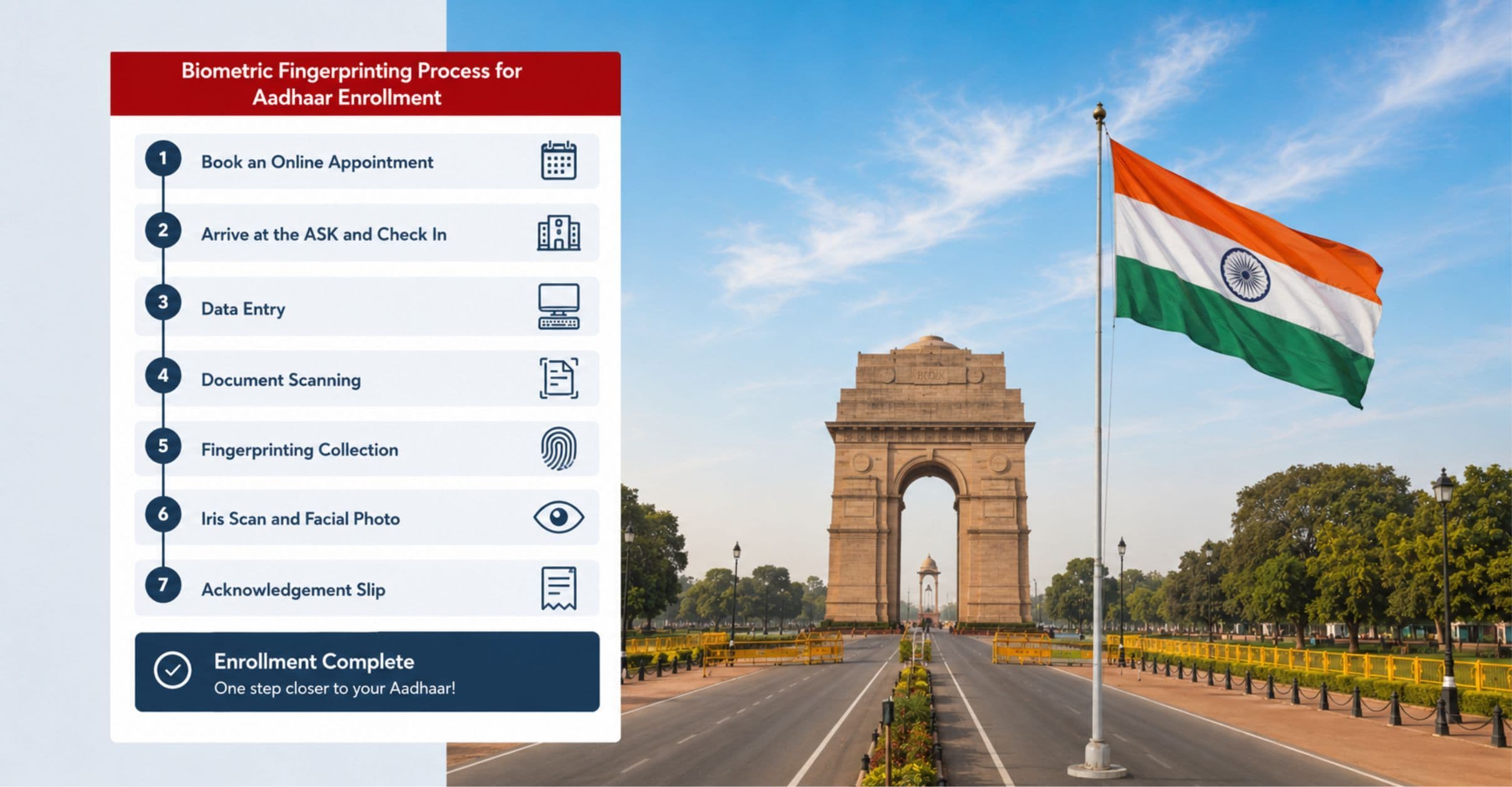
To make Aadhaar-related services easier for the public, UIDAI has opened dedicated service centres known as Aadhaar Seva Kendras (ASKs), where you can walk in for new enrollment or to update existing Aadhaar details.
ASKs are currently operational in 78 districts across India, complementing the 66,000+ existing Aadhaar centres already run by banks, post offices, BSNL, and state governments.
Step 1: Book an Online Appointment
You can easily book your appointment through the official UIDAI link bookappointment.uidai.gov.in. You'll be prompted to fill in your state, district, and nearest enrollment centre or ASK, preferred date and time, followed by personal details like name and mobile number. After you’re done, click on “confirm.” You'll receive an appointment confirmation SMS with a reference number.
Helpful Tip: Most ASKs and enrollment centres accept walk-ins, but you may have to wait. You'll be given a token number and served on a first-come, first-served basis after appointment holders. So, it’s best to make an online appointment.
Step 2: Arrive at the ASK and Check In
Arrive at the centre with your original documents and your appointment reference number. Show these at the reception counter, where you'll be issued a token number or directed to a queue.
Step 3 Data Entry
The operator will sit with you at a computer terminal and enter your name, address, gender, and date of birth into the software. You will be asked to review this on a secondary screen to ensure there are no spelling errors. Check this carefully.
Step 4 Document Scanning
The operator will then scan your original documents. They will hand them back to you immediately. Never give originals without getting them back.
Step 5: Fingerprinting Collection
You will place your 4 right-hand fingers (index, middle, ring, pinky) flat on the electronic scanner simultaneously, then your 4 left-hand fingers the same way, followed by both thumbs together. The machine captures a scan and shows a quality score. If quality is low, the operator will ask you to clean your hands and try again. The whole fingerprint process takes about 2–5 minutes
Step 6: Iris Scan and Facial Photo
Step 7: Acknowledgement Slip
At the end of the session, you will receive a slip containing your 14-digit Enrollment ID (EID). This is very important. Keep it safe. It's your only way to track your Aadhaar application until you receive your number.
After the process is done, your fingerprints and iris scans are sent to UIDAI's central database. The system compares your biometrics against every other person already in the system to ensure you aren't already enrolled. Your demographic data and documents are also verified. Once everything is cleared, your Aadhaar number is generated. You will receive an SMS notification.
You do not need to wait for the physical card to arrive by mail. Once your 12-digit Aadhaar number is generated, you can immediately download a digitally signed, universally valid e-Aadhaar online.
Special Cases in Aadhaar Biometric Enrollment
While the standard enrollment process works smoothly for most people, UIDAI has specific provisions for those who face certain difficulties during biometric capture. Some commonly seen exceptional cases are:
1. Elderly Individuals with Worn or Faded Fingerprints
Years of manual labor, age-related skin changes, or certain skin conditions can cause fingerprint ridges to flatten or fade over time, making them difficult for scanners to read. If the quality score remains low after multiple attempts, the operator can mark a biometric exception. In such cases, UIDAI's system allows enrollment to proceed using iris scans as the primary biometrics, with a note added to the record. The Aadhaar number is still issued.
2. Physically Challenged Individuals / Missing or Damaged Fingers
If a person is missing one or more fingers or even an entire hand due to a congenital condition, accident, or amputation, the operator has to take the biometrics as per the biometric exception guidelines of UIDAI.
3. Children Under 5 Years of Age
Children below the age of 5 are enrolled under a special category called Baal Aadhaar, issued as a blue-coloured card. Since young children's biometrics are not yet stable enough for reliable long-term identification, no fingerprints or iris scans are collected at the time of enrollment. Instead, the child's Aadhaar is biometrically linked to one parent's Aadhaar. When the child turns 5, and again at 15, they must visit an enrollment centre to provide and update their biometrics, so their record is updated with full biometric data.
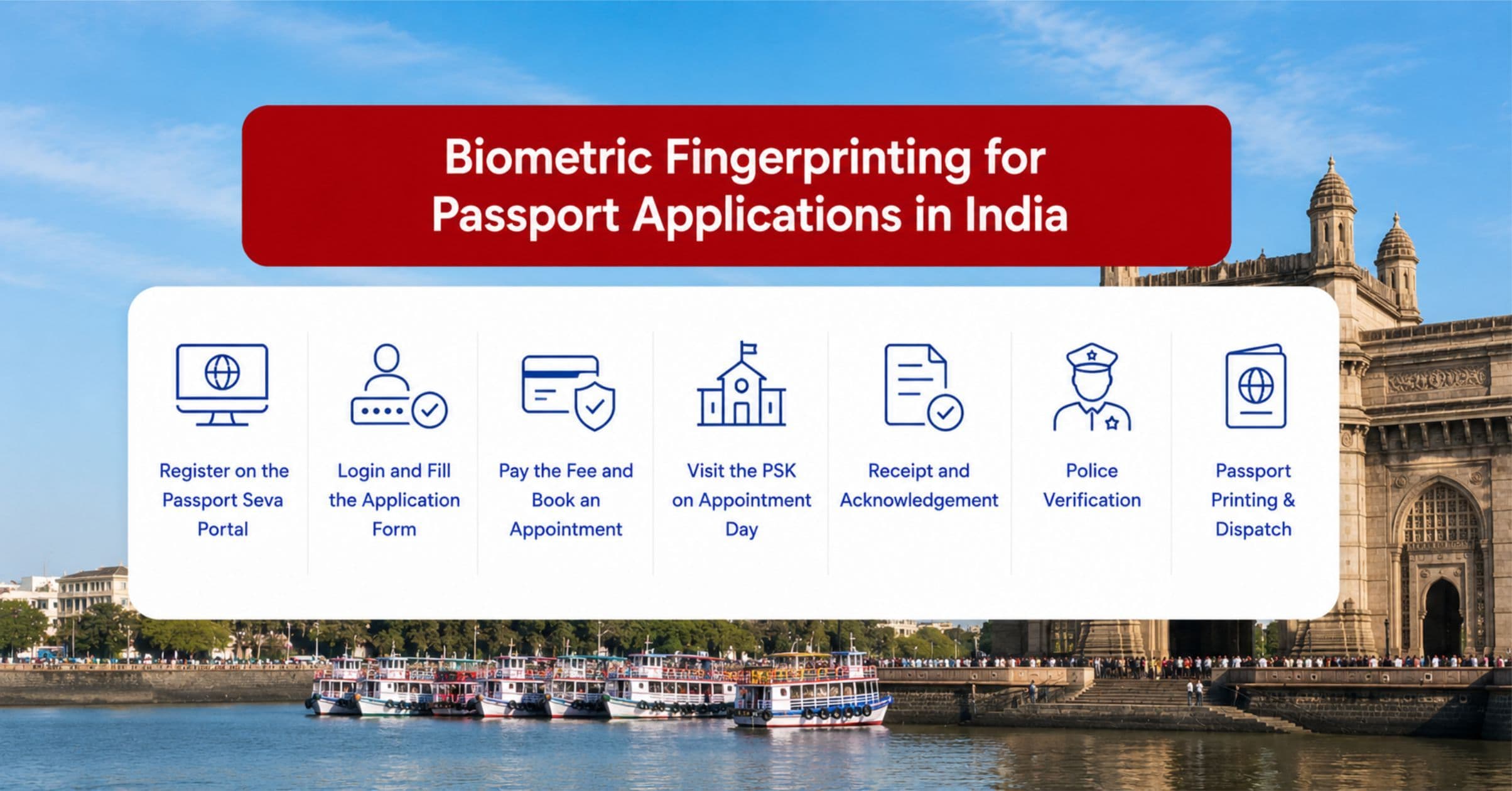
Passports in India are issued through a network of passport offices, Passport Seva Kendras (PSKs), and Post Office Passport Seva Kendras (POPSKs) across the country, all managed under the Passport Seva Portal. The entire process is digital, which means you must complete the registration and book an appointment online in advance. Walk-in applications are not accepted in this case.
Step 1: Register on the Passport Seva Portal
Go to www.passportindia.gov.in/psp and click on “Register” on the top navigation menu. After filling all the details, you’ll receive an email verification link. Click it to activate your account.
Step 2: Login and Fill the Application Form
Login using your credentials, and click on "Apply for Fresh Passport / Re-issue of Passport." You'll be taken to the online form, where you’ll have to fill in many details, such as name, DOB, gender, marital status, family details, current address, emergency contact, etc. Click "Submit."
You will receive an Application Reference Number (ARN). Save this.
Step 4: Pay the Fee and Book an Appointment
After submitting the form, you’ll be redirected to the payment gateway. Choose the desired method and complete the payment. After payment, go to "Schedule Appointment."
You have to select the RPO based on your current area of residence. Then you’ll be shown your nearest PSK. Choose the available date and time slot from the calendar and confirm the appointment.
You'll receive an appointment confirmation via email and SMS where the appointment date, time, location,and your ARM will be mentioned. Print it as you’ll have to carry it with you to the PSK
Step 5: Visit the PSK on Appointment Day
When you enter, you will have to visit multiple counters.
Counter A: The security will check your appointment letter and give you a token number. You have to wait in the waiting area. Keep an eye on the display screens for your token number to appear.
Counter B: An officer will verify all of your original documents and self-attested photocopies. If documents are in order, they will be accepted and scanned.
Counter C: This is the counter for biometric data collection.
What if fingerprints cannot be captured? If a person has a permanent medical condition, injury, worn ridges due to age or manual labor, or missing fingers, the officer will make multiple attempts using different fingers or hands first. If capture still fails, the officer marks a biometric exception directly in the system. The process continues using your photograph as the sole biometric, and the exception is noted in your passport file and on the embedded chip in your e-Passport. In cases of medical conditions or permanent physical exceptions, you will have to submit relevant medical records or certificates so the officer can verify and document your condition properly.
Counter D: A supervisor will conduct a final review of all the captured data and documents, to make sure everything is correct and in order.
Step 6: Receipt and Acknowledgement
At the final step, you will receive a printed receipt with your file number, expected processing timeline, status tracking instructions, and "Police Verification Required." The entire PSK visit usually takes 1.5 to 3 hours depending on the queue.
Step 7: Police Verification
Your application is then sent to the local police station of your residence. A local police officer first calls you to verify your address and background, and then will visit your registered address to make sure you actually live there and how your overall conduct has been. Be available at home. If you miss the visit, coordinate with the police station directly.
Step 8: Passport Printing & Dispatch
After the police verification is cleared, your e-passport will be dispatched via speed post to your address.
What is an e-Passport?
The e-Passport is like a smart passport that comes with built-in biometric technology and is part of the Government of India’s Passport Seva Programme (PSP) 2.0. Today, most new passports issued through PSKs are e-Passports. While it looks almost exactly like a regular passport from the outside, it has a small tamper-proof electronic chip and antenna securely embedded inside the cover or one of the pages.
This electronic chip safely stores your personal information, such as your name and date of birth, along with your biometric details like your fingerprints and digital photograph. The information stored on the chip is encrypted and protected against tampering.
The main purpose of this technology is to make passports much safer and harder to forge or tamper with. For example, if someone tries to change the printed information on the passport, the details will no longer match the encrypted information stored inside the chip. This immediately helps authorities identify the passport as altered or forged.
You can easily recognize an e-Passport by looking for a small gold-colored chip symbol printed on the front cover, usually below the word “Passport.”
Why it’s a big deal for travellers
Does Your Existing Passport Need to Be Replaced? No, you do not need to replace your existing passport if it is still valid. Your current passport remains completely valid until its expiry date. When you apply for a passport renewal or a fresh passport in the future, you will automatically receive an e-Passport as part of the new system.
Fingerprint requirements are a huge part of Indian immigration and visa processes. The enrollment of applicants using biometrics like fingerprints and digital photographs has become quite important in modern immigration systems worldwide. These unique markers help in more accurate identification of individuals, and also enable the creation of long-term databases that can be stored and referenced for years to come. The entire process is essentially designed to ensure that the person applying for a visa and the person actually travelling are one and the same.
Whether you are a foreign national planning to visit India or an Indian citizen applying for a visa to travel abroad, you will have your fingerprints taken in the process. It might feel like a small, routine step. But behind that brief moment is an entire system built to verify identity, track movement, and maintain the kind of records that modern immigration cannot function without.
Fingerprints in the immigration and visa processes of India are usually recorded in two situations:
| Topic | Who It Affects | When Fingerprints Are Taken |
| e-Visa / Visa on Arrival | Foreign nationals | On arrival in India |
| Visa applications abroad | Indian citizens | At VAC appointment |
The e-visa or electronic visa facility of India allows foreign nationals to apply for and receive a visa electronically, without visiting an Indian embassy or consulate. It is only relevant for those who wish to visit for short-term purposes, like tourism, sight-seeing, visiting a friend or relative, attending business meetings, conferences, medical treatments, etc.
Once you apply successfully and pay the required fee, you’ll receive the approval, called an Electronic Travel Authorization or ETA via email. This has to be presented at the immigration check post upon arrival in India, and they will place the e-visa stamp in your passport.
Also, you are required to complete an e-Arrival Card before flying to India. This can be done through the official portal or the Su-Swagatam mobile app at least 72 hours before your flight. The e-Arrival Card is basically the digital version of the old paper “Disembarkation Card” that passengers earlier had to fill out manually after landing in India.
Fingerprint Collection Points for e-Visa Holders Entering India
If you are travelling on an Indian e-Visa, you do not need to submit fingerprints during the online visa application process. Instead, your biometric details, including fingerprints and a digital photograph, are collected after you arrive in India at the immigration checkpoint.
Most major international airports in India, including Delhi, Mumbai, Bangalore, and Chennai, have separate immigration counters. After landing, you should head directly to the counters marked “e-Visa” or “Electronic Travel Authorization (ETA)” instead of joining the regular immigration queues.
As someone on an Indian e-visa, you cannot enter the country through anywhere. Biometric collection for e-Visa holders is currently available at 31 designated international airports and 5 authorized seaports in India. Your fingerprints and photograph will be captured there before you are officially granted entry into the country.
The designated e-Visa entry airports are:
| Region | Entry Airports |
| North India | Delhi (Indira Gandhi), Amritsar, Chandigarh, Jaipur, Lucknow, Varanasi |
| West India | Mumbai (Chhatrapati Shivaji), Ahmedabad, Pune, Nagpur, Goa (Dabolim), Goa (Mopa), Indore |
| South India | Bengaluru, Chennai, Hyderabad, Cochin, Thiruvananthapuram, Calicut, Mangalore, Coimbatore, Trichy, Madurai, Kannur |
| East & NE India | Kolkata, Gaya, Bagdogra, Guwahati, Bhubaneshwar |
| Others | Visakhapatnam (Vizag), Port Blair (Andaman Islands) |
What Happens At Immigration Counter After Landing
Quick Tip: Before travelling, make sure your fingertips are clean and free from anything that could affect the scan quality. Mehndi, cuts, injuries, wet fingers, or bandages can sometimes prevent the scanner from reading fingerprints properly and may lead to delays during immigration clearance.
Why Does India Collect Fingerprints at the Border?
The entire immigration and visa process at Indian airports is managed by a highly centralized, master e-governance platform overseen by the Ministry of Home Affairs, called the IVFRT system. IVFRT stands for Immigration, Visa, Foreigners Registration & Tracking.
The system is designed to build a complete, 360-degree digital profile of every foreign visitor in India, using their biometrics and other details. Instead of just being a tool to grab fingerprints at the border, it handles the entire lifecycle of a foreign national travelling to India. It connects multiple government departments so that a person’s travel information stays linked from the moment they apply for a visa until the time they leave the country.
The IVFRT system links all these steps together into one digital platform.
Here’s how the IVFRT works:
| Steps | Description |
| V - Visa Issuance | It completely handles the backend of e-visas and regular visas. When a traveller applies for a visa at an Indian Mission abroad or online, that application feeds directly into the IVFRT network. It has made the e-visa process almost entirely contactless, allowing over 91% of e-visas to be processed and cleared within 72 hours. |
| I - Immigration Check Posts | At the airport or the border, the immigration officer opens your pre-existing IVFRT profile. This is where the biometrics (fingerprints and facial scans) are captured and matched. |
| FR - Foreigners Registration | If the traveller stays for more than 180 days (or holds certain visa types), they must register with the FRRO within 14 days. |
| T - Tracking | The entire trail of where the person is located is created, with the help of multiple authorities. Hotels, dharamshalas, Airbnbs, hospitals, and universities have to submit Form-C via the IVFRT portal within 24 hours of the foreigner's arrival. If a visitor overstays their visa or fails to register at their designated location, the system auto-generates alerts for security agencies. |
| Exit | When the person is leaving, the system verifies their identity and checks if they overstayed or violated any conditions. The record is then closed in the active tracking list. |
The simple answer is that most countries today use biometric systems to make international travel more secure. Just like India collects fingerprints and photographs from many foreign travelers entering the country, other nations also require Indian citizens to provide biometrics when applying for visas. It works as a kind of “two-way system” followed by governments around the world. This is primarily governed by bilateral agreements and the global shift toward smart borders.
Biometric information taken from a person is useful in many ways:
Identity Verification Fingerprints help confirm that the person travelling is the same individual who actually applied for and received the visa. This helps prevent identity fraud, misuse of stolen passports, and fake travel documents.
Security Screening Many governments compare fingerprints against international criminal and security databases, including systems connected with organizations like Interpol. This helps countries identify individuals who may pose security risks.
Immigration Tracking Digital biometric records make it much harder for someone to overstay a visa and later try to re-enter the country using a different identity, name, or passport.
What Are Visa Application Centres (VACs)
When applying for visas to countries like the USA, the UK, Canada, Australia, or Schengen countries, you usually do not submit your documents directly at the embassy. Instead, most embassies work with private companies called Visa Application Centres, commonly known as VACs.
These centres handle the administrative part of the visa process because most embassies lack the staff or infrastructure to manage thousands of visa applicants every day.
In India, the most commonly used VAC providers are government-authorized Visa Application Centre (VAC) operators.
How a VAC Works
If you are applying for a foreign visa from India, your experience at a VAC will usually look like this:
Step 1: Document Submission
You submit your passport, visa application form, photographs, bank statements, travel itinerary, and any other required supporting documents at the VAC.
Step 2: Biometric Enrollment
This is the stage where your fingerprints and photograph are collected. You are guided to a secure biometric booth where:
Step 3: Secure Data Transfer
The biometric data collected by the VAC is encrypted and securely transmitted to the immigration or visa authorities of the respective country for processing and verification. This happens automatically, you don't need to do anything at this stage
Step 4: Passport Return
After the embassy makes a decision on your visa application, the VAC receives your passport back. You will be notified to either collect it from the centre or receive it through courier delivery.
Countries that require biometrics from Indians
| Country / Region | Biometric Requirement Frequency |
| USA | Every time (for most visa types) |
| United Kingdom | Every time |
| Schengen Area (like, Spain, Germany, France, etc) | Once every 59 months |
| Canada | Once every 10 years |
| Australia | Every time (depending on visa subclass) |
| Ireland | Every time |
Important Distinction: VAC is not the embassy itself. The staff at these centres cannot approve or reject your visa application. Their role is mainly to collect your documents and biometric data and securely forward them to the embassy or immigration authorities of the country you are applying to.
An Indian Criminal Record Check, or Criminal Record Check, is a commonly requested document for visas, immigration, and permanent residency abroad. It might also be required within the country for some special reasons. It serves as official proof that you do not have a criminal record, or it details any existing record verified by the Indian police authorities. Because of its importance, many applicants assume that fingerprint submission is mandatory for obtaining a Criminal Record Check. However, the reality is quite different. Fingerprints do play a huge role in India’s criminal and investigation purposes, but not in the way you’d think.
This document is required from people who must prove they do not have a criminal record in India. And this comes down to three main categories: Indians moving abroad, foreigners who lived in India for a significant period, and individuals requiring a Criminal Record Check for certain sensitive purposes within India.
Indian Citizens Going Abroad
If you have an Indian passport, you will need a Criminal Record Check for:
Foreign Nationals Who Lived in India
If you are not an Indian but have spent more than 6 months living in India for work, study, or residence, you may need an Indian Criminal Record Check when:
Though it’s rare, some entities within India may ask for a Criminal Record Check:
Who does NOT need a Criminal Record Check? If you’re just going for a vacation, or other short-term purposes like attending business meetings, conferences, meeting friends or relatives abroad, you do not need a Criminal Record Check. You just need a relevant visa and reason-relevant documents.
Is Fingerprinting Required to Get an Indian Criminal Record Check?
The Criminal Record Check requirements discussed in almost all of the situations above refer to the type of background check where fingerprints are not required. This is the standard Indian Criminal Record Check, and it is the version accepted by the majority of countries abroad.
A background check done using fingerprints is a completely different process and involves different authorities altogether. It is not for public or civilian fingerprinting needs.
The basic difference is as follows:
| Parameter | Standard Criminal Record Check | Fingerprint-Based Background Check |
| Issuing Authority | Regional Passport Office (RPO) / Passport Seva Kendra (PSK) | Specialized Forensic Agencies / State Police CID |
| Verification Method | Name, DOB, Address check against the national passport database and local police records. | Fingerprint matching against criminal databases maintained by NAFIS. |
| Typical Use Case | General Immigration | Strictly reserved for official law enforcement use, like arrested or convicted criminals, suspects, unidentified bodies, etc. |
When Do You Need Fingerprints? All destinations abroad, such as the USA, Canada, the UK, Australia, and New Zealand, only ask for the standard Indian Criminal Record Check issued by the Passport Office, which does not require fingerprint submission. However, some foreign governments require your fingerprints, but they require you to get them done on a specific card to check against their own international databases, not the Indian one.
NAFIS has over 1,300 fingerprint workstations across the country, but you cannot just walk into the office to have your fingerprints taken. The process, machines, and the equipment are strictly designed for a specific group of people, arrested criminals, investigation or identification of victims, or chargesheet suspects of the country.
Also if you’re joining some specialized sectors in India, like the defense or intelligence, your fingerprints will be taken only through established government services and run against the NAFIS database to check for any past criminal history across India. This is done as a part of the joining process.
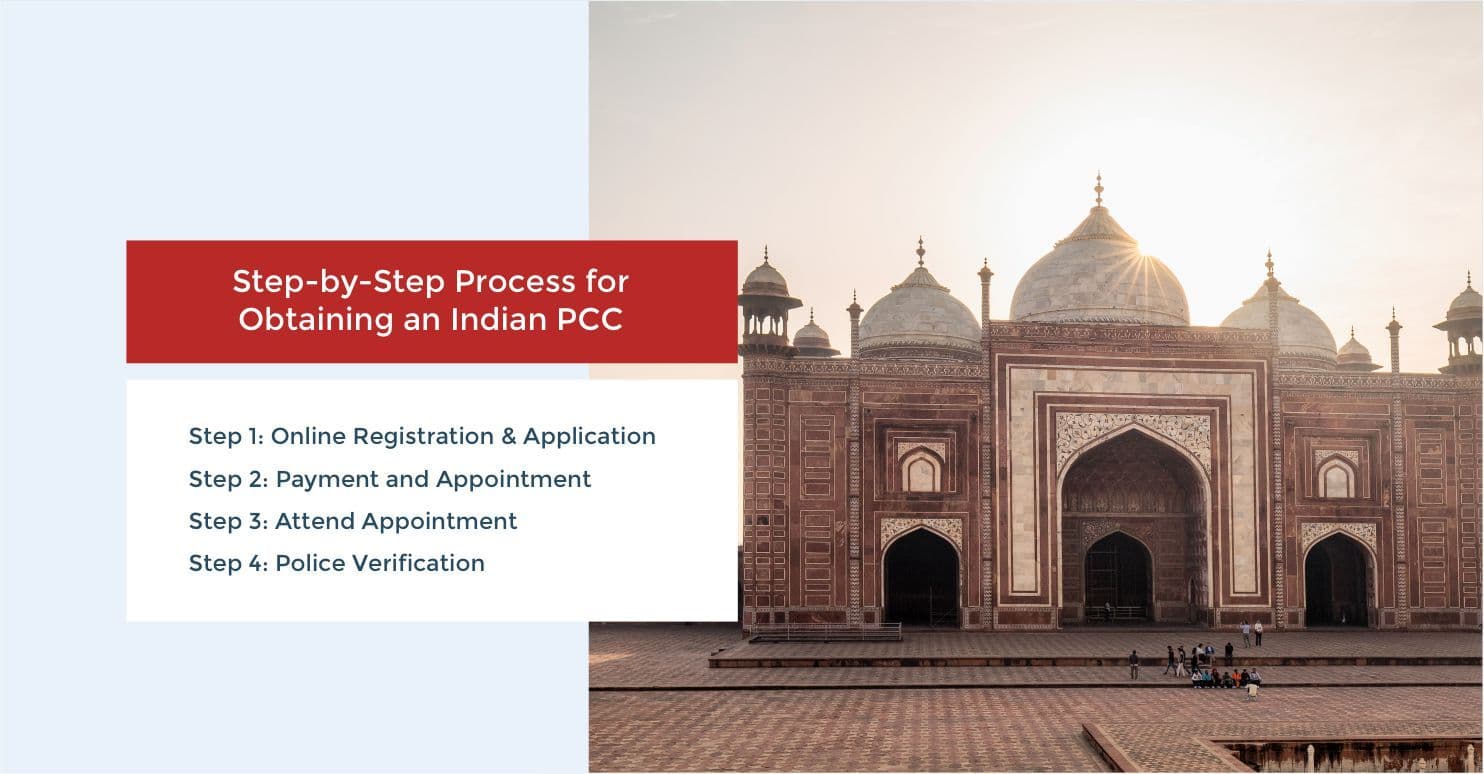
To obtain this Criminal Record Check, you must apply online through the official portal, visit the nearest PSK for document verification, and complete local police verification at your registered address.
The entire process of getting your Criminal Record Check is managed through the Passport Seva portal.
Step 1: Online Registration & Application
Step 2: Payment and Appointment
Since you cannot walk into a PSK without a scheduled slot, you have to make an appointment online.
Step 3: Attend Appointment
You must appear in person for document verification and photograph capture. The documents usually required are your passport, proof of residence, a copy of your visa, and any other supporting documents like your employment contract, or admission letter from the university.
You can check the exact list of documents here!
An officer there will verify your originals. Then your photo will be taken digitally.
Step 4: Police Verification
After your appointment, your file will be sent electronically to the local police station tied to your address. A police officer will either visit your home or ask you to come to the station with two witnesses and identity proofs. They will check for any criminal records or pending court cases.
You can track the status of your police report on the Passport Seva website using your ARN.
Once you pass the check and the "Clear" report is uploaded by the police from their end, you will receive an SMS stating your Criminal Record Check is ready. You can usually download the electronic Criminal Record Check from the portal or collect the physical certificate from the RPO as instructed.
How Can NRIs Apply for an Indian Criminal Record Check from Abroad
This is one of the most commonly asked questions, as a large number of Indians live abroad. So, let’s understand the process for Non-Resident Indians (NRIs).
For example, suppose you are an Indian citizen living in Canada, and the immigration department there asks you to provide an Indian Criminal Record Check for permanent residency. In that case, this is the process you need to follow:
Basically, the process remains more or less the same. The Indian embassy or mission abroad, wherever you are staying, acts as the intermediary in obtaining your Criminal Record Check from India.
This is one of the most commonly requested fingerprinting services in India. Every year, more than 25 lakh Indians migrate or relocate abroad for work, education, permanent residency, or other long-term purposes. Since international criminal record checks are usually required for long-stay applications, fingerprinting becomes an essential part of the process.
What happens is, when you apply for immigration, residency, employment, or citizenship in another country, the authorities want to verify your conduct and criminal history in countries where you have previously lived for a good amount of time, more than 6-12 months. This is why they may ask you to obtain official background checks or Criminal Record Checks issued by the relevant authorities of those countries.
In many cases, these authorities require fingerprints to conduct a search against their national criminal databases before issuing a clearance certificate or confirming that you have no criminal record.
The table below lists some of the most common countries from which Indians are required to obtain international criminal record checks, along with information on whether fingerprint submission is required.
| Country | Criminal Record Checks | Issuing Authority | Fingerprint Submission |
| Australia | National Police Check | Australian Federal Police | Generally not required. |
| Belgium | Extrait de Casier Judiciaire/ Uittrekseluit het Strafregister | Central Criminal Records Office of the Ministry of Justice | Applicants will be separately notified, if required in some rare cases. |
| Canada | RCMP Criminal Record Check | Royal Canadian Mounted Police (RCMP) / CCRTIS | Not RequiredRequired, on official C216C or equivalent cards. |
| Germany | Police Good Conduct Certificate / Führungszeugnis | Federal Central Register of the Federal Office of Justice | Not Required |
| Hong Kong | Certificates of No Criminal Conviction (CNCC) | Hong Kong Police Force | Required on a standard 10-fingerprint card like FD-258 or equivalent. |
| Malaysia | Certificate of Good Conduct | Royal Malaysia Police (PDRM) | Not Required |
| Netherlands | Certificate of Good Conduct/ (VOG) Verklaring Omtrent het Gedrag | Central Office of Registry for Certificate of Good Conduct (COGVOG) | Not Required |
| New Zealand | Criminal Conviction Report | Criminal Records Unit of the Ministry of Justice | Not Required |
| Singapore | Certificate of Clearance | Criminal Investigation Department of the Singapore Police Force | Required on COC Fingerprint Form or equivalents. |
| Spain | Certificado de Antecedentes Penales (Certificate of Criminal Convictions) | Registro Central de Penados y Rebeldes Ministerio de Justica (Ministry of Justice) | Not Required |
| UAE | Clearance / Good Conduct Certificates | Embassy of the United Arab Emirates | Required on a standard 10-fingerprint card like FD-258 or equivalent. |
| UK | ACRO Police Certificate | ACRO Criminal Records Office | Not required in most cases. Applicants will be notified, if required. |
| USA | FBI Background Check | Federal Bureau of Investigation | Required on FD-258/FD-1164 cards. |
If you are in India and wondering where to get your fingerprints taken for requesting international background checks, you have three options:
Local Police Stations
You can visit your nearest police station or fingerprint bureau to get your fingerprints taken. But many police stations in India do not keep internationally recognized fingerprint cards in stock. You will usually need to carry your own fingerprint card, such as the FBI FD-258 or FD-1164 form, which can be downloaded from the official websites or the links provided above.
Local police officers can help with rolling your ink fingerprints onto the card, but they may not be familiar with international documentation standards or requirements. If you go this route, arrive with your fingerprint card already printed.
Private Fingerprint Service Providers
You can easily hire a private third-party fingerprinting service in India. Most of them offer professional fingerprinting services specifically for international background checks and immigration applications. The associates or team working here is usually more familiar with international fingerprinting requirements.
Their services may include:
Some providers may also offer mobile fingerprinting in India, where a technician can come to your location to capture fingerprints.
Agencies Providing Full Background Check Package
There are some private companies or agencies in India that provide complete support for international background checks. They not just provide fingerprinting services, but also help with submission coordination to the issuing authorities, international courier services, real-time document tracking, and additional documentation support such as apostille or legalisation.
Can I Take The Fingerprints Myself?
Yes, you can, but it is highly discouraged and risky for two main reasons. First, while agencies like the FBI may accept self-captured fingerprints, many international background check authorities, such as those in Canada (RCMP), Australia, and South Africa, require fingerprints to be taken by a recognized authority or trained associate. Second, even if you choose to do it yourself, rolling fingerprints correctly is not as easy as it seems. Agencies like the FBI follow strict fingerprint quality standards, and even minor smudges, blurriness, or incomplete impressions, which are very common in self-captured prints, can result in rejection.
Which Fingerprinting Option Should You Choose?
The best fingerprinting option depends on your personal requirements, like how much you want to spend, is it urgent or not, etc.
| Option | Cost | Convenience | Expertise |
| Local Police Station | Low | Medium | Low |
| Private Fingerprinting Agency | Medium | High | High |
| Full Service Agency | High | Very High | Very High |
Check Out Where Do I Get Fingerprinting for FBI Background Check in India?
From wherever you’re getting your fingerprints done in India, the process just depends on the technique used: live-scan digital or ink-based fingerprinting.
Digital Fingerprinting
Ink-Based Fingerprinting
Who sends the fingerprint cards to the international authorities?
Check the official website of the country’s embassy, consulate or respective issuing authority. There, you will find the exact fingerprint submission process. In some cases, you can courier the fingerprint cards yourself, while some authorities only accept submissions from accredited agencies.
Regardless of whether you choose the police or a private agency, you must arrive prepared. Most Indian centers will require:
The process of fingerprinting in India is not just limited to criminal records or background checks. It's now embedded in everyday administrative processes, showing up across sectors and institutions that form a normal part of life in India.
This change is largely due to Aadhaar. With over a billion Indians enrolled, fingerprint-linked identity verification has now become central to how government departments, courts, employers, and financial institutions confirm who you are. The infrastructure is already there, and more processes are being built on top of it every year.
Private Sector
Fingerprinting for employee background verification in India's private sector is relatively uncommon and is usually limited to specific situations where a higher level of identity verification is required. Employers mostly rely on standard background checks and document verification. But biometric authentication may be requested in certain roles or industries.
For example, you may be asked to provide biometric information if:
The use of fingerprinting in private-sector employment is legally permitted in India, but it is regulated and generally used only when there is a clear business or compliance requirement. If biometric collection is part of the hiring process, the purpose, consent requirements, and any relevant authority or regulatory obligations are explained during recruitment or mentioned in the employment documentation.
Government Sector
When it comes to the recruitment process of government jobs in India, fingerprinting does play a role. But again, it’s limited to some specific positions and recruiting bodies. It is particularly relevant where large-scale examinations are conducted and there is a need to prevent impersonation and identity fraud.
Recruiting bodies such as the Staff Selection Commission (SSC), Railway Recruitment Board (RRB), and National Testing Agency (NTA) have introduced biometric verification as part of their exam and selection processes.
Other Sensitive/High-Security Jobs
If you’re joining the Indian armed workforce, defence, intelligence, or any other sectors of the country, where they have to confirm that you don't have any major criminal record or history, fingerprint submission is mandatory. Your ten fingerprints will be taken on a physical card or using the live scanning machine, and sent to NAFIS for further verifications.
Private Sector vs Government Sector Background Checks
For most jobs in India, employee background verification does not involve fingerprint collection. In any given firm, the focus is on verifying your identity, educational background, employment history, and criminal record.
| Parameter | Private Sector | Government Sector |
| Authority | Third-party agencies hired on contracts. | Police Departments and Intelligence Bureau. |
| Education/Work | Rigorous check of degrees and past salary slips. | Verification of degrees via university registrars. |
| Criminal Check | Searches via online court records. | Physical verification at local police stations of all past residences. |
Biometric attendance systems in India are now a normal part of daily life in many offices, schools, and colleges across the country. You have probably seen friends use their fingerprints to enter their workplace, or you may use such a system yourself. While the basic idea is the same everywhere, using biometrics to mark attendance, the process works differently in private and government institutions.
This is how the process differs in both:
Most Private Firms
In most private companies, schools, and colleges, the process is very simple.
Under Indian data protection and fingerprinting laws, companies are not supposed to store raw biometric information. But some private attendance systems may store biometric templates locally to operate access control systems. You don’t have to worry. There are important protections in place.
If a company collects your fingerprint for attendance purposes, it cannot legally use that information for background checks, performance monitoring, or any other purpose without obtaining separate consent from you. And when you leave the organization, you also have the right to request that your biometric data be deleted from the company's systems.
Government Sector Jobs
The process is different for many government departments and regulated institutions. Most Central Government offices, along with certain sectors such as pharmacy institutions and Bar Council-approved organizations, use the Aadhaar Enabled Biometric Attendance System (AEBAS). For this, they’re required to use a UIDAI L1 Certified biometric device.
The process usually works as follows:
The important difference is that the employer does not store your actual fingerprint image. Instead, the Aadhaar system verifies your identity in real time whenever you mark your attendance.
So, every time you punch in, the Aadhaar database confirms that you are the person you claim to be, and the attendance system records your presence based on that verification.
In India, fingerprinting for real estate transactions has undergone a major shift from 2025 onwards, and applies for all new registrations. Earlier, the Registration Act of 1908 required physical thumb impressions. But modern property laws have replaced this with Aadhaar-linked biometric verification systems and facial scans. Your live fingerprint must match the data stored with UIDAI (Unique Identification Authority of India). This requirement is mandatory for all parties involved, including buyers, sellers, and witnesses.
Property fraud has long been a concern in India, with cases involving forged documents, fake identities, and people attempting to sell properties they do not legally own. The introduction of biometric verification is done mainly to prevent impersonation, where someone pretends to be the owner and illegally sells a property.
How The Verification Process Works at the SRO
When you visit the Sub-Registrar’s Office (SRO) to register a sale deed, the following fingerprinting steps occur:
Because the transaction is linked to a digital identity, the history of the property and the associated documents becomes much more transparent.
Fingerprinting in the legal landscape of India is governed by two important laws. The first is the Bharatiya Sakshya Adhiniyam (BSA), which recognizes fingerprints as a valid form of evidence in court. The second is the Bharatiya Nagarik Suraksha Sanhita (BNSS), which lays down when and why fingerprints can be collected. If a court orders fingerprinting, it is usually connected to a criminal investigation, identity verification, or resolving disputes in family or civil matters.
Investigation of Crime
In criminal cases, a court may order fingerprinting for:
The fingerprints are usually collected by the local police or the National Crime Records Bureau (NCRB). If a person has no previous criminal record and is later discharged or acquitted, the fingerprint records are required to be destroyed unless the court directs otherwise.
If a Magistrate orders you to provide fingerprints for an investigation, you cannot legally refuse. If in any case a person refuses to comply with a lawful order for fingerprint collection, it will be treated as an offense under Section 221 of the Bharatiya Nyaya Sanhita Act for obstructing a public servant in the discharge of official duties.
Another use case of fingerprinting in the criminal and investigative area of India is identification of unidentified bodies or disaster victims. There might be cases when a person's face may be severely damaged, making visual identification impossible. This is especially common after natural disasters, accidents, or other large-scale incidents.
If the fingertips remain intact, fingerprints can be collected and compared with existing records to establish the person's identity. These records can be anything from criminal databases, government identity records, employment records, and other official documents. Since a large portion of the population in India is already fingerprinted, this process is considered one of the most effective methods of identification in such situations.
Common Uses in Family Courts
In family and matrimonial disputes, fingerprints are used to help establish the facts. Some common examples include:
Common Uses in Civil Disputes
Civil courts deal with property and financial disputes where fingerprints play an important role in proving authenticity, especially for people who cannot sign their names and use thumb impressions instead of signatures.
How the Court Orders Fingerprinting
The court does not automatically collect fingerprints whenever there is a dispute. The process works as follows:
Important Note: Fingerprints are not conclusive evidence and are usually not enough to determine the outcome of a case. In Indian courts, fingerprint experts provide their professional opinion on whether two sets of fingerprints match. While this evidence can be highly reliable and influential, courts only consider it alongside other evidence, witness statements, and facts of the case before reaching a final decision.
Getting fingerprinted in India and receiving your documents is only one part of the process, especially when those documents need to be used abroad or submitted to foreign embassies and consulates in India. In this case, three major steps come into play: Apostille, Embassy Legalization, and Translations. Without these, many Indian documents are legally worthless and may not be accepted by foreign authorities.
Normally, an international government agency wouldn't know if an Indian birth certificate or Criminal Record Check card is real or fake. An apostille and legalization/attestation solves this problem. This authentication is attached to the document in the form of a certificate, stamp, or sticker issued by the appropriate authorities.
After the document has been authenticated, translation may also be required in some cases. This is common when documents must be submitted in countries where English is not an official or accepted language for immigration, employment, education, or legal purposes.
Many Indians tend to be confused between these two requirements. Both apostille and embassy legalization are requirements of different countries, based on the being part of a specific treaty.
| Parameter | Apostille | Attestation / Legalization |
| When is it required? | Used only when both the country issuing the document and the destination country are members of the Hague Convention. | Used when one or both countries are not members of the Hague Convention. |
| Steps Involved |
|
|
| Final Authority | Ministry of External Affairs (MEA) | The Embassy or Consulate of the destination country gives the final stamp of approval. |
| Cost and Time | Generally faster and cheaper because it involves a single domestic agency. | Slower and more expensive because you must pay separate fees to multiple domestic ministries and the foreign embassy. |
You never get to choose between an apostille and legalization. The legal relationship between the country you are leaving and the country you are entering dictates exactly which route you must follow.
But there's one sequence you cannot reverse: apostille/attestation comes before translation, always. The translator is required to translate the apostille sticker text itself, which means the sticker must physically exist on the document before translation begins.
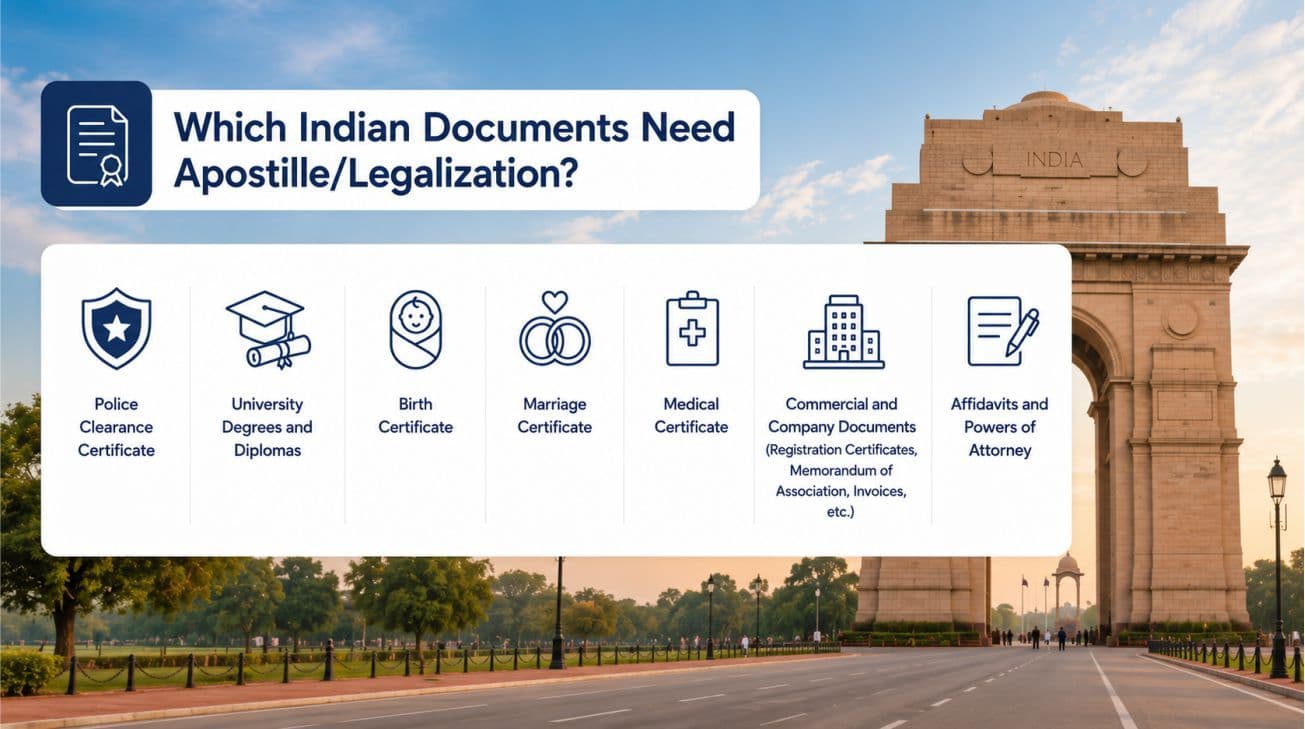
If your document was issued by an official government body, educational institution, or registered corporate entity in India, it needs an Apostille or both Apostille and Legalization if you are using it to prove your legal status, identity, qualifications, or a clean record to an international authority. Some common ones are:
Documents like your bank statements, income tax returns, salary slips, and passport etc do not require any apostille or legalization step.
The processes explained below are for apostille and normal attestation of documents in India. But before proceeding, you need to get your documents notarized by a public notary in India. This is a mandatory step, especially for private documents, such as power of attorney, affidavits, single status certificates, company documents, etc. MEA attestation or an Apostille sticker will not be processed unless a licensed Notary Public has already stamped, signed, and registered the documents.
You can find dozens of licensed notaries sitting at desks or small booths around:
Or you can just search "Notary near me" or "Notary Public in (your area name)]" on Google Maps that will bring up verified offices, user reviews, and contact numbers.
For the next steps of Apostille and Normal Attestation in India, you have two routes:
Route 1: e-Sanad (The Digital Route)
What is e-Sanad? e-Sanad is the Ministry of External Affairs' online portal that lets you get documents apostilled without physically visiting any office. Instead of you submitting original documents, the portal connects directly to the digital repositories of Document Issuing Authorities (DIAs) and the verification and apostille happen digitally.
All types of documents, like personal, educational, and commercial can be apostilled using e-Sanad, but only if they're available in the digital repository. Currently, e-Sanad is helping with the apostille of CBSE and National Academic Depository (NAD) issued documents, as only they have a digital depository of their documents. This service will expand to other issuing authorities over time, as soon as they set up their own digital repositories.
One of the best things about the e-Sanad portal is that it lets Spanish visa officers or foreign authorities cross-verify your digital attestation or apostille online.
Using e-Sanad to Get Apostille for Spain Visa from India
Route 2: The Traditional Route
This is the usual route to apostille personal documents like birth and marriage certificates, Criminal Record Checks, older educational documents, and anything not covered by e-Sanad. Until e-Sanad finishes expanding its services, most applicants will still need to follow this route.
Step 1: State-Level Pre-Authentication at the RAC
The MEA will only apostille a document after it has been authenticated by a competent state-level authority. This is because MEA doesn't verify the content of your document, it only certifies that the signature/stamp of the authenticating authority on that document is genuine. So the state authority goes first. You have to submit the documents to the designated RAC in your state.
Various types of documents are authenticated by different departments within the Regional Authentication Centre (RAC):
| Document Type | Examples | Authenticating Authority |
| Personal Documents | Birth certificates, death certificates, marriage certificates, domicile certificates, etc. | State Home/General Department |
| Educational Documents | Degree certificates, mark sheets, diplomas, school leaving certificates, except those covered by e-Sanad | State Education Department |
| Commercial Documents | Power of attorney, memoranda, articles of association, commercial contracts, etc. | Chamber of Commerce |
Step 2: Submission to Branch Secretariats/RPOs via MEA-Authorized Service Providers
MEA has officially decentralized its apostille services in India to Branch Secretariats/RPOs in 16 cities. This means the apostille stamp is legally affixed at these RPO locations, not at the MEA headquarters in New Delhi.
The 16 cities with active Branch Secretariats/RPOs for apostille are: Ahmedabad, Bengaluru, Bhopal, Chandigarh, Chennai, Guwahati, Hyderabad, Jaipur, Kochi, Kolkata, Lucknow, Mumbai, New Delhi, Patna, Pune, and Thiruvananthapuram.
But you cannot walk into these RPOs on your own to submit documents. Applications can be made only through the Authorized Service Providers (ASPs), that act as the mandatory intermediary between applicants and the RPO. Always verify that the agency you approach is on MEA's official list of ASPs before handing over any documents, do not use an unlisted agent.
You can find the official list of authorized agencies, along with the physical addresses of their collection centers in every city where RPOs are located, directly on the MEA government website.
You have to visit your nearest outsource agency and bring your pre-authenticated original documents along with photocopies of each document and your passport. The ASP physically carries these to the nearest Branch Secretariat/RPO and submits them in bulk. MEA officials there verify the state-level authentication already on each document and, if valid, affix the apostille/attestation sticker on the back of each document. The completed documents are then returned to the ASP, from where you collect them.
Apostille Processing Time in India
The usual processing time for attestation or apostille by the MEA is 2-3 working days. However, e-Sanad is integrated with DigiLocker, allowing supported documents to be verified in real time. Once verified, these documents are transmitted directly to the MEA for processing, which can reduce the overall turnaround time to as little as 1-3 working days.
Fees for Apostille and Normal Attestation of Documents in India
Since it is mandatory to use authorized service providers for the apostille, there are additional fees charged by the outsourcing agencies, alongside the MEA charges:
| Types of Service | MEA Fee | Outsource Agency Fee | |
| Service Charge | Scanning Charge | ||
| Apostille | ₹50 per apostille sticker | ₹84 per document | ₹3 per page |
| Attestation | Free of Cost | ₹84 per document | ₹3 per page |
International Documents Apostille Process from India
Just as the MEA is responsible for the apostille process in India, many countries have their own designated authorities responsible for apostilling international documents. A criminal record check is one of the few fingerprint-based international documents that can be obtained while living in India. If this document is intended for use in another Hague Convention country, it needs to be apostilled in its country of origin. This is the usual procedure:
Since the international criminal record check is a federal document, it has to be apostilled by a federal agency only.
Some common countries and their apostille authorities are listed below:
| Country Name | Apostille Authority |
| Australia | Department of Foreign Affairs and Trade (DFAT) |
| Canada | Global Affairs Canada (GAC) |
| Germany | Federal Office for Foreign Affairs (Bundesamt für Auswärtige Angelegenheiten - BfAA) |
| Ireland | Department of Foreign Affairs (DFA) |
| New Zealand | Department of Internal Affairs (DIA), Legalisation Office |
| South Africa | Department of International Relations and Cooperation (DIRCO) |
| UK | Foreign, Commonwealth & Development Office (FCDO) |
| USA | US Department of State, Office of Authentications, in Washington, D.C. |
The MEA will give it a normal attestation, but you have to take your documents a step further and have the destination country's specific Embassy or Consulate in India stamp it. For non-Hague countries, the outsourced agency will take your MEA-attested document directly to the embassy or consulate of your destination country to receive its final stamp. It is a multi-layered process, with a sequential chain of certifications required.
Translation from Regional Language to English
Many Indian applicants have birth/marriage certificates in regional languages, like Punjabi, Kashmiri, Bengali, Odia, Assamese, Marathi, etc. You might be required to first get it translated into English by a certified translator for use in international embassies within India, or for financial and legal contracts.
For this, you can hire any reputable ISO 9001 certified company in India. Usually, you’ll be required to send the agency high-resolution scans of the front and back of the document. The exact process will be mentioned on their official website.
Translation from English to Country-Specific Language
Most countries where English isn’t the official language, such as Germany, Spain, Italy, etc, require a Sworn or Legalized Translation. This means translation of a document via a linguist who has been officially registered with their high court or embassy. India does not have a central, government-run body that licenses sworn or officially authorized translators.
You can visit the official website of the target country’s embassy in India. Because some of them explicitly publish a directory of authorized translators they trust. If they have a list, you must pick a professional from it. If they don't, any reputable ISO 17100 certified agency in India will do.
Do not have your document translated in another foreign language until it has already received its state stamps or MEA Apostille. The final translation has to include a translated version of the stamps and seals on the back of your original document. If you translate too early, you'll have to pay to do it again.
While fingerprints are taken using both digital live scan and ink methods in India, the majority of mistakes are seen in ink fingerprinting. This is because digital scanning machines automatically alert the technician on the spot if the prints do not meet the required standards. The prints are usually not accepted by the system unless they are clear and properly captured.
However, during ink fingerprinting, fingerprint cards are sometimes not checked carefully before being sent to the authorities. This can lead to rejection and force applicants to restart the process from the beginning.
No matter which type of fingerprinting is being used in your case, it is always best to understand why fingerprints get rejected and how to avoid these problems in advance. Below are some of the most common reasons for rejection and ways to make sure they do not happen to you:
We’ve all been there, your hands get a little clammy when you're nervous. If your fingers are wet or if the technician applies too much ink, the ink fills in the valleys between your fingerprint ridges. Instead of a crisp pattern, you end up with a dark, blurry blob.
To avoid this, you can ask for a paper towel to dry your hands immediately before printing. If the ink looks like a puddle on the card, you’ve used too much. The end result needs to be a thin, greyish-black film, not a coat of paint.
This causes the opposite of a smudge. If your skin is extremely dry or if there isn't enough ink on the pad, the ridges won’t pick up enough pigment to leave a continuous line. To a computer, this looks like a broken, unreadable pattern.
How to fix this? If you know that you tend to have dryness on your skin a lot, use a non-greasy moisturizer for a few days leading up to your appointment. Just don't apply it right before you walk in, or you'll end up back with sweaty palms or fingers!
If your finger slips or rotates while it's being pressed onto the card, this will lead to a smear. This creates a double image or a blurred section that masks the minutiae (the tiny details like splits and dots in your ridges) that agencies use for identification. The only fix is to keep your arm steady and move your entire hand as one unit.
It’s natural to think that if you press down your fingers hard, the ink will stick better. But fingerprints aren't like rubber stamps. When you press too hard, you flatten the skin ridges, causing them to spread out and smudge the delicate patterns. It’s best to just relax your hand and keep your fingers a bit limp during the process. Let the technician use the right amount of pressure for it.
This one usually isn't your fault! If you work with your hands, like in construction, gardening, or even frequent dishwashing, your ridges can actually wear down over time. Similarly, as we age, our skin loses elasticity and the prints tend to become less distinct.
If you know you have faint ridges, tell the technician. They sometimes carry a solution or an enhancer that can help the ridges pop. They are also aware of some techniques for your fingers to pick up a tiny bit of natural oil, which helps the ink adhere better. Rubbing the fingertip on the side of the nose or forehead is a common one.
A fingerprint isn't just the very tip of your finger. Agencies need to see those little triangular patterns where the ridges meet near the sides of your finger. These are called deltas. If the roll is too narrow, the software won't have enough data to confirm it's you.
While you’re giving the prints, make sure they’re being taken nail edge to nail edge. You should feel the side of your fingernail touch the paper on both the start and the finish of the roll.
If your fingerprints get rejected after ink fingerprint cards were submitted for an international background check, resubmission is the only option. Return to your fingerprinting agency with the rejection notice and request a retake. A reputable agency will redo the prints at no charge or a reduced fee if the rejection was caused by a quality issue on their end.
If your fingerprints cannot be processed and get rejected even after the second attempt, another rejection letter will be issued by the authority. You can submit this letter to the requesting agency, employer, or organization as valid documentation, confirming that despite multiple attempts, fingerprint-based identity verification was not possible. Many employers or immigration bodies might accept this letter alongside a name-based check as a substitute.

You will find yourselves in need of a good fingerprinting agency or service provider when applying for an international background check or related purpose.
There are hundreds, perhaps thousands, of fingerprinting service providers across India. You can find one in almost every major city and commercial area. In such a saturated market, it’s very normal to get confused while selecting the right provider for your international background check needs.
The main problem is that not all fingerprinting agencies follow the same standards. Some specialize in international submissions for the FBI, RCMP, and foreign immigration authorities, while others just offer basic ink fingerprinting with little understanding of overseas compliance requirements.
We'll explain here what to look for in a fingerprinting service in India, which warning signs to avoid, and how to ensure your fingerprints meet international acceptance standards the first time.
Your fingerprinting requirements will vary depending on how the receiving authorities want them. Some countries require ink fingerprint cards, while others prefer digitally captured fingerprints. Also, the fingerprint card requirements differ from country to country. Before choosing the service provider for taking your fingerprints, make sure they have an inventory of the required fingerprint card format. And check whether digital or ink-based capture is done.
Just because you were able to find an appointment at a fingerprinting agency, it doesn’t mean they’re the right one. You have to see whether they can prove the receiving authority will and has accepted their fingerprint cards in the past.
Check carefully if the provider has experience with immigration or police checks submissions and is well aware of the embassy requirements. Ask questions about it. A good provider should be able to clearly explain which fingerprint card is needed in your situation, what are the quality standards and mailing procedures, and the risks of rejection.
Avoid agencies that cannot explain international compliance requirements.
Do not just consider the one that is willing to give you an appointment at the lowest price in the market. The cheapest option can very easily become expensive if fingerprints are rejected.
Ask whether the total pricing includes:
The acceptable price range in India, depending on the fingerprinting service chosen, is given below:
| Service | Price Range (INR) |
| Fingerprinting Only | 2,000-4,000 |
| Fingerprinting + Courier | 6,000-12,000 |
| Mobile Fingerprinting | 3,000-5,000 |
You have to make sure that the fingerprinting agency has experience with your destination country. For example, if you want to obtain the FBI background check, FD-258 or FD-1164 cards are used. And there are certain international standards set by the FBI regarding their acceptance. The provider you choose should be able to prevent usage of incorrect card formats, missed details like a signature or stamp, etc.
Ask these questions to understand their experience:
Your fingerprint data is regarded as highly sensitive biometric information. Choose only those providers where they do not retain data unnecessarily. They should have a proper privacy policy chalked out for clients. Ask them what they do with the fingerprints after they’re processed. If they clearly say that those records are returned and then destroyed, that is a green flag. If they say anything opposite of this, you can ask them for how long they store fingerprint records and who has access to them.
After asking all these questions, you’ll be able to gauge whether they’re legitimate and safe or not.
Type the name of the agency or service provider on Google and carefully look for reviews, specifically those that are most recent and read like they were written by a real person. You can also put a filter and look for reviews mentioning
Be extra cautious if there are more than 10-15 recent reviews mentioning smudged prints, rejections, poor communication, hidden charges, or anything negative.
If you’re a first time applicant, you will need all the help you can get. Check out the list of services provided by that particular agency or provider. Many reputable firms now offer home visits across major cities, highly recommended if you prefer the comfort of your home or office.
Choose someone who can help you with not only fingerprinting, but also packaging, international courier, and tracking of the document. Much better if the provider can also provide you with apostille or legalization guidance.
Also, some top-tier services will also offer to re-do your prints for free if the FBI or RCMP rejects them due to low quality. Ask for this as well.
When researching fingerprinting agencies in India, you’ll come across plenty of bold promises designed to make one provider appear more official, faster, or more connected than the rest. While some agencies are actually professional and trustworthy, many marketing claims are exaggerated and misleading.
Below are some of the most common fingerprinting service claims you should approach with caution:
| Feature | Green Light (Trustworthy) | Red Flag (Avoid) |
| Location | Professional lab or a permanent office. | Meeting in a coffee shop or a cafe. |
| Documentation | Provides a receipt and a Certificate of Identity. | Cash-only transactions with no formal receipt. |
| Process | Verifies your Passport/ID before starting. | Doesn't check your ID or verify who you are. |
| Fingerprint Cards | Uses high-quality, pre-printed fingerprint cards. | Prints forms on standard xerox paper. |
| Data Privacy | Provides written data retention policy. | No privacy policy or unclear answer when asked. |
Trust your instincts! A good fingerprinting agency will always welcome your questions. If they can't answer them clearly, that's your answer.
We hope this guide helped you understand the relevance of fingerprinting in modern India. And the system will only keep growing. New laws will be introduced, existing ones will be updated, and processes that are still manual today will slowly move into fully digital systems. India already has the world's largest biometric database in Aadhaar and is rapidly expanding its forensic and identity infrastructure. The future is less about fingerprinting in isolation and more about fingerprints as one layer in a broader national identity and security stack.

Everything you need for a UK apostille in 2026 - FCDO process, fees, timelines, document types, non-Hague countries, and common rejection fixes.

Learn how Canada apostille services work after the Hague Convention. Understand provincial authorities, Global Affairs Canada process, fees, timelines, document requirements, and how to apostille Canadian documents for international use.

Everything Indians need to move to New Zealand in 2026 - visas, Green List occupations, taxes, healthcare, schools, jobs, and a full moving checklist.
Need help with your application or background check?
Contact us now and speak with a dedicated Globeia expert today.


